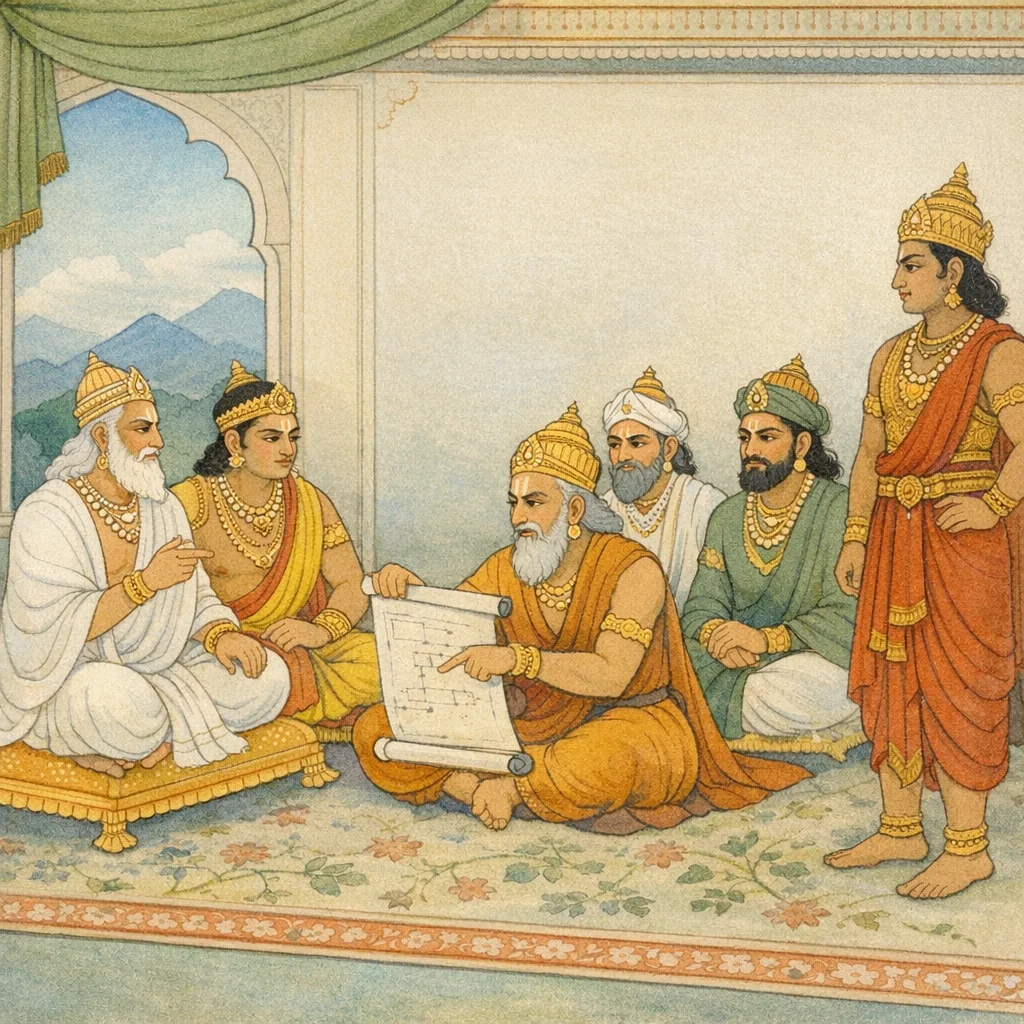
Adhyaya 51
देवविमान-दर्शनम् / The Celestial Assembly and Vimana Spectacle (Bhīṣma–Arjuna Encounter Framed Cosmically)
Upa-parva: Gograhaṇa (Gograhana) Upaparva / Kīcakavadha–Uttara-gograhaṇa cycle (contextual war-episode segment)
Vaiśaṃpāyana describes Kuru battle-formations moving like monsoon clouds in late heat, with cavalry and war-elephants positioned near the engagement. The scene then expands beyond the terrestrial field: Śakra (Indra) arrives with divine hosts, and the sky is portrayed as cleared of clouds and ornamented like a planet-studded firmament. A radiant divine palace-like structure with innumerable golden and gem-set pillars supports a celestial vimāna of the devarāja, capable of moving at will and decorated with all jewels. The thirty-three gods stand with Vāsava, accompanied by gandharvas, rākṣasas, serpents, pitṛs, and great ṛṣis; illustrious kings and ancestral figures are also seen within Indra’s aerial assembly. Additional deities (Agni, Īśa, Soma, Varuṇa, Prajāpati, Dhātṛ, Vidhātṛ, Kubera, Yama) and famed gandharvas (Alambusā, Ugrasena, Tumburu) appear with their respective vimānas. The totality of devas, siddhas, and paramarṣis gathers to witness the strategic engagement between Arjuna and the Kurus, especially the Bhīṣma–Arjuna meeting; the atmosphere is suffused with divine fragrances, banners, parasols, garlands, and fans, while dust settles and the air is filled with luminous rays and jewel-like aerial vehicles.
Chapter Arc: कौरव-सभा में उत्तर के गो-ग्रहण के प्रसंग पर सेनापतियों की वाणी टकराती है—दुर्योधन की सुरक्षा और विजय-नीति पर भीष्म, कृप और कर्ण के मत सामने आते हैं। → भीष्म दुर्योधन को समझाते हैं कि अश्वत्थामा और कृप की सावधानी उचित है, जबकि कर्ण केवल क्षत्रिय-धर्म के आग्रह से युद्ध को ही उपाय मानता है। भीष्म पाँच प्रहारक शत्रुओं (पाण्डवों) की सूर्य-सम तेजस्विता का स्मरण कराते हैं—ऐसे प्रतिद्वन्द्वियों के उदय में बुद्धिमान भी चूक सकता है। → द्रोण का निर्णायक प्रतिपादन—विद्या (वेदान्त, पुराण, इतिहास) और अस्त्र-ज्ञान का अद्वितीय संयोग आचार्य-परम्परा में ही है; परशुराम के बाद द्रोण-सम कोई नहीं। इसी आधार पर वे नीति-निर्देश देते हैं: सेना की पराजय न हो और धृतराष्ट्र-पुत्र पर प्रत्यक्ष आघात न पड़े—ऐसी रचना की जाए। → सभा का स्वर युद्धोन्माद से हटकर संगठित नीति और रक्षात्मक अनुशासन की ओर मुड़ता है—दुर्योधन की रक्षा, सेना की एकता, और आक्रमण-प्रतिक्रमण का संतुलन ही तत्काल लक्ष्य ठहरता है। → किस प्रकार की ‘नीति’ और व्यूह-रचना से दुर्योधन को सुरक्षित रखते हुए उत्तर के अभियान/मुठभेड़ को साधा जाएगा—यह अगले अध्याय में खुलता है।
Shlokas
Verse 1
हि >> आय न हुक हि ० एकपज्चाशत्तमो< ध्याय: भीष्मजीके द्वारा सेनामें शान्ति और एकता बनाये रखनेकी चेष्टा तथा द्रोणाचार्यके द्वारा दुर्योधनकी रक्षाके लिये प्रयत्न भीष्म उवाच साधु पश्यति वै द्रौणि: कृप: साध्वनुपश्यति । कर्णस्तु क्षत्रधमेंण केवलं योद्धुमिच्छति
Bhishma said: “Drauni (Aśvatthāmā) indeed sees what is proper; Kripa too rightly considers the matter. But Karna, driven solely by the warrior’s code, wishes only to fight.”
Verse 2
भीष्मजी बोले--दुर्योधन! अश्वत्थामा ठीक विचार कर रहे हैं। कृपाचार्यकी दृष्टि भी ठीक है। कर्ण तो केवल क्षत्रिय-धर्मकी दृष्टिसे युद्ध करना चाहता है ।। आचार्यो नाभिवक्तव्य: पुरुषेण विजानता । देशकालौ तु सम्प्रेक्ष्य योद्धव्यमिति मे मति:,विज्ञ पुरुषको अपने आचार्यकी निन्दा या तिरस्कार नहीं करना चाहिये। मेरा भी विचार यही है कि देश, कालका विचार करके ही युद्ध करना उचित है
Bhishma said: “O Duryodhana, a discerning man should not speak ill of (or disparage) his teacher. In my judgment, one should decide to fight only after carefully considering the place and the time.”
Verse 3
यस्य सूर्यसमा: पठच सपत्ना: स्यु: प्रहारिण: । कथमभ्युदये तेषां न प्रमुह्देत पण्डित:,जिसके सूर्यके समान तेजस्वी और प्रहार करनेमें समर्थ पाँच शत्रु हों और उन शत्रुओंका अभ्युदय हो रहा हो, तो उस दशामें विद्वान् पुरुषको भी कैसे मोह न होगा
When a man has five rival foes, radiant like the sun and able to strike down their mark, and those enemies are rising in power and fortune—how, at such a time, could even a wise person remain wholly unbewildered? The saying shows how the surge of formidable adversaries can shake even steady judgment, and thus calls for vigilance and self-mastery amid political and martial pressure.
Verse 4
स्वार्थे सर्वे विमुहान्ति येडपि धर्मविदो जना: । तस्माद् राजन ब्रवीम्येष वाक््यं ते यदि रोचते
Even those who know dharma become deluded when their own self-interest is at stake. Therefore, O King, I shall speak this counsel to you—if it pleases you to hear it.
Verse 5
स्वार्थके विषयमें सोचते समय सभी मनुष्य--धर्मज्ञ पुरुष भी मोहमें पड़ जाते हैं; अतः राजन! यदि तुम्हें जचे, तो मैं इस विषयमें अपनी सलाह भी देता हूँ ।। कर्णो हि यदवोचत् त्वां तेज:संजननाय तत् । आचार्यपुत्र: क्षमतां महत् कार्यमुपस्थितम्,कर्णने तुमसे जो कुछ कहा है, वह तेज एवं उत्साहको बढ़ानेके लिये ही कहा है । आचार्यपुत्र क्षमा करें। इस समय महान् कार्य उपस्थित है
Bhishma said: “When people brood over matters of self-interest, all of them—even those who know dharma—can fall into delusion. Therefore, O king, if it pleases you, I will also offer my counsel on this matter. What Karna said to you was spoken only to kindle your vigor and resolve. Let the son of the teacher forgive it; a great task now stands before us.”
Verse 6
नायं कालो विरोधस्य कौन्तेये समुपस्थिते । क्षन्तव्यं भवता सर्वमाचार्येण कृपेण च,यह समय आपसके विरोधका नहीं है; विशेषतः ऐसे मौकेपर जब कि कुन्तीनन्दन अर्जुन युद्धके लिये उपस्थित हैं। पूजनीय आचार्य द्रोण तथा कृपाचार्यको सब अपराध क्षमा करना चाहिये
Bhīṣma said: “This is not the time for internal opposition, especially now that Arjuna, son of Kuntī, stands ready for battle. You should forbear everything—showing forgiveness toward the venerable teacher Droṇa and toward Kṛpa as well.”
Verse 7
भवतां हि कृतास्त्रत्वं यथा5<दित्ये प्रभा तथा । यथा चन्द्रमसो लक्ष्मी: सर्वथा नापकृष्यते,जैसे सूर्यमें प्रभा और चन्द्रमामें लक्ष्मी (शोभा) सर्वथा विद्यमान रहती है--कभी कम नहीं होती, उसी प्रकार आपलोगोंका अस्त्रविद्यामें जो पाण्डित्य है, वह अक्षुण्ण है
Bhīṣma said: “Your mastery of weapons is like the sun’s radiance; and like the moon’s beauty, it is never diminished in any way. In the same manner, your learned skill in the science of arms remains wholly intact.”
Verse 8
एवं भवत्सु ब्राह्माण्यं ब्रह्मास्त्रं च प्रतिष्ठितम् । चत्वार एकतो वेदाः क्षात्रमेकत्र दृश्यते,इस प्रकार आपलोगोंमें ब्राह्मणत्व तथा ब्रद्मास्त्र दोनों ही प्रतिष्ठित हैं, यद्यपि प्राय: एक व्यक्तिमें चारों वेदोंका ज्ञान देखा जाता है, तो दूसरेमें क्षात्रधर्मका
Thus, among you, both brahminhood and the Brahmāstra stand firmly established. Often one sees in a single man the knowledge of the four Vedas together, while in another the kṣatriya-dharma is manifest.
Verse 9
नैतत् समस्तमुभयं कम्मिंश्रचिदनुशुश्रुम । अन्यत्र भारताचार्यात् सपुत्रादिति मे मति:,ये दोनों बातें पूर्णरूपसे किसी एक व्यक्तिमें हमने नहीं सुनी हैं। केवल भरतवंशियोंके आचार्य कृप, द्रोण और उनके पुत्र अश्वत्थामामें ही ये दोनों शक्तियाँ (ब्रह्मबल और क्षात्रबल) हैं। इनके सिवा और कहीं उक्त दोनों बातोंका एकत्र समावेश नहीं है। यह मेरा दृढ़ विश्वास है
Bhīṣma said: “We have not heard of these two excellences—taken together in their fullness—being found in any single person. Only in the Bhārata preceptor, Droṇa, along with his son, do these two powers (the spiritual force of brahman and the martial force of kṣatra) abide together. Apart from them, nowhere else do these two qualities unite. This is my firm conviction.”
Verse 10
वेदान्ताश्व पुराणानि इतिहासं पुरातनम् । जामदग्न्यमृते राजन् को द्रोणादधिको भवेत्,राजन! वेदान्त, पुराण और प्राचीन इतिहासके ज्ञानमें जमदग्निनन्दन परशुरामजीके सिवा दूसरा कौन मनुष्य द्रोणाचार्यसे बढ़कर हो सकता है?
Bhīṣma said: “O King, in the knowledge of Vedānta, the Purāṇas, and the ancient Itihāsa, who could be superior to Droṇa—except Jāmadagnya Paraśurāma?”
Verse 11
ब्रह्मास्त्रं चैव वेदाश्न नैतदन्यत्र दृश्यते । आचार्यपुत्र: क्षमतां नायं कालो विभेदने,ब्रह्मास्त्र और वेद--ये दोनों वस्तुएँ हमारे आचार्योंके सिवा अन्यत्र कहीं नहीं देखी जातीं। आचार्यपुत्र क्षमा करें, यह समय आपसमें फूट पैदा करनेका नहीं है। हम सब लोग मिलकर यहाँ आये हुए अर्जुनसे युद्ध करेंगे
Bhīṣma said: “The Brahmāstra and the Vedas—these are not seen elsewhere apart from our teachers’ lineage. O son of the preceptor, be patient; this is not the time to create divisions among ourselves. Let all of us unite and fight Arjuna who has come here.”
Verse 12
सर्वे संहत्य युध्याम: पाकशासनिमागतम्,ब्रह्मास्त्र और वेद--ये दोनों वस्तुएँ हमारे आचार्योंके सिवा अन्यत्र कहीं नहीं देखी जातीं। आचार्यपुत्र क्षमा करें, यह समय आपसमें फूट पैदा करनेका नहीं है। हम सब लोग मिलकर यहाँ आये हुए अर्जुनसे युद्ध करेंगे
Bhīṣma said: “Let us all unite and fight the one who has come here like Pākaśāsana (Indra). The Brahmāstra and the Vedas—these two treasures are not seen anywhere except through our own teachers. O son of the preceptor, forgive this: this is not the time to create divisions among ourselves. All of us, together, will fight Arjuna who has arrived here.”
Verse 13
बलस्य व्यसनानीह यान्युक्तानि मनीषिभि: । मुख्यो भेदो हि तेषां तु पापिष्ठो विदुषां मत:,मनीषी पुरुषोंने सेनाका विनाश करनेवाले जितने संकट बताये हैं, उनमें आपसकी फूट सबसे प्रधान कहा है। विद्वानोंने इस फूटको महान् पाप माना है
Bhishma said: “Among the calamities that wise thinkers have identified as bringing about the ruin of an army, internal division is foremost. The learned regard such factionalism as the gravest sin.”
Verse 14
अश्वत्थामोवाच नैव न्याय्यमिदं वाच्यमस्माकं पुरुषर्षभ । कि तु रोषपरीतेन गुरुणा भाषिता गुणा:,अश्वत्थामाने कहा--पुरुषश्रेष्ठ! हमारी न्न्यायोचित बातकी निन्दा नहीं की जानी चाहिये। आचार्य द्रोणने पाण्डवोंपर हुए पहलेके अन्यायोंका स्मरण करके रोषपूर्वक अर्जुनके गुणोंका यहाँ वर्णन किया है (भेद उत्पन्न करनेके लिये नहीं)
Aśvatthāman said: “O bull among men, it is not right that this should be said against us. Rather, the teacher, overcome by anger and recalling earlier wrongs done to the Pāṇḍavas, has spoken here of Arjuna’s virtues in a heated spirit—not with the aim of creating division, but out of resentment.”
Verse 15
शत्रोरपि गुणा ग्राह्मा दोषा वाच्या गुरोरपि । सर्वथा सर्वयत्नेन पुत्रे शिष्ये हितं वदेत्,शत्रुके भी गुण ग्रहण करने चाहिये और गुरुके भी दोष बतानेमें संकोच नहीं करना चाहिये। गुरुको सब प्रकारसे पूर्ण प्रयत्न करके पुत्र और शिष्यके लिये जो हितकर हो, वही बात कहनी चाहिये
“Even an enemy’s virtues should be acknowledged, and even a teacher’s faults should be spoken of. In every way, with every effort, a teacher should say only what is for the good of his son and his disciple.”
Verse 16
दुर्योधन उवाच आचार्य एव क्षमतां शान्तिरत्र विधीयताम् । अभिश्यमाने तु गुरी तद् वृत्तं रोषकारितम्,दुर्योधनने कहा--आचार्य! क्षमा करें, अब शान्ति धारण करनी चाहिये। यदि गुरुके मनमें भेद न हो, तभी यह समझा जायगा कि पहले जो बातें कही गयी हैं, उनमें रोष ही कारण था
Duryodhana said: “Teacher, forgive us; let calm be established here. If there is no intent to sow division in the guru’s heart, then it will be understood that the words spoken earlier were prompted only by anger.”
Verse 17
वैशम्पायन उवाच ततो दुर्योधनो द्रोणं क्षमयामास भारत । सह कर्णेन भीष्मेण कृपेण च महात्मना,वैशम्पायनजी कहते हैं--जनमेजय! तदनन्तर दुर्योधनने कर्ण, भीष्म और महात्मा कृपाचार्यके साथ आचार्य द्रोणसे क्षमा माँगी
Vaiśampāyana said: “Then Duryodhana, O descendant of Bharata, sought forgiveness from Droṇa, in the company of Karṇa, Bhīṣma, and the great-souled Kṛpa.”
Verse 18
द्रोण उवाच यदेतत् प्रथमं वाक््यं भीष्म: शान्तनवोड<ब्रवीत् । तेनैवाहं प्रसन्नो वै नीतिरत्र विधीयताम्,तब द्रोण बोले--शान्तनुनन्दन भीष्मजीने पहले जो बात कही थी, उसीसे मैं प्रसन्न हूँ। अब ऐसी नीतिसे काम लेना चाहिये, जिससे अर्जुन इस युद्धमें दुर्योधनके पासतक न पहुँच सकें। साहससे अथवा प्रमादवश भी दुर्योधनपर उनका आक्रमण न हो, ऐसी नीति निर्धारित करनी चाहिये
Droṇa said: “As for the first counsel that Bhīṣma, the son of Śāntanu, spoke—by that alone I am satisfied. Therefore, let a policy be laid down here accordingly.”
Verse 19
यथा दुर्योधन पार्थो नोपसर्पति संगरे । साहसाद् यदि वा मोहात् तथा नीतिर्विधीयताम्,तब द्रोण बोले--शान्तनुनन्दन भीष्मजीने पहले जो बात कही थी, उसीसे मैं प्रसन्न हूँ। अब ऐसी नीतिसे काम लेना चाहिये, जिससे अर्जुन इस युद्धमें दुर्योधनके पासतक न पहुँच सकें। साहससे अथवा प्रमादवश भी दुर्योधनपर उनका आक्रमण न हो, ऐसी नीति निर्धारित करनी चाहिये
Droṇa said: “A strategy should be arranged so that Pārtha (Arjuna) does not come near Duryodhana in the battle. Whether out of reckless daring or out of delusion, he must not be allowed to make an assault upon Duryodhana; therefore let policy be determined accordingly.”
Verse 20
वनवासे हानिर्वत्ते दर्शयेन्न धनंजय: । धनं चालभमानोजत्र नाद्य तत् क्षन्तुमहति,वनवासकी अवधि पूर्ण हुए बिना अर्जुन अपनेको प्रकट नहीं कर सकते थे। आज यदि वे यहाँ आकर अपना गोधन न पा सके, तो हमको क्षमा नहीं कर सकते
Droṇa said: “So long as the term of exile had not fully run its course, Dhanañjaya (Arjuna) could not reveal himself. But if today, having come here, he fails to recover his wealth (the cattle), he will not be bound to forgive us.”
Verse 21
यथा नायं समायुज्ज्याद् धार्तराष्ट्रनू कथंचन । न च सेना: पराजय्यात् तथा नीतिर्विधीयताम्,ऐसी दशामें जैसे भी सम्भव हो; वे धृतराष्ट्रपुत्रोपर आक्रमण न कर सकें और किसी प्रकार भी कौरव-सेनाओंको परास्त न करने पावें, ऐसी कोई नीति बनानी चाहिये
Droṇa said: “Devise such a policy that, in whatever way possible, he may not be able to engage the sons of Dhṛtarāṣṭra in battle at all, and that the armies may not be defeated. Let a strategy be framed to prevent any overthrow of the Kaurava forces.”
Verse 22
उक्तं दुर्योधनेनापि पुरस्ताद् वाक्यमीदृशम् । तदनुस्मृत्य गाड़ेय यथावद् वक्तुमहसि,दुर्योधनने भी पहले ऐसी बात कही थी कि पाण्डवोंका अज्ञातवास पूर्ण होनेमें संदेह है, अतः गंगानन्दन भीष्म! आप स्वयं स्मरण करके यथार्थ बात क्या है--उनका अज्ञातवास पूर्ण हो गया है या नहीं, इसका निर्णय करें
Droṇa said: “Duryodhana has already spoken earlier in this very vein. Therefore, recalling that point, O descendant of Gaṅgā, you ought to state the matter correctly—whether the Pāṇḍavas’ period of concealment has truly been completed or not—so that a just decision may be reached.”
Verse 51
इति श्रीमहाभारते विराटपर्वणि गोहरणपर्वणि उत्तरगोग्रहे द्रोणवाक्ये एकपज्चाशत्तमो5ध्याय:
Thus, in the Śrī Mahābhārata, within the Virāṭa Parva—specifically the episode of the cattle-raid and the capture of Uttara’s cattle—ends the fifty-first chapter, marked by Droṇa’s words. The colophon signals the close of a narrative unit where counsel and martial judgment frame the ethical tensions of raiding, protection of subjects’ wealth, and the responsibilities of warriors and teachers in war.
Frequently Asked Questions
Rather than a direct dialogue-based dilemma, the chapter frames an ethical tension implicitly: martial action (kṣātra-karman) occurs under heightened accountability, as if performed before a cosmic tribunal of devas and ṛṣis.
The passage teaches that consequential political violence is not merely local or private; it is evaluated within broader orders—social, ancestral, and cosmic—encouraging disciplined conduct, restraint, and clarity of purpose.
No explicit phalaśruti is stated here; the meta-function is aesthetic and legitimating—elevating the Bhīṣma–Arjuna engagement by situating it within a witnessed, cosmologically structured arena.