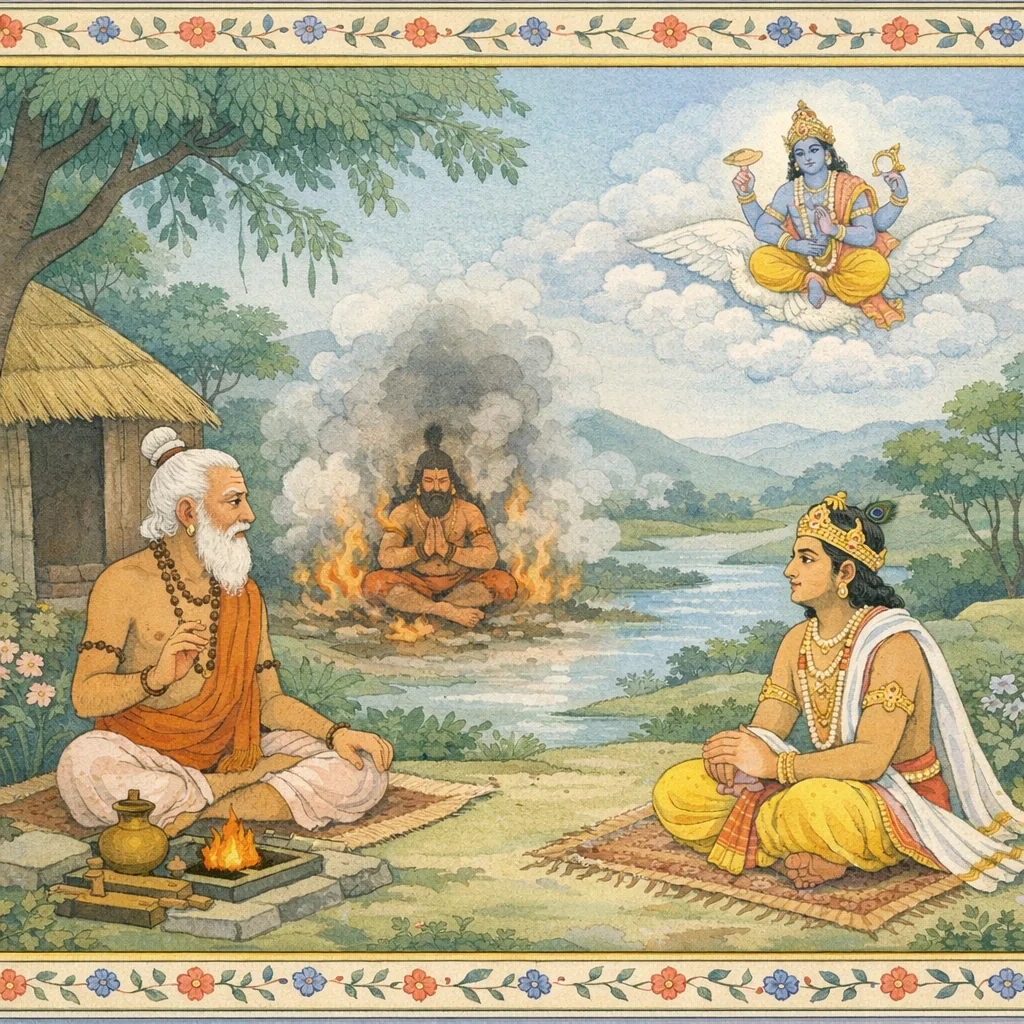
Adhyaya 202
पञ्चमहाभूतगुण-इन्द्रियनिग्रह-उपदेशः | Teaching on the Qualities of the Five Elements and Sense-Control
Upa-parva: Mārkaṇḍeya–Dharmavyādha Saṃvāda (Didactic Discourse on Elements and Sense-Control)
Mārkaṇḍeya introduces the continuation of a Brahmin’s inquiry to the Dharmavyādha, requesting a precise account of the pañca-mahābhūtas and their guṇas. The Dharmavyādha enumerates earth, water, fire, air, and ether, assigning sensory qualities in a graded scheme: earth with five (sound, touch, form, taste, smell), water with four (sound, touch, form, taste), fire with three (sound, touch, form), air with two (sound, touch), and ether with one (sound). He notes these fifteen guṇas as foundational to embodied worlds and indicates that balance supports prosperity, while disequilibrium leads the embodied self to transition to another body in time. The discourse then distinguishes the ‘manifest’ (vyakta) as that produced/known through the senses, and the ‘unmanifest’ (avyakta) as inferred and beyond direct sense-grasp. The chapter pivots to a yoga-oriented ethic: the senses, when released or restrained, are linked to outcomes described as well-being or suffering; indriya-dhāraṇa is presented as the complete method in this frame. Using the chariot analogy—body as chariot, self as controller, senses as horses—the text emphasizes vigilant governance of mind and senses; uncontrolled sense-following carries away discernment like wind driving a boat. Concentrated study and meditation upon these faculties yields a contemplative result (dhyānaja phala).
Chapter Arc: वनवास के बीच धर्मराज युधिष्ठिर दीर्घायु, निष्कल्मष तपस्वी मार्कण्डेय से प्रश्न करते हैं—ऐसे मुनि जिनकी दृष्टि देव-दानव-राक्षस, राजवंश और ऋषिवंश तक फैली है, वे धर्म के गूढ़ प्रसंगों को स्पष्ट करें। → युधिष्ठिर के आग्रह पर मार्कण्डेय ‘धौन्धुमार’ उपाख्यान आरम्भ करते हैं—धुन्धु नामक महासुर लोक-उत्सादन के लिए घोर तप में प्रवृत्त है; उसके उभार से त्रैलोक्य पर संकट की छाया पड़ती है और यह प्रश्न उठता है कि उसे कौन रोकेगा। → विष्णु का वचन/आदेश निर्णायक बनता है—योगबल से समर्थ एक ‘पार्थिवोत्तम’ (राजर्षि) तुम्हारे निर्देश से ‘धुन्धुमार’ बनेगा; विष्णु यह कहकर अंतर्धान हो जाते हैं, और दैवी संकल्प मानव-कर्तव्य में रूपांतरित हो जाता है। → मार्कण्डेय कथा को इस बिंदु तक स्थिर करते हैं कि धुन्धु के विनाश का उपाय दैवी अनुग्रह और तप-तेज से संयुक्त राजधर्म में निहित है—लोक-रक्षा हेतु योग्य पुरुष का उदय निश्चित है। → धुन्धु के घोर तप और उसके वधकर्ता के उदय की घोषणा के बाद अगला प्रश्न खुला रह जाता है—वह राजर्षि कौन है, और किस प्रकार धुन्धु का संहार होगा?
Shlokas
Verse 1
न लक कल > यहाँ जो पिता आदि गुरुजन, सेवक और स्त्रियोंको दिया दान व्यर्थ कहा है, इसका अभिप्राय यह है कि माता-पिता आदि गुरुजनोंकी सेवा करना तथा स्त्री और नौकरोंका पालन-पोषण करना तो मनुष्यका कर्तव्य ही है। अतः उनको देना तो अपने कर्तव्यका ही पालन है, इसलिये वह उनको देना दानकी श्रेणीमें नहीं है। एकाधिकंद्विशततमो<्ध्याय: उत्तड़ककी तपस्यासे प्रसन्न होकर भगवान्का उन्हें वरदान देना तथा इक्ष्वाकुवंशी राजा कुवलाश्वका धुन्धुमार नाम पड़नेका कारण बताना वैशम्पायन उवाच श्र॒ुत्वा तु राजा राजर्षेरिन्द्रद्यम्नस्य तत् तथा । मार्कण्डेयान्महा भागात् स्वर्गस्य प्रतिपादनम्,वैशम्पायनजी कहते हैं--भरतश्रेष्ठ महाराज जनमेजय! महाभाग मार्कण्डेय मुनिके मुखसे राजर्षि इन्द्रद्ुम्नको पुनः स्वर्गप्राप्ति होनेका वृत्तान्त (तथा दानमाहात्म्य) सुनकर राजा युधिष्ठिरने पापरहित, दीर्घायु तथा तपोवृद्ध महात्मा मार्कण्डेयसे इस प्रकार पूछा --
Vaiśampāyana said: Having heard from the greatly fortunate sage Mārkaṇḍeya the account of how the royal seer Indradyumna attained heaven again, King Yudhiṣṭhira—eager to grasp the true meaning of merit and righteous giving—addressed the sinless, long-lived, and austerity-rich Mārkaṇḍeya with a question.
Verse 2
युधिष्ठिरो महाराज पप्रच्छ भरतर्षभ । मार्कण्डेयं तपोवृद्ध दीर्घायुषमकल्मषम्,वैशम्पायनजी कहते हैं--भरतश्रेष्ठ महाराज जनमेजय! महाभाग मार्कण्डेय मुनिके मुखसे राजर्षि इन्द्रद्ुम्नको पुनः स्वर्गप्राप्ति होनेका वृत्तान्त (तथा दानमाहात्म्य) सुनकर राजा युधिष्ठिरने पापरहित, दीर्घायु तथा तपोवृद्ध महात्मा मार्कण्डेयसे इस प्रकार पूछा --
Vaiśampāyana said: Then King Yudhiṣṭhira, O bull among the Bharatas, questioned the sage Mārkaṇḍeya—great through austerity, long-lived, and free from sin—seeking deeper understanding after hearing of Indradyumna’s renewed attainment of heaven and the greatness of giving.
Verse 3
विदितास्तव धर्मज्ञ देवदानवराक्षसा: | राजवंशाक्ष विविधा ऋषिवंशाशक्ष शाश्वता:,“धर्मज्ञ मुने! आप देवता, दानव तथा राक्षसोंको भी अच्छी तरह जानते हैं। आपको नाना प्रकारके राजवंशों तथा ऋषियोंकी सनातन वंशपरम्पराका भी ज्ञान है
Yudhiṣṭhira said: “O knower of dharma! You are well acquainted with the gods, the Dānavas, and the Rākṣasas. You also know the many kinds of royal lineages, and the eternal successions of the seer-families.”
Verse 4
न ते>स्त्यविदितं किज्चिदस्मिल्लोके द्विजोत्तम । कथां वेत्सि मुने दिव्यां मनुष्योरगरक्षसाम्
“O best of the twice-born, there is nothing in this world unknown to you. O sage, how do you come to know the wondrous accounts concerning men, serpents, and rākṣasas?”
Verse 5
देवगन्धर्वयक्षाणां किन्नराप्सरसां तथा । द्विजश्रेष्ठ॒ इस लोकमें कोई ऐसी वस्तु नहीं जो आपसे अज्ञात हो। मुने! आप मनुष्य, नाग, राक्षस, देवता, गन्धर्व, यक्ष, किन्नर तथा अप्सराओंकी भी दिव्य कथाएँ जानते हैं ।। ४ हे || इदमिच्छाम्यहं श्रीतुं तत््वेन द्विजसत्तम,“विप्रवर! अब मैं यथार्थरूपसे यह सुनना चाहता हूँ कि इक्ष्वाकुवंशमें जो कुवलाश्व नामसे विख्यात विजयी राजा हो गये हैं, वे क्यों नाम बदलकर “धुन्धुमार' कहलाने लगे?
“You know as well the divine histories of gods, gandharvas, yakṣas, kinnaras, and apsarases. Therefore I wish to hear this in its true form, O foremost of brāhmaṇas: in the Ikṣvāku line, why did the victorious king famed as Kuvalāśva come to be called by the changed name ‘Dhundhumāra’?”
Verse 6
कुवलाश्च इति ख्यात इक्ष्वाकुरपराजित: । कथं नामविपर्यासाद् धुन्धुमारत्वमागत:,“विप्रवर! अब मैं यथार्थरूपसे यह सुनना चाहता हूँ कि इक्ष्वाकुवंशमें जो कुवलाश्व नामसे विख्यात विजयी राजा हो गये हैं, वे क्यों नाम बदलकर “धुन्धुमार' कहलाने लगे?
Vaiśampāyana said: “How did the unconquered king of the Ikṣvāku line, famed by the name Kuvalāśva, come—through a change of name—to be known as Dhundhumāra?”
Verse 7
एतदिच्छामि तत्त्वेन ज्ञातुं भार्गवसत्तम । विपर्यस्तं यथा नाम कुवलाश्वस्य धीमत:,'भगुश्रेष्ठ! बुद्धिमान् राजा कुवलाश्वके इस नाम-परिवर्तनका यथार्थ कारण मैं जानना चाहता हूँ
Vaiśaṃpāyana said: “O best of the Bhārgavas, I wish to know this truthfully—how it came about that the wise king Kuvalāśva’s name was altered. Tell me the real cause behind that change of name.”
Verse 8
वैशम्पायन उवाच युधिष्ठिरेणैवमुक्तो मार्कण्डेयो महामुनि: । धौन्धुमारमुपाख्यानं कथयामास भारत,वैशम्पायनजीने कहा--भारत! धर्मराज युधिष्ठिरके ऐसा कहनेपर महामुनि मार्कण्डेयने धुन्धुमारकी कथा प्रारम्भ की
Vaiśampāyana said: When Dharma-king Yudhiṣṭhira had spoken thus, the great sage Mārkaṇḍeya, addressed in that manner, began to narrate to you, O Bhārata, the legendary account of Dhaundhumāra.
Verse 9
मार्कण्डेय उवाच हन्त ते कथयिष्यामि शूणु राजन् युधिष्छिर । धर्मिष्ठमिदमाख्यानं॑ धुन्धुमारस्य तच्छृुणु,मार्कण्डेयजी बोले--राजा युधिष्ठिर! सुनो। धुन्धुमारका आख्यान धर्ममय है। अब इसका वर्णन करता हूँ, ध्यान देकर सुनो
Mārkaṇḍeya said: “Very well—now I shall tell you. Listen, O king Yudhiṣṭhira. This narrative is profoundly grounded in dharma; hear, then, the account of Dhundhumāra.”
Verse 10
यथा स राजा इक्ष्वाकु: कुवलाश्वो महीपति: । धुन्धुमारत्वमगमत् तच्छृणुष्व महीपते,महाराज! इक्ष्वाकुवंशी राजा कुवलाश्व जिस प्रकार धुन्धुमार नामसे विख्यात हुए, वह सब श्रवण करो
Mārkaṇḍeya said: “O great king, listen as I tell you how that sovereign Kuvalāśva of the Ikṣvāku line came to be renowned by the name Dhundhumāra.”
Verse 11
महर्षिविश्रुतस्तात उत्तड़क इति भारत । मरुधन्वसु रम्येषु आश्रमस्तस्य कौरव,भरतनन्दन! कुरुकुलरत्न! महर्षि उत्तड़कका नाम बहुत प्रसिद्ध है। तात! मरुके रमणीय प्रदेशमें उनका आश्रम है
Mārkaṇḍeya said: “Dear child, O Bhārata—among the great seers there is a sage famed far and wide, named Uttaṅka. O Kaurava, delight of the Bharatas, jewel of the Kuru line—his hermitage lies in the lovely tracts of the desert region, Maru-dhanvan.”
Verse 12
उत्तड़कस्तु महाराज तपो5तप्यत् सुदुश्चरम् । आरिराधयिषुर्विष्णुं बहून् वर्षमणान् विभु:,महाराज! प्रभावशाली उत्तड़कने भगवान् विष्णुकी आराधनाकी इच्छासे बहुत वर्षोंतक अत्यन्त दुष्कर तपस्या की थी
Mārkaṇḍeya said: “O great king, the mighty Uttaṅka, desiring to win the favor of Lord Viṣṇu, undertook an exceedingly arduous austerity and practiced it for many years.”
Verse 13
तस्य प्रीत: स भगवान् साक्षाद् दर्शनमेयिवान् | दृष्टवैव चर्षि: प्रह्वस्तं तुष्टाव विविधै: स्तवै:,उनकी तपस्यासे प्रसन्न होकर भगवानने उन्हें प्रत्यक्ष दर्शन दिया। उनका दर्शन पाते ही महर्षि नम्नतासे झुक गये और नाना प्रकारके स्तोत्रोंद्वारा उनकी स्तुति करने लगे
Pleased by his austerity, the Lord himself appeared before him in direct vision. At the sight of him, the great seer bowed in humility and began to praise him with hymns of many kinds.
Verse 14
उत्तडुक उवाच त्वया देव प्रजा: सर्वा: ससुरासुरमानवा: । स्थावराणि च भूतानि जड़मानि तथैव च,उत्तड़क बोले--देव! देवता, असुर, मनुष्य आदि सारी प्रजा आपसे ही उत्पन्न हुई है। समस्त स्थावर-जंगम प्राणियोंकी सृष्टि भी आपने ही की है
Uttaṅka said: “O Lord, all beings—gods, asuras, and humans—have arisen through you. The whole creation too, the immobile orders of life and all creatures, even those that are insentient, are likewise your making.”
Verse 15
ब्रह्म वेदाश्न वेद्यं च त्वया सृष्टं महाद्युते । शिरस्ते गगन देव नेत्र शशिदिवाकरौ,महातेजस्वी परमेश्वर! ब्रह्मा, वेद और जाननेयोग्य सभी वस्तुएँ आपने ही उत्पन्न की हैं। देव! आकाश आपका मस्तक है। चन्द्रमा और सूर्य नेत्र हैं। वायु श्वास है तथा अग्नि आपका तेज है। अच्युत! सम्पूर्ण दिशाएँ आपकी भुजाएँ और महासागर आपका कुक्षिस्थान है। देव! मधुसूदन! पर्वत आपके ऊरु और अन्तरिक्ष-लोक आपकी नाभि है। पृथ्वीदेवी आपके चरण तथा ओषधियाँ रोएँ हैं
Uttaṅka said: “O mighty Lord, you have brought forth Brahmā, the Vedas, and all that is knowable. O God, the sky is your head; the moon and the sun are your eyes.”
Verse 16
निःश्वास: पवनश्चापि तेजोडग्निश्व तवाच्युत । बाहवस्ते दिश: सर्वा: कुक्षिश्नापि महार्णव:,महातेजस्वी परमेश्वर! ब्रह्मा, वेद और जाननेयोग्य सभी वस्तुएँ आपने ही उत्पन्न की हैं। देव! आकाश आपका मस्तक है। चन्द्रमा और सूर्य नेत्र हैं। वायु श्वास है तथा अग्नि आपका तेज है। अच्युत! सम्पूर्ण दिशाएँ आपकी भुजाएँ और महासागर आपका कुक्षिस्थान है। देव! मधुसूदन! पर्वत आपके ऊरु और अन्तरिक्ष-लोक आपकी नाभि है। पृथ्वीदेवी आपके चरण तथा ओषधियाँ रोएँ हैं
Uttanka said: “O Acyuta, your breath is the wind; your radiance is fire. All the directions are your arms, and the great ocean is your belly. O supremely radiant Lord, Supreme Ruler—Brahmā, the Vedas, and all that can be known have been brought forth by you alone. O God, the sky is your head; the moon and the sun are your eyes. The mountains are your thighs and the mid-space your navel. The Earth is your feet, and the herbs are the hairs upon your body.”
Verse 17
ऊरू ते पर्वता देव खं नाभिममधुसूदन । पादौ ते पृथिवी देवी रोमाण्योषधयस्तथा,महातेजस्वी परमेश्वर! ब्रह्मा, वेद और जाननेयोग्य सभी वस्तुएँ आपने ही उत्पन्न की हैं। देव! आकाश आपका मस्तक है। चन्द्रमा और सूर्य नेत्र हैं। वायु श्वास है तथा अग्नि आपका तेज है। अच्युत! सम्पूर्ण दिशाएँ आपकी भुजाएँ और महासागर आपका कुक्षिस्थान है। देव! मधुसूदन! पर्वत आपके ऊरु और अन्तरिक्ष-लोक आपकी नाभि है। पृथ्वीदेवी आपके चरण तथा ओषधियाँ रोएँ हैं
Uttanka said: “O God, O Madhusūdana—your thighs are the mountains, and the mid-region of space is your navel. The Earth-goddess is your feet, and the herbs are your body-hair. O supremely radiant Lord, Supreme Ruler: Brahmā, the Vedas, and all knowable things have been brought forth by you alone. The sky is your head; the moon and the sun are your eyes; the wind is your breath, and fire is your splendor. O Acyuta, all the directions are your arms, and the great ocean is your belly.”
Verse 18
इन्द्रसोमाग्निवरुणा देवासुरमहोरगा: । प्रह्दास्त्वामुपतिष्ठन्ति स्तुवन्तो विविध: स्तवै:,भगवन! इन्द्र, सोम, अग्नि, वरुण देवता, असुर और बड़े-बड़े नाग--ये सब आपके सामने नतमस्तक हो नाना प्रकारके स्तोत्र पढ़कर आपकी स्तुति करते हुए आपको हाथ जोड़कर प्रणाम करते हैं
O Bhagavān! Indra, Soma, Agni, Varuṇa—the gods, the asuras, and the mighty nāgas—all bow before you, praising you with hymns of many kinds, and with joined palms offering reverence.
Verse 19
त्वया व्याप्तानि सर्वाणि भूतानि भुवनेश्वर । योगिन: सुमहावीर्या: स्तुवन्ति त्वां महर्षय:,भुवनेश्वर! आपने सम्पूर्ण भूतोंको व्याप्त कर रखा है। महान् शक्तिशाली योगी और महर्षि आपका स्तवन करते हैं
Uttanka said: “O Lord of the world, all beings throughout the universe are pervaded by you. Mighty yogins and the great seers praise you.”
Verse 20
त्वयि तुष्टे जगत् स्वास्थ्यं त्वयि क्रुद्धे महद् भयम् । भयानामपनेतासि त्वमेक: पुरुषोत्तम,पुरुषोत्तम! आपके संतुष्ट होनेपर ही संसार स्वस्थ एवं सुखी होता है और आपके कुपित होनेपर इसे महान् भयका सामना करना पड़ता है। एकमात्र आप ही सम्पूर्ण भयका निवारण करनेवाले हैं
Uttanka said: “When you are pleased, the world becomes whole—healthy, stable, and at ease; when you are angered, it is seized by great fear. You alone, O Supreme Person, are the remover of all fears.”
Verse 21
देवानां मानुषाणां च सर्वभूतसुखावह: । त्रिभिविक्रमणैर्देव त्रयो लोकास्त्वया हृता:,देव! आप देवताओं, मनुष्यों तथा सम्पूर्ण भूतोंको सुख पहुँचानेवाले हैं। आपने तीन पगोंद्वारा ही (बलिके हाथसे) तीनों लोक (दानद्वारा) हरण कर लिये थे
Uttanka said: “O god, you are the bringer of happiness to the gods, to human beings, and to all creatures. By merely three strides you once took away the three worlds—won from Bali through the act of giving—showing how divine power can uphold cosmic order without cruelty.”
Verse 22
असुराणां समृद्धानां विनाशश्व त्वया कृत: । तव विक्रमणैदेवा निर्वाणमगमन् परम्,आपने समृद्धिशाली असुरोंका संहार किया है। आपके ही पराक्रमसे देवता परम सुख- शान्तिके भागी हुए हैं
You have brought about the destruction of the prosperous Asuras. By the force of your valor, the gods attained the highest peace—release from fear and the restoration of their rightful order.
Verse 23
पराभूताश्र दैत्येन्द्रास्त्वयि क्रुद्धे महाद्युते | त्वं हि कर्ता विकर्ता च भूतानामिह सर्वश:
Uttanka said: “When you blaze with anger, O mighty and radiant one, even the lords of the Daityas are brought low. For here you are truly the maker and the unmaker of all beings in every way.”
Verse 24
एवं स्तुतो हृषीकेश उत्तड़केन महात्मना
Thus praised by the noble Uttaduka, Hṛṣīkeśa (Kṛṣṇa), the Lord of the senses, received his hymn of devotion—signaling that sincere reverence offered by a great-souled person becomes a fitting prelude to divine response and guidance in the unfolding narrative.
Verse 25
उत्तड्ुक उवाच पर्याप्तो मे वरो होष यदहं दृष्टवान् हरिम्
Uṭaṅka said, “O Hōṣa, the boon is sufficient for me, since I have beheld Hari.” In ethical tone, he declares that the highest ‘gift’ is the direct vision of the divine, making further worldly rewards unnecessary.
Verse 26
विष्णुरुवाच प्रीतस्तेडहमलौल्येन भकक्त्या तव च सत्तम
Viṣṇu said: “O best of the virtuous, I am pleased with you—by your freedom from greed and by your devotion.”
Verse 27
मार्कण्डेय उवाच एवं स छन््द्यमानस्तु वरेण हरिणा तदा
Mārkaṇḍeya said: “Thus, at that time, he—being urged on and enticed by the boon offered by the deer—was drawn forward, his resolve shaped by the lure of a promised reward.”
Verse 28
यदि मे भगवन् प्रीत: पुण्डरीकनिभेक्षण,“भगवन्! कमलनयन! यदि आप मुझपर प्रसन्न हैं तो मेरी बुद्धि सदा धर्म, सत्य और इन्द्रियनिग्रहमें लगी रहे। मेरे स्वामी! आपके भजनका मेरा अभ्यास सदा बना रहे"
Mārkaṇḍeya said: “O Blessed Lord, lotus-eyed One—if You are pleased with me, then let my understanding remain ever devoted to dharma and truth, and to the restraint of the senses. O my Master, let my practice of worship and remembrance of You never cease.”
Verse 29
धर्मे सत्ये दमे चैव बुद्धिर्भवतु मे सदा । अभ्यासश्न भवेद् भक्त्या त्वयि नित्यं ममेश्वर,“भगवन्! कमलनयन! यदि आप मुझपर प्रसन्न हैं तो मेरी बुद्धि सदा धर्म, सत्य और इन्द्रियनिग्रहमें लगी रहे। मेरे स्वामी! आपके भजनका मेरा अभ्यास सदा बना रहे"
Mārkaṇḍeya said: “May my understanding ever remain grounded in dharma, truth, and self-restraint. And, O my Lord, may my devoted practice of worship toward You continue unceasingly.”
Verse 30
श्रीभगवानुवाच सर्वमेतद्धि भविता मत्प्रसादात् तव द्विज । प्रतिभास्यति योगश्न येन युक्तो दिवौकसाम्
The Blessed Lord said: “All this will indeed come to pass for you, O brahmin, by My grace. And that spiritual discipline (yoga) will also become clear to you—by which, when you are endowed with it, you will attain the state of the gods.”
Verse 31
उत्सादनार्थ लोकानां धुन्धुर्नाम महासुर:
Mārkaṇḍeya said: “For the destruction of the worlds, there was a mighty asura named Dhundhu.”
Verse 32
राजा हि वीर्यवांस्तात इक्ष्वाकुरपराजित:,तात! इक्ष्वाकुकुलमें बृहदश्व नामसे प्रसिद्ध एक महापराक्रमी और किसीसे पराजित न होनेवाले राजा उत्पन्न होंगे। उनका पवित्र और जितेन्द्रिय पुत्र कुवलाश्वके नामसे विख्यात होगा
Mārkaṇḍeya said: “Dear child, in the Ikṣvāku lineage there will arise a king named Bṛhadaśva—renowned for great valor and unconquered by any foe. His son, pure in conduct and master of his senses, will become celebrated by the name Kuvalāśva.”
Verse 33
बृहदश्च इति ख्यातो भविष्यति महीपति: । तस्य पुत्र: शुचिर्दान्त: कुवलाश्व इति श्रुतः,तात! इक्ष्वाकुकुलमें बृहदश्व नामसे प्रसिद्ध एक महापराक्रमी और किसीसे पराजित न होनेवाले राजा उत्पन्न होंगे। उनका पवित्र और जितेन्द्रिय पुत्र कुवलाश्वके नामसे विख्यात होगा
That lord of the earth will be famed as Bṛhadaśva. His son, pure and self-restrained, will be known by the name Kuvalāśva.
Verse 34
स योगबलमास्थाय मामकं पार्थिवोत्तम: । शासनात् तव विद्रर्षे धुन्धुमारो भविष्यति । एवमुक्त्वा तु त॑ विप्रं विष्णुरन्तरधीयत,ब्रह्मर्षे! तुम्हारे आदेशसे वे नृपश्रेष्ठ कुवलाश्व ही मेरे योगबलका आश्रय लेकर धुन्धु राक्षसका वध करेंगे और लोकमें धुन्धुमार नामसे विख्यात होंगे। उत्तड़कसे ऐसा कहकर भगवान् विष्णु अन्तर्धान हो गये
“That foremost of kings, taking refuge in my yogic power, will—by your command, O brahmin-seer—slay the demon Dhundhu and become renowned in the world by the name ‘Dhundhumāra.’” Having spoken thus to the sage, Lord Viṣṇu vanished from sight.
Verse 200
इस प्रकार श्रीमह्या भारत वनप्वके अन्तर्गत मार्कण्डेययमास्यापर्वमें दानमाहात्म्यविषयक दो सौवाँ अध्याय पूरा हुआ
Thus ends the two-hundredth chapter of the Vana Parva in the Śrī Mahābhārata, within the Markandeya-samāsya section, dealing with the greatness of giving (dāna).
Verse 233
आराधयित्वा त्वां देवा: सुखमेधन्ति सर्वश: । महाद्युते! आपके रुष्ट होनेसे ही दैत्यराज देवताओंके सामने पराजित हो जाते हैं। आप इस जगतके सम्पूर्ण प्राणियोंकी सृष्टि तथा संहार करनेवाले हैं। प्रभो! आपकी आराधना करके ही सम्पूर्ण देवता सुख एवं समृद्धि-लाभ करते हैं
O mighty one of great splendor! By worshiping you, the gods prosper everywhere in happiness and abundance. When you are angered, the king of the Daityas is defeated before the very eyes of the gods. You are the creator and the destroyer of all beings in this world. O Lord, only by adoring you do all the gods attain joy and prosperity.
Verse 243
उत्तड़कमब्रवीद् विष्णु: प्रीतस्ते5हं वरं वृणु । महात्मा उत्तड़कके इस प्रकार स्तुति करनेपर सम्पूर्ण इन्द्रियोंके प्रेरक भगवान् विष्णुने उनसे कहा--'सहर्ष! मैं तुमपर बहुत प्रसन्न हूँ। तुम कोई वर माँगो”
Pleased, Viṣṇu said to Uttaḍaka: “I am satisfied with you. Choose a boon.” Thus, in response to the great ascetic’s praise, the Lord—mover of all the senses—granted him leave to ask.
Verse 253
पुरुष शाश्व॒तं दिव्यं स्रष्टारं जगत: प्रभुम् । उत्तड़कने कहा--भगवन्! समस्त संसारकी सृष्टि करनेवाले दिव्य सनातन पुरुष आप सर्वशक्तिमान् श्रीहरिका जो मुझे दर्शन मिला, यही मेरे लिये सबसे महान् वर है
Uttanka said: “O Blessed Lord—eternal, divine Person, Creator of the whole world and its sovereign Master—this vision of you, the all-powerful Lord Hari, is for me the greatest boon.”
Verse 266
अवश्यं हि त्वया ब्रह्मन् मत्तो ग्राह्मो वरो द्विज । भगवान् विष्णु बोले--सज्जनशिरोमणे! मैं तुम्हारी लोभशून्यता एवं उत्तम भक्तिसे तुमपर बहुत प्रसन्न हूँ। ब्रह्मन! तुम्हें मुझसे कोई वर अवश्य लेना चाहिये
The Blessed Lord Viṣṇu said: “O Brahmin, O twice-born, you must certainly accept a boon from me.” Then he added: “O crown-jewel among the virtuous! I am greatly pleased with you for your freedom from greed and your excellent devotion. Therefore, O Brahmin, you should surely ask a boon from me.”
Verse 303
त्रयाणामपि लोकानां महत् कार्य करिष्यसि । श्रीभगवान् बोले--ब्रह्मन! मेरी कृपासे यह सब कुछ तुम्हें प्राप्त हो जायगा। इसके सिवा तुम्हारे हृदयमें उस योगविद्याका प्रकाश होगा जिससे युक्त होकर तुम देवताओं तथा तीनों लोकोंका महान् कार्य सिद्ध कर सकोगे
Mārkaṇḍeya said: “You will accomplish a great work for all the three worlds.” The Lord replied: “O Brahmin, by my grace all this will come to you. Moreover, within your heart the light of yogic knowledge will arise; endowed with it, you will be able to fulfill a great task for the gods and for the three worlds.”
Verse 313
तपस्यति तपो घोरं शृणु यस्तं हनिष्यति । विप्रवर! धुन्धु नामसे प्रसिद्ध एक महान् असुर है, जो तीनों लोकोंका संहार करनेके लिये घोर तपस्या कर रहा है। जो वीर उस महान् असुरका वध करेगा, उसका परिचय देता हूँ, सुनो
Mārkaṇḍeya said: “He is performing a dreadful austerity—listen to who will slay him. O best of brāhmaṇas, there is a mighty asura, famed by the name Dhundhu, who is undertaking severe penance with the aim of destroying the three worlds. Hear now: I shall tell you the identity of the hero who will bring about the death of that great demon.”
Verse 2031
इति श्रीमहा भारते वनपर्वणि मार्कण्डेयसमास्यापर्वणि धुन्धुमारोपाख्याने एकाधिकद्विशततमो<ध्याय:
Thus, in the revered Mahābhārata, within the Vana Parva—specifically in the section associated with Mārkaṇḍeya—during the episode concerning Dhundhumāra, ends the two-hundred-and-second chapter. This is a colophon marking the close of a narrative unit, situating the listener within the forest-book’s moral storytelling framework, where exemplary tales are used to illuminate dharma through remembered history.
Verse 2736
उत्तड़क: प्राञ्जलियरतव्रे वरं भरतसत्तम । मार्कण्डेयजी कहते हैं--भरतश्रेष्ठ इस प्रकार भगवान् विष्णुके द्वारा वर लेनेके लिये आग्रह होनेपर उत्तड्कने हाथ जोड़कर इस प्रकार वर माँगा
Markandeya said: “O best of the Bharatas, when the blessed Lord Vishnu urged Uttanka to choose a boon, Uttanka—joining his hands in reverence—requested a boon in this manner.”
Frequently Asked Questions
The risk is cognitive and ethical drift: when mind follows roaming senses, discernment is ‘carried away,’ producing error and harmful outcomes; disciplined restraint is prescribed as prevention.
Cosmology and ethics are linked: understanding element-qualities and the manifest/unmanifest distinction supports a practice of indriya-dhāraṇa, presented as the operative basis of tapas and stable well-being.
A direct phalaśruti formula is not stated; however, the chapter explicitly frames a result: regulated senses lead to siddhi-like stability and ‘dhyānaja phala’ (a meditation-born outcome), while unregulated engagement leads to doṣa (fault) and suffering.