Adhyaya 139
Raibhya-putrayoḥ satra-vṛttāntaḥ — The Satra Episode of Raibhya’s Sons (Parāvasu and Arvāvasu)
Upa-parva: Tīrtha-yātrā / Āśrama-Upākhyāna Cycle (Lomāśa’s pilgrimage-legend sequence)
Lomāśa recounts that King Bṛhaddyumna sponsors a satra in which the sages Parāvasu and Arvāvasu, sons of Raibhya, assist. Returning at night to the āśrama, Parāvasu, impaired by sleep and darkness, mistakes his father for an animal and harms him fatally. After performing the funerary rites, Parāvasu returns to the satra and persuades Arvāvasu to undertake penance for brahmahatyā on his behalf while he continues the ritual responsibilities. Arvāvasu completes the penance and comes back; Parāvasu then publicly warns Bṛhaddyumna to bar Arvāvasu as a ‘brahmahā,’ leading to Arvāvasu’s attempted expulsion despite his repeated denial. Arvāvasu states that the act was committed by his brother and that he only protected the ritual order. The gods approve Arvāvasu’s conduct, select him for honor, and grant boons; he requests the restoration of his father and related figures (including Bharadvāja and Yavakrīta). When Yavakrīta questions how Raibhya could have overcome him, the gods explain that learning without proper guru-discipline is inferior to knowledge attained through arduous service and right method. The revived figures depart, and Lomāśa concludes by praising the sanctity of that āśrama as a place where residence yields release from sins.
Chapter Arc: लोमश ऋषि युधिष्ठिर को रैभ्य-वंश के दो तेजस्वी पुत्रों—अर्वावसु और परावसु—की कथा में ले जाते हैं, जहाँ यज्ञ-कार्य और ब्रह्महत्या-प्रायश्चित्त एक साथ चलने वाले हैं। → बुद्धिमान राजा बृहद्द्युम्न के सत्र-यज्ञ की पूर्ति हेतु रैभ्य के दोनों पुत्र सहाय बनकर जाते हैं; परावसु यज्ञ-व्यवस्था संभालता है, जबकि अर्वावसु अपने ऊपर आए ब्रह्महत्या-दोष से मुक्त होने के लिए कठोर तप और इन्द्रिय-संयम का व्रत लेता है। तप की उग्रता बढ़ती जाती है—वह दिवाकर (सूर्य) का आश्रय लेकर रहस्य-विद्या की साधना करता है। → अर्वावसु की उग्र तपस्या से प्रसन्न होकर सूर्य-सम्बन्धी रहस्यमय ज्ञान/वेद का प्रादुर्भाव होता है; उसी क्रम में यवक्रीत की कथा-धारा में देवगण (अग्नि-पुरोगामी) प्रकट होकर विधिपूर्वक मृत/नष्ट हुए मुनियों को पुनर्जीवित करते हैं—यह अध्याय का चमत्कार-शिखर है। → देवगण मुनियों को संजीवित कर त्रिविष्टप लौट जाते हैं; यवक्रीत देवताओं से विधि और सामर्थ्य के विषय में प्रश्न करता है, और लोमश इस प्रसंग को युधिष्ठिर के सामने धर्म-बोध के रूप में स्थिर कर देते हैं—तप, प्रायश्चित्त और देव-कृपा की संगति स्पष्ट होती है। → यवक्रीत द्वारा देवताओं से किया गया प्रश्न आगे की कथा में उसके अहं/जिज्ञासा और परिणामों की ओर संकेत करता है।
Shlokas
Verse 1
हि >> आय न [हुक हि 7 आम अष्टात्रिशर्दाधिकशततमो< ध्याय: अर्वावसुकी तपस्याके प्रभावसे परावसुका ब्रह्महत्यासे मुक्त होना और रैभ्य, भरद्वाज तथा यवक्रीत आदिका पुनर्जीवित होना लोगश उवाच एतस्मिन्नेव काले तु बृहद्द्युम्नो महीपति: । सत्र तेने महाभागो रैभ्ययाज्य: प्रतापवान्,लोमशजी कहते हैं--युधिष्ठिर! इन्हीं दिनों महान् सौभाग्यशाली एवं प्रतापी नरेश बृहद्द्युम्नने एक यज्ञका अनुष्ठान आरम्भ किया। वे रैभ्यके यजमान थे
Lomaśa said: “At that very time, King Bṛhaddyumna—noble and mighty—began the performance of a sacrificial session (satra). In that rite he served as the patron (yajamāna) for the sage Raibhya.”
Verse 2
तेन रैभ्यस्य वै पुत्रावर्वावसुपरावसू । वृतौ सहायौ सत्रार्थ बृहद्द्युम्नेन धीमता,बुद्धिमान बृहद्द्युम्नने यज्ञकी पूर्तिके लिये रैभ्यके दोनों पुत्र अर्वावसु तथा परावसुको सहयोगी बनाया
Therefore the wise Bṛhaddyumna appointed Raibhya’s two sons, Arvāvasu and Parāvasu, as his assistants, so that the sacrificial session (satra) might be brought to completion. Thus is it shown that great rites are upheld not by one man’s might alone, but by capable cooperation and rightly chosen helpers, whereby sacred duty is fulfilled without disorder.
Verse 3
तत्र तौ समनुज्ञातौ पित्रा कौन्तेय जग्मतु:ः । आश्रमे त्वभवद् रैभ्यो भार्या चैव परावसो:,कुन्तीनन्दन! पिताकी आज्ञा पाकर वे दोनों भाई राजाके यज्ञमें चले गये। आश्रममें केवल रैभ्य मुनि तथा उनके पुत्र परावसुकी पत्नी रह गयी। एक दिन घरकी देख-भाल करनेके लिये परावसु अकेले ही आश्रमपर आये। उस समय उन्होंने काले मृगचर्मसे ढके हुए अपने पिताको वनमें देखा
There, O son of Kuntī, the two brothers, having received their father’s permission, departed for the king’s sacrifice. In the hermitage remained only the sage Raibhya and the wife of Parāvasu. (Thus the scene is set for a moral crisis: when elders are left unprotected and household duties are neglected, disorder and wrongdoing can arise even in an āśrama.)
Verse 4
अथावलोककोडगच्छद् गृहानेक: परावसु: । कृष्णाजिनेन संवीतं ददर्श पितरं वने,कुन्तीनन्दन! पिताकी आज्ञा पाकर वे दोनों भाई राजाके यज्ञमें चले गये। आश्रममें केवल रैभ्य मुनि तथा उनके पुत्र परावसुकी पत्नी रह गयी। एक दिन घरकी देख-भाल करनेके लिये परावसु अकेले ही आश्रमपर आये। उस समय उन्होंने काले मृगचर्मसे ढके हुए अपने पिताको वनमें देखा
Then Parāvasu, coming alone to look after the household, went to the hermitage. There in the forest he saw his father, wrapped in a black antelope-skin. O son of Kuntī, after receiving their father’s command, the two brothers had gone to the king’s sacrifice; only the sage Raibhya and Parāvasu’s wife remained at the āśrama. This sight sets the stage for a moral tension between obedience to elders, the duties of household management, and the dangers of misrecognition and rash judgment in a sacred setting.
Verse 5
जघन्यरात्रे निद्रान्ध: सावशेषे तमस्यपि । चरन्तं गहने5रण्ये मेने स पितरं मृगम्,रातका पिछला पहर बीत रहा था और अभी अन्धकार शेष था। परावसु नींदसे अन्धे हो रहे थे; अतः उन्होंने गहन वनमें विचरते हुए अपने पिताको हिंसक पशु ही समझा
In the last watch of the night, when darkness still lingered, Parāvasu—blinded by sleep—wandered through the dense forest and mistook his own father, who was moving about there, for a wild beast. The verse underscores how negligence and clouded perception can lead to grievous moral error, especially when one fails to recognize and protect those to whom one owes the highest duty.
Verse 6
मृगं तु मन्यमानेन पिता वै तेन हिंसितः । अकामयानेन तदा शरीरत्राणमिच्छता,और उसे हिंसक पशु समझकर धोखेसे ही उन्होंने अपने पिताकी हत्या कर डाली। यद्यपि वे ऐसा करना नहीं चाहते थे, तथापि हिंसक पशुसे अपने शरीरकी रक्षाके लिये उनके द्वारा यह क्रूरतापूर्ण कार्य बन गया
Mistaking him for a beast, he struck and slew his father. He did not wish to do so; yet, seeking then to save his own body from what he believed a violent creature, he unwittingly committed that cruel deed.
Verse 7
तस्य स प्रेतकार्याणि कृत्वा सर्वाणि भारत । पुनरागम्य तत् सत्रमब्रवीद् भ्रातरं वच:,भारत! उसने पिताके समस्त प्रेतकर्म करके पुनः यज्ञमण्डपमें आकर अपने भाई अर्वावसुसे कहा--'भैया! वह यज्ञकर्म तुम अकेले किसी प्रकार निभा नहीं सकते। इधर मैंने हिंसक पशु समझकर धोखेसे पिताजीकी हत्या कर डाली है; इसलिये तात! तुम तो मेरे लिये ब्रह्महत्यानिवारणके हेतु व्रत करो और मैं राजाका यज्ञ कराऊँगा। मुने! मैं अकेला भी इस कार्यका सम्पादन करनेमें समर्थ हूँ"
O Bhārata, having performed in full all the funerary rites for him, he returned again to that sacrificial session (satra) and spoke these words to his brother. The tale turns from ritual duty to moral accountability: once the debt to the dead is paid, he comes back to face the practical and ethical consequences that now rest upon the living.
Verse 8
इदं कर्म न शक्तस्त्वं वोढुमेक: कथंचन । मया तु हिंसितस्तातो मन्यमानेन त॑ मृगम्,भारत! उसने पिताके समस्त प्रेतकर्म करके पुनः यज्ञमण्डपमें आकर अपने भाई अर्वावसुसे कहा--'भैया! वह यज्ञकर्म तुम अकेले किसी प्रकार निभा नहीं सकते। इधर मैंने हिंसक पशु समझकर धोखेसे पिताजीकी हत्या कर डाली है; इसलिये तात! तुम तो मेरे लिये ब्रह्महत्यानिवारणके हेतु व्रत करो और मैं राजाका यज्ञ कराऊँगा। मुने! मैं अकेला भी इस कार्यका सम्पादन करनेमें समर्थ हूँ"
Lomaśa said: “You cannot, by any means, carry this rite through alone. But I—mistaking him for a wild beast—have struck down my father. Therefore, dear brother, undertake on my behalf the vow that averts the sin of brahmahatyā, and I will see to the king’s sacrifice.”
Verse 9
सोअस्मदर्थ व्रतं तात चर त्वं ब्रह्महिंसनम् । समर्थो5प्यहमेकाकी कर्म कर्तुमिदं मुने,भारत! उसने पिताके समस्त प्रेतकर्म करके पुनः यज्ञमण्डपमें आकर अपने भाई अर्वावसुसे कहा--'भैया! वह यज्ञकर्म तुम अकेले किसी प्रकार निभा नहीं सकते। इधर मैंने हिंसक पशु समझकर धोखेसे पिताजीकी हत्या कर डाली है; इसलिये तात! तुम तो मेरे लिये ब्रह्महत्यानिवारणके हेतु व्रत करो और मैं राजाका यज्ञ कराऊँगा। मुने! मैं अकेला भी इस कार्यका सम्पादन करनेमें समर्थ हूँ"
“Dear brother, undertake for my sake the vow that expiates the slaying of a brāhmaṇa. Though I am able to complete this rite alone, in delusion I killed our father, mistaking him for a violent beast. Therefore, perform the atonement on my behalf, while I proceed to carry out the king’s sacrifice.”
Verse 10
अववियुरुवाच करोतु वै भवान् सत्र बृहद्द्युम्नस्य धीमत: । ब्रह्मवध्यां चरिष्ये5हं त्वदर्थ नियतेन्द्रिय:
Avaviyu said: “Do you indeed perform here the sacrificial session (satra) for the wise Bṛhaddyumna. For your sake, with my senses restrained, I shall undertake the expiation for brahmahatyā.”
Verse 11
अर्वावसु बोले--भाई! आप परम बुद्धिमान् राजा बृहद्द्युम्नका यज्ञकार्य सम्पन्न करें और मैं आपके लिये इन्द्रियसंयमपूर्वक ब्रह्महत्याका प्रायश्चित्त करूँगा ।। लोगश उवाच स तस्य ब्रह्मुवध्याया: पारं गत्वा युधिष्ठिर । अर्वावसुस्तदा सत्रमाजगाम पुनर्मुनि:,लोमशजी कहते हैं--युधिष्ठिर! अर्वावसु मुनि भाईके लिये ब्रह्महत्याका प्रायश्ित्त पूरा करके पुनः उस यज्ञमें आये। परावसुने अपने भाईको वहाँ उपस्थित देखकर राजा बृहद्द्युम्नसे हर्षगदगद वाणीमें कहा--'राजन! यह ब्रह्महत्यारा है। अतः इसे आपका यज्ञ देखनेके लिये इस मण्डपमें प्रवेश नहीं करना चाहिये। ब्रह्मघाती मनुष्य अपनी दृष्टिमात्रसे भी आपको महान् कष्टमें डाल सकता है, इसमें संशय नहीं है”
Lomaśa said: “O Yudhiṣṭhira, having fully completed, on behalf of his brother, the expiation for the sin of brahmahatyā (the killing of a brāhmaṇa), the sage Arvāvasu returned once more to that sacrificial session (satra).” The episode sets a moral tension: sincere atonement and self-restraint on one side, and social fear of ritual pollution and the stigma of grave sin on the other.
Verse 12
ततः परावसूुर्दष्टवा भ्रातरं समुपस्थितम् । बृहद्द्युम्नमुवाचेदं वचन हर्षगद्गदम्,लोमशजी कहते हैं--युधिष्ठिर! अर्वावसु मुनि भाईके लिये ब्रह्महत्याका प्रायश्ित्त पूरा करके पुनः उस यज्ञमें आये। परावसुने अपने भाईको वहाँ उपस्थित देखकर राजा बृहद्द्युम्नसे हर्षगदगद वाणीमें कहा--'राजन! यह ब्रह्महत्यारा है। अतः इसे आपका यज्ञ देखनेके लिये इस मण्डपमें प्रवेश नहीं करना चाहिये। ब्रह्मघाती मनुष्य अपनी दृष्टिमात्रसे भी आपको महान् कष्टमें डाल सकता है, इसमें संशय नहीं है”
Lomaśa said: Then Parāvasu, seeing his brother standing there before him, addressed King Bṛhaddyumna in a voice choked with excited emotion: “O King, this man is a slayer of a brāhmaṇa. Therefore he should not be allowed to enter this sacrificial pavilion to witness your rite. A brahma-slayer can bring great calamity upon you even by his mere glance—of this there is no doubt.”
Verse 13
एष ते ब्रह्महा यज्ञं मा द्रष्टूं प्रविशेदिति । ब्रह्माहा प्रेक्षितेनापि पीडयेत् त्वामसंशयम्,लोमशजी कहते हैं--युधिष्ठिर! अर्वावसु मुनि भाईके लिये ब्रह्महत्याका प्रायश्ित्त पूरा करके पुनः उस यज्ञमें आये। परावसुने अपने भाईको वहाँ उपस्थित देखकर राजा बृहद्द्युम्नसे हर्षगदगद वाणीमें कहा--'राजन! यह ब्रह्महत्यारा है। अतः इसे आपका यज्ञ देखनेके लिये इस मण्डपमें प्रवेश नहीं करना चाहिये। ब्रह्मघाती मनुष्य अपनी दृष्टिमात्रसे भी आपको महान् कष्टमें डाल सकता है, इसमें संशय नहीं है”
Lomaśa said: “This man is a slayer of a brāhmaṇa; let him not enter to behold your sacrifice. A brahma-slayer, even by merely casting his gaze, can afflict you with great harm—of this there is no doubt.”
Verse 14
लोगश उवाच तच्छुत्वैव तदा राजा प्रेष्यानाह स विट्पते । प्रेष्यैरुत्सार्यमाणस्तु राजन्नर्वावसुस्तदा,लोमशजी कहते हैं--प्रजानाथ! परावसुकी यह बात सुनते ही राजाने अपने सेवकोंको यह आज्ञा दी कि “अर्वावसुको भीतर न आने दो।” राजन्! उस समय सेवकोंद्वारा हटाये जानेपर अर्वावसुने बार-बार यह कहा कि -मैंने ब्रह्महत्या नहीं की है।' भारत! तो भी राजाके सेवक उन्हें ब्रह्महत्यारा कहकर ही सम्बोधित करते थे
Lomaśa said: Hearing that report, the king at once commanded his attendants, “O lord of the people, drive him away.” And as Arvāvasu was being pushed out by the servants, he repeatedly protested before the king, “I have not committed brahmahatyā (the killing of a brāhmaṇa).” Yet the king’s men continued to address him as a ‘brahmahantā,’ a killer of a Brāhmaṇa.
Verse 15
न मया ब्रह्माहत्येयं कृतेत्याह पुन: पुन: । उच्चमानो<5सकृप्प्रेष्यैर््रह्मह॒ज्निति भारत,लोमशजी कहते हैं--प्रजानाथ! परावसुकी यह बात सुनते ही राजाने अपने सेवकोंको यह आज्ञा दी कि “अर्वावसुको भीतर न आने दो।” राजन्! उस समय सेवकोंद्वारा हटाये जानेपर अर्वावसुने बार-बार यह कहा कि -मैंने ब्रह्महत्या नहीं की है।' भारत! तो भी राजाके सेवक उन्हें ब्रह्महत्यारा कहकर ही सम्बोधित करते थे
Lomaśa said: “Again and again he kept declaring, ‘I have not committed this brahmin-slaying.’ Yet, O Bhārata, as the king’s attendants repeatedly drove him away, they continued to address him as ‘brahmahantā’—a killer of a Brāhmaṇa.”
Verse 16
नैव सम प्रतिजानाति ब्रह्मवध्यां स्वयंकृताम् । मम क्रात्रा कृतमिदं मया स परिमोक्षित:,अर्वावसु किसी तरह उस ब्रह्महत्याको अपनी की हुई स्वीकार नहीं करते थे। उन्होंने बार-बार यही बतानेकी चेष्टा की कि "मेरे भाईने ब्रह्महत्या की है। मैंने तो प्रायश्षित्त करके उन्हें पापसे छुड़ाया है”
He would not at all admit that the brahma-slaying was his own deed. Again and again he tried to make this point: “This act was done by my brother; I have performed the expiation (prāyaścitta) and have freed him from the sin.”
Verse 17
स तथा प्रवदन् क्रोधात् तैश्न प्रेष्यै: प्रभाषित: । तूष्णीं जगाम ब्रद्य॒र्षिवनमेव महातपा:,उनके ऐसा कहनेपर भी राजाके सेवकोंने उन्हें क्रोधपूर्वक फटकार दिया। तब वे महातपस्वी ब्रह्मर्षि चुपचाप वनको ही चले गये
Even as he spoke thus, the king’s attendants, seized by anger, answered him with harsh words. The great ascetic Brahmarṣi, choosing restraint over retaliation, fell silent and departed again for the forest—showing that dignity and self-control are higher than returning insult for insult.
Verse 18
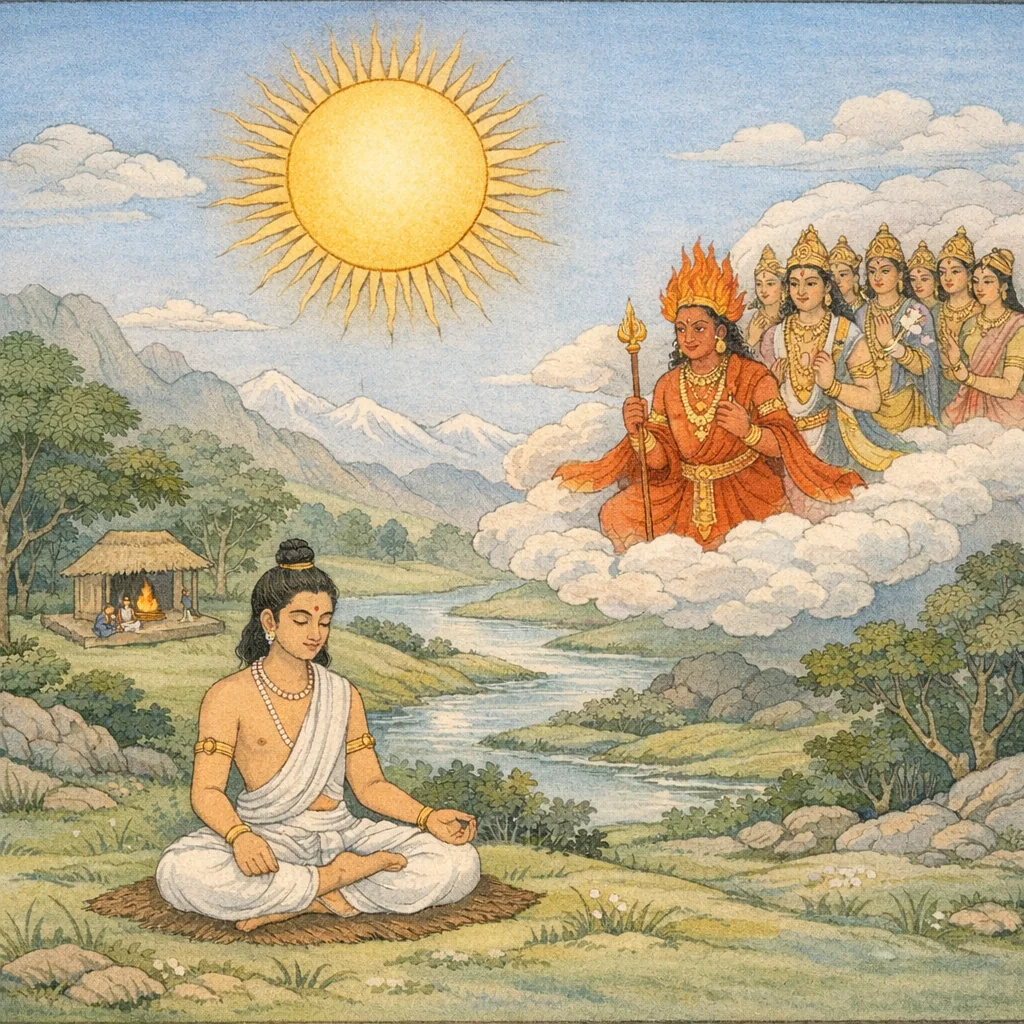
उग्र॑ं तप: समास्थाय दिवाकरमथाश्रित: । रहस्यवेदं कृतवान् सूर्यस्य द्विजसत्तम:
Undertaking fierce austerities and taking refuge in the Sun (Divākara), that best of the twice-born sages obtained the Sun’s secret knowledge—an esoteric Vedic teaching—through disciplined tapas and devotion.
Verse 19
लोगमश उवाच प्रीतास्तस्याभवन् देवा: कर्मणार्वावसोर्नूप,लोमशजी कहते हैं--राजन्! अर्वावसुके उस कार्यसे सूर्य आदि सब देवता उसपर प्रसन्न हो गये। उन्होंने अर्वावसुका यज्ञमें वरण कराया एवं परावसुको निकलवा दिया। तत्पश्चात् अग्नि-सूर्य आदि देवताओंने उन्हें वर देनेकी इच्छा प्रकट की
Lomaśa said: “O King, by that deed of Ārvāvasu the gods became pleased. The Sun and the other deities were satisfied with him. They had Ārvāvasu chosen in the sacrifice and caused Parāvasu to be driven out. Thereafter Agni, Sūrya, and the other gods expressed their wish to grant him a boon.”
Verse 20
त॑ ते प्रवरयामासुर्निरासुश्च॒ परावसुम् । ततो देवा वरं तस्मै ददुरग्निपुरोगमा:,लोमशजी कहते हैं--राजन्! अर्वावसुके उस कार्यसे सूर्य आदि सब देवता उसपर प्रसन्न हो गये। उन्होंने अर्वावसुका यज्ञमें वरण कराया एवं परावसुको निकलवा दिया। तत्पश्चात् अग्नि-सूर्य आदि देवताओंने उन्हें वर देनेकी इच्छा प्रकट की
Lomaśa said: “O King, pleased with that deed, the gods—led by Agni—caused him to be chosen as the officiant in the sacrifice, and they expelled Parāvasu. Thereafter, the gods headed by Agni expressed their wish to grant him a boon.”
Verse 21
स चापि वरयामास पितुरुत्थानमात्मन: । अनागस्त्वं ततो भ्रातुः पितुश्नास्मरणं वधे,तब अर्वावसुने यह वर माँगा कि “मेरे पिताजी जीवित हो जायाँ। मेरे भाई निर्दोष हों और उन्हें पिताके वधकी बात भूल जाय'
Lomaśa said: He too chose a boon—his own father’s restoration to life. Then he further asked that his brother be regarded as blameless, and that the memory of the father’s slaying be erased, so that the family might be freed from the stain of guilt and the cycle of retaliatory hatred.
Verse 22
भरद्वाजस्य चोत्थानं यवक्रीतस्य चो भयो: । प्रतिष्ठां चापि वेदस्य सौरस्य द्विजसत्तम: । एवमस्त्विति तं देवा: प्रोचुश्नापि वरान् ददु:,साथ ही उन्होंने यह भी माँगा कि “भरद्वाज तथा यवक्रीत दोनों जी उठें और इस सूर्यदेवतासम्बन्धी रहस्यमय वेदमन्त्रकी प्रतिष्ठा हो।' द्विजश्रेष्ठ अर्वावसुके इस प्रकार वर माँगनेपर देवता बोले--'ऐसा ही हो।” इस प्रकार उन्होंने पूर्वोक्त सभी वर दे दिये
Lomasha said: “(He asked) that Bharadvāja should rise again, and that Yavakrīta too—both of them—should be restored to life; and further, O best of twice-born, that the sacred Vedic lore connected with the Sun should be firmly established and gain due authority. The gods replied to him, ‘So be it,’ and thus they granted those boons as well.”
Verse 23
ततः प्रादुर्बभूवुस्ते सर्व एव युधिष्ठिर । अथाब्रवीद् यवक्रीतो देवानग्निपुरोगमान्,तथायुक्तेन विधिना निहन्तुममरोत्तमा: । युधिष्ठिर! इसके बाद पूर्वोक्त सभी मुनि जीवित हो गये। उस समय यवक्रीतने अग्नि आदि सम्पूर्ण देवताओंसे पूछा--*देवेश्वरो! मैंने वेदका अध्ययन किया है, वेदोक्त व्रतोंका अनुष्ठान भी किया है। मैं स्वाध्यायशील और तपस्वी भी हूँ, तो भी रैभ्यमुनि इस प्रकार अनुचित रीतिसे मेरा वध करनेमें कैसे समर्थ हो सके”
Then, O Yudhiṣṭhira, all those sages reappeared alive. Thereupon Yavakrīta addressed the gods, with Agni at their head: “O best of the immortals, how could the sage Raibhya, by a method contrary to right procedure, become capable of killing me—when I have studied the Veda, performed the Vedic observances, and live devoted to self-study and austerity?”
Verse 24
समधीतं मया ब्रह्म व्रतानि चरितानि च | कथं च रैभ्य: शक्तो मामधीयानं तपस्विनम्
Lomaśa said: “I have duly studied the sacred Veda, and I have also observed vows and practiced disciplined conduct. How, then, could Raibhya have had the power to harm me—while I was engaged in study and living as an ascetic?”
Verse 25
देवा ऊचु मैवं कृथा यवक्रीत यथा वदसि वै मुने । ऋते गुरुमधीता हि सुखं वेदास्त्वया पुरा,देवताओंने कहा--मुनि यवक्रीत! तुम जैसी बात कहते हो, वैसा न समझो। तुमने पूर्वकालमें बिना गुरुके ही सुखपूर्वक सब वेद पढ़े हैं और इन रैभ्यमुनिने बड़े क्लेश उठाकर अपने व्यवहारसे गुरुजनोंको संतुष्ट करके दीर्घकालतक कष्टसहनपूर्वक उत्तम वेदोंका ज्ञान प्राप्त किया है
The gods said: “Yavakrīta, do not act in this way; do not think as you are speaking, O sage. For in former times you indeed studied the Vedas with ease even without a teacher.”
Verse 26
अनेन तु गुरून् दुःखात् तोषयित्वा55त्मकर्मणा । कालेन महता क्लेशाद् ब्रह्माधिगतमुत्तमम्,देवताओंने कहा--मुनि यवक्रीत! तुम जैसी बात कहते हो, वैसा न समझो। तुमने पूर्वकालमें बिना गुरुके ही सुखपूर्वक सब वेद पढ़े हैं और इन रैभ्यमुनिने बड़े क्लेश उठाकर अपने व्यवहारसे गुरुजनोंको संतुष्ट करके दीर्घकालतक कष्टसहनपूर्वक उत्तम वेदोंका ज्ञान प्राप्त किया है
“But by this course—by enduring hardship and by one’s own disciplined conduct—one pleases the elders and teachers. Over a long span of time, through great exertion, the highest sacred knowledge (brahman/veda) is attained. Therefore, O Yavakrīta, do not think as you speak: you may have studied the Vedas earlier with ease and without a teacher, but Raibhya, having borne severe trials and satisfied his gurus by proper service and behavior, has gained excellent Vedic realization through prolonged austerity.”
Verse 27
लोगमश उवाच यवक्रीतमथोकत्वैवं देवा: साग्निपुरोगमा: । संजीवयित्वा तानू् सर्वान् पुनर्जग्मुस्त्रिविष्टपम्,लोमशजी कहते हैं--राजन्! अग्नि आदि देवताओंने यवक्रीतसे ऐसा कहकर उन सबको नूतन जीवन प्रदान करके पुन: स्वर्गलोकको प्रस्थान किया
Lomaśa said: “O King, having spoken thus to Yavakrīta, the gods—led by Agni—restored all of them to life, and then departed again for Triviṣṭapa (heaven).”
Verse 28
आश्रमस्तस्य पुण्यो5यं सदापुष्पफलद्रुम: | अन्रोष्य राजशार्दूल सर्व पापं प्रमोक्ष्यसि,नृपश्रेष्ठ! यह उन्हीं रैभ्यमुनिका पवित्र आश्रम है। यहाँके वृक्ष सदा फ़ूल और फलोंसे लदे रहते हैं। यहाँ एक रात निवास करके तुम सब पापोंसे छूट जाओगे
Lomaśa said: “This is the holy hermitage of that sage; its trees are ever laden with flowers and fruits. O tiger among kings, by spending a night here you will be released from all sin.”
Verse 137
इस प्रकार श्रीमह्ााभारत वनपर्वके अन्तर्गत तीर्थयात्रापर्वमें लोमशतीर्थयात्राके प्रसंगमें यवक्रीतोपाख्यानविषयक एक सौ सैंतीसवाँ अध्याय पूरा हुआ
Thus ends the one hundred and thirty-seventh chapter of the Mahābhārata’s Vana Parva, within the pilgrimage section (Tīrtha-yātrā Parva), in the context of Lomāśa’s pilgrimage narrative—this chapter being devoted to the episode (upākhyāna) of Yavakrīta.
Verse 138
इति श्रीमहाभारते वनपर्वणि तीर्थयात्रापर्वणि लोमशतीर्थयात्रायां यवक्रीतोपाख्याने अष्टात्रिंशधिकशततमो< ध्याय:,इस प्रकार श्रीमह्याभारत वनपर्वके अन्तर्गत तीर्थयात्रापर्वमें लोगशती र्थयात्राके प्रसंगमें यवक्रीतोपाख्यानविषयक एक सौ अड़तीसवाँ अध्याय पूरा हुआ
“Here ends, in the Mahābhārata, in the Vana Parva, within the Tīrtha-yātrā Parva, in the course of Lomāśa’s pilgrimage, the upākhyāna of Yavakrīta—chapter one hundred and thirty-eight.”
Verse 183
मूर्तिमांस्तं ददर्शाथ स्वयमग्रभुगव्यय: । वहाँ जाकर उन्होंने भगवान् सूर्यकी शरण ली और बड़ी उग्र तपस्या करके उन ब्राह्मणशिरोमणिने सूर्यसम्बन्धी रहस्यमय वैदिक मन्त्रका अनुष्ठान किया। तदनन्तर अग्रभोजी एवं अविनाशी साक्षात् भगवान् सूर्यने साकाररूपमें प्रकट हो अर्वावसुको दर्शन दिया
Then the imperishable Sun-god, the foremost enjoyer of offerings, manifested in a tangible form and was seen directly. Having taken refuge in Sūrya and performed fierce austerities along with the prescribed Vedic rite connected with the Sun’s secret mantra, Arvāvāsu received the deity’s gracious vision.
Verse 243
तथायुक्तेन विधिना निहन्तुममरोत्तमा: । युधिष्ठिर! इसके बाद पूर्वोक्त सभी मुनि जीवित हो गये। उस समय यवक्रीतने अग्नि आदि सम्पूर्ण देवताओंसे पूछा--*देवेश्वरो! मैंने वेदका अध्ययन किया है, वेदोक्त व्रतोंका अनुष्ठान भी किया है। मैं स्वाध्यायशील और तपस्वी भी हूँ, तो भी रैभ्यमुनि इस प्रकार अनुचित रीतिसे मेरा वध करनेमें कैसे समर्थ हो सके”
Lomaśa said: “O Yudhiṣṭhira, by employing the proper method, the foremost of the immortals were able to destroy the danger, and thereafter all the sages previously mentioned were restored to life. At that time Yavakrīta questioned Agni and the other deities: ‘O Lord of the gods, I have studied the Veda and performed the Vedic vows. I am devoted to svādhyāya and austere practice; even so, how could the sage Raibhya have been capable of killing me by an improper means?’”
Frequently Asked Questions
The dilemma is whether preserving ritual continuity and personal reputation can justify concealment and blame transfer after unintended harm; the chapter critiques expedient misattribution and elevates transparent remediation.
The gods distinguish effortless learning without proper guru-framework from knowledge attained through sustained service and correct method, presenting discipline and right procedure as integral to legitimate attainment.
Yes: the closing assertion that the āśrama is inherently meritorious and that dwelling there leads to release from sins functions as a localized phalaśruti, framing the narrative as both exemplum and sacred-geographic endorsement.