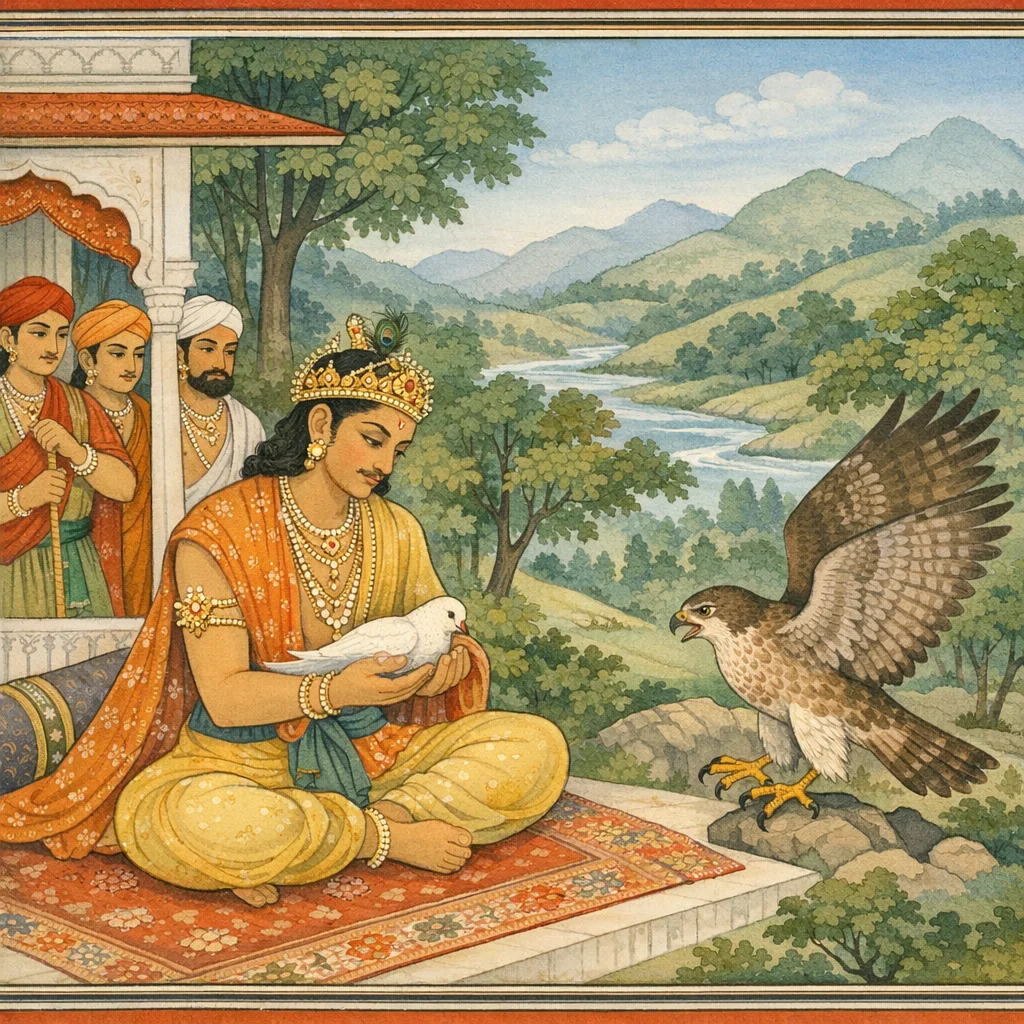
Adhyaya 131
Śibi’s Weighing of Dharma (The Hawk and the Dove Trial) — शिबेर्धर्मतुला (श्येन-कपोतोक्तिः)
Upa-parva: Śibi–Śyena–Kapotopākhyāna (Dharma-Testing Episode of King Śibi)
Chapter 131 presents a tightly argued ethical dialogue framed as a dharma-sankat (moral dilemma). A hawk (śyena) challenges King Śibi’s reputation for righteousness by asserting the necessity of food: all beings depend on āhāra, and renouncing nourishment is unsustainable. The king counters with the royal duty to protect a terrified dove (kapota) that has sought refuge, stating that abandoning a supplicant constitutes grave adharma. The hawk introduces a key hermeneutic: a “dharma” that obstructs dharma becomes kudharma; one should select a course where duties do not mutually injure, weighing relative gravity (guru-lāghava). The king proposes alternative offerings (livestock), but the hawk insists that the dove is its divinely allotted prey and refuses substitutes. The resolution is formalized through equivalence: the king offers his own flesh, measured on a scale against the dove’s weight; when insufficient, he mounts the scale himself. The hawk reveals itself as Indra and the dove as Agni (Havyavāhana), declaring the event a deliberate test that generates enduring renown (kīrti). Lomāśa then marks the locale as a sanctified site where devas and ancient sages are perceived by the meritorious.
Chapter Arc: लोमश ऋषि युधिष्ठिर को तीर्थ-यात्रा के रहस्य बताते हैं—कुछ स्थान ऐसे हैं जहाँ देह-त्याग भी स्वर्ग-प्राप्ति का द्वार बन जाता है, इसलिए असंख्य लोग वहाँ निवास कर मृत्यु की प्रतीक्षा करते हैं। → सरस्वती के ‘विनशन’ (जहाँ वह पृथ्वी में लुप्त होती है) का कारण-प्रसंग आता है—निषादों के दोष से नदी का धरती में प्रवेश; फिर वसिष्ठ के पुत्र-शोक का उल्लेख, जहाँ वे आत्म-विनाश की ओर झुकते हैं पर पुनः उठ खड़े होते हैं। तीर्थों की श्रृंखला (मानसरोवर का द्वार, वितस्ता का पावन प्रवाह) कथा को व्यापक धर्म-भूगोल में फैलाती है। → उशीनर राजा की परीक्षा—इन्द्र श्येन (बाज) बनकर और अग्नि कपोत (कबूतर) बनकर आते हैं; भयभीत कपोत राजा की गोद में शरण लेता है और श्येन ‘धर्म’ के नाम पर अपना आहार माँगता है, जिससे शरणागत-रक्षा बनाम न्याय/भोजन-धर्म का तीखा संघर्ष खड़ा होता है। → राजा उशीनर शरणागत की रक्षा का व्रत निभाने को तत्पर होता है—कथा का निष्कर्ष यह स्थापित करता है कि राजधर्म का शिखर शरणागत-पालन और करुणा है; देवता परीक्षा द्वारा उसकी कीर्ति को प्रकाशित करते हैं।
Shlokas
Verse 1
लोमशजी कहते हैं--भारत! यहाँ शरीर छूट जानेपर मनुष्य स्वर्गलोकमें जाते हैं; इसलिये हजारों इस तीर्थमें मरनेके लिये आकर निवास करते हैं
Lomaśa said: “O descendant of Bharata, when the body is cast off here, people attain the heavenly world. Therefore, thousands come and dwell at this sacred ford, seeking to die here.”
Verse 2
एवमाशी: प्रयुक्ता हि दक्षेण यजता पुरा । इह ये वै मरिष्यन्ति ते वै स्वर्गजितो नरा:,प्राचीनकालमें प्रजापति दक्षने यज्ञ करते समय यह आशीर्वाद दिया था कि जो मनुष्य यहाँ मरेंगे वे स्वर्गलोकपर अधिकार प्राप्त कर लेंगे। यह रमणीय, दिव्य और तीव्र प्रवाहवाली सरस्वती नदी है और यह सरस्वतीका विनशन नामक तीर्थ है
Thus, in ancient times, while Prajāpati Dakṣa was performing a sacrifice, this very blessing was pronounced: “Those men who die here shall indeed win the realms of heaven.” By these words the place is established as a consecrated tīrtha, where death is not mere loss but a passage secured by sacrificial sanctification and religious merit.
Verse 3
एषा सरस्वती रम्या दिव्या चौधवती नदी । एतद् विनशनं नाम सरस्वत्या विशाम्पते,प्राचीनकालमें प्रजापति दक्षने यज्ञ करते समय यह आशीर्वाद दिया था कि जो मनुष्य यहाँ मरेंगे वे स्वर्गलोकपर अधिकार प्राप्त कर लेंगे। यह रमणीय, दिव्य और तीव्र प्रवाहवाली सरस्वती नदी है और यह सरस्वतीका विनशन नामक तीर्थ है
Lomaśa said: “This is the lovely Sarasvatī—divine, a river of swift current. And this, O lord of the people, is the sacred ford called Vinaśana on the Sarasvatī.”
Verse 4
द्वारं निषादराष्ट्रस्य येषां दोषात् सरस्वती । प्रविष्टा पृथिवीं वीर मा निषादा हि मां विदु:,यह निषादराजका द्वार है। वीर युधिष्ठिर! उन निषादोंके ही संसर्गदोषसे सरस्वती नदी यहाँ इसलिये पृथ्वीके भीतर प्रविष्ट हो गयी कि निषाद मुझे जान न सकें। यह चमसोद्धेदतीर्थ है; जहाँ सरस्वती पुनः प्रकट हो गयी है। यहाँ समुद्रमें मिलनेवाली सम्पूर्ण पवित्र नदियाँ इसके सम्मुख आयी हैं
Lomaśa said: “This is the gateway to the realm of the Niṣādas. Because of association with them (and the taint that follows), the river Sarasvatī entered into the earth here, O hero—so that the Niṣādas might not recognize me.”
Verse 5
एष वै चमसोद्धेदो यत्र दृश्या सरस्वती । यत्रैनामभ्यवर्तन्त सर्वा: पुण्या: समुद्रगा:,यह निषादराजका द्वार है। वीर युधिष्ठिर! उन निषादोंके ही संसर्गदोषसे सरस्वती नदी यहाँ इसलिये पृथ्वीके भीतर प्रविष्ट हो गयी कि निषाद मुझे जान न सकें। यह चमसोद्धेदतीर्थ है; जहाँ सरस्वती पुनः प्रकट हो गयी है। यहाँ समुद्रमें मिलनेवाली सम्पूर्ण पवित्र नदियाँ इसके सम्मुख आयी हैं
This is the sacred ford called Camasoddheda, where the river Sarasvatī becomes visible again. Here, all the holy rivers that ultimately flow to the ocean are said to have come forth to meet her.
Verse 6
एतत् सिन्धोर्महत् तीर्थ यत्रागस्त्यमरिंदम । लोपामुद्रा समागम्य भर्तारमवृणीत वै,शत्रुमन! यह सिन्धुका महान् तीर्थ है; जहाँ जाकर लोपामुद्राने अपने पति अगस्त्यमुनिका वरण किया था
O subduer of foes, this is the great sacred ford of the Sindhu River; here Lopāmudrā, having come to meet him, chose the sage Agastya as her husband.
Verse 7
एतत् प्रकाशते तीर्थ प्रभासं भास्करद़्ुते । इन्द्रस्य दयितं पुण्यं पवित्रं पापनाशनम्,सूर्यके समान तेजस्वी नरेश! यह प्रभासतीर्थ- प्रकाशित हो रहा है, जो इन्द्रको बहुत प्रिय है। यह पुण्यमय क्षेत्र सब पापोंका नाश करनेवाला और परम पवित्र है
Lomaśa said: “O king, radiant as the Sun, there now appears the sacred ford called Prabhāsa. Dear to Indra, it is a meritorious and supremely purifying holy place, famed for destroying sin.”
Verse 8
एतदू विष्णुपद॑ं नाम दृश्यते तीर्थमुत्तमम् । एषा रम्या विपाशा च नदी परमपावनी,यह विष्णुपद नामवाला उत्तम तीर्थ दिखायी देता है तथा यह परम पावन और मनोरम विपाशा (व्यास) नदी है। यहीं भगवान् वसिष्ठ मुनि पुत्रशोकसे पीड़ित हो अपने शरीरको पाशोंसे बाँधकर कूद पड़े थे, परंतु पुनः विपाश (पाशमुक्त) होकर जलसे बाहर निकल आये
“Here is seen the supreme sacred ford known as Viṣṇupada. And this is the delightful river Vipāśā, most purifying. It is here that the sage Vasiṣṭha, tormented by grief for his son, bound his body with nooses and leapt in; yet he was released from the bonds and emerged again from the waters.”
Verse 9
अत्र वै पुत्रशोकेन वसिष्ठो भगवानृषि: । बद्ध्वा55त्मानं निपतितो विपाश: पुनरुत्थित:,यह विष्णुपद नामवाला उत्तम तीर्थ दिखायी देता है तथा यह परम पावन और मनोरम विपाशा (व्यास) नदी है। यहीं भगवान् वसिष्ठ मुनि पुत्रशोकसे पीड़ित हो अपने शरीरको पाशोंसे बाँधकर कूद पड़े थे, परंतु पुनः विपाश (पाशमुक्त) होकर जलसे बाहर निकल आये
Here, the venerable sage Vasiṣṭha, overwhelmed by grief for his son, bound his own body with nooses and leapt into the river. Yet the river became ‘Vipāśā’—free from bonds—for him, and he rose up again, emerging from the waters.
Verse 10
काश्मीरमण्डलं चैतत् सर्वपुण्यमरिंदम । महर्षिभिश्नाध्युषितं पश्येदं भ्रातृभि: सह,शत्रुदमन! यह पुण्यमय काश्मीरमण्डल है, जहाँ बहुत-से महर्षि निवास करते हैं। तुम भाइयोंसहित इसका दर्शन करो। भारत! यह वही स्थान है जहाँ उत्तरके समस्त ऋषि, नहुषकुमार ययाति, अग्नि और काश्यपका संवाद हुआ था
Lomaśa said: “O subduer of foes, this is the region of Kāśmīra—wholly sacred and rich in merit. It is inhabited by great seers. Behold it together with your brothers.”
Verse 11
शत्रुदमन! यह पुण्यमय काश्मीरमण्डल है, जहाँ बहुत-से महर्षि निवास करते हैं। तुम भाइयोंसहित इसका दर्शन करो। भारत! यह वही स्थान है जहाँ उत्तरके समस्त ऋषि, नहुषकुमार ययाति, अग्नि और काश्यपका संवाद हुआ था
O tamer of foes, this is the holy region of Kashmir, where many great seers dwell. Behold it together with your brothers. O descendant of Bharata, this is that very place where the northern sages assembled, and where the dialogue between Agni and Kāśyapa took place in connection with Yayāti, the son of Nahuṣa.
Verse 12
एतद् द्वारं महाराज मानसस्य प्रकाशते । वर्षमस्य गिरेर्मध्ये रामेण श्रीमता कृतम्,महाराज! यह मानससरोवरका द्वार प्रकाशित हो रहा है। इस पर्वतके मध्यभागमें परशुरामजीने अपना आश्रम बनाया था
O great king, this is the gateway to Mānasarovara that now comes into view. Within the central region of this mountain, the illustrious Rāma (Paraśurāma) established his hermitage.
Verse 13
यत्रोत्तराणां सर्वेषामृषीणां नाहुषस्य च । अम्नेश्लैवात्र संवाद: काश्यपस्य च भारत,एष वातिकषण्डो वै प्रख्यात: सत्यविक्रम: । नात्यवर्तत यदद्धारं विदेहादुत्तरं च यः: युधिष्ठिर! परशुरामजी सर्वत्र विख्यात हैं। वे सत्यपराक्रमी हैं। उनके इस आश्रमका द्वार विदेह देशसे उत्तर है। यह बवंडर (वायुका तूफान) भी उनके इस द्वारका कभी उल्लंघन नहीं कर सकता है (फिर औरोंकी तो बात ही क्या है)
Lomaśa said: “O Bhārata, here is the famed hermitage-region where the northern sages dwell, and where the traditions and dialogues of Kāśyapa and of Nāhuṣa are preserved. This very whirlwind is renowned for its unfailing force; yet it cannot overstep the gateway of Paraśurāma’s āśrama, which lies to the north of Videha. If even such a storm cannot cross that threshold, how could ordinary beings do so?”
Verse 14
इदमाश्चर्यमपरं देशेडस्मिन् पुरुषर्षभ । क्षीणे युगे तु कौन्तेय शर्वस्य सह पार्षदै:
“O bull among men, here in this very region there is yet another marvel. O son of Kuntī, when the age had waned, Śarva (Śiva) appeared together with his attendants.”
Verse 15
सहोमया च भवति दर्शनं कामरूपिण: । अस्मिन् सरसि सम्रैवैं चैत्रे मासि पिनाकिनम्
“And in the company of Sahomā, there occurs a vision of the shape-shifting one. In this very lake, in the month of Caitra, (one may behold) Pinākin—Śiva, the bearer of the bow Pināka.”
Verse 16
यजन्ते याजका: सम्यक् परिवारं शुभार्थिन: । अन्रोपस्पृश्य सरसि श्रद्दधानो जितेन्द्रिय:
Lomaśa said: “Seeking auspicious results, the officiating priests perform the sacrifice properly, together with the full complement of attendants and requisites. Having bathed in the lake and touched the water in due manner, the faithful man—self-controlled—proceeds with the rite.”
Verse 17
क्षीणपाप: शुभाल्लोंकान प्राप्तुते नात्र संशय: । एष उज्जानको नाम पावकिर्यत्र शान्तवान् | अरुन्धतीसहायश्व वसिष्ठो भगवानृषि:
Lomaśa said: “One whose sins have been exhausted attains the auspicious worlds—of this there is no doubt. This is the sacred place called Ujjānaka, where the tranquil sage Vasiṣṭha, the blessed ṛṣi, dwells together with Arundhatī.”
Verse 18
नरश्रेष्ठ) इस देशमें दूसरी आश्वर्यकी बात यह है कि यहाँ निवास करनेवाले साधकको युगके अन्तमें पार्षदों तथा पार्वतीसहित इच्छानुसार रूप धारण करनेवाले भगवान् शंकरका प्रत्यक्ष दर्शन होता है। इस सरोवरके तटपर चैत्र मासमें कल्याणकामी याजक पुरुष अनेक प्रकारके यज्ञोंद्वारा परिवारसहित पिनाकधारी भगवान् शिवकी आराधना करते हैं। इस तालाबमें श्रद्धापूर्वक स्नान एवं आचमन करके पापमुक्त हुआ जितेन्द्रिय पुरुष शुभ लोकोंमें जाता है; इसमें संशय नहीं है। यह सरोवर उज्जानक नामसे प्रसिद्ध है। यहाँ भगवान् स्कन्द तथा अरुन्धतीसहित महर्षि वसिष्ठने साधना करके सिद्धि एवं शान्ति प्राप्त की है ।। १४-- १७ || हृदश्न कुशवानेष यत्र पद्म॑ कुशेशयम् | आश्रमश्चैव रुक्मिण्या यत्राशाम्यदकोपना
“O best of men! In this land there is yet another wonder: the ascetic who dwells here, at the end of the age, gains the direct vision of Lord Śaṅkara, who may assume whatever form he wills, together with his attendants and with Pārvatī. On the bank of this lake, in the month of Caitra, priests who seek welfare worship Lord Śiva, bearer of the Pināka, by many kinds of sacrifices, along with their households. Whoever, with faith, bathes in this pool and performs ācaman, becomes free of sin; and, having mastered his senses, goes to the auspicious worlds—of this there is no doubt. This lake is famed as Ujjānaka. Here Lord Skanda and the great ṛṣi Vasiṣṭha, together with Arundhatī, practiced austerities and attained perfection and peace. “Here is the lake and this kuśa-grass grove, where the lotus—resting among the kuśa—blooms. Here too is the hermitage of Rukmiṇī, where the gentle one, free from anger, found her calm.”
Verse 19
यह कुशवान् नामक हृद है, जिसमें कुशेशय नामवाले कमल खिले रहते हैं। यहीं रुक्मिणीदेवीका आश्रम है जहाँ उन्होंने क्रोधको जीतकर शान्तिका लाभ किया था |। समाधीनां समासस्तु पाण्डवेय श्रुतस्त्वया । त॑ द्रक्ष्यसि महाराज भृगुतुड़ंं महागिरिम्,पाण्डुनन्दन! महाराज! तुमने जिसके विषयमें यह सुन रखा है कि वह योगसिद्धिका संक्षिप्त स्वरूप है--जिसके दर्शनमात्रसे समाधिरूप फलकी प्राप्ति हो जाती है, उस भगुतुंग नामक महान् पर्वतका अब तुम दर्शन करोगे
“This is the lake called Kuśavān, where lotuses known as Kuśeśaya bloom. Here too is the hermitage of Lady Rukmiṇī, where she conquered anger and attained peace. And now, O son of Pāṇḍu, O great king: you will behold the mighty mountain called Bhṛgutunga—of which you have heard as a concise embodiment of the attainments of samādhi, a place whose very sight is said to yield the fruit of meditative absorption.”
Verse 20
वितस्तां पश्य राजेन्द्र सर्वपापप्रमोचनीम् । महर्षिभिश्चाध्युषितां शीततोयां सुनिर्मलाम्,राजेन्द्र! वितस्ता (झेलम) नदीका दर्शन करो जो सब पापोंसे मुक्त करनेवाली है। इसका जल बहुत शीतल और अत्यन्त निर्मल है। इसके तटपर बहुत-से महर्षिगण निवास करते हैं
Lomaśa said: “Behold, O best of kings, the Vitastā—she who frees one from all sins. Her waters are cool and perfectly clear, and her banks are inhabited by great seers.”
Verse 21
जलां चोपजलां चैव यमुनामभितो नदीम् | उशीनरो वै यत्रेष्टवा वासवादत्यरिच्यत,यमुना नदीके दोनों पार्श्वमें जला और उपजला नामकी दो नदियोंका दर्शन करो, जहाँ राजा उशीनरने यज्ञ करके इन्द्रसे भी ऊँचा स्थान प्राप्त किया था
Behold the rivers Jalā and Upajalā on either bank of the Yamunā. It was here that King Uśīnara performed a sacrifice and, through its merit, attained a station surpassing even Vāsava (Indra).
Verse 22
तां देवसमितिं तस्य वासवश्न विशाम्पते । अभ्यागच्छन्नपवरं ज्ञातुमग्निश्च भारत,महाराज भरतनन्दन! नृपश्रेष्ठ उशीनरके महत्त्वको समझनेके लिये किसी समय इन्द्र और अग्नि उनकी राजसभामें गये
O lord of the people, Indra (Vāsava) and Agni approached his divine royal assembly, wishing to ascertain the true measure of that king’s greatness.
Verse 23
जिज्ञासमानौ वरदौ महात्मानमुशीनरम् । इन्द्र: श्येन: कपोतो<ग्निर्भूत्वा यज्ञेडभिजग्मतु:,वे दोनों वरदायक महात्मा उस समय उशीनरकी परीक्षा लेना चाहते थे; अतः इन्द्रने बाज पक्षीका रूप धारण किया और अग्निने कबूतरका। इस प्रकार वे राजाके यज्ञमण्डपमें गये
Wishing to test the great-souled king Uśīnara, the two boons-givers set out: Indra assumed the form of a hawk, and Agni became a dove, and thus they came to the king’s sacrificial arena.
Verse 24
ऊरू राज्ञ: समासाद्य कपोत: श्येनजाद भयात् । शरणार्थी तदा राजन् निलिल्ये भयपीडित:,अपनी रक्षाके लिये आश्रय चाहनेवाला कबूतर बाजके भयसे डरकर राजाकी गोदीमें जा छिपा
Fleeing in terror from the hawk, the pigeon rushed to the king’s thighs (lap). Seeking refuge, O King, it hid there, oppressed by fear.
Verse 130
इति श्रीमहाभारते वनपर्वणि तीर्थयात्रापर्वणि लोमशतीर्थयात्रायां श्येनकपोतीये त्रिंशदधिकशततमो< ध्याय:,इस प्रकार श्रीमहाभारत वनपर्वके अन्तर्गत तीर्थयात्रापर्वमें लोमशती र्थयात्राके प्रसंगमें श्येनकपोतीयोपाख्यानविषयक एक सौ तीसवाँ अध्याय पूरा हुआ
Thus, in the Śrī Mahābhārata, within the Vana Parva, in the Tīrthayātrā Parva, in the account of Lomasa’s pilgrimage, ends the one hundred and thirtieth chapter concerning the episode of the Hawk and the Dove.
Frequently Asked Questions
The king must reconcile two claims: the duty to protect a refugee dove seeking safety versus the hawk’s claim to sustenance and customary prey, with both framed as dharmically grounded obligations.
Dharma is presented as requiring avirodha (non-injury across duties) and deliberation by guru–lāghava: when norms conflict, one should choose the course that minimizes ethical harm and preserves higher obligations.
Yes: the divine disclosure (Indra and Agni testing) functions as validation, and the text explicitly states the king’s enduring kīrti and the sanctity of the site—linking comprehension of the episode to moral exemplarity and sacred geography.