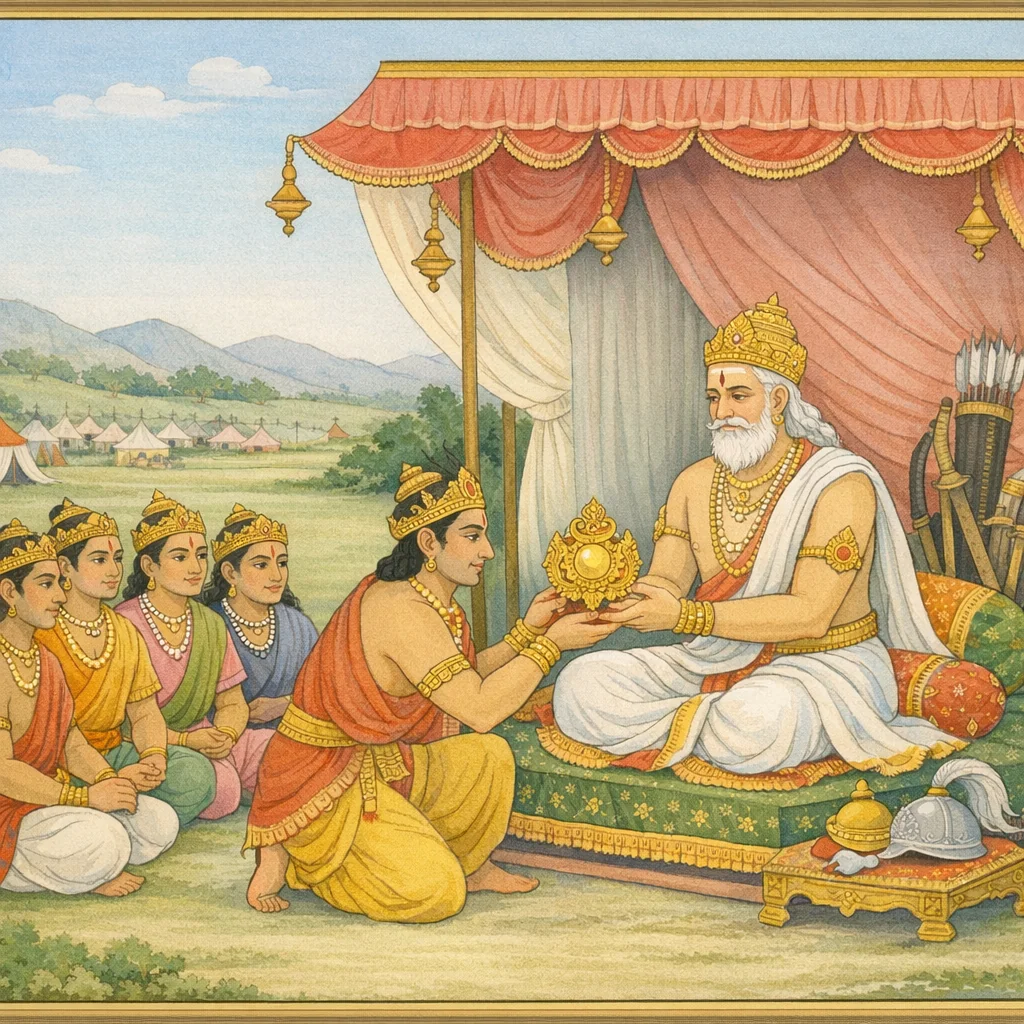
Adhyaya 155
Rukmī’s Offer of Aid and Arjuna’s Refusal (रुक्मिप्रस्तावः—अर्जुनप्रत्याख्यानम्)
Upa-parva: Alliance Mobilization and Rukmī’s Approach (Udyoga Parva, late council episodes)
Vaiśaṃpāyana identifies Rukmī—son of the southern ruler associated with Bhīṣmaka’s line—as a celebrated archer trained in the complete fourfold discipline of dhanurveda. The chapter catalogs divine bows to establish martial hierarchy: Gāṇḍīva (Varuṇa/Pāvaka lineage), Vijaya (Māhendra), and Śārṅga (Vaiṣṇava), with Kṛṣṇa’s acquisition of Śārṅga recalled through prior victories. Rukmī, having obtained the bow Vijaya, advances toward the Pāṇḍavas with a large fourfold army and enters their camp under an aditya-hued banner. Yudhiṣṭhira receives and honors him according to protocol. Rukmī then offers himself as Arjuna’s battlefield helper, claiming unmatched prowess and promising victory services. In the presence of Dharmarāja and Keśava, Arjuna responds with controlled irony, citing earlier high-risk engagements (Ghoṣayātrā episode, Khāṇḍava conflict, battles with Nivātakavacas and Kālakeyas, and Virāṭa’s city) to assert that his established support network and divine armament suffice. He explicitly denies fear and declines the need for additional assistance, permitting Rukmī to go elsewhere. Rukmī withdraws his ocean-like force and approaches Duryodhana, but is similarly rejected. The chapter closes by noting that only two figures abstain from that impending engagement context (Balarāma/Rauhiṇeya and Rukmī), and the Pāṇḍavas resume counsel as the royal assembly shines like a star-filled sky with the moon.
Chapter Arc: कुरु-सेना के विशाल होने पर भी एक प्रश्न धधकता है—यदि ‘सेनाप्रणेतार’ न हो तो यह महाबल भी युद्ध में चींटियों के ढेर-सा बिखर जाएगा। दुर्योधन के सामने अब शस्त्र नहीं, नेतृत्व का संकट खड़ा है। → सभा में तर्क उभरता है कि दो योग्य नायकों की बुद्धि कभी समान नहीं होती; शौर्य और नेतृत्व-प्रतिस्पर्धा भीतर से सेना को फाड़ सकती है। इसी भय के बीच दुर्योधन को ऐसा प्रधान सेनापति चाहिए जो सबको एक ध्वज के नीचे बाँध दे—और जिसकी प्रतिष्ठा स्वयं अनुशासन बन जाए। → भीष्म का प्रधान सेनापति के रूप में अभिषेक—और उनका स्पष्ट वचन कि वे ‘एक शर्त’ पर ही सेनापति होंगे। यह क्षण कुरु-पक्ष की युद्ध-यात्रा को औपचारिक रूप से अपरिवर्तनीय दिशा देता है: अब सेना का सिर तय है, और उसके साथ युद्ध का भाग्य भी। → दुर्योधन, भीष्म को अग्रणी बनाकर, जय-आशीर्वादों के साथ सेना को लेकर निकलता है। कुरुक्षेत्र के निकट मधुर, अनूषर (ऊसर-रहित) प्रदेश में—जहाँ घास और ईंधन प्रचुर हैं—शिविर-निर्माण होता है; व्यवस्था, विभाग और पड़ाव युद्ध-यंत्र को चालू कर देते हैं। → भीष्म की ‘शर्त’ का नैतिक भार और उसका आगामी युद्ध-नीति पर प्रभाव—यह संकेत देता है कि सेनापति का अभिषेक केवल आरंभ है; निर्णायक टकराव अब निकट है।
Shlokas
Verse 1
ऑपनआ कराता बा अं षट्पज्चाशर्दाधेकशततमो< ध्याय: दुर्योधनके द्वारा भीष्मजीका प्रधान सेनापतिके पदपर अभिषेक और कुरक्षेत्रमें पहुँचकर शिविर-निर्माण वैशम्पायन उवाच तत: शान्तनवं भीष्म प्राञ्जलिर्धुतराष्ट्रज: । सह सर्वर्महीपालैरिदं वचनमत्रवीत्,वैशम्पायनजी कहते हैं--जनमेजय! तदनन्तर धृतराष्ट्रपुत्र दुर्योधन समस्त राजाओंके साथ शान्तनु-नन्दन भीष्मके पास जा हाथ जोड़कर इस प्रकार बोला--
Vaiśampāyana said: Then Dhṛtarāṣṭra’s son Duryodhana, with palms joined, approached Bhīṣma, the son of Śantanu, together with all the kings, and addressed him with these words.
Verse 2
ऋते सेनाप्रणेतारं पृतना सुमहत्यपि । दीर्यते युद्धमासाद्य पिपीलिकपुटं यथा,“पितामह! कितनी ही बड़ी सेना क्यों न हो? किसी योग्य सेनापतिके बिना युद्धमें जाकर चींटियोंकी पंक्तिके समान छिलन्न-भिन्न हो जाती है
“Grandfather! However vast an army may be, without a worthy commander it falls apart when it meets battle—scattered and crushed like a line of ants.”
Verse 3
न हि जातु द्वयोरबुद्धि: समा भवति कर्हिचित् | शौर्य च बलनेतृणां स्पर्थते च परस्परम्,“दो पुरुषोंकी बुद्धि कभी समान नहीं होती। यदि दोनों ओर योग्य सेनापति हों तो उनका शौर्य एक-दूसरेकी होड़में बढ़ता है
“Never, at any time, do the judgments of two persons become exactly the same. And when both sides have capable commanders, their valor competes—each spurring the other on.”
Verse 4
श्रूयते च महाप्राज्ञ हैहघानमितौजस: । अभ्ययुब्रद्विणा: सर्वे समुच्छितकुशध्वजा:,“महामते! सुना जाता है कि समस्त ब्राह्मणोंने अपनी कुशमयी ध्वजा फहराते हुए पहले कभी अमिततेजस्वी हैहयवंशके क्षत्रियोंपर आक्रमण किया था
Vaiśampāyana said: “O great-minded one, it is indeed heard in ancient tradition that all the Brahmins—raising aloft banners made of sacred kuśa grass—once marched forth in hostility and attacked the Haihaya Kṣatriyas of immeasurable might.”
Verse 5
तानभ्ययुस्तदा वैश्या: शूद्राश्नैव पितामह । एकतत्तु त्रयो वर्णा एकत: क्षत्रियर्षभा:,“पितामह! उस समय ब्राह्मणोंके साथ वैश्यों और शूद्रोंने भी उनपर धावा किया था। एक ओर तीनों वर्णके लोग थे और दूसरी ओर चुने हुए श्रेष्ठ क्षत्रिय
Vaiśampāyana said: “Grandfather, at that time the Vaiśyas and the Śūdras too rushed to attack them. Thus, on one side stood the three social orders together, while on the other side were the bull-like best among the Kṣatriyas.”
Verse 6
ततो युद्धेष्वभज्यन्त त्रयो वर्णा: पुन: पुन: । क्षत्रियाश्न॒ जयन्त्येव बहुलं चैकतो बलम्,“तदनन्तर जब युद्ध आरम्भ हुआ, तब तीनों वर्णोके लोग बारंबार पीठ दिखाकर भागने लगे। यद्यपि इनकी सेना अधिक थी तो भी क्षत्रियोंने एकमत होकर उनपर विजय पायी
Then, as the battles began, men of the three social orders repeatedly broke ranks and turned back in flight. Yet the Kṣatriyas, acting in unity, prevailed over them—despite the opposing force being numerically greater.
Verse 7
ततस्ते क्षत्रियानेव पप्रच्छुद्धिजसत्तमा: । तेभ्य: शशंसुर्धर्मज्ञा याथातथ्यं पितामह,“पितामह! तब जन श्रेष्ठ ब्राह्मणोंने क्षत्रियोंसे ही पूछा--हमारी पराजयका क्या कारण है? उस समय धर्मज्ञ क्षत्रियोंने उनसे यथार्थ कारण बता दिया
Then those foremost among the twice-born questioned the Kṣatriyas alone: “What was the cause of our defeat?” Thereupon the Kṣatriyas, discerning in dharma, reported to them—truthfully and exactly as it had occurred—O Grandsire.
Verse 8
वयमेकस्य शृण्वाना महाबुद्धिमतो रणे । भवन्तस्तु पृथक् सर्वे स्वबुद्धिवशवर्तिन:,“वे बोले--हमलोग एक परम बुद्धिमान् पुरुषको सेनापति बनाकर युद्धमें उसीका आदेश सुनते और मानते हैं। परंतु आप सब लोग पृथक्-पृथक् अपनी ही बुद्धिके अधीन हो मनमाना बर्ताव करते हैं
They said: “In battle we heed a single man of great wisdom, whom we appoint as commander, and we listen to and obey his orders. But you all act separately, each ruled by his own understanding, behaving as he pleases.”
Verse 9
ततस्ते ब्राह्मुणाश्षक्रुरेकं सेनापतिं द्विजम् | नये सुकुशलं शूरमजयन क्षत्रियांस्तत:,“यह सुनकर उन ब्राह्मणोंने एक शूरवीर एवं नीति-निपुण ब्राह्मणको सेनापति बनाया और क्षत्रियोंपर विजय प्राप्त की
Then those Brahmins appointed a single Brahmin as their commander—valiant and thoroughly skilled in statecraft. Under his guidance they went on to defeat the Kshatriyas.
Verse 10
एवं ये कुशल शूरं हितेप्सितमकल्मषम् | सेनापतिं प्रकुर्वन्ति ते जयन्ति रणे रिपून्,“इस प्रकार जो लोग किसी हितैषी, पापरहित तथा युद्ध-कुशल शूरवीरको सेनापति बना लेते हैं, वे संग्राममें शत्रुओंपर अवश्य विजय पाते हैं
Vaiśampāyana said: Those who appoint as commander a warrior skilled in warfare, devoted to their side’s welfare, and free from moral taint—such people surely conquer their enemies in battle.
Verse 11
भवानुशनसा तुल्यो हितैषी च सदा मम । असंहार्य: स्थितो धर्मे स न: सेनापतिर्भव,“आप सदा मेरा हित चाहनेवाले तथा नीतिमें शुक्राचार्यके समान हैं। आपको आपकी इच्छाके बिना कोई मार नहीं सकता। आप सदा धर्ममें ही स्थित रहते हैं, अतः हमारे प्रधान सेनापति हो जाइये
Vaiśampāyana said: “You are ever my well-wisher, and in matters of policy you are equal to Uśanas (Śukrācārya). None can slay you against your own will. Steadfast in dharma, therefore become our commander-in-chief.”
Verse 12
रश्मिवतामिवादित्यो वीरुधामिव चन्द्रमा: । कुबेर इव यक्षाणां देवानामिव वासव:,'जैसे किरणोंवाले तेजस्वी पदार्थोंके सूर्य, वृक्ष और ओषधियोंके चन्द्रमा, यक्षोंके कुबेर, देवताओंके इन्द्र, पर्वतोंके मेरु, पक्षियोंके गरुड़, समस्त देवयोनियोंके कार्तिकिय और वसुओंके अग्निदेव अधिपति एवं संरक्षक हैं (उसी प्रकार आप हमारी समस्त सेनाओंके अधिनायक और संरक्षक हों)
Vaiśampāyana said: “Just as the Sun stands foremost among radiant beings, the Moon among plants and herbs, Kubera among the Yakṣas, and Vāsava (Indra) among the gods—so may you be the commander and protector of all our armies.”
Verse 13
पर्वतानां यथा मेरु: सुपर्ण: पक्षिणां यथा । कुमार इव देवानां वसूनामिव हव्यवाट्,'जैसे किरणोंवाले तेजस्वी पदार्थोंके सूर्य, वृक्ष और ओषधियोंके चन्द्रमा, यक्षोंके कुबेर, देवताओंके इन्द्र, पर्वतोंके मेरु, पक्षियोंके गरुड़, समस्त देवयोनियोंके कार्तिकिय और वसुओंके अग्निदेव अधिपति एवं संरक्षक हैं (उसी प्रकार आप हमारी समस्त सेनाओंके अधिनायक और संरक्षक हों)
Vaiśampāyana said: “Just as Meru stands foremost among mountains, and Suparṇa (Garuḍa) among birds, and Kumāra (Kārttikeya) among the gods, and Havyavāṭ (Agni) among the Vasus—so may you be the commander and protector of all our armies.”
Verse 14
भवता हि वंय गुप्ता: शक्रेणेव दिवौकस: । अनाधृष्या भविष्यामस्त्रिदशानामपि ध्रुवम्,“इन्द्रके द्वारा सुरक्षित देवताओंकी भाँति आपके संरक्षणमें रहकर हमलोग निश्चय ही देवगणोंके लिये भी अजेय हो जायँगे
For, protected by you—just as the gods are protected by Śakra (Indra)—we shall surely become unassailable, indeed invincible even to the hosts of the Thirty-three.
Verse 15
प्रयातु नो भवानग्रे देवानामिव पावकि: । वयं त्वामनुयास्थाम: सौरभेया इवर्षभम्,'जैसे कार्तिकेय देवताओंके आगे-आगे चलते हैं, वैसे ही आप हमारे अगुआ हों। जैसे बछड़े साँड़के पीछे चलते हैं, उसी प्रकार हम आपका अनुसरण करेंगे”
May you go before us as the Fire-god goes at the head of the gods. We shall follow you, just as the calves of the Surabhi-cows follow the bull.
Verse 16
भीष्म उवाच एवमेतन्महाबाहो यथा वदसि भारत | यथैव हि भवन्तो मे तथैव मम पाण्डवा:,भीष्मने कहा--भारत! तुम जैसा कहते हो वह ठीक है, पर मेरे लिये जैसे तुम हो, वैसे ही पाण्डव हैं
Bhishma said: “So it is, O mighty-armed Bharata—just as you say. For to me, you are my own; and in the very same way, the Pandavas too are my own.”
Verse 17
अपि चैव मया श्रेयो वाच्यं तेषां नराधिप । संयोद्धव्यं तवार्थाय यथा मे समय: कृत:,नरेश्वर! मैं पाण्डवोंको उनके पूछनेपर अवश्य ही हितकी बात बताऊँगा और तुम्हारे लिये युद्ध करूँगा। ऐसी ही मैंने प्रतिज्ञा की है
Bhīṣma said: “Moreover, O king, I must speak to them what is truly for their good. And for your sake I must fight, just as I have made my pledge.”
Verse 18
न तु पश्यामि योद्धारमात्मन: सदृशं भुवि | ऋते तस्मान्नरव्याप्रात् कुन्तीपुत्रादू धनंजयात्,मैं इस भूतलपर नरश्रेष्ठ कुन्तीपुत्र अर्जुनके सिवा दूसरे किसी योद्धाको अपने समान नहीं देखता हूँ
Bhīṣma said: “Yet I do not see on this earth any warrior equal to myself—except that tiger among men, Kuntī’s son Dhanañjaya (Arjuna).”
Verse 19
स हि वेद महाबुद्!िर्दिव्यान्यस्त्राण्यनेकश: । नतुमां विवृतो युद्धे जातु युध्येत पाण्डव:,महाबुद्धिमान् पाण्डुकुमार अर्जुन अनेक दिव्यास्त्रोंका ज्ञान रखते हैं; परंतु वे मेरे सामने आकर प्रकट रूपमें कभी युद्ध नहीं कर सकते
Bhīṣma said: “That Pāṇḍava, Arjuna—of great intelligence—indeed knows many divine weapons in abundance. Yet he would never, in battle, fight me while standing openly before me.”
Verse 20
अहं चैव क्षणेनैव निर्मनुष्यमिदं जगत् । कुर्या शस्त्रबलेनैव ससुरासुरराक्षसम्,अर्जुनकी ही भाँति मैं भी यदि चाहूँ तो अपने शस्त्रोंके बलसे देवता, मनुष्य, असुर तथा राक्षसोंसहित इस सम्पूर्ण जगत्को क्षणभरमें निर्जीव बना दूँ
Bhīṣma said: “Even I, in a single instant, could render this world devoid of men—by the sheer power of my weapons—this entire realm together with the gods, the asuras, and the rākṣasas.” In context, the statement underscores that mere martial capacity, however overwhelming, is not the highest measure of right action; restraint and adherence to dharma must govern the use of force.
Verse 21
न त्वेवोत्सादनीया मे पाण्डो: पुत्रा जनाधिप । तस्माद् योधान् हनिष्यामि प्रयोगेणायुतं सदा,परंतु जनेश्वर! मैं पाण्डुके पुत्रोंकी किसी तरह हत्या नहीं करूँगा। कुरुनन्दन! यदि पाण्डव इस युद्धमें मुझे पहले ही नहीं मार डालेंगे तो मैं अपने अस्त्रोंके प्रयोगद्वारा प्रतिदिन उनके पक्षके दस हजार योद्धाओंका वध करता रहूँगा, मैं इस प्रकार इनकी सेनाका संहार करूँगा
Bhishma said: “Yet, O lord of men, the sons of Pandu are not to be exterminated by me. Therefore, I shall instead, by the disciplined use of my weapons, continually slay ten thousand warriors in battle. Thus will I bring about the destruction of their army—without committing myself to the total killing of the Pandavas.”
Verse 22
एवमेषां करिष्यामि निधनं कुरुनन्दन । न चेत् ते मां हनिष्यन्ति पूर्वमेव समागमे,परंतु जनेश्वर! मैं पाण्डुके पुत्रोंकी किसी तरह हत्या नहीं करूँगा। कुरुनन्दन! यदि पाण्डव इस युद्धमें मुझे पहले ही नहीं मार डालेंगे तो मैं अपने अस्त्रोंके प्रयोगद्वारा प्रतिदिन उनके पक्षके दस हजार योद्धाओंका वध करता रहूँगा, मैं इस प्रकार इनकी सेनाका संहार करूँगा
Bhishma said: “Thus will I bring about their destruction, O delight of the Kurus. Yet if they do not strike me down first in the very encounter, then by the use of my weapons I shall, day after day, continue to slay ten thousand warriors from their side. In this manner I will wear down and annihilate their host—while still refusing, out of principle, to kill the sons of Pāṇḍu.”
Verse 23
सेनापतिस्त्वहं राजन् समये नापरेण ते । भविष्यामि यथाकामं तन्मे श्रोतुमिहाहसि,राजन! मैं अपनी इच्छाके अनुसार एक शर्तपर तुम्हारा सेनापति होऊँगा। उसके बदले दूसरी शर्त नहीं मानूँगा। उस शर्तको तुम मुझसे यहाँ सुन लो
Bhīṣma said: “O King, I will serve as your commander-in-chief at the appointed time, and not under any other condition. I shall do so according to my own choice; therefore you ought to hear from me, here and now, what that condition is.”
Verse 24
कर्णो वा युध्यतां पूर्वमहं वा पृथिवीपते । स्पर्थते हि सदात्यर्थ सूतपुत्रो मया रणे,पृथ्वीपते! या तो पहले कर्ण ही युद्ध कर ले या मैं ही युद्ध करूँ; क्योंकि यह सूतपुत्र सदा युद्धमें मुझसे अत्यन्त स्पर्धा रखता है
Bhīṣma said: “O lord of the earth, let Karṇa fight first—or else let me fight first. For this son of a charioteer is always, to an extreme degree, in rivalry with me on the battlefield, O king.”
Verse 25
कर्ण उवाच नाहं जीवति गाड़ेये राजन् योत्स्पे कथंचन । हते भीष्मे तु योत्स्यामि सह गाण्डीवधन्चना,कर्ण बोला--राजन! मैं गंगानन्दन भीष्मके जीते-जी किसी प्रकार युद्ध नहीं करूँगा। इनके मारे जानेपर ही गाण्डीवधारी अर्जुनके साथ लड़ूँगा
Karna said: “O King, so long as Bhishma, son of the Ganga, is alive, I will not fight in battle in any way. Only after Bhishma has been slain will I fight—then I will engage in combat with Arjuna, the wielder of the Gandiva.”
Verse 26
वैशम्पायन उवाच ततः सेनापतिं चक्रे विधिवद् भूरिदक्षिणम् । धृतराष्ट्रात्मजो भीष्म सोडभिषिक्तो व्यरोचत,वैशम्पायनजी कहते हैं--जनमेजय! तदनन्तर धृतराष्ट्रपुत्र दुर्योधनने प्रचुर दक्षिणा देनेवाले भीष्मजीका प्रधान सेनापतिके पदपर विधिपूर्वक अभिषेक किया। अभिषेक हो जानेपर उनकी बड़ी शोभा हुई
Vaiśampāyana said: Thereafter, Dhṛtarāṣṭra’s son (Duryodhana) duly appointed Bhīṣma as commander-in-chief, honoring the rite with abundant gifts. Once consecrated, Bhīṣma shone with heightened splendor—an outward sign of the grave responsibility now placed upon him as war becomes formally organized under solemn procedure.
Verse 27
ततो भेरीश्व॒ शड्खांश्व शतशो5थ सहस्रश: । वादयामासुरव्यग्रा वादका राजशासनात्,तदनन्तर बाजा बजानेवालोंने राजाकी आज्ञासे निर्भय होकर सैकड़ों और हजारों भेरियों तथा शंखोंको बजाया
Then, at the king’s command, the musicians—unhesitating and unafraid—sounded hundreds and even thousands of kettle-drums and conch-shells. The proclamation of royal authority thus became audible to all, signaling a decisive public moment and the gathering momentum toward the coming conflict.
Verse 28
सिंहनादाश्न विविधा वाहनानां च नि:स्वना: । प्रादुरासन्नन भ्रे च वर्ष रुधिरकर्दमम्,उस समय वीरोंके सिंहनाद तथा वाहनोंके नाना प्रकारके शब्द सब ओर गूँज उठे। बिना बादलके ही आकाशसे रक्तकी वर्षा होने लगी, जिसकी कीच जम गयी
Vaiśampāyana said: Many kinds of lion-like war-cries and the varied clamour of chariots and other vehicles resounded on every side. And though the sky was cloudless, a rain of blood appeared, turning the ground into a mire of gore—an ominous portent foretelling the moral darkness and devastation that war unleashes.
Verse 29
निर्घाता: पृथिवीकम्पा गजबंहितनि:स्वना: । आसंश्न सर्वयोधानां पातयन्तो मनांस्युत,हाथियोंके चिग्घाड़नेके साथ ही बिजलीकी गड़गड़ाहटके समान भयंकर शब्द होने लगे। धरती डोलने लगी। इन सब उत्पातोंने प्रकट होकर समस्त योद्धाओंके मानसिक उत्साहको दबा दिया
Terrible crashes arose—like thunder with the elephants’ roars—and the earth began to quake. Those portents, once revealed, weighed down the hearts of all the warriors and crushed their ardor.
Verse 30
वाचश्नाप्यशरीरिण्यो दिवश्नोल्का: प्रपेदिरे । शिवाश्व भयवेदिन्यो नेदुर्दीप्ततरा भूशम्,अशुभ आकाशवाणी सुनायी देने लगी, आकाशसे उल्काएँ गिरने लगीं, भयकी सूचना देनेवाली सियारिनियाँ जोर-जोरसे अमंगलजनक शब्द करने लगीं
Vaiśampāyana said: Disembodied voices were heard, and blazing meteors fell from the sky. Jackals—sensing danger—howled loudly with an ominous intensity.
Verse 31
सैनापत्ये यदा राजा गाड़ेयमभिषिक्तवान् | तदैतान्युग्ररूपाणि बभूवु: शतशो नृूप,नरेश्वर! राजा दुर्योधनने जब गंगानन्दन भीष्मको सेनापतिके पदपर अभिषिक्त किया, उसी समय ये सैकड़ों भयानक उत्पात प्रकट हुए
Vaiśampāyana said: O king, when Duryodhana installed Bhīṣma, the son of the Gaṅgā, as commander-in-chief, at that very moment hundreds of dreadful portents appeared.
Verse 32
ततः सेनापतिं कृत्वा भीष्म परबलार्दनम् | वाचयित्वा द्विजश्रेष्ठान् गोभिनिष्किश्व भूरिश:,इस प्रकार शत्रुसेनाको पीड़ित करनेवाले भीष्मको सेनापति बनाकर दुर्योधनने श्रेष्ठ ब्राह्मणोंसे स््वस्तिवाचन कराया और उन्हें गौओं तथा सुवर्णमुद्राओंकी भूरि-भूरि दक्षिणाएँ दीं। उस समय ब्राह्मणोंने विजयसूचक आशीर्वादोंद्वारा राजाका अभ्युदय मनाया और वह सैनिकोंसे घिरकर भीष्मजीको आगे करके भाइयोंके साथ हस्तिनापुरसे बाहर निकला तथा विशाल तम्बू-शामियानोंके साथ कुरुक्षेत्रको गया
Then Duryodhana appointed Bhīṣma—crusher of the enemy’s strength—as commander-in-chief. He had the foremost Brahmins recite auspicious benedictions and bestowed abundant gifts upon them—cows and gold coins.
Verse 33
वर्धमानो जयाशोीर्भिनिर्यियौ सैनिकैर्वृत: । आपगेय॑ पुरस्कृत्य भ्रातृभि: सहितस्तदा,इस प्रकार शत्रुसेनाको पीड़ित करनेवाले भीष्मको सेनापति बनाकर दुर्योधनने श्रेष्ठ ब्राह्मणोंसे स््वस्तिवाचन कराया और उन्हें गौओं तथा सुवर्णमुद्राओंकी भूरि-भूरि दक्षिणाएँ दीं। उस समय ब्राह्मणोंने विजयसूचक आशीर्वादोंद्वारा राजाका अभ्युदय मनाया और वह सैनिकोंसे घिरकर भीष्मजीको आगे करके भाइयोंके साथ हस्तिनापुरसे बाहर निकला तथा विशाल तम्बू-शामियानोंके साथ कुरुक्षेत्रको गया
Vaiśampāyana said: Thus, as blessings of victory were being pronounced, the king set out, surrounded by his troops. Placing Bhīṣma—Āpageya—at the forefront, he departed then together with his brothers.
Verse 34
स्कन्धावारेण महता कुरुक्षेत्र जगाम ह,इस प्रकार शत्रुसेनाको पीड़ित करनेवाले भीष्मको सेनापति बनाकर दुर्योधनने श्रेष्ठ ब्राह्मणोंसे स््वस्तिवाचन कराया और उन्हें गौओं तथा सुवर्णमुद्राओंकी भूरि-भूरि दक्षिणाएँ दीं। उस समय ब्राह्मणोंने विजयसूचक आशीर्वादोंद्वारा राजाका अभ्युदय मनाया और वह सैनिकोंसे घिरकर भीष्मजीको आगे करके भाइयोंके साथ हस्तिनापुरसे बाहर निकला तथा विशाल तम्बू-शामियानोंके साथ कुरुक्षेत्रको गया
Vaiśampāyana said: With a vast military encampment, he indeed set out for Kurukṣetra. Having appointed Bhīṣma—renowned for afflicting the enemy host—as commander-in-chief, Duryodhana had eminent brāhmaṇas recite auspicious benedictions and granted them abundant gifts of cows and gold coins. The brāhmaṇas then celebrated the king’s prosperity with victory-invoking blessings; and the king, surrounded by soldiers, placing Bhīṣma at the fore, departed from Hastināpura with his brothers and proceeded to Kurukṣetra with great tents and pavilions.
Verse 35
परिक्रम्य कुरुक्षेत्र कर्णेन सह कौरव: । शिबिरं मापयामास समे देशे जनाधिप,जनमेजय! कर्णके साथ कुरक्षेत्रमें जाकर दुर्योधनने एक समतल प्रदेशमें शिविरके लिये भूमिको नपवाया
Vaiśampāyana said: Having gone around the field of Kurukṣetra together with Karṇa, the Kaurava (Duryodhana), O king Janamejaya, had the ground measured out on a level tract for the establishment of a military camp.
Verse 36
मधुरानूषरे देशे प्रभूतयवसेन्धने । यथैव हास्तिनपुरं तद्गच्छिेबिरमाबभौ,ऊसररहित मनोहर प्रदेशमें जहाँ घास और ईंधनकी बहुतायत थी, दुर्योधनकी सेनाका शिविर हस्तिनापुरकी भाँति सुशोभित होने लगा
Vaiśampāyana said: In a pleasant tract free from saline barrenness, where grass for fodder and fuel-wood were abundant, Duryodhana’s army-camp came to look splendid—like Hastināpura itself.
Verse 155
इस प्रकार श्रीमहाभारत उद्योगपर्वके अन्तर्गत सैन्यनिर्याणपर्वमें दुर्योधनकी सेनाका विभागविषयक एक सौ पचपनवाँ अध्याय पूरा हुआ
Thus ends the one hundred and fifty-fifth chapter of the Udyoga Parva of the Śrī Mahābhārata, within the section called the Sainyaniryāṇa Parva, dealing with the division and arrangement of Duryodhana’s army.
Verse 156
इति श्रीमहाभारते उद्योगपर्वणि सैन्यनिर्याणपर्वणि भीष्मसैनापत्ये षट्पञज्चाशदधिकशततमो<ध्याय:
Thus, in the Śrī Mahābhārata, within the Udyoga Parva, in the section on the marching forth of the armies, in the episode concerning Bhīṣma’s appointment as commander-in-chief, ends the one-hundred-and-fifty-sixth chapter.
Frequently Asked Questions
Whether to accept powerful assistance from a politically motivated ally whose past grievances may compromise trust—balancing immediate advantage against long-term strategic and ethical risk.
Legitimate strength includes discernment: alliances are not merely additive; reliability, prior conduct, and alignment with dharma determine whether support stabilizes or destabilizes a just cause.
No explicit phalaśruti appears; the meta-function is historiographic and ethical—ranking weapons and reputations to clarify why some offers are refused despite apparent utility.