Adhyaya 311
Śuka’s Manifestation from the Araṇi (Āraṇeya-janma) — शुकजन्म (आरणेय-सम्भव)
Upa-parva: Mokṣa-dharma (Liberation Ethics) — Śuka-janma narrative unit
Bhīṣma narrates that Vyāsa (Satyavatī’s son), having obtained a divine boon, takes up araṇis to kindle fire. In the forest he sees the apsaras Ghṛtācī, whose radiance agitates his mind; she approaches in another form (as Śukī), intensifying his disturbance. Vyāsa attempts to restrain desire while maintaining his ritual-intent, yet his semen falls upon the araṇi. Continuing the churning without hesitation, a great yogin—Śuka—arises from the araṇi’s womb, radiant like a smokeless sacrificial fire. Cosmic recognition follows: Gaṅgā bathes the newborn on Meru’s back; ascetic emblems (staff and black antelope skin) descend from the sky; gandharvas sing, apsarases dance, and devas and ṛṣis assemble as flowers rain down. Śuka receives formal initiation and divine gifts (including a kamaṇḍalu and celestial garments), and birds circumambulate. The chapter closes by outlining Śuka’s early life of disciplined observance: the Vedas attend him at birth; he chooses Bṛhaspati as teacher, masters Veda, Vedāṅga, Itihāsa, and rājaśāstra, gives guru-dakṣiṇā, undertakes severe tapas, earns respect even in youth, and shows disinterest in the three āśramas rooted in household life, being oriented toward mokṣadharma.
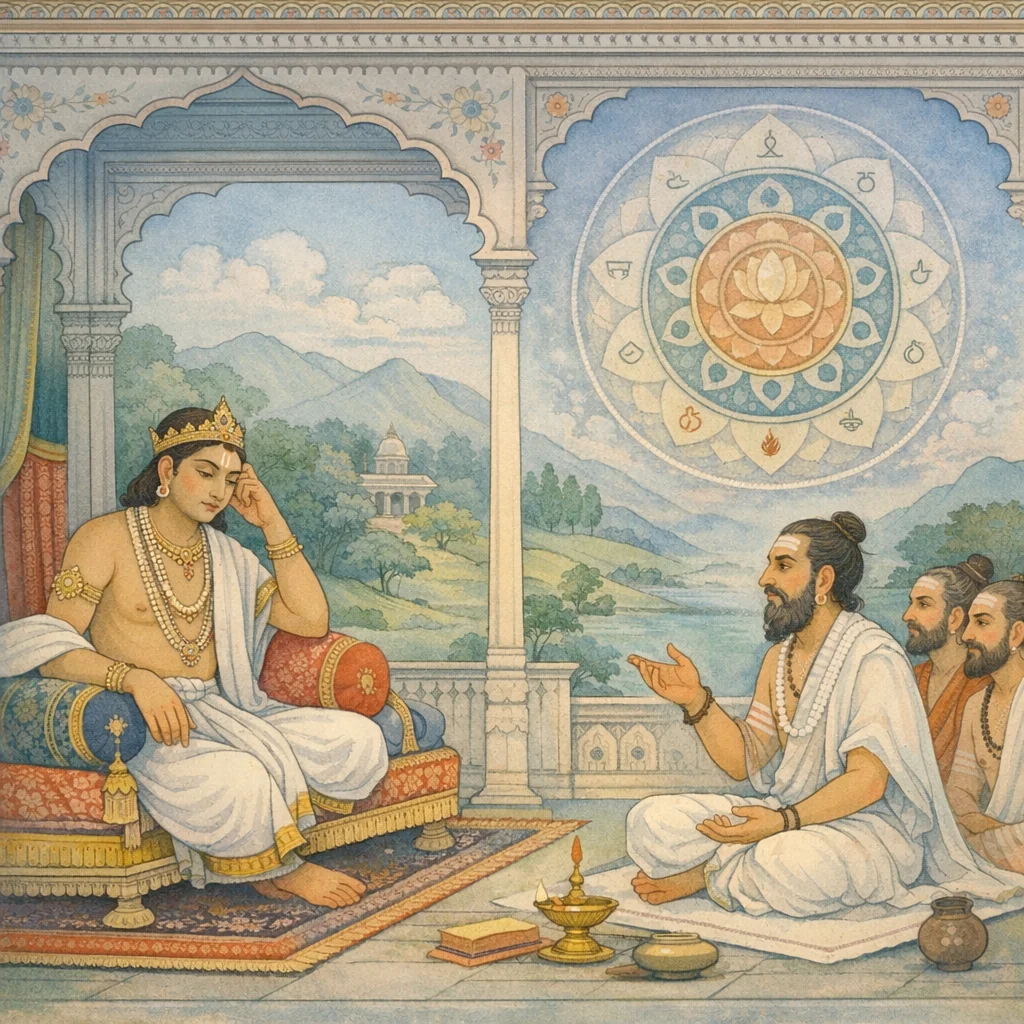
Chapter Arc: जनक के समक्ष याज्ञवल्क्य अव्यक्त (प्रकृति) की ‘काल-संख्या’ का द्वार खोलते हैं—सृष्टि का दिन-रात्रि भी माप में बँधा है, और वही माप जीव की भटकन का भी। → अव्यक्त से महत्तत्त्व, अहंकार, मन और पंचमहाभूतों के विषय-विशेष (शब्द, स्पर्श, रूप, रस, गन्ध) तक क्रमशः विस्तार होता है; फिर ब्रह्मा (हिरण्याण्डसमुद्भव) की उत्पत्ति और देव-पितृ-लोकों की परतें जुड़ती हैं। इसी के साथ यह तनाव उभरता है कि इन्द्रियाँ ‘देखती’ हैं, पर मन व्याकुल हो तो देखती हुई भी नहीं देख पाती—ज्ञान का आधार बाहर नहीं, भीतर है। → मन की प्रधानता का निर्णायक प्रतिपादन: ‘मन व्याकुल हो तो चक्षु पश्यन्नपि न पश्यति’—इन्द्रियों की समस्त क्रियाएँ मन के अधीन हैं; विषयों का आकर्षण जीव को तिर्यग्योनियों और संसार-चक्र में घुमाता है, और यह चक्र भी ‘दिन-रात्रि’ की गणना में बाँधा गया है। → याज्ञवल्क्य सृष्टि-तत्त्वों की रचना-श्रृंखला और काल-मान को एक सूत्र में बाँधते हैं: अव्यक्त से व्यक्त तक जो क्रम है, वही बन्धन का कारण भी बनता है जब मन विषयासक्त हो; और वही क्रम विवेक से समझा जाए तो वैराग्य का आधार बनता है।
Shlokas
Verse 1
ऑपन- मा छा अप ऋाल एकादशाधिकत्रिशततमो< ध्याय: अव्यक्त, महत्तत्त्व, अहंकार, मन और विषयोंकी कालसंख्याका एवं सृष्टिका वर्णन तथा इन्द्रियोंमें मनकी प्रधानताका प्रतिपादन याज़्ञवल्क्य उवाच अव्यक्तस्य नरश्रेष्ठ कालसंख्यां निबोध मे । पञ्चकल्पसहस्राणि द्विगुणान्यहरुच्यते
Yājñavalkya said: “O best of men, learn from me the measure of time that pertains to the Unmanifest. Five thousand kalpas are spoken of; and a ‘day’ is said to be twice that amount.”
Verse 2
याज्ञवल्क्थजी कहते हैं--नरश्रेष्ठी अब तुम मुझसे अव्यक्तकी काल-संख्या सुनो। दस हजार कल्पोंका (महायुगोंका) इस अव्यक्तका एक दिन बताया जाता है ।। रात्रिरेतावती चास्य प्रतिबुद्धो नराधिप । सृजत्योषधिमेवाग्रे जीवनं सर्वदेहिनाम्,नरेश्वर! उसकी रात्रि भी उतनी ही बड़ी होती है। ज्ञानस्वरूप परब्रह्म परमात्मा पहले समस्त प्राणियोंके जीवन-निर्वाहके लिये ओषधि (नाना प्रकारके अन्न) की सृष्टि करते हैं
Yājñavalkya said: “O best of men, now hear from me the reckoning of time belonging to the Unmanifest. Ten thousand kalpas (great ages) are declared to constitute a single day of that Unmanifest. Its night is of the same measure, O king. When that cosmic cycle awakens, the Supreme Self—Brahman, whose nature is pure knowledge—first brings forth ‘herbs’, that is, the various foods, for the sustenance of the life of all embodied beings.”
Verse 3
ततो ब्रह्माणमसृजद्धिरण्याण्डसमुद््भवम् । सा मूर्ति: सर्वभूतानामित्येवमनुशुश्रुम,हमने सुना है कि परमात्माने ओषधियोंकी सृष्टिके बाद ब्रह्माजीकी सृष्टि की थी, जो सुवर्णमय अण्डके भीतरसे प्रकट हुए थे। वे ही सम्पूर्ण भूतोंके उद्गमस्थान हैं
Then the Supreme brought forth Brahmā, who arose from the golden cosmic egg (Hiraṇyāṇḍa). Thus have we heard: that form—Brahmā—became the source and originating ground of all beings, marking the ordered unfolding of creation after the emergence of life-sustaining herbs.
Verse 4
संवत्सरमुषित्वाण्डे निष्क्रम्य च महामुनि: । संदधे स महीं कृत्स्नां दिवमूर्थ्व प्रजापति:,वे महामुनि प्रजापति ब्रह्मा उस सुवर्णमय अण्डके भीतर एक वर्षतक निवास करके उससे बाहर निकल आये। फिर उन्होंने सम्पूर्ण पृथ्वी, आकाश और ऊर्ध्वलोक (स्वर्ग) की सृष्टिके लिये विचार आरम्भ किया
Yājñavalkya said: After dwelling for a full year within the golden cosmic egg, the great sage Prajāpati (Brahmā) emerged. Then he set his mind to bringing forth the whole earth, the sky, and the higher realms—initiating the ordered creation of the worlds.
Verse 5
द्यावापृथिव्योरित्येष राजन् वेदेषु पठ्यते । तयो: शकलयोर्मध्यमाकाशमकरोत् प्रभु:,राजन! शक्तिशाली ब्रह्माजीने उस अण्डके दोनों टुकड़ोंके एवं स्वर्ग तथा भूतलके मध्यभागमें आकाशकी सृष्टि की। यह बात वेदोंमें कही गयी है
Yājñavalkya said: “O King, the Vedas recite the formula ‘Dyāvā–Pṛthivī’ (Heaven and Earth). From the space between those two halves, the Lord fashioned the mid-region—ākāśa, the expanse between heaven and earth. Thus the tradition teaches that the ordered cosmos arises through divine power and measured separation, not through chaos.”
Verse 6
एतस्यापि च संख्यानं वेदवेदाड्भगपारगै: | दशकल्पसहस्राणि पादोनान्यहरुच्यते,वेदों और वेदांगोंके पारंगत विद्वान् ब्रह्माजीकी भी कालसंख्याका विचार करते हुए कहते हैं कि दस हजार कल्पोंमेंसे एक चौथाई कम कर देनेपर जितना शेष रहता है, उतना ही ब्रह्माजीके एक दिनका मान है अर्थात् साढ़े सात हजार कल्पोंका उनका एक दिन होता है
Yājñavalkya said: Even of this cosmic measure the calculation is stated by those who have mastered the Vedas and the Vedāṅgas. They declare that Brahmā’s “day” consists of ten thousand kalpas diminished by one quarter—thus 7,500 kalpas. The teaching places human time within a vast moral cosmos (dharma), urging humility and perspective about life, duty, and the long arc of order.
Verse 7
रात्रिमेतावतीं चास्य प्राहुरध्यात्मचिन्तका: । सृजत्यहड्कारमृषिर्भूतं दिव्यात्मकं तथा,अध्यात्मतत्त्वोंका चिन्तन करनेवाले विद्वानोंका कथन है कि ब्रह्माजीकी रात्रि भी इतनी ही बड़ी है। महान् ऋषि ब्रह्मा अहंकार नामक दिव्य भूतकी सृष्टि करते हैं
Yājñavalkya said: “Those who contemplate the truths of the Self declare that Brahmā’s night is of the same vast measure as his day. In that cosmic cycle, the great seer Brahmā brings forth the principle called ‘I-maker’ (ahaṅkāra), a subtle, divine entity—setting in motion the inner sense of individuality from which further creation proceeds.”
Verse 8
चतुरश्नापरान् पुत्रान् देहात् पूर्व महानृषि: । ते वै पितृणां पितर: श्रूयन्ते राजसत्तम,नृपश्रेष्ठट महान् ऋषि ब्रह्माने पूर्वकालमें भौतिक देहकी उत्पत्तिसे पहले चार अन्य पुत्रोंको उत्पन्न किया (जिनके नाम ये हैं--बुद्धि, अहंकार, मन और चित्त)। वे चारों पुत्र 'पितरोंके भी पितर' अर्थात् पज्चमहाभूतोंके भी जनक सुने जाते हैं
Yājñavalkya said: “That great seer, even before the arising of a physical body, brought forth four other sons. O best of kings, those four are heard of as the ‘fathers of the Pitṛs’—the primordial progenitors standing behind the later line of cosmic generation.”
Verse 9
देवा: पितृणां च सुता देवैलोका: समावृता: । चराचरा नरश्रेष्ठ इत्येवमनुशुश्रुम
Yājñavalkya said: “We have heard it thus, O best of men: the gods too are the offspring of the Pitṛs, and the divine worlds are encompassed within them; indeed, all that moves and all that is unmoving is included in this order.”
Verse 10
नरश्रेष्ठ) देवता (श्रोत्र आदि इन्द्रियाँ) पितरों (पञ्चमहाभूतों) के पुत्र हैं अर्थात् सारी इन्द्रियाँ पजच-महाभूतोंसे ही उत्पन्न हुई हैं और वे समस्त चराचर जगत्का आश्रय लेकर स्थित हैं, ऐसा हमने सुना है ।। परमेष्ठी त्वहड्कार: सृजन् भूतानि पठ्चधा । पृथिवी वायुराकाशमापो ज्योतिश्न॒ पञजचमम्,स्रष्टाके उत्तम पदपर प्रतिष्ठित हुआ अहंकार आकाश, वायु, तेज, जल और पृथ्वी-- इन पाँच प्रकारके भूतोंकी सृष्टि करता है
Yājñavalkya said: “O best of men, the ‘deities’—that is, the faculties such as hearing and the rest—are called the offspring of the Pitṛs, namely the five great elements. In other words, all the senses arise from the five elements, and they abide by taking support in the entire moving and unmoving universe—so we have heard. Moreover, the cosmic principle called Ahaṅkāra, established in the highest station of the Creator, brings forth the elements in fivefold form: earth, wind, space, water, and as the fifth, light (fire).”
Verse 11
एतस्यापि निशामाहुस्तृतीयमिह कुर्वतः । पञठ्चकल्पसहस््राणि तावदेवाहरुच्यते,इस तृतीय भौतिक सर्गकी सृष्टि करनेवाले अहंकारकी रात्रि पाँच हजार कल्पोंकी होती है। उसका दिन भी उतना ही बड़ा बताया जाता है
Yājñavalkya said: “Of this (cosmic principle) too, they speak of a ‘night’—belonging to the third stage here, as it carries on its work. That night is said to last five thousand kalpas, and its day is declared to be of the same measure.”
Verse 12
शब्द: स्पर्शक्षु रूपं च रसो गन्धस्तथैव च । एते विशेषा राजेन्द्र महाभूतेषु पडचसु
Yājñavalkya said: “Sound, touch, form, taste, and smell—these indeed are the distinguishing qualities, O king, that are found in the five great elements.”
Verse 13
राजेन्द्र! आकाश आदि पाँच महाभूतोंमें क्रमश: शब्द, स्पर्श, रूप, रस और गन्ध--ये विशेष गुण हैं ।। यैराविष्टानि भूतानि अहन्यहनि पार्थिव । अन्योन्यं स्पृहयन्त्येते अन्योन्यस्य हिते रता:,पृथ्वीनाथ! प्रवाहरूपसे सदा विद्यमान रहनेवाले इन मनोहर शब्द आदि विषयोंसे आविष्ट होकर सभी प्राणी प्रतिदिन कभी एक-दूसरेको चाहते हैं, कभी पारस्परिक हितसाधनमें तत्पर रहते हैं, कभी एक-दूसरेको नीचा दिखानेकी चेष्टा करते हैं, कभी आपसमें ईर्ष्या रखते हैं और कभी परस्पर प्रहार भी कर बैठते हैं
Yājñavalkya said: “O king! In the five great elements beginning with space, the distinctive qualities arise in order—sound, touch, form, taste, and smell. Ensnared by these, creatures day after day, O ruler of the earth, long for one another and also engage in one another’s welfare. Yet, O lord of the land, captivated by these delightful sense-objects—ever-present as a continuous stream—beings each day sometimes desire one another, sometimes strive for mutual benefit, sometimes try to belittle one another, sometimes burn with jealousy, and sometimes even strike one another.”
Verse 14
अन्योन्यमतिवर्तन्ते अन्योन्यस्पर्थिनस्तथा । ते वध्यमाना हान्योन्यं गुणै्हारिभिरव्ययै:,पृथ्वीनाथ! प्रवाहरूपसे सदा विद्यमान रहनेवाले इन मनोहर शब्द आदि विषयोंसे आविष्ट होकर सभी प्राणी प्रतिदिन कभी एक-दूसरेको चाहते हैं, कभी पारस्परिक हितसाधनमें तत्पर रहते हैं, कभी एक-दूसरेको नीचा दिखानेकी चेष्टा करते हैं, कभी आपसमें ईर्ष्या रखते हैं और कभी परस्पर प्रहार भी कर बैठते हैं
Yājñavalkya said: “O lord of the earth, beings continually overstep one another and remain in mutual rivalry. Though they are being struck down (by the consequences of such conduct), they still assail one another—drawn on by alluring and seemingly inexhaustible ‘qualities’ (the attractions of sense-objects).”
Verse 15
इहैव परिवर्तन्ते तिर्यग्योनिप्रवेशिन: । त्रीणि कल्पसहस्राणि एतेषामहरुच्यते
Those who have entered into animal wombs keep revolving here itself, again and again. For such beings, it is said that a single ‘day’ amounts to three thousand kalpas—an image meant to convey the vast, oppressive duration of their bondage and the grave ethical cost of falling into subhuman states of existence.
Verse 16
मनश्ष्रति राजेन्द्र चारितं सर्वमिन्द्रिये:,राजेन्द्र! मन इन्द्रियोंद्वारा संचालित होकर सब विषयोंकी ओर जाता है। इन्द्रियाँ उन विषयोंको नहीं देखतीं, मन ही उन्हें निरन्तर देखता है। आँख मनके सहयोगसे ही रूपका दर्शन करती है, अपनी शक्तिसे नहीं
Yājñavalkya said: “O king, the entire course of experience is governed by the mind in relation to the senses. The mind, working through the senses, moves toward all objects of perception. The senses themselves do not truly ‘see’ those objects; it is the mind alone that continually apprehends them. Even the eye perceives form only with the mind’s cooperation, not by its own independent power.”
Verse 17
न चेन्द्रियाणि पश्यन्ति मन एवानुपश्यति । चक्षु: पश्यति रूपाणि मनसा तु न चक्षुषा,राजेन्द्र! मन इन्द्रियोंद्वारा संचालित होकर सब विषयोंकी ओर जाता है। इन्द्रियाँ उन विषयोंको नहीं देखतीं, मन ही उन्हें निरन्तर देखता है। आँख मनके सहयोगसे ही रूपका दर्शन करती है, अपनी शक्तिसे नहीं
Yājñavalkya said: “The sense-organs do not truly perceive; it is the mind alone that follows and apprehends. The eye sees forms only with the mind’s participation, not by its own independent power, O king. Thus, the mind—moving through the instruments of the senses—turns toward objects, and it is the mind that continually ‘sees’ and cognizes them. The ethical implication is that mastery of conduct begins with mastery of the mind, for perception and attachment arise there rather than in the organs themselves.”
Verse 18
मनसि व्याकुले चक्षु: पश्यन्नपि न पश्यति | तथेन्द्रियाणि सर्वाणि पश्यन्तीत्यभिचक्षते,जिस समय मन व्यग्र रहता है, उस समय आँख देखती हुई भी नहीं देख पाती। लोग भ्रमवश ही ऐसा कहते हैं कि सम्पूर्ण इन्द्रियाँ विषयोंको प्रत्यक्ष करती हैं
Yājñavalkya said: “When the mind is agitated, the eye, though looking, does not truly see. So too people err in saying that all the senses directly perceive their objects; without a steady mind, sensory ‘perception’ is only an appearance.”
Verse 19
न चेन्द्रियाणि पश्यन्ति मन एवात्र पश्यति । मनस्युपरते राजन्निन्द्रियोपरमो भवेत्,किंतु इन्द्रियाँ कुछ नहीं देखतीं, केवल मन ही देखता है। राजन! मन विषयोंसे उपरत हो जाय तो इन्द्रियाँ भी विषयोंसे निवृत्त हो जाती हैं
Yājñavalkya said: “The senses do not truly ‘see’; it is the mind alone that sees here. O King, when the mind withdraws from sense-objects, the senses too are restrained and cease their outward rush.”
Verse 20
न चेन्द्रियव्युपरमे मनस्युपरमो भवेत् | एवं मन:प्रधानानि इन्द्रियाणि प्रभावयेत्,परंतु इन्द्रियोंके उपरत होनेपर मनमें उपरति नहीं आती। इस प्रकार यह निश्चय करना चाहिये कि सम्पूर्ण इन्द्रियोंमें मन ही प्रधान है
Yājñavalkya said: “Even when the senses cease their activity, the mind does not necessarily become quiet. Therefore one should understand that among all faculties the mind is foremost: it governs and impels the senses. Ethical restraint is not achieved merely by shutting down sense-activity, but by mastering the mind that stands behind them.”
Verse 21
इन्द्रियाणां तु सर्वेषामी श्वर॑ मन उच्यते । एतदू विशन्ति भूतानि सर्वाणीह महायश:,मनको सम्पूर्ण इन्द्रियोंका स्वामी कहा जाता है। महायशस्वी नरेश! जगत्के समस्त प्राणी इस मनका ही आश्रय लेते हैं
Yājñavalkya said: “Of all the senses, the mind is declared to be their sovereign. O illustrious king, in this world all beings depend upon—and are guided by—this mind.”
Verse 156
रात्रिरेतावती चैव मनसश्ष नराधिप । ऐसे विषयासक्त प्राणी तिर्यग्योनियोंमें प्रवेश करके इसी संसारमें चक्कर काटते रहते हैं। इन शब्दादि विषयोंका एक दिन तीन हजार कल्पोंका बताया जाता है। नरेश्वर! इनकी रात भी इतनी ही बड़ी है। मनके भी दिन-रातका परिमाण इतना ही है
Yājñavalkya said: “O king, the night is of this very measure for the mind as well. Thus a being, attached to sense-objects, enters animal wombs and keeps revolving within this world. For the domains of sound and the other sense-objects, a single ‘day’ is declared to span three thousand kalpas; O lord of men, their ‘night’ is equally vast. The mind’s own day and night are to be understood as of the same measure.”
Verse 310
इस प्रकार श्रीमह्या भारत शान्तिपर्वके अन्तर्गत मोक्षधर्मपर्वमें याज्ञवल्क्य-जनक- संवादविषयक तीन सौ दसवाँ अध्याय पूरा हुआ
Thus ends the three hundred and tenth chapter of the Mokṣadharma section within the Śānti Parva of the great Mahābhārata, concerning the dialogue between Yājñavalkya and King Janaka. This closing colophon marks the completion of a teaching episode on liberation-oriented dharma and reflective kingship.
Verse 311
इति श्रीमहाभारते शान्तिपर्वणि मोक्षधर्मपर्वणि याज्ञवल्क्यजनकसंवादे एकादशाधिकत्रिशततमो<ध्याय:
Thus ends, in the revered Mahābhārata, within the Śānti Parvan—specifically the Mokṣadharma section—the dialogue between Yājñavalkya and King Janaka: the three-hundred-and-eleventh chapter. This closing colophon marks the completion of a unit of teaching framed as a philosophical exchange on liberation and right understanding.
Frequently Asked Questions
The episode stages an ascetic dilemma: how a sage committed to ritual and discipline responds to sudden sensory provocation, emphasizing attempted restraint and continuity of purpose rather than narrative sensationalism.
Liberation ethics is framed as a life-trajectory grounded in restraint, learning, and initiation: spiritual authority is shown as emerging from disciplined practice and knowledge, not merely from birth or status.
No explicit phalaśruti is stated here; the meta-function is etiological and pedagogical—establishing Śuka’s extraordinary origin and credentials to support the authority of mokṣa-oriented instruction in the surrounding discourse.