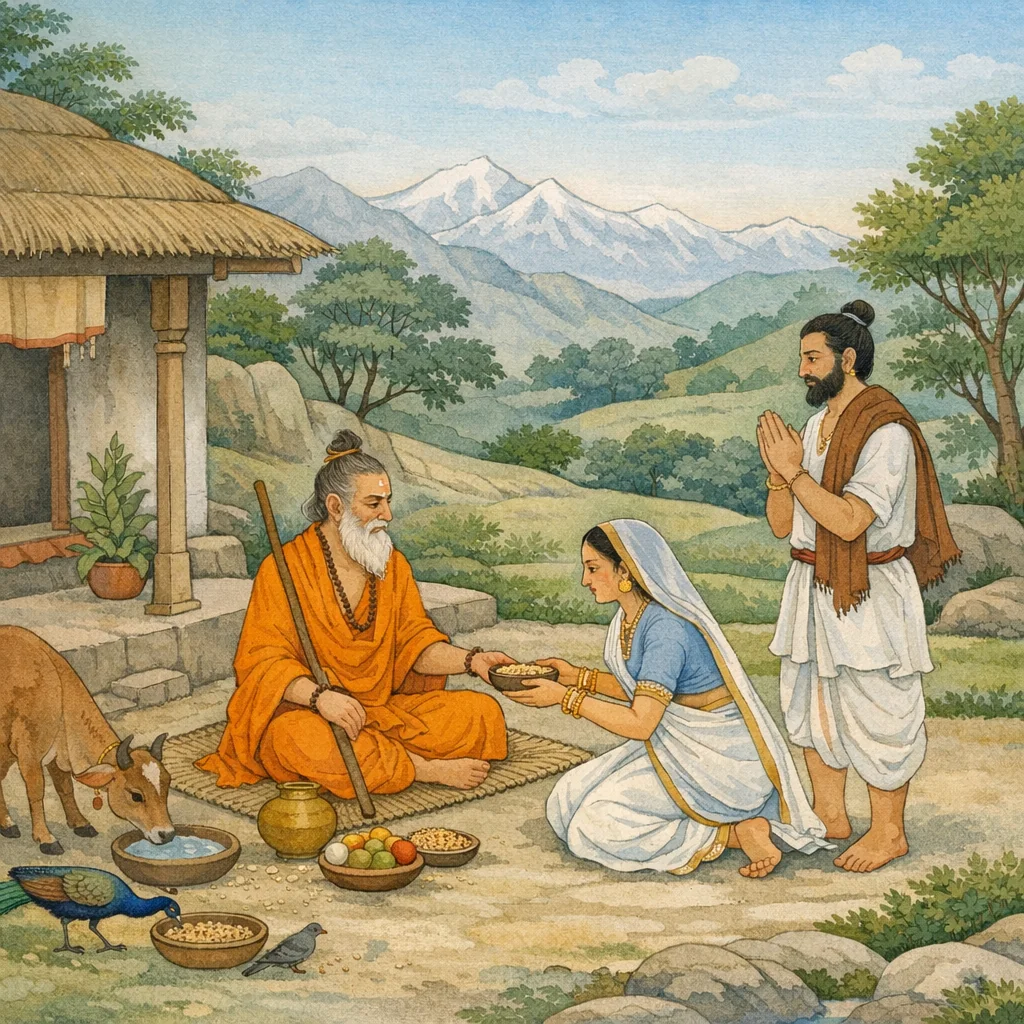
Adhyaya 243
कामबन्धन-निवृत्ति तथा शान्तिलक्षण-उपदेशः | Release from Desire-Bondage and the Marks of Peace
Upa-parva: Mokṣa-dharma (Liberation Teachings) — Desire, Restraint, and the Marks of Peace (Chapter 243)
Vyāsa outlines a graded ethical psychology of liberation. He begins by rejecting the pursuit of sensory indulgence, luxury, ornamentation, and social acclaim as incompatible with the vocation of the discerning brāhmaṇa (1). He then distinguishes formal attainments—Vedic study, ritual competence, encyclopedic knowledge, sacrificial performances with gifts—from the realized condition of brahmanhood, insisting these alone do not secure it (2–4). The decisive criteria are fearlessness and non-intimidation, absence of craving and hatred, and the cessation of harmful intent toward any being in action, speech, or mind (5–6). Desire (kāma) is identified as the singular binding force; freedom from it enables brahma-bhāva (7–8). Metaphors illustrate stability amid inflow (like the ocean) and the clearing of obscuration (like the moon freed from smoky clouds), portraying the steady person who is not driven by desire (8–9). A didactic chain links Veda to truth, truth to self-control, self-control to giving, giving to austerity, austerity to renunciation, renunciation to happiness, happiness to heaven, and heaven to tranquility (10–11), suggesting that inner peace is the culminating refinement. The chapter defines śānti through contentment and lists marks of the integrated person—sorrowlessness, non-possessiveness, calm, clarity, and self-knowledge—associated with sattva and wise counsel (12–14). It affirms an unmanufactured inner happiness (adhyātma) accessed by disciplined intelligence and by making the mind ‘without outgoing movement’ (15–16). Further, it describes the paradox of satisfaction without consumption and strength without attachment (17), recommends guarding the ‘doors’ (senses) and contemplative inwardness (18), and depicts the desire-depleted sage as luminous and untouched by decay and death (19–21). The culmination is complete release and equanimity, transcending sense-objects while embodied, reaching the supreme cause beyond return (22–23).
Chapter Arc: Vyasa begins by turning Shuka’s inquiry toward the “second portion of life”: the householder’s path, and asks what kind of living makes a home a sanctuary of dharma rather than a net of desire. → Four modes of household livelihood are laid out—kusāla-dhānya, kumbha-dhānya, unchha-shila, and the “kapoti” (pigeon-like) subsistence—each progressively stricter, raising the question of how far restraint can go while still sustaining family, guests, and ritual obligations. → The teaching peaks in the ethic of distribution: the householder must share—honoring learned guests (atithi), sustaining beings, and giving even to those who cook for him—so that the home becomes a living altar where havya and kavya are offered with purity and humility. → Vyasa affirms that such disciplined household conduct purifies ancestors, strengthens the realm where such people dwell, and establishes the householder in a firm spiritual standing; the grihastha-ashrama is praised as divinely ordained and a gateway to heaven for the self-restrained. → The discourse points beyond: after the householder’s stage comes the “third and more exalted” ashrama—forest-dwelling/renunciation—inviting the listener onward to the next ascent of life and liberation.
Shlokas
Verse 1
अपन का छा | अत-४#-#कत त्रिचत्वारिशर्दाधिकद्विशततमो< ध्याय: ब्राह्मणोंके उपलक्षणसे गार्हस्थ्य-धर्मका वर्णन व्यास उवाच द्वितीयमायुषो भागं गृहमेधी गृहे वसेत् । धर्मलब्धैर्युतो दारैरग्नीनाहृत्य सुब्रत:,व्यासजी कहते हैं--बेटा! गृहस्थ पुरुष अपनी आयुके दूसरे भागतक गृहस्थधर्मका पालन करते हुए घरपर ही रहे। धर्मानुसार स्त्रीसे विवाह करके उसके साथ अग्नि-स्थापना करनेके पश्चात् नित्य अग्निहोत्र आदि करे और उत्तम व्रतका पालन करता रहे
Vyāsa said: “My son, in the second stage of life a householder should dwell at home, living the discipline of the household dharma. Having obtained a wife through righteous means, he should establish the sacred fires and, firm in good vows, regularly perform duties such as the daily fire-offering (agnihotra), thus sustaining dharma through ordered domestic life.”
Verse 2
गृहस्थवृत्तयश्वैव चतस्र: कविशि: स्मृता: । कुसूलधान्य: प्रथम: कुम्भधान्यस्त्वनन्तरम्
Vyāsa said: The sages have remembered four distinct modes of livelihood for a householder. Of these, the first is the “granary-stored” householder, and next comes the “jar-stored” householder.
Verse 3
अश्वस्तनो5थ कापोतीम॒श्रितोवृत्तिमाहरेत् । तेषां पर: परो ज्यायान् धर्मतो धर्मजित्तम:
Then one should adopt the pigeon-like livelihood—a harmless, non-violent way of subsistence. Among these modes of life, each succeeding one is held superior; and best is he who, by righteousness, is most victorious in righteousness.
Verse 4
गृहस्थ ब्राह्मणके लिये विद्वानोंने चार प्रकारकी आजीविका बतायी है--कोठेभर अनाजका संग्रह करके रखना, यह पहली जीविकावृत्ति है। कुंडेभर अन्नका संग्रह करना, यह दूसरी वृत्ति है तथा उतने ही अन्नका संग्रह करना जो दूसरे दिनके लिये शेष न रहे, यह तीसरी वृत्ति है। अथवा “कापोतीवृत्ति” (उज्छवृत्ति) का आश्रय लेकर जीवन-निर्वाह करे, यह चौथी वृत्ति है। इन चारोंमें पहलीकी अपेक्षा दूसरी-दूसरी वृत्ति श्रेष्ठ है। अन्तिम वृत्तिका आश्रय लेनेवाला धर्मकी दृष्टिसे सर्वश्रेष्ठ है और वही सबसे बढ़कर धर्मविजयी है ।। षट््कर्मा वर्तयत्येकस्त्रिभिरन्य: प्रवर्तते । द्वाभ्यामेकश्नतुर्थस्तु ब्रह्मसत्रे व्यवस्थित:,पहली श्रेणीके अनुसार जीविका चलानेवाले ब्राह्मणको यजन-याजन, अध्ययन- अध्यापन तथा दान और प्रतिग्रह--ये छ: कर्म करने चाहिये। दूसरी श्रेणीवालेको अध्ययन, यजन और दान--इन तीन कर्मोमें ही प्रवृत्त होना चाहिये। तीसरी श्रेणीवालेको अध्ययन और दान-ये दो ही कर्म करने चाहिये तथा चौथी श्रेणीवालेको केवल ब्रह्मयज्ञ (वेदाध्ययन) करना उचित है
Vyāsa said: Among householding brāhmaṇas, the learned describe four modes of livelihood, graded by increasing purity and restraint: (1) maintaining a full store of grain, (2) keeping a smaller reserve, (3) living with only what leaves nothing over for the next day, and (4) sustaining oneself by the ‘pigeon-like’ gleaning mode (uñchavṛtti), taking only what is freely available without accumulation. In this hierarchy, each successive mode is ethically superior to the previous; the one who lives by the final mode is regarded as foremost in dharma and the most victorious in righteousness. Correspondingly, one brāhmaṇa may engage in all six traditional duties; another confines himself to three; another to two; while the fourth remains established in the ‘brahma-sacrifice’—the disciplined offering of oneself through Vedic study.
Verse 5
गृहमेधिव्रतान्यत्र महान्तीह प्रचक्षते । नात्मार्थे पाचयेदन्नं न वृथा घातयेत् पशून्,गृहस्थोंके लिये शास्त्रोंमें बहुत-से श्रेष्ठ नियम बताये गये हैं। वह केवल अपने ही भोजनके लिये रसोई न बनावे (अपितु देवता, पितर और अतिथियोंके उद्देश्यसे ही बनावे) और पशुहिंसा न करे, क्योंकि यह अनर्थमूलक है
Vyāsa said: “Here, the scriptures proclaim many great observances for the householder. One should not cook food merely for one’s own sake; and one should not kill animals without purpose, for such violence is rooted in futility and leads to harm.”
Verse 6
प्राणी वा यदि वाप्राणी संस्कारं यजुषाहति । न दिवा प्रस्वपेज्जातु न पूर्वापररात्रिषु,यज्ञमें यजमान एवं हविष्य आदि सबका यजुर्वेदके मन्त्रसे संस्कार होना चाहिये। गृहस्थ पुरुष दिनमें कभी न सोये। रातके पहले और पिछले भागमें भी नींद न ले
Vyāsa said: Whether the offering is living or non-living, it should be duly consecrated with Yajurvedic mantras. A householder should never sleep during the day, nor should he indulge in sleep in the early or the latter part of the night—thus maintaining the disciplined vigilance expected of one engaged in sacrifice and righteous household life.
Verse 7
न भुज्जीतान्तरा काले नानृतावाद्नयेत् स्त्रियम् नास्यानश्रन् गृहे विप्रो वसेत् कश्चिदपूजित:,सबेरे और शाम दो ही समय भोजन करे, बीचमें न खाय। ऋतुकालके सिवा अन्य समयमें स्त्रीको अपनी शय्यापर न बुलावे। उसके घरपर आया हुआ कोई ब्राह्मण अतिथि आदर-सत्कार और भोजन पाये बिना न रह जाय
Let him eat only at two times—morning and evening—and not between. Except in the ritu season (ṛtu), let him not summon his wife to his bed. And in his house, let no brāhmaṇa who comes as a guest remain without honor, hospitality, and food.
Verse 8
तथास्यातिथय: पूज्या हव्यकव्यवहा: सदा । वेदविद्याव्रतस्नाता: श्रोत्रिया वेदपारगा:,यदि द्वारपर अतिथिके रूपमें वेदके पारंगत विद्वान, स्नातक, श्रोत्रिय, हव्य (यज्ञान्न) और कव्य (श्राद्धान्र) भोजन करनेवाले, जितेन्द्रिय, क्रियानिष्ठ, स्वधर्मसे ही जीवन-निर्वाह करनेवाले और तपस्वी ब्राह्मण आ जायाँ तो सदा उनकी विधिवत् पूजा करके उन्हें हव्य और कव्य समर्पित करने चाहिये। उनके सत्कारके लिये यह सब करनेका विधान है
Vyāsa said: Therefore, guests are always to be honored—especially those fit to receive havya (sacrificial offerings) and kavya (ancestral śrāddha offerings): Brahmins learned in the Veda, disciplined by vows, purified by the completion of study (snātaka), recognized as śrotriyas, and who have mastered the Vedas. When such a learned, self-controlled, duty-abiding ascetic arrives at one’s door as a guest, one should worship him respectfully according to rule and offer him what is due in havya and kavya. This is enjoined as the proper way of receiving guests and sustaining dharma through hospitality.
Verse 9
स्वधर्मजीविनो दान्ता: क्रियावन्तस्तपस्विन: । तेषां हव्यं च कव्यं चाप्यर्हणार्थ विधीयते,यदि द्वारपर अतिथिके रूपमें वेदके पारंगत विद्वान, स्नातक, श्रोत्रिय, हव्य (यज्ञान्न) और कव्य (श्राद्धान्र) भोजन करनेवाले, जितेन्द्रिय, क्रियानिष्ठ, स्वधर्मसे ही जीवन-निर्वाह करनेवाले और तपस्वी ब्राह्मण आ जायाँ तो सदा उनकी विधिवत् पूजा करके उन्हें हव्य और कव्य समर्पित करने चाहिये। उनके सत्कारके लिये यह सब करनेका विधान है
Vyāsa said: Those Brahmins who sustain themselves by their own rightful duties, who are self-controlled, devoted to prescribed rites, and austere—for them the offering of havya (sacrificial food) and kavya (ancestral śrāddha offering) is enjoined as an act of due honor. In ethical terms, when such learned and disciplined guests arrive, one should receive them with proper reverence and provide what is ritually appropriate, because honoring the worthy upholds dharma and sustains the sacred order of giving.
Verse 10
नखरै: सम्प्रयातस्य स्वधर्मज्ञापकस्य च । अपविद्धानग्निहोत्रस्य गुरो्वालीककारिण:
Vyāsa said: “(Consider the case) of one who has departed from the right path through the agency of his own ‘claws’—one who nevertheless points out what is one’s duty—yet who has cast aside the sacred agnihotra, and who, in relation to his teacher, acts with deceit and falsehood.”
Verse 11
संविभागोअत्र भूतानां सर्वेषामेव शिष्यते । तथैवापचमाने भ्य: प्रदेयं गृहमेधिना
Vyāsa said: “Here, the principle is taught that all living beings are to be given their due share. Likewise, a householder who maintains the sacred household fire should give food to those who are cooking and laboring as well—ensuring that none who contribute to the household’s sustenance are left without their portion.”
Verse 12
जो धार्मिकताका ढोंग दिखानेके लिये अपने नख और बाल बढ़ाकर आया हो, अपने ही मुखसे अपने किये हुए धर्मका विज्ञापन करता हो, अकारण अन्निहोत्रका त्याग कर चुका हो अथवा गुरुके साथ कपट करनेवाला हो, ऐसा मनुष्य भी गृहस्थके घरमें अन्न पानेका अधिकारी है। वहाँ सभी प्राणियोंके लिये अन्न-वितरणकी विधि है। जो अपने हाथसे भोजन नहीं बनाते, ऐसे लोगों (ब्रह्मचारियों और संन्यासियों) के लिये गृहस्थ पुरुषको सदा ही अन्न देना चाहिये ।। विघसाशी भवेन्नित्यं नित्यं चामृतभोजन: । अमृतं यज्ञशेषं स्थाद् भोजनं हविषा समम्,गृहस्थको सदा विघस और अमृत अन्नका भोजन करना चाहिये। यज्ञसे बचा हुआ भोजन हविष्यके समान और अमृत माना गया है
Vyāsa said: Even one who comes with nails and hair grown long merely to feign righteousness; one who advertises his own “dharma” with his own mouth; one who has abandoned the agnihotra without cause; or one who deals deceitfully with his teacher—even such a person is still entitled to food in a householder’s home. For there is a rule there for the distribution of food to all beings. And for those who do not cook with their own hands (such as brahmacārins and saṃnyāsins), the householder should always give food. The householder should regularly eat vighasa, what remains after feeding others, and should habitually eat what is called “amṛta”. For the food left over from sacrifice is regarded as amṛta, and eating it is held to be on a par with consuming havis, the sacrificial oblation.
Verse 13
भृत्यशेषं तु यो5श्नाति तमाहुर्विघसाशिनम् | विघसं भृत्यशेषं तु यज्ञशेषमथामृतम्,कुट॒म्बमें भरण-पोषणके योग्य जितने लोग हैं, उनको भोजन करानेके बाद बचे हुए अन्नको जो भोजन करता है, उसे विघसाशी (विघस अन्न भोजन करनेवाला) बताया गया है। पोष्यवर्गसे बचे हुए अन्नको विघस तथा पंचमहायज्ञ एवं बलिवैश्वदेवसे बचे हुए अन्नको अमृत कहते हैं
Vyāsa said: One who eats what remains after feeding those who are to be supported—dependents and members of the household—is called a vighasāśin, an eater of vighasa. The remainder left after feeding dependents is termed vighasa; but the remainder left after the sacrificial duties—such as the pañca-mahāyajñas and the bali-vaiśvadeva offerings—is called amṛta, “nectar”.
Verse 14
स्वदारनिरतो दान्तो हानसूयुर्जितिन्द्रिय: । ऋष्विक् पुरोहिताचार्यमातुलातिथिसंश्रितै:,गृहस्थ पुरुष सदा अपनी ही स्त्रीसे प्रेम करे। इन्द्रियोंका संयम करके जितेन्द्रिय बने। किसीके गुणोंमें दोष न ढूँढ़े। वह ऋत्विज, पुरोहित, आचार्य, मामा, अतिथि, शरणागत, वृद्ध, बालक, रोगी, वैद्य, जाति-भाई, सम्बन्धी, बन्धु-बान्धव, माता-पिता, कुटु॒म्बकी स्त्री, भाई, पुत्र, पत्नी, पुत्री तथा सेवक-समूहके साथ कभी विवाद न करे। जो इन सबके साथ कलह त्याग देता है, वह सब पापोंसे मुक्त हो जाता है
Vyāsa said: A householder should be devoted to his own wife, self-restrained, free from malice and fault-finding, and a conqueror of the senses. He should not enter into quarrels with those to whom reverence or care is due—such as the officiating priests (ṛtvij), the family priest (purohita), the teacher (ācārya), the maternal uncle, guests, those who seek refuge, the aged, children, the sick, physicians, members of one’s own community, relatives and allies, one’s mother and father, the women of the household, brothers, sons, wife, daughters, and one’s servants. One who abandons contention with all these becomes freed from sins.
Verse 15
वृद्धबालातुरैर्वेद्यैज्ञातिसम्बन्धिबान्धवै: । मातापितृभ्यां जामीकभ्ि भ्रात्रा पुत्रेण भार्यया,गृहस्थ पुरुष सदा अपनी ही स्त्रीसे प्रेम करे। इन्द्रियोंका संयम करके जितेन्द्रिय बने। किसीके गुणोंमें दोष न ढूँढ़े। वह ऋत्विज, पुरोहित, आचार्य, मामा, अतिथि, शरणागत, वृद्ध, बालक, रोगी, वैद्य, जाति-भाई, सम्बन्धी, बन्धु-बान्धव, माता-पिता, कुटु॒म्बकी स्त्री, भाई, पुत्र, पत्नी, पुत्री तथा सेवक-समूहके साथ कभी विवाद न करे। जो इन सबके साथ कलह त्याग देता है, वह सब पापोंसे मुक्त हो जाता है
Vyāsa said: A householder should always cherish affection for his own wife, restrain his senses, and avoid searching for faults in others’ virtues. He should never enter into disputes with priests and officiants, teachers, maternal uncles, guests, those seeking refuge, the aged, children, the sick, physicians, kinsmen of one’s community, relatives, friends and allies, one’s mother and father, the women of one’s household, brothers, sons, wife, daughters, and one’s servants. One who abandons quarrelling with all these becomes freed from every sin.
Verse 16
दुहित्रा दासवर्गेण विवादं न समाचरेत् । एतान् विमुच्य संवादान् सर्वपापैर्विमुच्यते,गृहस्थ पुरुष सदा अपनी ही स्त्रीसे प्रेम करे। इन्द्रियोंका संयम करके जितेन्द्रिय बने। किसीके गुणोंमें दोष न ढूँढ़े। वह ऋत्विज, पुरोहित, आचार्य, मामा, अतिथि, शरणागत, वृद्ध, बालक, रोगी, वैद्य, जाति-भाई, सम्बन्धी, बन्धु-बान्धव, माता-पिता, कुटु॒म्बकी स्त्री, भाई, पुत्र, पत्नी, पुत्री तथा सेवक-समूहके साथ कभी विवाद न करे। जो इन सबके साथ कलह त्याग देता है, वह सब पापोंसे मुक्त हो जाता है
Vyāsa said: One should not engage in quarrels with one’s daughter or with the household’s servants. By giving up such contentious exchanges, a householder frees himself from all sins.
Verse 17
एतैर्जितस्तु जयति सर्वाल्लॉकान् न संशय: । आचार्यो ब्रद्मलोकेश: प्राजापत्ये पिता प्रभु:,इनसे हार मानकर रहनेवाला मनुष्य सम्पूर्ण लोकोंपर विजय पाता है, इसमें संशय नहीं है। आचार्य ब्रह्मलोकका स्वामी है, पिता प्रजापतिलोकका ईश्वर है, अतिथि इन्द्रलोकके और ऋत्विज देवलोकके स्वामी हैं। कुटुम्बकी स्त्रियाँ अप्सराओंके लोककी स्वामिनी हैं और जाति-भाई विश्वेदेव लोकके अधिकारी हैं
Vyāsa said: “One who has been ‘conquered’ by these (that is, who yields to and honors these revered persons) truly conquers all worlds—of this there is no doubt. The teacher is lord in the world of Brahmā, and the father is sovereign in the world of Prajāpati.”
Verse 18
अतिथि स्त्विन्द्रलोकस्य देवलोकस्य चर्त्विज: । जामयो>प्सरसां लोके वैश्वदेवे तु ज्ञातय:,इनसे हार मानकर रहनेवाला मनुष्य सम्पूर्ण लोकोंपर विजय पाता है, इसमें संशय नहीं है। आचार्य ब्रह्मलोकका स्वामी है, पिता प्रजापतिलोकका ईश्वर है, अतिथि इन्द्रलोकके और ऋत्विज देवलोकके स्वामी हैं। कुटुम्बकी स्त्रियाँ अप्सराओंके लोककी स्वामिनी हैं और जाति-भाई विश्वेदेव लोकके अधिकारी हैं
Vyāsa said: “The guest is to be regarded as the lord of Indra’s world; the officiating priest as the lord of the gods’ world. The women of the household are to be regarded as the mistresses of the Apsarases’ realm, and one’s kinsmen are entitled to the world of the Viśvedevas.”
Verse 19
सम्बन्धिबान्धवा दिक्षु पृथिव्यां मातृमातुलौ । वृद्धबालातुरकृशास्त्वाकाशे प्रभविष्णव:,सम्बन्धी और बन्धु-बान्धव दिशाओंपर, माता और मामा पृथ्वीपर तथा वृद्ध, बालक और निर्बल रोगी आकाशपर अपना प्रभुत्व रखते हैं। इन सबको संतुष्ट रखनेसे उन-उन लोकोंकी प्राप्ति होती है
Kinsmen and relatives hold sway in the directions; one’s mother and maternal uncle upon the earth; and the aged, the young, and the sickly weak in the sky. By keeping all of them satisfied, one attains those respective worlds.
Verse 20
भ्राता ज्येष्ठ: सम: पित्रा भार्या पुत्र: स्वका तनु: । छाया सवा दासवर्गश्व दुहिता कृपणं परम्,बड़ा भाई पिताके समान है। पत्नी और पुत्र अपने ही शरीर हैं तथा सेवकगण अपनी छायाके समान हैं। बेटी तो और भी अधिक दयनीय है
Vyāsa said: “An elder brother is to be regarded as equal to one’s father. A wife and a son are as one’s own body. Servants are like one’s shadow, ever following. But a daughter is the most vulnerable—most deserving of compassion and protection.”
Verse 21
तस्मादेतैरधिक्षिप्त: सहेन्नित्यमसंज्वर: । गृहधर्मपरो विद्वान् धर्मशीलो जितक्लम:,अतः इनके द्वारा कभी अपना तिरस्कार भी हो जाय तो सदा क्रोधरहित रहकर सहन कर लेना चाहिये। गृहस्थधर्मका पालन करनेवाले विद्वान् पुरुषको निश्चिन्त होकर क्लेश और थकावटको जीतकर धर्मका निरन्तर पालन करते रहना चाहिये
Therefore, even if one is insulted or disparaged by such people, one should always endure it without agitation or anger. A wise person devoted to the duties of the householder should remain steadfast in righteous conduct, conquering fatigue and distress, and continue the practice of dharma without interruption.
Verse 22
न चार्थबद्धः कर्माणि धर्मवान् कश्चिदाचरेत् । गृहस्थवृत्तयस्तिस्रस्तासां नि:श्रेयसं परम्,किसी भी धर्मात्मा पुरुषको धनके लोभसे धर्मकर्मोंका अनुष्ठान नहीं करना चाहिये। गृहस्थ ब्राह्मणके लिये जो तीन आजीविकाकी वृत्तियाँ बतायी गयी हैं, उनमें उत्तरोत्तर श्रेष्ठ एवं कल्याणकारिणी हैं
Vyāsa said: “No righteous person should perform acts of dharma with the motive bound to wealth. For a householder, three modes of livelihood are taught; among them, each succeeding one is superior, leading more surely to the highest good.”
Verse 23
परं परं तथैवाहुश्नातुराश्रम्यमेव तत् । यथोक्ता नियमास्तेषां सर्व कार्य बुभूषता,इसी प्रकार चारों आश्रम भी उत्तरोत्तर श्रेष्ठ कहे गये हैं। उन आश्रमोंके जो शास्त्रोक्त नियम हैं, उन सबका अपनी उन्नति चाहनेवाले पुरुषको पालन करना चाहिये
Vyāsa said: “Thus they declare the four āśramas to be progressively superior, each succeeding stage higher than the former. Therefore, one who seeks the fulfillment of all aims and duties should observe, as taught in the scriptures, the disciplines prescribed for those stages of life.”
Verse 24
कुम्भधान्यैरुञ्छशिलै: कापोतीं चास्थितास्तथा । यस्मिंश्वैते वसन्त्यहस्तिद् राष्ट्रमभिवर्धते,कुंडेभर अनाजका संग्रह करके अथवा उज्छशिल (अनाजके एक-एक दाने बीनने अथवा उस अनाजकी बाली बीनने) के द्वारा अन्नका संग्रह करके “कापोती-वृत्ति” का आश्रय लेनेवाले पूजनीय ब्राह्मण जिस देशमें निवास करते हैं, उस राष्ट्रकी वृद्धि होती है
Vyāsa said: “In whatever land there dwell venerable brāhmaṇas who sustain themselves by storing grain in small measures, by gleaning (collecting scattered grains or ears after harvest), and by adopting the ‘pigeon-like’ mode of living, that kingdom—free from oppression—steadily prospers. The presence of such self-restrained, non-burdensome ascetics becomes a moral wealth that nourishes the realm.”
Verse 25
पूर्वान् दश दश परान् पुनाति च पितामहान् | गृहस्थवृत्तीक्षाप्येता वर्तयेद् यो गतव्यथ:,जो मनमें तनिक भी क्लेशका अनुभव न करके गृहस्थकी इन वृत्तियोंके सहारे जीवन निभाता है, वह अपनी दस पीढ़ीके पूर्वजोंको तथा दस पीढ़ीतक आगे होनेवाली संतानोंको पवित्र कर देता है
Vyāsa said: “One who, free from inner distress, sustains life by rightly practicing these duties and means of livelihood of the householder purifies ten generations of ancestors and also ten generations of descendants yet to come.”
Verse 26
स चक्रधरलोकानां सदृशीमाप्रुयाद् गतिम् । जितेन्द्रियाणामथवा गतिरेषा विधीयते,उसे चक्रधारी श्रीविष्णुके लोकके सदृश उत्तम लोकोंकी प्राप्ति होती है अथवा वह जितेन्द्रिय पुरुषको मिलनेवाली श्रेष्ठ गति प्राप्त कर लेता है
Vyāsa said: “He attains a state of passage and final destination comparable to the worlds of the Disc-bearer (Viṣṇu). Or else, this is ordained as the very highest goal granted to those who have conquered their senses.”
Verse 27
स्वर्गलोको गृहस्थानामुदारमनसां हित: । स्वर्गो विमानसंयुक्तो वेददृष्ट: सुपुष्पित:,उदारचित्तवाले गृहस्थोंकों हितकारक स्वर्गलोक प्राप्त होता है। उनके लिये विमानसहित सुन्दर फूलोंसे सुशोभित परम रमणीय स्वर्ग सुलभ होता है, जिसका वेदोंमें वर्णन है
Vyāsa said: “For householders of noble and generous mind, the heavenly world is a true good. That heaven—described in the Vedas—is attainable for them: adorned with blossoms and furnished with celestial chariots, supremely delightful to behold.”
Verse 28
स्वर्गलोको गृहस्थानां प्रतिष्ठा नियतात्मनाम् । ब्रहद्मणा विहिता योनिरेषा यस्माद् विधीयते । द्वितीयं क्रमश: प्राप्य स्वर्गलोके महीयते,मन और इन्द्रियोंको संयममें रखनेवाले गृहस्थोंके लिये स्वर्गलोकको ही प्रतिष्ठाका स्थान नियत किया है। ब्रह्माजीने गा्हस्थ्य-आश्रमको स्वर्गकी प्राप्तिका कारण बनाया है; इसीलिये इसके पालनका विधान किया गया है। इस प्रकार क्रमश: द्वितीय आश्रम गार्हस्थ्यको पाकर मनुष्य स्वर्गलोकमें प्रतिष्ठित होता है
Vyāsa said: For householders who keep the mind disciplined, heaven is appointed as their firm standing and support. This mode of life—the householder’s estate—was ordained by Brahmā as a generative source and a cause leading to heaven; therefore its observance is enjoined. Thus, by duly attaining the second āśrama in proper order, a person is honored and established in the heavenly world.
Verse 29
अत: परं परममुदारमाश्रमं तृतीयमाहुस्त्यजतां कलेवरम् । वनौकसां गृहपतिनामनुत्तमं शृणुष्व संश्लिष्टशरीरकारिणाम्,इस गृहस्थाश्रमके पश्चात् तीसरा उससे भी श्रेष्ठ परम उदार वानप्रस्थ-आश्रम है; जो शरीरको सुखाकर अस्थिचर्मावशिष्ट कर देनेवाले तथा वनमें रहकर तपस्यापूर्वक शरीरको त्यागनेवाले वानप्रस्थियोंका आश्रय है। यह गृहस्थोंसे श्रेष्ठठटम माना गया है, अब इसके धर्म बताता हूँ, सुनो
After the householder’s stage comes the third āśrama, the supremely noble and exalted one, called the vānaprastha. It is the refuge of those who, dwelling in the forest, discipline and dry down the body and ultimately relinquish it through austerity. Hear now of this unsurpassed way of life—held higher than the householder’s—for those who undertake such embodied discipline.
Verse 243
इति श्रीमहाभारते शान्तिपर्वणि मोक्षधर्मपर्वणि शुकानुप्रश्ने त्रिचत्वारिंशदधिकद्विशततमो< ध्याय:,इस प्रकार श्रीमहाभारत शान्तिपर्वके अन्तर्गत मोक्षधर्मपर्वमें शुकदेवका अनुप्रश्नविषयक दो सौ तैतालीसवाँ अध्याय पूरा हुआ
Thus, in the Śrī Mahābhārata, within the Śānti Parva and specifically the Mokṣa-dharma section, the two-hundred-and-forty-third chapter—concerning Śuka’s follow-up inquiry—comes to an end. (This is the colophon marking the completion of the chapter.)
Frequently Asked Questions
Inner realization expressed as fearlessness, non-hatred, and desirelessness—together with non-malefic intention toward all beings—rather than merely Vedic recitation, ritual success, or social recognition.
Bondage is primarily kāma (desire-driven compulsion); liberation is the steady cessation of craving and aversion through self-control, guarded senses, and a mind stabilized inwardly.
Yes: it presents a chain of inner disciplines—truth → self-control → giving → austerity → renunciation—leading toward happiness, tranquility (śama), and the non-returning attainment of the supreme principle.