Adhyaya 203
Yoga, Nārāyaṇa as Supreme Principle, and the Emanation of Categories (Sāṅkhya-Yoga Outline)
Upa-parva: Mokṣa-dharma (Liberation Teachings) — Guru–Śiṣya Itihāsa on Yoga and Cosmology
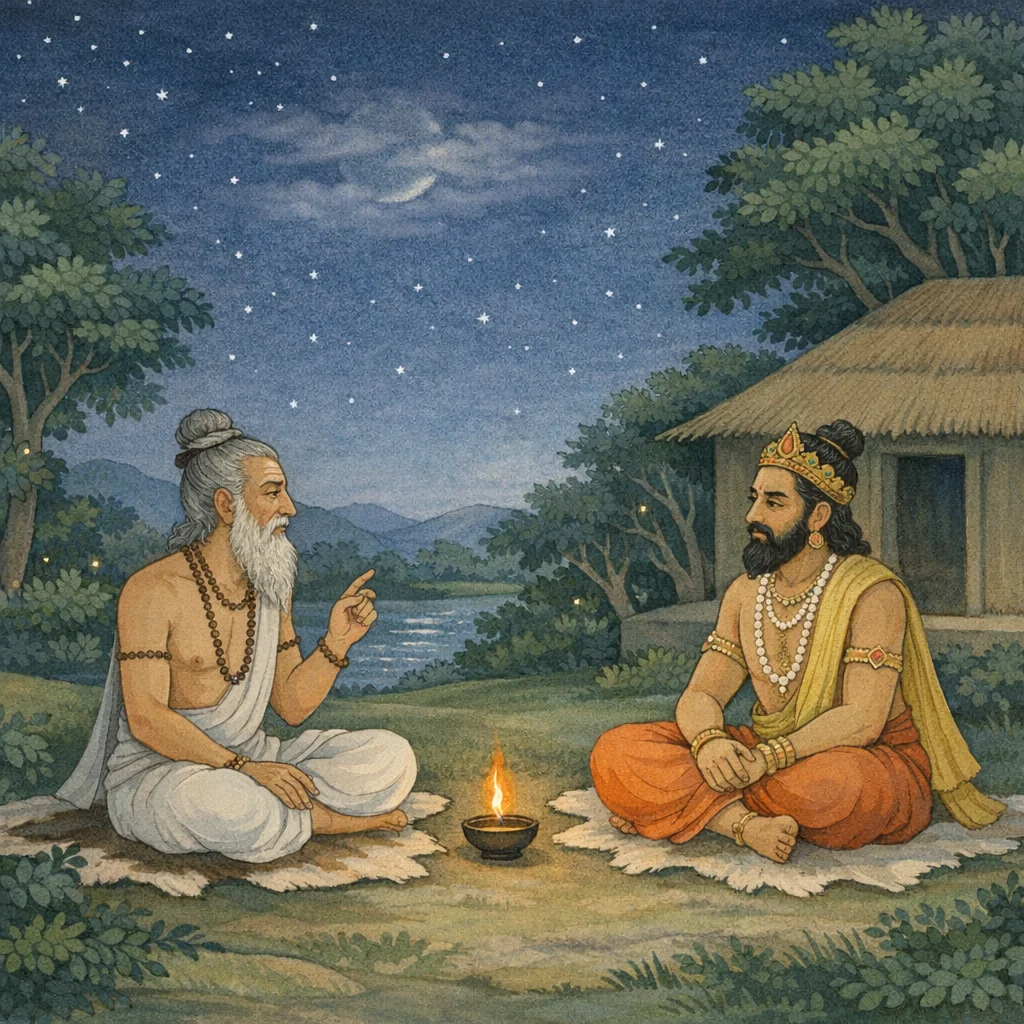
Yudhiṣṭhira requests Bhīṣma to explain the highest yoga leading to mokṣa. Bhīṣma replies by citing an ancient teacher–student dialogue. The student, after reverential approach, asks foundational questions: the origin of self and other, how differences of conduct arise among beings regarded as equal, and how Vedic and worldly statements are to be understood in truth. The teacher presents a doctrinal frame in which Vāsudeva/Nārāyaṇa is identified with the imperishable, unmanifest Brahman and with cyclical time governing the three worlds. Knowledge and social order are described as re-emerging across yugas, with sages articulating diverse śāstras. A sāṅkhya-like causal sequence is outlined: from avyaktam arise buddhi and ahaṃkāra, then the elements (ākāśa, vāyu, tejas, ap, pṛthivī), with senses, mind, and objects specified; deities are associated with the sixteen categories. The puruṣa is described as pervasive, subtle, and the knower within embodied life (the “nine-gated city”), discernible through yoga, while karma is presented as the force that conditions embodiment and transition from body to body.
Chapter Arc: मनु आत्मा के नित्यत्व का प्रतिपादन आरम्भ करते हैं—शरीर, इन्द्रिय, मन और बुद्धि से परे एक ‘परम शरीरी’ है जो सब अनुभवों का साक्षी है। → शंका उठती है: यदि आत्मा नित्य है तो जन्म-वृद्धि-क्षय और चेतना का आना-जाना क्यों दिखता है? मनु इन्द्रियों के विषय-ग्रहण, गुणों (सत्त्व-रजस्-तमस्) के परिवर्तन, और देह-आश्रित अनुभवों को उदाहरणों से अलगाते हैं। → चन्द्रमा-दृष्टान्त निर्णायक बनता है—अमावस्या में चन्द्रमा ‘दिखता नहीं’, पर नष्ट नहीं होता; वैसे ही देह-आवरण/अविद्या से आत्मा अप्रकट लगती है, पर उसका नाश नहीं। → मनु निष्कर्ष देते हैं कि प्रत्यक्ष जन्म-वृद्धि-क्षय देह/उपाधि की वृत्ति है, आत्मा की नहीं; देह-निर्मुक्त होने पर जीव कर्म-फलों से संयुक्त होता है और उपयुक्त लोक/अवस्था में पुनः प्रकाशित होता है। → अगले अध्यायों की ओर संकेत: यदि आत्मा नित्य है तो कर्म-फल का बन्धन कैसे चलता है और उससे मुक्ति का उपाय क्या है—यह प्रश्न आगे विस्तार माँगता है।
Shlokas
Verse 1
अपन का छा | अफ्-४#-रू- जा तर्याधिकद्विशततमो< ध्याय: शरीर, इन्द्रिय और मन-बुद्धिसे अतिरिक्त आत्माकी नित्य सत्ताका प्रतिपादन मनुर॒ुवाच यदिन्द्रियैस्तूपहितं पुरस्तात् प्राप्तान् गुणात् संस्मरते चिराय । तेष्विन्द्रियेष्पहतेषु पश्चात् स बुद्धिरूप: परम: स्वभाव:,मनुजी कहते हैं--बृहस्पते! बुद्धिके साथ तद्गूप हुआ जो जीव नामक चेतनतत्त्व है, वह इन्द्रियोंद्वारा दीर्घकालतक पहलेके भोगे हुए विषयोंका कालान्तरमें स्मरण करता है। यद्यपि उस समय उन विषयोंका इन्द्रियोंसे सम्बन्ध नहीं है, उनका सम्बन्ध-विच्छेद हो गया है तो भी वे बुद्धिमें संस्काररूपसे अंकित हैं; इसलिये उनका स्मरण होता है। (इससे बुद्धिके अतिरिक्त उसके प्रकाशक चेतनकी सत्ता स्वतः सिद्ध हो जाती है)
Manu said: “That conscious principle which was formerly associated with the senses later recalls—after a long time—the objects and qualities it once experienced. Even when the senses have ceased their contact with those objects, the recollection still arises, because the impressions remain inscribed in the intellect. Thus, beyond body and senses, a higher, enduring self is implied as the illuminator of cognition.”
Verse 2
यथेन्द्रियार्थान् युगपत् समस्ता- न्नोपेक्षते कृत्सममतुल्यकालम् । तथाचलं संचरते स दिद्दां- स्तस्मात् स एक: परम: शरीरी,वह एक समय अथवा अनेक समयोंमें भूत और भविष्यके सम्पूर्ण पदार्थोकी, जो इस जन्ममें या दूसरे जन्मोंमें देखे गये हैं, सामान्य रूपसे उपेक्षा नहीं करता अर्थात् उन्हें प्रकाशित ही करता है तथा परस्पर विलग न होनेवाली तीनों अवस्थाओंमें विचरता रहता है; अतः वह सबको जाननेवाला साक्षी सर्वोत्कृष्ट देहका स्वामी आत्मा एक है
Bhishma said: “Just as (the inner witness) does not disregard the entire range of sense-objects—whether all at once or throughout immeasurable time—so too, remaining unmoving, it yet ‘moves about’ as the seer. Therefore that supreme embodied Self is one: the all-knowing witness, the highest lord of the body, who illuminates all experiences across the three inseparable states of consciousness.”
Verse 3
रजस्तम: सत्त्वमथो तृतीयं गच्छत्यसौ स्थानगुणान् विरूपान् | तथेन्द्रियाण्याविशते शरीरी हुताशनं वायुरिवेन्धनस्थम्,बुद्धिके जो स्थान-जागरित आदि अवस्थाएँ हैं, वे सभी सत्त्व, रज और तम--इन तीन गुणोंसे विभक्त हैं। इन अवस्थाओंसे सम्बन्धित जो सुख-दुःख आदि गुण हैं, वे परस्पर विलक्षण हैं। उन सबको वह आत्मा बुद्धिके सम्बन्धसे अनुभव करता है। इन्द्रियोंमें भी उस जीवात्माका आवेश उसी प्रकार होता है जैसे काठमें लगी हुई आगमें वायुका अर्थात् वायु जैसे अग्निमें प्रविष्ट होकर अग्निको उद्दीप्त कर देती है, इसी प्रकार आत्मा इन्द्रियोंको चेतना प्रदान करता है
Bhishma said: “The embodied Self passes through the three guṇas—rajas, tamas, and the third, sattva—entering their diverse modes and conditions, each marked by distinct qualities. In the same way, the indwelling being enters the senses: as wind enters fire lodged in fuel and makes it blaze, so the Self, by its presence, awakens the senses and enables the experience of pleasure, pain, and the other differing states that arise in those modes.”
Verse 4
न चक्षुषा पश्यति रूपमात्मनो न पश्यति स्पर्शनमिन्द्रियेन्द्रियम् । न श्रोत्रलिड्रं श्रवणेन दर्शन तथा कृतं पश्यति तद् विनश्यति,मनुष्य नेत्रोंद्वारा आत्माके रूपका दर्शन नहीं कर सकता। त्वचा नामक इन्द्रिय उसका स्पर्श नहीं कर सकती; क्योंकि वह इन्द्रियोंकी भी इन्द्रिय अर्थात् उनका प्रकाशक है। उस आत्माके स्वरूपका श्रवणेन्द्रियके द्वारा श्रवण नहीं हो सकता; क्योंकि वह शब्दरहित है। ज्ञानविषयक विचारसे जब आत्माका साक्षात्कार किया जाता है, तब उसके साधनोंका बाध हो जाता है
Bhīṣma said: The Self’s form is not seen by the eye; nor can the skin, an organ of touch, touch it—for the Self is the inner power that illumines the senses themselves. Nor can the ear apprehend it by hearing, since that Self is beyond sound. When the Self is realized through discriminative knowledge, the instruments of ordinary cognition fall away, for what is grasped by them is perishable.
Verse 5
श्रोत्रादीनि न पश्यन्ति स्वं स्वमात्मानमात्मना । सर्वज्ञ: सर्वदर्शी च सर्वज्ञस्तानि पश्यति,श्रोत्र आदि इन्द्रियाँ स्वयं अपने द्वारा आपको नहीं जान सकतीं। आत्मा सर्वज्ञ और सबका साक्षी है। सर्वज्ञ होनेके कारण ही वह उन सबको जानता है
Bhīṣma said: “The ear and the other sense-faculties do not perceive their own Self by their own power. But the Self—omniscient and the all-seeing witness—perceives and knows them all.”
Verse 6
यथा हिमवत: पार्श्व॑ पृष्ठ चन्द्रमसो यथा । न दृष्टपूर्व मनुजैर्न च तन्नास्ति तावता,जैसे मनुष्योंद्वारा हिमालय पर्वतका दूसरा पार्श्व तथा चन्द्रमाका पृष्ठ भाग देखा हुआ नहीं है तो भी इसके आधारपर यह नहीं कहा जा सकता कि उनके पार्श्व और पृष्ठ भागका अस्तित्व ही नहीं है। उसी प्रकार सम्पूर्ण भूतोंके भीतर रहनेवाला उनका अन्तर्यामी ज्ञानस्वरूप आत्मा अत्यन्त सूक्ष्म होनेके कारण कभी नेत्रोंद्वारा नहीं देखा गया है; अतः उतनेहीसे यह नहीं कहा जा सकता कि आत्मा है ही नहीं
Bhishma said: Just as people have not previously seen the far side of the Himalaya, nor the reverse side of the moon, yet one cannot on that account conclude that those sides do not exist—so too the indwelling Self, the inner ruler present within all beings, is of the nature of consciousness and exceedingly subtle; because it is not seen by the eyes, one should not therefore say that the Self does not exist.
Verse 7
तद्वद् भूतेषु भूतात्मा सूक्ष्मो ज्ञानात्मवानसौ । अदृष्टपूर्वश्चक्षुभ्भ्या न चासौ नास्ति तावता,जैसे मनुष्योंद्वारा हिमालय पर्वतका दूसरा पार्श्व तथा चन्द्रमाका पृष्ठ भाग देखा हुआ नहीं है तो भी इसके आधारपर यह नहीं कहा जा सकता कि उनके पार्श्व और पृष्ठ भागका अस्तित्व ही नहीं है। उसी प्रकार सम्पूर्ण भूतोंके भीतर रहनेवाला उनका अन्तर्यामी ज्ञानस्वरूप आत्मा अत्यन्त सूक्ष्म होनेके कारण कभी नेत्रोंद्वारा नहीं देखा गया है; अतः उतनेहीसे यह नहीं कहा जा सकता कि आत्मा है ही नहीं
Bhīṣma said: “In the same way, within all beings abides the inner Self of beings—subtle, constituted of knowledge. Though it has never been seen by the eyes, one must not conclude from that alone that the Self does not exist.”
Verse 8
पश्यन्नपि यथा लक्ष्म जगत् सोमे न विन्दति । एवमस्ति न चोत्पन्नं न च तन्न परायणम्,जैसे चन्द्रमामें जो कलंक है, वह जगतका अर्थात् तदगत पृथ्वीका ही चिह्न है; परंतु उसको देखकर भी मनुष्य ऐसा नहीं समझता कि वह जगत्का अर्थात् पृथ्वीका चिह्न है। इसी प्रकार सबको “मैं हूँ” इस रूपमें आत्माका ज्ञान है; परंतु यथार्थ ज्ञान नहीं है; इस कारण मनुष्य उसके परायण-आश्रित नहीं है
Bhishma said: “Just as a person, though seeing the mark on the Moon, does not recognize it as a sign belonging to the world (i.e., the earth), so too this sense of ‘I am’ is present in everyone, yet it is not true awakened knowledge. Therefore a person does not take refuge in it as the final ground.”
Verse 9
रूपवन्तमरूपत्वादुदयास्तमने बुधा: । धिया समनुपश्यन्ति तद्गता: सवितुर्गतिम्,रूपवान् पदार्थ अपनी उत्पत्तिसे पूर्व और नष्ट हो जानेके बाद रूपहीन ही रहते हैं, इस नियमसे जैसे बुद्धिमान लोग उनकी अरूपताका निश्चय करते हैं तथा सूर्यके उदय और अस्तके द्वारा विद्वान् पुरुष बुद्धिसे जिस प्रकार न दिखायी देनेवाली सूर्यकी गतिका अनुमान कर लेते हैं, उसी प्रकार विवेकी मनुष्य बुद्धिरूप दीपकके द्वारा इन्द्रियातीत ब्रह्मका साक्षात्कार कर लेते हैं और इस निकटवर्ती दृश्य-प्रपंचको उस ज्ञानस्वरूप परमात्मामें विलीन कर देना चाहते हैं
Bhishma said: Just as wise people, by reasoning, understand that things which possess form are in fact formless before their arising and after their passing away, and just as learned men infer—through the sun’s rising and setting—the otherwise unseen course of the sun, so too the discerning, using the lamp of intellect, realize the Brahman that lies beyond the senses and seek to dissolve this nearby, visible world-appearance into that Supreme Self which is of the nature of knowledge.
Verse 10
तथा बुद्धिप्रदीपेन दूरस्थं सुविपश्चित: । प्रत्यासन्नं निनीषन्ति ज्ञेयं ज्ञानाभिसंहितम्,रूपवान् पदार्थ अपनी उत्पत्तिसे पूर्व और नष्ट हो जानेके बाद रूपहीन ही रहते हैं, इस नियमसे जैसे बुद्धिमान लोग उनकी अरूपताका निश्चय करते हैं तथा सूर्यके उदय और अस्तके द्वारा विद्वान् पुरुष बुद्धिसे जिस प्रकार न दिखायी देनेवाली सूर्यकी गतिका अनुमान कर लेते हैं, उसी प्रकार विवेकी मनुष्य बुद्धिरूप दीपकके द्वारा इन्द्रियातीत ब्रह्मका साक्षात्कार कर लेते हैं और इस निकटवर्ती दृश्य-प्रपंचको उस ज्ञानस्वरूप परमात्मामें विलीन कर देना चाहते हैं
Bhishma said: In the same way, by the lamp of intellect the truly discerning bring what seems far away close at hand—namely, the knowable Reality that is grounded in knowledge. Thus, using insight as their light, they seek direct realization of the Brahman beyond the senses, and they wish to dissolve this near-at-hand, visible world of appearances into that Supreme Self whose very nature is knowledge.
Verse 11
न हि खल्वनुपायेन कश्रिदर्थोडभिसिद्धाति । सूत्रजालैर्यथा मत्स्यान् बध्नन्ति जलजीविन:,उचित उपाय किये बिना कोई भी प्रयोजन सिद्ध नहीं होता है, जैसे जलमें रहनेवाले प्राणियोंसे जीविका चलानेवाले सूतके जाल बनाकर उनके द्वारा मछलियोंको बाँध लेते हैं, जैसे मृगोंके द्वारा मृगोंको, पक्षियोंद्वारा पक्षियोंको और हाथियोंद्वारा हाथियोंको पकड़ा जाता है, उसी प्रकार ज्ञेय वस्तुका ज्ञानके द्वारा ग्रहण होता है
Bhishma said: No aim is ever accomplished without a proper means. Just as those who make their living from creatures of the water catch fish by casting nets of thread, so too every knowable thing is grasped only through the appropriate instrument—knowledge—applied in the right way.
Verse 12
मृगैर्मुगाणां ग्रहणं पक्षिणां पक्षिभियर्यथा । गजानां च गजैरेव ज्ञेयं ज्ञानेन गृहते,उचित उपाय किये बिना कोई भी प्रयोजन सिद्ध नहीं होता है, जैसे जलमें रहनेवाले प्राणियोंसे जीविका चलानेवाले सूतके जाल बनाकर उनके द्वारा मछलियोंको बाँध लेते हैं, जैसे मृगोंके द्वारा मृगोंको, पक्षियोंद्वारा पक्षियोंको और हाथियोंद्वारा हाथियोंको पकड़ा जाता है, उसी प्रकार ज्ञेय वस्तुका ज्ञानके द्वारा ग्रहण होता है
Bhīṣma said: “Just as deer are caught by deer, birds by birds, and elephants by elephants, so too what is to be known is grasped only through knowledge. No purpose is accomplished without employing a fitting means; the proper instrument alone secures the intended result.”
Verse 13
अहिरेव हाहे: पादान् पश्यतीति हि नः श्रुतम् तद्वन्मूर्तिषु मूर्तिस्थं ज्ञेयं ज्ञानेन पश्यति,हमने सुना है कि सर्पके पैरोंको सर्प ही पहचानता है, उसी प्रकार मनुष्य समस्त शरीरोंमें शरीरस्थ ज्ञेयस्वरूप आत्माको ज्ञानके द्वारा ही जान सकता है
Bhishma said: “We have heard that only a serpent can recognize the serpent’s feet. In the same way, within all embodied forms, the knowable Self that abides in the body is perceived only through true knowledge.”
Verse 14
नोत्सहन्ते यथा वेत्तुमिन्द्रियैरिन्द्रियाण्यपि । तथैवेह परा बुद्धि: परं बोध्यं न पश्यति,जैसे इन्द्रियाँ भी इन्द्रियोंद्वारा किसी ज्ञेयको नहीं जान सकतीं, उसी प्रकार यहाँ परा बुद्धि भी उस परम बोध्य तत्त्वको स्वयं नहीं देख पाती है; किंतु ज्ञाता पुरुष ही बुद्धिके द्वारा उसका साक्षात् करता है
Bhishma said: Just as the sense-organs cannot truly know the sense-organs by means of the senses themselves, so too in this world even the highest intellect cannot, by itself, behold the Supreme object of knowledge. Rather, it is the conscious knower—the person as witness—who, using the intellect as an instrument, realizes That directly.
Verse 15
यथा चन्द्रो ह्मावास्यामलिड्त्वान्न दृश्यते | न च नाशो<स्य भवति तथा विद्धि शरीरिणम्,जैस चन्द्रमा अमावास्याको प्रकाशहीन हो जानेके कारण दिखायी नहीं देता है; किंतु उस समय उसका नाश नहीं होता। उसी प्रकार शरीरधारी आत्माके विषयमें भी समझना चाहिये अर्थात् आत्मा अदृश्य होनेपर भी उसका अभाव नहीं है, ऐसा समझना चाहिये
Bhishma said: “Just as the moon on the new-moon night is not seen, as though its light were swallowed up, yet it is not destroyed—so too you should understand the embodied Self. Even when it becomes unseen, it does not cease to exist.”
Verse 16
क्षीणकोशो ह्ुमावास्यां चन्द्रमा न प्रकाशते । तद्वन्मूर्तिविमुक्तोड्सौ शरीरी नोपलभ्यते,जैसे चन्द्रमा अमावास्याको अपने प्रकाश्य स्थानसे वियुक्त हो जानेके कारण दिखायी नहीं देता है, उसी प्रकार देहधारी आत्मा शरीरसे वियुक्त होनेपर दृष्टिगोचर नहीं होता है
Bhishma said: Just as the moon, on the new-moon night, does not shine when its luminous sphere is diminished and its light is not manifest, so too the embodied Self, once separated from the body, is not available to ordinary perception. The teaching underscores that what we call a ‘person’ is not exhausted by what the senses can grasp; when the bodily basis is gone, the Self is not an object of sight, and therefore one should not mistake invisibility for non-existence.
Verse 17
यथा55काशान्तरं प्राप्य चन्द्रमा भ्राजते पुन: । तद्वल्लिड्डान्तरं प्राप्प शरीरी भ्राजते पुन:,फिर वही चन्द्रमा जैसे अन्यत्र आकाशमें स्थान पाकर पुनः प्रकाशित होने लगता है, उसी प्रकार जीवात्मा दूसरा शरीर धारण करके पुनः प्रकट हो जाता है
Bhīṣma says: Just as the moon, reaching another region of the sky, shines forth again, so too the embodied self—having taken up another body—manifests again. The image teaches continuity of the jīva across changing embodiments, grounding ethical responsibility beyond a single lifespan.
Verse 18
जन्म वृद्धि: क्षयश्चास्य प्रत्यक्षेणोपलभ्यते । सा तु चान्द्रमसी वृत्ति्न तु तस्य शरीरिण:,जन्म, वृद्धि और क्षयका जो प्रत्यक्ष दर्शन होता है, वह चन्द्रमण्डलमें प्रतीत होनेवाली वृत्ति चन्द्रमाकी नहीं है। उसी प्रकार शरीरका ही जन्म आदि होता है, उस शरीरधारी आत्माका नहीं
Bhīṣma said: “Birth, growth, and decay are indeed perceived directly in this world. Yet the waxing and waning seen in the lunar orb is not a change belonging to the moon itself. In the same way, what is observed as birth and the rest pertains to the body alone, not to the embodied Self.”
Verse 19
उत्पत्तिवृद्धिवयसा यथा स इति गृहाते । चन्द्र एव त्वमावास्यां तथा भवति मूर्तिमान्,जैसे किसी व्यक्तिका जन्म होता है, वह बढ़ता है और किशोर, यौवन आदि भिन्न-भिन्न अवस्थाओंमें पहुँच जाता है तो भी यही समझा जाता है कि यह वही व्यक्ति है तथा अमावास्याके बाद जब चन्द्रमा पुनः मूर्तिमान् होकर प्रकट होता है तो यही माना जाता है कि यह वही चन्द्रमा है (उसी प्रकार दूसरे शरीरमें प्रवेश करनेपर भी वह देहधारी आत्मा वही है--ऐसा समझना चाहिये)
Bhishma said: “Just as, through birth, growth, and the successive stages of age, one is still understood to be the very same person, so too the Moon—though it disappears at the new-moon night—when it becomes visible again is accepted as that very same Moon. In the same way, when the embodied self enters another body, it should be understood as the same continuing self.”
Verse 20
नोपसर्पद् विमुज्चद् वा शशिन दृश्यते तम: । विसृजंश्नोपसर्पश्च॒ तद्बधत् पश्य शरीरिणम्,जैसे अन्धकाररूप राहु चन्द्रमाकी ओर आता और उसे छोड़कर जाता हुआ नहीं दिखायी देता है, उसी प्रकार जीवात्मा भी शरीरमें आता और उसे छोड़कर जाता हुआ नहीं दीख पड़ता है ऐसा समझो
“Just as the darkness called Rāhu is not seen approaching the Moon or departing from it, so too the jīva is not seen entering the body or leaving it—understand it thus.”
Verse 21
यथा चन्द्रार्कसंयुक्ते तमस्तदुपलभ्यते । तद्वच्छरीरसंयुक्त: शरीरीत्युपलभ्यते
Bhīṣma said: “Just as darkness is perceived only when it stands in relation to the moon and the sun, so too the embodied self is recognized as an ‘embodied being’ only when conjoined with a body.”
Verse 22
जैसे सूर्यग्रहणकालमें चन्द्रमा सूर्यसे संयुक्त होनेपर सूर्यमें छायारूपी राहुका दर्शन होता है, उसी प्रकार शरीरसे संयुक्त होनेपर शरीरधारी आत्माकी उपलब्धि होती है ।। यथा चन्द्रार्कनिर्मुक्तः स राहुनोपलभ्यते । तद्धच्छरीरनिर्मुक्त: शरीरी नोपलभ्यते,जैसे चन्द्रमा-सूर्यससे अलग होनेपर सूर्यमें राहुकी उपलब्धि नहीं होती, उसी प्रकार शरीरसे विलग होनेपर शरीरधारी आत्माका दर्शन नहीं होता
Bhishma said: “Just as Rāhu’s shadow is perceived only when the Moon comes into conjunction with the Sun (as at an eclipse), so too the embodied Self is apprehended only in association with the body. When the Moon is separated from the Sun, Rāhu is not perceived there; likewise, when the Self is dissociated from the body, the embodied Self is not an object of perception.”
Verse 23
यथा चन्द्रो हामावास्यां नक्षत्रैर्युज्यते गत: । तद्वच्छरीरनिर्मुक्त: फलैर्युज्यति कर्मण:,जैसे अमावास्याका अतिक्रमण करनेपर चन्द्रमा नक्षत्रोंसे संयुक्त होता है, उसी प्रकार जीवात्मा एक शरीरका त्याग करनेपर कर्मोके फलस्वरूप दूसरे शरीरसे युक्त होता है
“Just as the Moon, having passed beyond the new-moon night, is joined again with the stars, so too the jīva, upon leaving one body, is joined to another body as the fruit of its karma.”
Verse 202
इस प्रकार श्रीमह्याभारत शान्तिपर्वके अन्तर्गत मोक्षधर्मपर्वमें मनु-ब॒हस्पति-संवादविषयक दो सौ दोवाँ अध्याय पूरा हुआ
Thus ends the two-hundred-and-second chapter of the Mokṣadharma section within the Śānti Parva of the Śrī Mahābhārata, dealing with the dialogue between Manu and Bṛhaspati. This closing colophon marks the completion of a teaching unit, framing the foregoing as guidance in liberation-oriented dharma rather than deeds of war.
Verse 203
इति श्रीमहाभारते शान्तिपर्वणि मोक्षधर्मपर्वणि मनुबृहस्पतिसंवादे त्यधिकद्वधिशततमो< ध्याय:,इस प्रकार श्रीमह्ााभारत शान्तिपर्वके अन्तर्गत मोक्षधर्मपर्वमें मनु और बृहस्पतिका संवादरूप दो सौ तीनवाँ अध्याय पूरा हुआ
Thus, in the Śrī Mahābhārata, within the Śānti Parvan, in the Mokṣa-dharma section, the dialogue between Manu and Bṛhaspati concludes here as the two-hundred-and-third chapter. This is the formal colophon ending a teaching unit: Bhīṣma’s instruction to Yudhiṣṭhira continues, presenting authoritative discourse on liberation-oriented dharma through the sages’ conversation.
Frequently Asked Questions
The student’s dilemma is epistemic and metaphysical: how to correctly understand origins (self/other), reconcile apparent equality of beings with divergent conduct and outcomes, and interpret Vedic and worldly claims without contradiction.
Liberation-oriented understanding requires disciplined yoga and discriminative knowledge: the puruṣa/ātman is the knower within the body and becomes directly appreciable through appropriate practice, not merely through sensory cognition.
No explicit phalaśruti is stated in the provided verses; the chapter’s meta-function is archival—embedding a systematic cosmology and a yoga epistemology as the interpretive basis for mokṣa within Bhīṣma’s instruction.