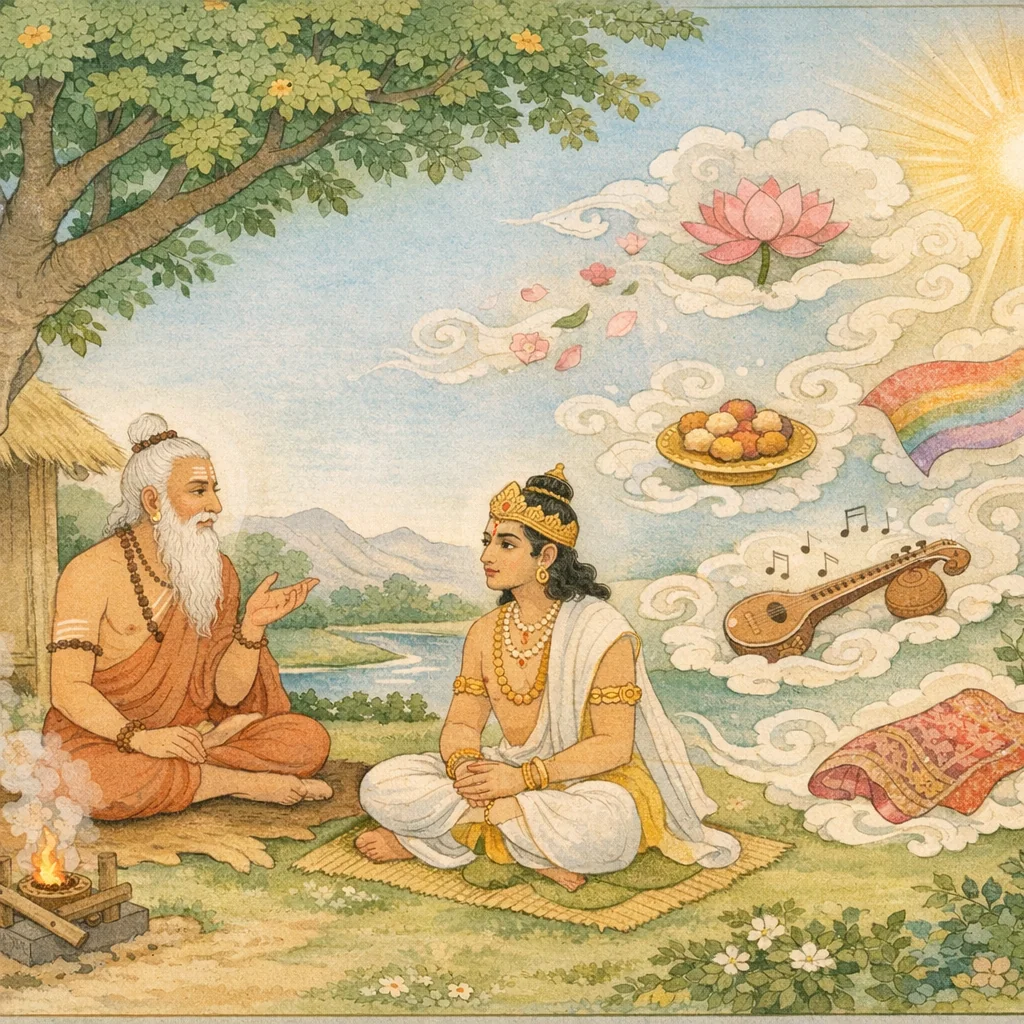
Adhyaya 202
Varāha-avatāra: Viṣṇu’s subterranean intervention and the cosmic nāda (Śānti-parva 202)
Upa-parva: Mokṣa-dharma (Liberation Discourse) — Varāha narrative unit
The chapter opens with Yudhiṣṭhira’s request to hear, in full, about Kṛṣṇa/Vişṇu as the imperishable lord—his radiance, ancient deeds, and the rationale by which Hari assumes an animal embodiment. Bhīṣma replies by situating the account in a prior visit to Mārkaṇḍeya’s āśrama, where many sages assemble and honor him with madhuparka; Bhīṣma then transmits a divine narrative told there by Kaśyapa. In the account, numerous dānavas, driven by anger and greed, disrupt the devas and distress the earth, described as burdened and sinking. The devas appeal to Brahmā, who explains that the dānavas, empowered by boons and delusion, will not recognize Viṣṇu’s subtle supremacy; Viṣṇu will therefore adopt Varāha form and enter the subterranean realm. Viṣṇu proceeds as Varāha, confronts the assembled daityas, and emits a vast, world-shaking roar (nāda) that stuns directions and beings; the dānavas, overwhelmed by Viṣṇu’s tejas, collapse. Varāha then destroys the subterranean adversaries with his tusks/hooves, after which the devas question Brahmā about the extraordinary sound. Brahmā identifies the agent as the great yogin—Acyuta, Puṇḍarīkākṣa, Padmanābha—whose power sustains worlds and whose action removes fear and stabilizes order. The chapter’s thematic lesson links avatāra, yogic sovereignty, and cosmic maintenance, answering Yudhiṣṭhira’s inquiry about “why” and “how” a divine being bears a non-human form.
Chapter Arc: मनु अक्षर-ब्रह्म से पंचमहाभूतों की उत्पत्ति-श्रृंखला का संकेत देकर श्रोता को उसी मूल तत्त्व की ओर मोड़ते हैं, जो इन्द्रियों की पकड़ से परे है। → विवेचन आगे बढ़ता है: देह-तत्त्व (भूत, इन्द्रियाँ, बुद्धि आदि) का विश्लेषण करते हुए बताया जाता है कि साधारण मनुष्य इन्द्रिय-विषयों में फँसकर ‘पर’ को नहीं देख पाता; इन्द्रियों का विषय-ग्रहण ही बन्धन का कारण बनता है। → निर्णायक उपदेश: रसना को रसों से, घ्राण को गन्ध से, श्रवण को शब्द से, त्वचा को स्पर्श से, चक्षु को रूप से ‘निवर्त’ कर—अर्थात् प्रत्याहार/वैराग्य द्वारा—बुद्धिमान साधक अपने ‘स्वभाव’ (परमात्मतत्त्व) का साक्षात्कार करता है; जैसे काष्ठ-मन्थन से धूम और अग्नि प्रकट होती है, वैसे ही योग से पर-तत्त्व प्रकट होता है। → परमात्मतत्त्व का निरूपण नकारात्मक लक्षणों से किया जाता है—न उष्ण, न शीत, न मधुर-तिक्त आदि; वह इन्द्रिय-गुणों से अतीत है। आत्मा देह से भिन्न है और उत्पत्ति-वृद्धि-व्यय से असंग है; कर्म-फल-संयोग के कारण लिङ्ग-शरीर का गमन समझाया जाता है।
Shlokas
Verse 1
अफ्-्#-रत द्रयोधिकद्विशततमो< ध्याय: आत्मतत्त्वका और बुद्धि आदि प्राकृत पदार्थोंका विवेचन तथा उसके साक्षात्कारका उपाय मनुर्वाच अक्षरात् खं ततो वायुस्ततो ज्योतिस्ततो जलम् | जलात् प्रसूता जगती जगत्यां जायते जगत्,मनु कहते हैं--बृहस्पते! अविनाशी परमात्मासे आकाश, आकाशसे वायु, वायुसे अग्नि, अग्निसे जल और जलसे यह पृथ्वी उत्पन्न हुई है। इस पृथ्वीमें ही सम्पूर्ण पार्थिव जगतकी उत्पत्ति होती है
Manu said: “O Bṛhaspati, from the Imperishable (akṣara) arises space; from space, wind; from wind, fire; from fire, water; and from water, the earth is born. Upon this earth, the entire world of embodied, earthly beings comes into manifestation.”
Verse 2
एतै: शरीरैर्जलमेव गत्वा जलाच्च तेज: पवनो<न््तरिक्षम् | खाद् वै निवर्तन्ति न भाविनस्ते मोक्ष च ते वै परमाप्नुवन्ति,इन पूर्वोक्त शरीरोंके साथ (पार्थिव शरीरके बाद) प्राणियोंका जलमें लय होता है; फिर वे जलसे अग्निमें, अग्निसे वायुमें और वायुसे आकाशमें लीन होते हैं। आकाशसे सृष्टिकालमें फिर वे पूर्वोक्त क्रमसे उत्पन्न होते हैं; परंतु जो ज्ञानी हैं, वे मोक्षस्वरूप परमात्माको प्राप्त हो जाते हैं। उनका पुनः इस संसारमें जन्म नहीं होता
Bhishma said: “With these bodies, beings dissolve into water; from water into fire, from fire into wind, and from wind into the expanse of space. From space, at the time of creation, they arise again in the same sequence. But those who are truly wise do not return in this cycle; they attain liberation and reach the Supreme, and are not born again into this world.”
Verse 3
नोष्णं न शीतं मृदु नापि तीक्ष्णं नाम्लं कषायं मधुरं न तिक्तम् । न शब्दवन्नापि च गन्धवत्त- न्न रूपवत्तत् परमस्वभावम्,वह परमात्मतत्त्व न गर्म है न शीतल, न कोमल है न तीक्ष्ण, न खट्टा है न कसैला, न मीठा है न तीता। शब्द, गन्ध और रूपसे भी वह रहित है। उसका स्वरूप सबसे उत्कृष्ट एवं विलक्षण है
Bhishma said: The supreme Self is not hot or cold, not soft or sharp; not sour, not astringent; not sweet, not bitter. It is devoid of sound, smell, and form. Its nature is the highest—utterly distinct from all sensory qualities.
Verse 4
स्पर्श तनुर्वेद रसं च जिह्ना घ्राणं च गन्धान् श्रवणौ च शब्दान् | रूपाणि चक्षुर्न च तत्परं यद् गृह्नन्त्यनध्यात्मविदो मनुष्या:,त्वचा स्पर्शका, जिह्ला रसका, प्राणेन्द्रिय गन्धका, कान शब्दका और नेत्र रूपका ही अनुभव करते हैं। ये इन्द्रियाँ परमात्माको प्रत्यक्ष नहीं कर सकतीं। अध्यात्मज्ञानसे हीन मनुष्य परमात्मतत्त्वका अनुभव नहीं कर सकते
Bhishma said: “The skin apprehends touch, the tongue taste, the nose scents, the ears sounds, and the eyes forms. Yet these senses do not grasp that Supreme Reality which is beyond them. Therefore, people who lack inner spiritual knowledge cannot directly realize the truth of the Self and the Supreme.”
Verse 5
निवर्तयित्वा रसनां रसे भ्यो घ्राणं च गन्धाच्छूवणौ च शब्दात् । स्पर्शात् त्वचं रूपगुणात् तु चक्षु- सतत: परं पश्यति स्वं स्वभावम्,अत: जो जिह्लाको रससे, नासिकाको गन्धसे, कानोंको शब्दसे, त्वचाको स्पर्शसे और नेत्रोंको रूपसे हटाकर अन्तर्मुखी बना लेता है, वही अपने मूलस्वरूप परमात्माका साक्षात्कार कर सकता है
Bhishma said: When a person withdraws the tongue from tastes, the nose from scents, the ears from sounds, the skin from touch, and the eyes from the qualities of form—turning the senses inward—he steadily beholds the Supreme and realizes his own true nature. The ethical thrust is self-mastery: freedom is gained not by chasing objects of pleasure, but by disciplining perception and resting awareness in the Self.
Verse 6
यतो गृहीत्वा हि करोति यच्च यस्मिंश्व॒ तामारभते प्रवृत्तिम् । यस्मिंश्व॒ यद् येन च यश्न कर्ता यत् कारणं ते समुदायमाहु:,महर्षिगण कहते हैं जो कर्ता जिस कारणसे, जिस फलके उद्देश्यसे, जिस देश या कालमें, जिस प्रिय या अप्रियके निमित्त, जिस राग या द्वेषसे प्रभावित हो प्रवृत्तिमार्गका आश्रय ले जिस कर्मको करता है, इन सबके समुदायका जो कारण है, वही सबका स्वरूपभूत परब्रह्म परमात्मा है
Bhishma said: Whatever motive one takes up and then acts upon; whatever course of outward engagement one begins; the place or circumstance in which one acts; the particular deed, the means by which it is done, and the doer himself—together with the cause behind all these—sages declare this entire aggregate to rest upon a single underlying principle. That foundational cause, which gives form and coherence to all factors of action, is the Supreme Brahman, the inner Self of all.
Verse 7
यद् व्याप्यभूद् व्यापकं साधकं च यन्मन्त्रवत् स्थास्यति चापि लोके | यः सर्वहेतु:ः परमात्मकारी तत् कारणं कार्यमतो यदन्यत्,श्रुतिके कथनानुसार जो व्यापक, व्याप्प और उनका साधन है, जो सम्पूर्ण लोकमें सदा ही स्थित रहनेवाला कूटस्थ, सबका कारण और स्वयं ही सब कुछ करनेवाला है, वही परम कारण है। उसके सिवा जो कुछ है, सब कार्यमात्र है
Bhishma explains that the supreme principle is that which pervades all and is itself all-pervading, which also serves as the means by which things are accomplished, and which—like a sacred mantra—abides steadily in the world. It is the universal cause and the inner Self that brings all about. That alone is the ultimate cause; whatever exists apart from it is merely an effect, dependent and secondary.
Verse 8
यथा हि वक्रित् सुकृतैर्मनुष्य: शुभाशुभं प्राप्रुतेडथाविरोधात् । एवं शरीरेषु शुभाशुभेषु स्वकर्मजैज्ञानमिदं निबद्धम्,जैसे कोई मनुष्य भलीभाँति किये हुए कर्मांद्वारा बिना किसी प्रतीकारके विभिन्न देश और कालमें उनका शुभाशुभ फल पाता है, उसी प्रकार अपने कर्मानुसार प्राप्त उत्तम और अधम शरीरोंमें यह चिन्मय ज्ञान बिना किसी विरोधके स्थित रहता है
Bhishma said: Just as a person, through deeds done in the past, inevitably comes to experience their auspicious and inauspicious results—across differing places and times, without any contradiction—so too, in bodies that are higher or lower according to one’s own actions, this conscious principle of knowledge remains bound and present, again without contradiction.
Verse 9
यथा प्रदीप्त: पुरत: प्रदीप: प्रकाशमन्यस्य करोति दीप्यन् | तथेह पज्चेन्द्रियदीपवृक्षा ज्ञानप्रदीप्ता: परवन्त एव,जिस प्रकार अग्निसे प्रज्वलित दीपक स्वयं प्रकाशित होता हुआ पासमें स्थित अन्य वस्तुओंको भी प्रकाशित कर देता है, उसी प्रकार इस शरीररूप वृक्षमें स्थित पाँच इन्द्रियाँ चैतन्यरूपी ज्ञानके प्रकाशसे प्रकाशित होकर विषयोंको प्रकाशित करती हैं (उनका प्रकाश चिन्मय प्रकाशके ही अधीन होनेके कारण वे पराधीन हैं। स्वतः प्रकाश करनेमें समर्थ नहीं हैं)
Bhishma said: Just as a lamp, kindled by fire, shines by itself and, while blazing, illumines other things placed nearby, so too in this body—likened to a tree bearing the lamps of the five senses—the senses are lit up by the radiance of consciousness in the form of knowledge and thereby reveal their objects. Yet their power to illuminate is dependent: they do not shine on their own, but only under the sovereignty of that inner light.
Verse 10
यथा च राज्ञा बहवो हाामात्या: पृथक् प्रमाणं प्रवदन्ति युक्ता: । तद्वच्छरीरेषु भवन्ति पठच ज्ञानैकदेश: परम: स तेभ्य:,जैसे किसी राजाके द्वारा भिन्न-भिन्न कार्योंमें नियुक्त किये गये बहुत-से मन्त्री अपने पृथक्-पृथक् कार्योॉकी जानकारी राजाको कराते हैं। उसी प्रकार शरीरोंमें स्थित पाँच ज्ञानेन्द्रियाँ अपने-अपने एकदेशीय विषयका परिचय राजस्थानीय बुद्धिको देती हैं। जैसे मन्त्रियोंसे राजा श्रेष्ठ है, उसी प्रकार उन पाँचों इन्द्रियोंसे उनका प्रवर्तक वह ज्ञान श्रेष्ठ है
Bhīṣma said: “Just as many ministers, each appointed by a king to different duties, report to him separately the facts and measures pertaining to their own departments, so too within the body the five organs of knowledge, each confined to its own limited field, present their respective objects to the intellect that stands in the place of the king. And as the king is superior to his ministers, so the directing principle—knowledge (as gathered and governed by the intellect)—is superior to those five senses.”
Verse 11
यथार्चिषो5ग्ने: पवनस्य वेगो मरीचयोड3र्कस्य नदीषु चाप: । गच्छन्ति चायान्ति च संचरन्त्य- स्तद्वच्छरीराणि शरीरिणां तु,जैसे अग्निकी शिखाएँ, वायुका वेग, सूर्यकी किरणें और नदियोंका बहता हुआ जल-- ये सदा आते-जाते रहते हैं, इसी प्रकार देहधारियोंके शरीर भी आवागमनके प्रवाहमें पड़े हुए हैं
Bhishma said: Just as the flames of fire, the rush of the wind, the rays of the sun, and the flowing waters in rivers are ever moving—going, coming, and circulating—so too the bodies of embodied beings are caught in the stream of continual passage. The ethical point is to see the body as transient and in motion, and to cultivate steadiness of understanding rather than clinging to what must change.
Verse 12
यथा च वक्चित् परशुं गृहीत्वा धूमं न पश्येज्ज्वलनं च काछ्े । तद्वच्छरीरोदरपाणिपादं छित्त्वा न पश्यन्ति ततो यदन्यत्,जैसे कोई मनुष्य कुल्हाड़ी लेकर लकड़ीको चीरे तो उसमें उसे न तो आग दिखायी देगी और न धुआँ ही प्रकट होगा, उसी प्रकार इस शरीरका पेट फाड़ने या हाथ-पैर काटनेसे कोई उसे नहीं देख पाता, जो अन्तर्यामी आत्मा शरीरसे भिन्न है
Bhīṣma said: “Just as a man may take up an axe and split a piece of wood, yet see in it neither fire nor smoke, so too—even if one were to tear open the belly of the body or cut off its hands and feet—one does not thereby behold that ‘other’ reality: the inner Self, the indwelling witness, which is distinct from the body. The teaching is that the Self is not an object revealed by violence or dissection; it is known by right understanding and inner discipline, not by harming the body.”
Verse 13
तान्येव काष्ठानि यथा विमथ्य धूमं च पश्येज्ज्वलनं च योगात् । तद्वत् सबुद्धि: सममिन्द्रियात्मा बुध: परं पश्यति तं स्वभावम्,परंतु उन्हीं काठोंका युक्तिपूर्वक मन्थन करनेपर जैसे अग्नि और धूम दोनों ही देखनेमें आते हैं, उसी प्रकार योगके द्वारा मन और इन्द्रियोंको बुद्धिके सहित समाहित कर लेनेवाला बुद्धिमान् ज्ञानी पुरुष इन सबसे परम श्रेष्ठ उस ज्ञानको और आत्माको साक्षात् कर लेता है
Bhīṣma said: Just as, by skillfully churning the very same pieces of wood, one comes to see both smoke and then fire arising through proper method, so too the wise knower—having gathered the mind and senses into steady equipoise, together with discerning intelligence, by the discipline of yoga—directly beholds that supreme reality: the highest knowledge and the Self, which is the true nature beyond all these instruments.
Verse 14
यथात्मनो>ऊूुं पतितं पृथिव्यां स्वप्रान्तरे पश्यति चात्मनो<न्यत् | श्रोत्रादियुक्त: सुमना: सुबुद्धि- लिंज्ात्तथा गच्छति लिड्रमन्यत्,जैसे स्वप्नमें मनुष्य अपने शरीरके कटे हुए अंगको अपनेसे अलग और पृथ्वीपर पड़ा देखता है, उसी प्रकार दस इन्द्रिय, पाँच प्राण तथा मन और बुद्धि--इन सत्रह तत्त्वोंके समुदायका अभिमानी शुद्ध मन और बुद्धिवाला मनुष्य शरीरको अपनेसे पृथक् जाने। जो ऐसा नहीं जानता, वही एक शरीरसे दूसरे शरीरमें जन्म लेता रहता है
Bhishma said: “Just as, in a dream, a person sees a severed limb of his own body lying on the ground as something separate from himself, so too the clear-minded and well-intentioned man—endowed with the faculties beginning with hearing—should understand the body to be distinct from the Self. Failing to know this, one continues to pass from one embodied state to another.”
Verse 15
उत्पत्तिवृद्धिव्ययसंनिपातै- न युज्यतेडसौ परम: शरीरी । अनेन लिड्जेन तु लिड्रमन्यद् गच्छत्यदृष्ट: फलसंनियोगात्,आत्मा शरीरसे सर्वथा भिन्न है। वह इसके उत्पत्ति, वृद्धि, क्षय और मृत्यु आदि दोषोंसे कभी लिप्त नहीं होता। किंतु अज्ञानी मनुष्य पूर्वकृत कर्मोके फलके सम्बन्धसे इस ऊपर बताये हुए सूक्ष्म शरीरके सहित दूसरे शरीरमें चला जाता है
Bhīṣma said: The supreme embodied Self is not connected with the conditions of birth, growth, decay, or death. Yet the unseen individual, bound to the subtle body, passes on to another embodiment due to the linkage of results produced by previously performed actions.
Verse 16
न चक्षुषा पश्यति रूपमात्मनो न चापि संस्पर्शमुपैति किंचित् । न चापि तै: साधयते तु कार्य ते त॑ न पश्यन्ति स पश्यते तान्,कोई भी इन चर्मचक्षुओंके द्वारा आत्माके स्वरूपको नहीं देख सकता। अपनी त्वचासे उसका स्पर्श भी नहीं कर सकता। भाव यह कि इन्द्रियोंद्वारा आत्माको जाननेका कोई कार्य नहीं किया जा सकता। वे इन्द्रियाँ उसे नहीं देखतीं; पर वह आत्मा उन सबको देखता है
Bhishma teaches that the Self cannot be grasped by the ordinary senses: the eye cannot behold the Self’s form, nor can the skin truly touch it. No sensory faculty can accomplish the task of knowing the Self. The senses do not perceive That; rather, the Self is the witness that perceives the senses themselves.
Verse 17
यथा समीपे ज्वलतो5नलस्य संतापजं रूपमुपैति कश्चित् | न चान्तरं रूपगुणं बिभर्ति तथैव तद् दृश्यति रूपमस्य,जैसे कोई लोहा आदि पदार्थ समीप जलती हुई आगकी गर्मीसे लाल रंगका हो जाता है और उसमें दाहकताका गुण भी थोड़ी मात्रामें आ जाता है; परंतु वह उसके वास्तविक आन्तरिक रूप और गुणको धारण नहीं करता, उसी प्रकार आत्माका स्वरूप चैतन्यमात्र इन्द्रियादिके समूह शरीरमें दिखायी देता है, किंतु उनका समुदायभूत शरीर वास्तवमें चेतन नहीं होता। एवं समीपस्थ वस्तुका जैसा रूप होता है वैसा ही रूप उस अग्निका भी प्रतीत होने लगता है
Bhīṣma said: Just as a piece of iron or the like, when brought near a blazing fire, takes on a heat-born appearance—glowing red—and even seems to acquire a small measure of the fire’s burning power, yet does not truly possess the fire’s inner nature and qualities; so too the Self, whose essence is pure consciousness, appears as though present in the aggregate of body and senses, while that bodily aggregate is not in reality conscious. Thus, by proximity, the form of one seems to be seen in the other.
Verse 18
तथा मनुष्य: परिमुच्य काय- मदृश्यमन्यद् विशते शरीरम् । विसृज्य भूतेषु महत्सु देहं तदाश्रयं चैव बिभर्ति रूपम्,इसी तरह मनुष्य अपने दृश्य शरीरका त्याग करके जब दूसरे अदृश्य शरीरमें प्रवेश करता है, तब पहलेके स्थूल शरीरको पञड्च महाभूतोंमें मिलनेके लिये छोड़कर दूसरे शरीरका आश्रय ले उसीको अपना स्वरूप मानकर धारण करता है
So too, a human being, casting off the visible body, enters another, invisible body. Leaving the former gross frame to merge back into the great elements, one then takes support in the other body and bears that as one’s very form.
Verse 19
खं वायुमग्निं सलिल॑ तथोर्वी समन्ततो<भ्याविशते शरीरी । नानाश्रया: कर्मसु वर्तमाना: श्रोत्रादय: पञठ्च गुणान् श्रयन्ते,देहाभिमानी जीव जब शरीर छोड़ता है, तब उस शरीरमें जो आकाशका अंश होता है, वह सब प्रकारसे आकाशमें, वायुका अंश वायुमें, अग्निका अंश अग्निमें, जलका अंश जलमें तथा पृथ्वीका अंश पृथ्वीमें विलीन हो जाता है। किंतु इन नाना भूतोंके आश्रित जो श्रोत्र आदि तत्त्व हैं, वे विलीन न होकर अपने-अपने कर्मोमें प्रवृत्त रहते हैं और दूसरे शरीरमें जाकर पाँचों भूतोंका आश्रय ले लेते हैं
Bhīṣma said: When the embodied self casts off a body, the portion of space within it merges everywhere into space; the portion of wind into wind; the portion of fire into fire; the portion of water into water; and the portion of earth into earth. Yet the faculties such as hearing—resting upon these various elements—do not dissolve; they continue in accordance with their own karmic activity and, going to another body, take up support in the five elemental constituents again. The teaching underscores moral causality: the gross body returns to nature, while the subtle instruments persist under karma and carry the continuity of experience and responsibility.
Verse 20
श्रोत्रं खतो प्राणमथो पृथिव्या- स्तेजोमयं रूपमथो विपाक: । जलाश्रयं स्वेदमुक्तं रसं च वाय्वात्मक: स्पर्शकृतो गुणश्व,आकाशशसे श्रोत्रेन्द्रिय (और उसका विषय शब्द), पृथ्वीसे प्राणेन्द्रिय (और उसका विषय गन्ध) होता है तथा रूप और विपाक वे दोनों (एवं नेत्र-इन्द्रिय)--ये सब तेजोमय हैं। स्वेद एवं रस (और रसना-) इन्द्रिय--ये जलके आश्रित हैं। एवं स्पर्श करनेवाली इन्द्रिय और स्पर्श यह वायुस्वरूप है
Bhīṣma said: “Hearing belongs to space (ākāśa), while smell and the life-breath (prāṇa) are rooted in earth. Form (color/visibility) and digestion or metabolic transformation (vipāka) are of the nature of fire. Sweat and taste rest upon water. Touch—and the quality that enables contact—are of the nature of wind.”
Verse 21
महत्सु भूतेषु वसन्ति पठच पज्चेद्धियार्थाश्व॒ तथेन्द्रियाणि । सर्वाणि चैतानि मनो5नुगानि बुद्धि मनोडन्वेति मति: स्वभावम्,पाँचों इन्द्रियोंक पाँचों विषय तथा पाँचों इन्द्रियाँ भी पठ्च सूक्ष्म महाभूतोंमें निवास करते हैं, ये शब्द आदि विषय, आकाश आदि भूत तथा श्रोत्र आदि इन्द्रियाँ सब-के-सब मनके अनुगामी हैं। मन बुद्धिका अनुसरण करता है और बुद्धि आत्माका आश्रय लेकर रहती है
Bhishma said: The five sense-objects and the five senses abide within the great (subtle) elements. All of these—objects, elements, and sense-faculties—move under the direction of the mind. The mind, in turn, follows the intellect (buddhi); and the intellect, by its very nature, rests upon the Self (Ātman). Thus, ethical self-mastery begins by governing the mind, for the entire field of experience is ordered through it and culminates in the Self.
Verse 22
शुभाशुभ॑ कर्म कृतं यदन्यत् तदेव प्रत्याददते स्वदेहे । मनो«नुवर्तन्ति परावराणि जलौकस: स्रोत इवानुकूलम्,जब जीवात्मा अपने कर्मोद्वारा उपार्जित नवीन शरीरमें स्थित होता है, उस समय वह पहले जो शुभाशुभ कर्म किये हुए हैं उन्हींका फल प्राप्त करता है। जैसे जल-जन्तु जलके अनुकूल प्रवाहका अनुसरण करते हैं, उसी प्रकार पूर्वकृत अच्छे और बुरे कर्म मनका अनुगमन करते हैं अर्थात् मनके द्वारा फल प्रदान करते हैं
Bhīṣma said: Whatever deed—auspicious or inauspicious—one has performed, that very karma returns to one in one’s own embodied state. The higher and lower results follow the mind, just as creatures of the water follow the current that suits them. Thus, when the self takes up a newly acquired body, it inevitably meets the fruits of its former good and evil actions, delivered through the mind’s continuing tendencies.
Verse 23
चलं॑ यथा दृष्टिपथं परैति सूक्ष्म महद् रूपमिवाभिभाति । स्वरूपमालोचयते च रूप॑ परं तथा बुद्धिपथं परैति,जैसे शीघ्रगामी नौकापर बैठे हुए पुरुषकी दृष्टिमें पार्श्ववर्ती वृक्ष पीछेकी ओर वेगसे भागते हुए दिखायी देते हैं, उसी प्रकार कूटस्थ निर्विकारी आत्मा बुद्धिके विकारसे विकारवान्-सा प्रतीत होता है एवं जैसे चश्मे या दूरबीनसे महीन अक्षर मोटा दीखता है और छोटी आकृति बहुत बड़ी दिखायी देती है, उसी प्रकार सूक्ष्म आत्मतत्त्व भी बुद्धि, विवेक- समूह शरीरसे संयुक्त होनेके कारण शरीरके रूपमें प्रतीत होने लगता है। तथा जैसे स्वच्छ दर्पण अपने मुखका प्रतिबिम्ब दिखा देता है, उसी प्रकार शुद्ध बुद्धिमें आत्माके स्वरूपकी झाँकी उपलब्ध हो जाती है
Bhishma said: Just as, to a man seated in a swiftly moving boat, the trees on the bank seem to rush backward, so the changeless, immutable Self appears as though it were subject to change because of the modifications of the intellect. And just as through a lens fine letters look thick and a small form appears very large, so too the subtle reality of the Self, when conjoined with the body and the aggregate of discriminative faculties, is taken to be the body’s form. Yet, as a clear mirror reveals the reflection of one’s face, so a purified intellect affords a glimpse of the Self’s own nature.
Verse 201
इस प्रकार श्रीमह्याभारत शान्तिपर्वके अन्तर्गत मोक्षधर्मपर्वमें मनु और बृहस्पतिका संवादविषयक दो सौ एकवाँ अध्याय पूरा हुआ
Thus ends the two-hundred-and-first chapter of the Mokṣadharma section within the Śānti Parva of the Śrī Mahābhārata, whose subject is the dialogue between Manu and Bṛhaspati. It marks the formal close of that teaching episode, framing the preceding discussion as guidance toward liberation and right conduct.
Verse 202
इति श्रीमहाभारते शान्तिपर्वणि मोक्षधर्मपर्वणि मनुबृहस्पतिसंवादे दव्यधिकद्धिशततमो<ध्याय:
Thus, in the Śrī Mahābhārata, within the Śānti Parvan—specifically the Mokṣa-dharma section—ends the two-hundred-and-second chapter of the dialogue between Manu and Bṛhaspati. This is a colophon marking the close of a unit of teaching on dharma and liberation as transmitted through their conversation.
Frequently Asked Questions
How an imperishable supreme lord (avyaya īśvara) can assume a non-human embodiment (tiryag-yoni) and what legitimate cosmic purpose (kārya-visarga) such an embodiment serves in restoring order.
Supreme agency is not constrained by form: the divine can manifest strategically to stabilize the world, and apparent anomalies (animal-form, overwhelming nāda) signify yogic sovereignty rather than limitation.
No formal phalaśruti is stated; instead, the chapter provides meta-identification of Viṣṇu (Acyuta, Puṇḍarīkākṣa, Padmanābha) and frames the narrative as fear-removing and order-sustaining instruction, implying soteriological value through understanding divine governance.