Adhyaya 40
Śiśupāla-janma-lakṣaṇaṃ (Śiśupāla’s birth marks and the prophecy of his end)
Upa-parva: Śiśupāla-upākhyāna (Legend of Śiśupāla within Sabhā-parva)
Bhīṣma describes Śiśupāla’s birth in the Cedi royal line with anomalous features: three eyes and four arms, accompanied by braying-like cries. His parents and kin react with fear and consider abandonment, but a disembodied voice instructs the king to protect the child, declaring him fortunate and powerful, and clarifying that his death is not imminent; rather, his slayer has already been born. The mother requests further specificity, and the voice provides a recognition test: when the child is placed on someone’s lap, his extra arms will fall away and the third eye will recede; the person for whom these signs occur will be his eventual killer. Many kings attempt the test without result. Later, Saṃkarṣaṇa (Balarāma) and Janārdana (Kṛṣṇa) arrive in Cedi; when the child is placed on Kṛṣṇa’s lap, the signs resolve, confirming the prophecy. Alarmed, the mother petitions Kṛṣṇa for a boon of protection; Kṛṣṇa grants conditional forbearance—he will forgive a hundred offenses of Śiśupāla—thereby establishing a measured ethic of restraint. Bhīṣma concludes by characterizing Śiśupāla as morally errant and emboldened by this boon, actively challenging Kṛṣṇa.
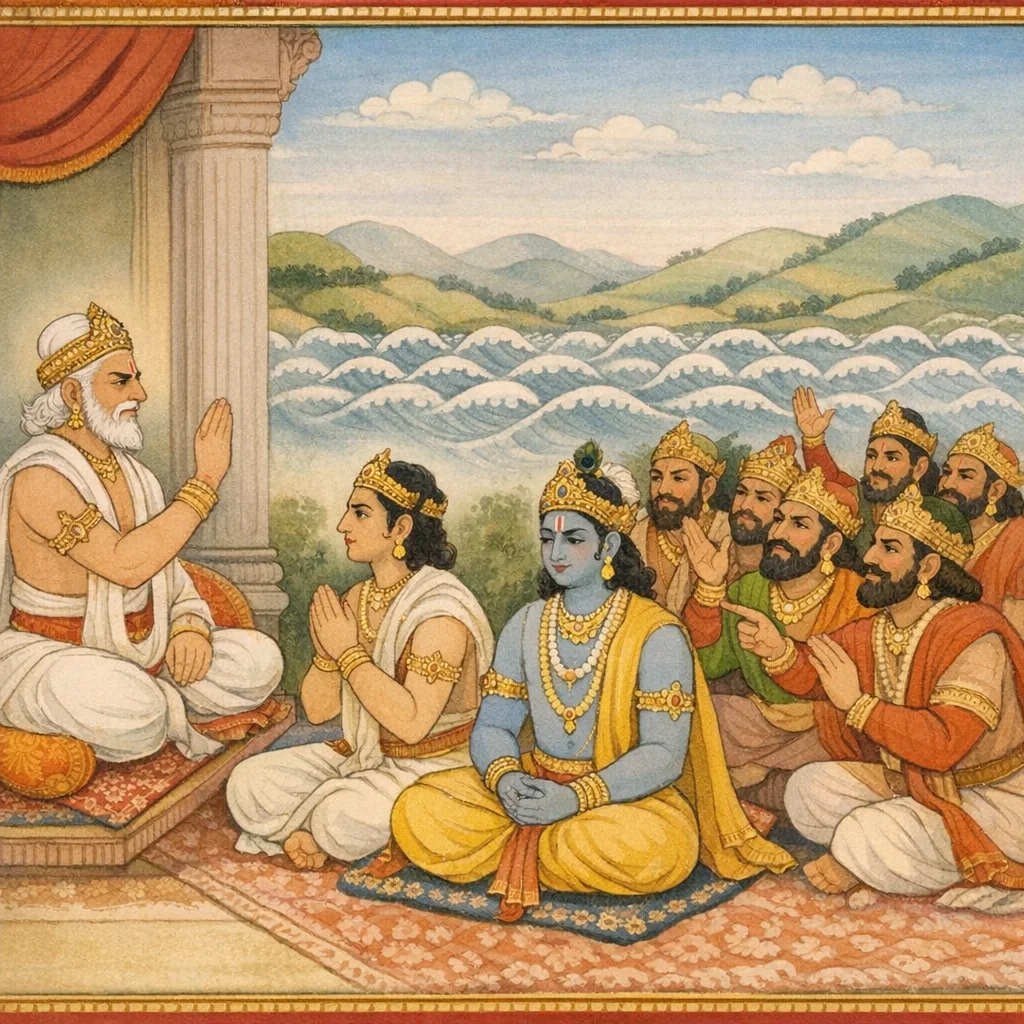
Chapter Arc: शिशुपाल-वध के बाद सभा में राजाओं का “महान् नृपतिसागर” रोष से उफन पड़ता है; युधिष्ठिर उस चंचल क्रोध-समुद्र को देखकर भीष्म से मार्ग पूछते हैं। → युधिष्ठिर कहते हैं—“पितामह! ऐसा उपाय बताइए कि यज्ञ में विघ्न न पड़े, प्रजा का हित हो, और यह सभा सर्वत्र शान्त हो।” भीष्म स्थिति की जड़ बताते हैं: कृष्ण के प्रति अज्ञानजन्य उन्माद, और शिशुपाल के भीतर स्थित तेज का रहस्य। → भीष्म का निर्णायक कथन—कृष्ण ‘सुप्त सिंह’ नहीं, जगत् के प्रभव और निधन हैं; लोग उन्हें न समझकर कुत्तों की तरह सिंह के निकट भौंक रहे हैं, और शिशुपाल का तेज स्वयं भगवान् में लीन होने को था। → भीष्म की रूक्ष परन्तु हितकारी वाणी से युधिष्ठिर को धर्मसम्मत दिशा मिलती है: यज्ञ-शान्ति का आधार कृष्ण-तत्त्व की स्वीकृति और सभा का संयम है, न कि प्रतिशोध या पक्षपात। → चेदिराज (शिशुपाल-पक्ष) भीष्म के कठोर शब्द सुनकर भीतर-ही-भीतर खौल उठता है—सभा की शान्ति टिकेगी या नया विरोध भड़केगा?
Shlokas
Verse 1
इस प्रकार श्रीमहाभारत सभापव॑के अन्तर्गत अर्घाभिद्दरणपर्वमें रुजाओंकी मन्त्रणाविषयक उनन््तालीसवाँ अध्याय पूरा हुआ ॥/ ३९ ॥। ऑपन-माज बक। डे (शिशुपालवधपर्व) चत्वारिशो< ध्याय: युधिष्ठिरकी चिन्ता और भीष्मजीका उन्हें सान्त्वना देना वैशम्पायन उवाच तत: सागरसंकाशं दृष्टवा नृपतिमण्डलम् । संवर्तवाताभिह्ठतं भीम॑ क्षुब्धमिवार्णवम्,वैशम्पायनजी कहते हैं--जनमेजय! तदनन्तर प्रलयकालीन महावायुके थपेड़ोंसे क्षुब्ध हुए भयंकर महासागरकी भाँति राजाओंके उस समुदायको क्रोधसे चंचल हुआ देख धर्मराज युधिष्ठिर बुद्धिमानोंमें श्रेष्ठ और कुरुकुलके वृद्ध पितामह भीष्मजीसे उसी प्रकार बोले, जैसे शत्रुहन्ता महातेजस्वी इन्द्र बृहस्पतिजीसे कोई बात पूछते हैं--
Vaiśampāyana said: Then, seeing the circle of kings—like a vast ocean, terrible and heaving as though struck by the cyclone-winds of dissolution—Yudhiṣṭhira perceived the assembly to be churned by wrath and unrest. In that charged moment, he turned to the wise elder Bhīṣma, seeking counsel on how dharma should be upheld amid the rising storm of royal passions.
Verse 2
रोषात् प्रचलितं सर्वमिदमाह युधिष्ठिर: । भीष्म मतिमतां मुख्यं वृद्धं कुरूपितामहम् । बृहस्पति बृहत्तेजा: पुरुहृत इवारिहा,वैशम्पायनजी कहते हैं--जनमेजय! तदनन्तर प्रलयकालीन महावायुके थपेड़ोंसे क्षुब्ध हुए भयंकर महासागरकी भाँति राजाओंके उस समुदायको क्रोधसे चंचल हुआ देख धर्मराज युधिष्ठिर बुद्धिमानोंमें श्रेष्ठ और कुरुकुलके वृद्ध पितामह भीष्मजीसे उसी प्रकार बोले, जैसे शत्रुहन्ता महातेजस्वी इन्द्र बृहस्पतिजीसे कोई बात पूछते हैं--
Vaiśampāyana said: When that entire assembly of kings was thrown into agitation by anger, Yudhiṣṭhira spoke. He addressed Bhīṣma—the foremost among the wise, the aged grandsire of the Kuru line—just as the enemy-slaying, great-splendoured Indra (Puruhūta) would address Bṛhaspati.
Verse 3
असौ रोषात् प्रचलितो महान् नृपतिसागर: । अत्र यत् प्रतिपत्तव्यं तन्मे ब्रूहि पितामह,“पितामह! यह देखिये, राजाओंका महासमुद्र रोषसे अत्यन्त चंचल हो उठा है। अब यहाँ इन सबको शान्त करनेका जो उचित उपाय जान पड़े, वह मुझे बताइये
Vaiśampāyana said: “Behold—this vast ocean of kings has been churned into agitation by anger. O Grandsire, tell me what course of action should be adopted here to pacify them and restore order.”
Verse 4
यज्ञस्य च न विध्न: स्यात् प्रजानां च हित॑ भवेत् । यथा सर्वत्र तत् सर्व ब्रूहि मेडद्य पितामह,“दादाजी! यज्ञमें विघ्न न पड़े और प्रजाओंका हित हो तथा जिस प्रकार सर्वत्र शान्ति भी बनी रहे, वह सब उपाय अब मुझे बतानेकी कृपा करें”
Vaiśampāyana said: “So that the sacrifice may proceed without obstruction, and the welfare of the subjects be secured—and so that peace may be maintained everywhere—tell me, O Grandsire, all the means for accomplishing this.”
Verse 5
इत्युक्तवति धर्मज्ञे धर्मराजे युधिष्ठिरे । उवाचेदं वचो भीष्मस्तत: कुरुपितामह:,धर्मके ज्ञाता धर्मराज युधिष्ठिरके ऐसा कहनेपर कुरुकुलपितामह भीष्मजी इस प्रकार बोले--
When the righteous king Yudhiṣṭhira—knower of dharma—had spoken thus, Bhīṣma, the grandsire of the Kuru line, then replied with these words.
Verse 6
मा भैस्त्वं कुरुशार्दूल श्वा सिंहं हन्तुमरहति । शिव: पन्था: सुनीतो<त्र मया पूर्वतरं वृत:,“कुरुवंशके वीर! तुम डरो मत, क्या कुत्ता कभी सिंहको मार सकता है? हमने कल्याणमय मार्ग पहले ही चुन लिया है (श्रीकृष्णका आश्रय ही वह मार्ग है जिसका मैंने वरण कर लिया है)
“Fear not, O tiger of the Kurus. Can a dog ever slay a lion? The auspicious path, well-guided, I chose long ago.”
Verse 7
प्रसुप्ते हि यथा सिंहे श्वानस्तस्मिन् समागता: । भषेयु: सहिता: सर्वे तथेमे वसुधाधिपा:
Vaiśampāyana said: “Just as, when a lion lies asleep, dogs gather around it and, banded together, bark at it—so too have these kings, lords of the earth, assembled and are emboldened to clamor in the presence of one who is momentarily inactive.”
Verse 8
भषन्ते तात संक्रुद्धा: श्वानः सिंहस्य संनिधौ,'क्रोधमें भरे हुए कुत्तोंके समान ये लोग सिंहके निकट तभीतक कोलाहल मचा रहे हैं, जबतक भगवान् श्रीकृष्ण सिंहकी तरह जाग नहीं उठते--इन्हें दण्ड देनेके लिये उद्यत नहीं हो जाते। राजाओंमें श्रेष्ठ चेदिकुलभूषण नृसिंह शिशुपाल भी अपनी विवेकशक्ति खो बैठा है, तभी इन सब नरेशोंको यमलोकमें भेज देनेकी इच्छासे कुत्तेसे सिंह बनानेकी कोशिश कर रहा है
Vaiśampāyana said: “O dear one, like enraged dogs barking in the very presence of a lion, these men raise their clamor only so long as Bhagavān Śrī Kṛṣṇa—lion-like—does not fully rouse himself to punish them. Even Śiśupāla, the lion among kings and ornament of the Cedi line, has lost his discernment; driven by a wish to send these rulers to Yama’s realm, he is attempting the impossible—trying to turn a dog into a lion.”
Verse 9
न हि सम्बुध्यते यावत् सुप्त: सिंह इवाच्युत: । तेन सिंहीकरोत्येतान् नृसिंहश्नेदिपुड्रवः,'क्रोधमें भरे हुए कुत्तोंके समान ये लोग सिंहके निकट तभीतक कोलाहल मचा रहे हैं, जबतक भगवान् श्रीकृष्ण सिंहकी तरह जाग नहीं उठते--इन्हें दण्ड देनेके लिये उद्यत नहीं हो जाते। राजाओंमें श्रेष्ठ चेदिकुलभूषण नृसिंह शिशुपाल भी अपनी विवेकशक्ति खो बैठा है, तभी इन सब नरेशोंको यमलोकमें भेज देनेकी इच्छासे कुत्तेसे सिंह बनानेकी कोशिश कर रहा है
Vaiśaṃpāyana said: “So long as Acyuta (Kṛṣṇa), like a sleeping lion, has not yet awakened, these men—like dogs swollen with rage—keep raising a clamor near the lion. But the moment he rouses himself, ready to punish, their noise will end. Yet the bull of the Cedi line, Nṛsiṃha Śiśupāla, having lost discernment, is trying to ‘make these dogs into lions’—stirring the kings toward a ruinous course and courting death.”
Verse 10
पार्थिवान् पार्थिवश्रेष्ठ;: शिशुपालो5प्यचेतन: । सर्वान् सर्वात्मना तात नेतुकामो यमक्षयम्,'क्रोधमें भरे हुए कुत्तोंके समान ये लोग सिंहके निकट तभीतक कोलाहल मचा रहे हैं, जबतक भगवान् श्रीकृष्ण सिंहकी तरह जाग नहीं उठते--इन्हें दण्ड देनेके लिये उद्यत नहीं हो जाते। राजाओंमें श्रेष्ठ चेदिकुलभूषण नृसिंह शिशुपाल भी अपनी विवेकशक्ति खो बैठा है, तभी इन सब नरेशोंको यमलोकमें भेज देनेकी इच्छासे कुत्तेसे सिंह बनानेकी कोशिश कर रहा है
Vaiśampāyana said: “O best of kings, even Śiśupāla—though famed among rulers—had become bereft of discernment. In his totality he was intent, dear one, on driving all those kings toward Yama’s imperishable realm (death).”
Verse 11
नूनमेतत् समादातु पुनरिच्छत्यधोक्षज: । यदस्य शिशुपालस्य तेजस्तिष्ठति भारत,“भारत! अवश्य ही भगवान् श्रीकृष्ण इस शिशुपालके भीतर उनका जो तेज है, उसे पुनः समेट लेना चाहते हैं
Vaiśampāyana said: “O Bhārata, surely the Lord Adhokṣaja (Śrī Kṛṣṇa) now wishes to gather back into Himself that divine radiance which abides within Śiśupāla.”
Verse 12
विप्लुता चास्य भद्रं ते बुद्धिर्बुद्धमतां वर । चेदिराजस्य कौन्तेय सर्वेषां च महीक्षिताम्,“बुद्धिमानोंमें श्रेष्ठ कुन्तीनन्दन युधिष्ठिर! तुम्हारा कल्याण हो। अवश्य ही इस चेदिराज शिशुपालकी तथा इन समस्त भूपालोंकी बुद्धि मारी गयी है
Vaiśampāyana said: “Blessings to you, O best among the wise, O Kuntī’s son. Surely the understanding of this king of Cedi—and indeed of all these rulers—has been thrown into confusion.”
Verse 13
आदातुं च नरव्याप्रो यं यमिच्छत्ययं तदा । तस्य विप्लवते बुद्धिरेवं चेदिपतेर्यथा,"क्योंकि नरश्रेष्ठ श्रीकृष्ण जिस-जिसको अपनेमें विलीन कर लेना चाहते हैं, उस-उस मनुष्यकी बुद्धि इसी प्रकार नष्ट हो जाती है, जैसे इस चेदिराज शिशुपालकी
Vaiśampāyana said: When that foremost of men, Śrī Kṛṣṇa, intent on taking someone to himself, chooses a particular person, then that person’s understanding is thrown into ruin—just as happened in the case of the king of Cedi, Śiśupāla.
Verse 14
चतुर्विधानां भूतानां त्रिषु लोकेषु माधव: । प्रभवश्वैव सर्वेषां निधनं च युधिष्ठिर:,'युधिष्ठिर! माधव श्रीकृष्ण तीनों लोकोंमें जो स्वेदज, अण्डज, उद्धिज्ज और जरायुज --ये चार प्रकारके प्राणी हैं, उन सबकी उत्पत्ति और प्रलयके स्थान हैं
Vaiśampāyana said: “O Yudhiṣṭhira, Mādhava (Śrī Kṛṣṇa) is, in the three worlds, both the source and the final end of all beings—of every kind of creature, in all four modes of birth.”
Verse 15
वैशम्पायन उवाच इति तस्य वच: श्रुत्वा ततश्रेदिपतिर्नुप: । भीष्म रूक्षाक्षरा वाच: श्रावयामास भारत,वैशम्पायनजी कहते हैं--जनमेजय! भीष्मजीकी यह बात सुनकर चेदिराज शिशुपाल उनको बड़ी कठोर बातें सुनाने लगा
Vaiśampāyana said: “O king (Janamejaya), having heard those words, the ruler of Cedi then began to address Bhīṣma with harsh, cutting speech, O descendant of Bharata.”
Verse 40
इति श्रीमहाभारते सभापर्वणि शिशुपालवधपर्वणि युधिष्ठिरा श्वासने चत्वारिंशो5ध्याय:
Thus ends the fortieth chapter in the Sabha Parva of the Śrī Mahābhārata, within the section concerning the slaying of Śiśupāla.
Verse 76
वृष्णिसिंहस्य सुप्तस्य तथामी प्रमुखे स्थिता: । 'जैसे सिंहके सो जानेपर बहुत-से कुत्ते उसके निकट आकर एक साथ भूकने लगते हैं, उसी प्रकार ये सामने खड़े हुए राजा भी तभीतक भूक रहे हैं, जबतक वृष्णिवंशका सिंह सो रहा है
Vaiśampāyana said: “While the lion of the Vṛṣṇis lies as if asleep, these kings standing at the front are making their noise only for so long—just as many dogs gather near a sleeping lion and bark together. Their boldness lasts only until that lion awakens.”
Frequently Asked Questions
The chapter stages a conflict between fear-driven exclusion (abandoning a child marked as abnormal) and rājadharma’s protective obligation, later extending to the dilemma of how long public provocation should be met with principled restraint.
It frames restraint as an intentional discipline rather than passivity: tolerance can be vowed for social reasons, yet accountability remains, and repeated transgression eventually exhausts the moral credit created by forbearance.
No explicit phalaśruti appears in this unit; its interpretive function is etiological and juridical—explaining later conduct and delimiting ethical patience—rather than promising a ritual merit for recitation.