Adhyaya 46
अभिमन्योरावरणम् (Encirclement and counter-strikes of Abhimanyu)
Upa-parva: Abhimanyu-in-the-formation (Cakravyūha engagement) — tactical containment episode
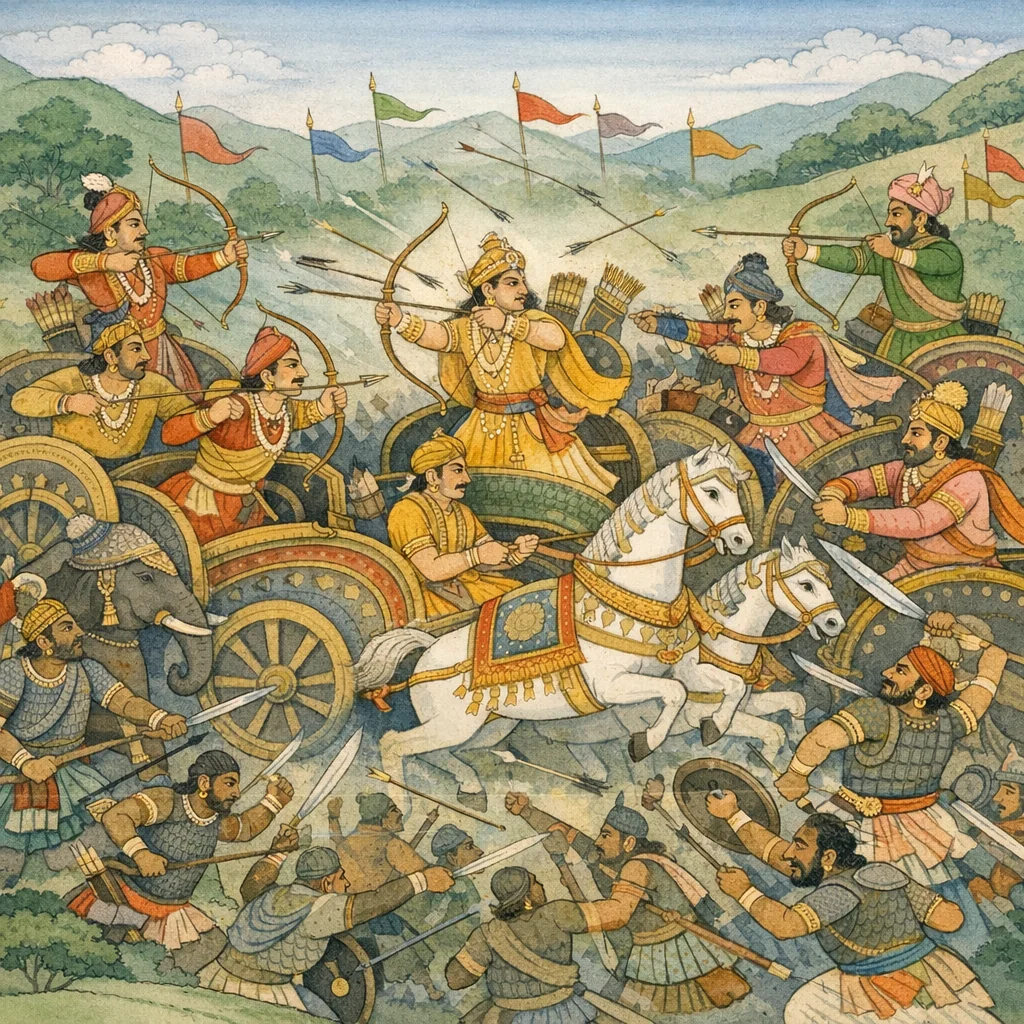
Dhṛtarāṣṭra asks which heroes checked the young, undefeated Saubhadra, who advances without retreat in battle. Sañjaya reports that Abhimanyu’s entry immediately turns many opposing kings away with sharp arrows. A coordinated ring of six chariot-warriors—Droṇa, Kṛpa, Karṇa, Aśvatthāman (Drauṇi), Bṛhadbala, and Kṛtavarman—surrounds him and showers missiles while drawing powerful bows. Abhimanyu stabilizes the engagement by obstructing these expert archers with precise arrow-work. Quantified exchanges follow: he wounds Droṇa, Bṛhadbala, Kṛtavarman, and Kṛpa with high counts of śilīmukhas; he strikes Aśvatthāman with ten swift arrows; and he pierces Karṇa in the ear amid the press of opponents. He disables Kṛpa’s horses and then is counter-struck. In the melee, the Kosala ruler Bṛhadbala attacks on foot with sword and shield after being unhorsed, but Abhimanyu pierces him in the heart, causing his fall. Abhimanyu continues moving through the battle, suppressing enemy bowmen with sustained arrow-rain.
Chapter Arc: धृतराष्ट्र संजय से विस्मय और अविश्वास के बीच पूछते हैं—कैसे अकेला सौभद्र अभिमन्यु इतने योद्धाओं के साथ घोर संग्राम करके भी विजयी रहा; और जिनका आश्रय धर्म है, उनके लिए यह ‘अत्यद्भुत’ भी क्यों नहीं। → दुर्योधन के विमुख होने और राजपुत्रों के मारे जाने से कौरव-पक्ष में हड़कम्प मचता है। तब द्रोण, अश्वत्थामा, बृहद्बल, कृप, कर्ण, कृतवर्मा और शकुनि जैसे महारथी क्रुद्ध होकर अभिमन्यु पर टूट पड़ते हैं; निकट-युद्ध का जाल कसता जाता है, गजसेना और विविध जनपदों की टुकड़ियाँ भी उसे घेरती हैं। → छः महारथियों द्वारा चारों ओर से घेर लिए जाने पर भी अभिमन्यु रथ, ध्वज, सारथि और अश्वों पर प्रहार कर शत्रु-रथों की व्यवस्था तोड़ता है; कलिंग, निषाद और क्राथपुत्र आदि के कवचधारी दलों तथा गजसेना के बीच वह तीक्ष्ण बाणों से मार्ग बनाता हुआ निर्णायक प्रतिरोध करता है। → अभिमन्यु के पराक्रम से कौरव-सेना बार-बार विमुख होती है; अनेक आक्रमणकारी घायल होकर हटते हैं और घेरा क्षण-क्षण टूटता-बनता रहता है—पर कौरव-पक्ष अपनी प्रतिष्ठा बचाने को और अधिक संगठित होकर उसे दबाने का संकल्प करता है। → घेरा और सघन होता जाता है—महारथियों की संयुक्त रणनीति के सामने अभिमन्यु की अगली घड़ी क्या होगी, यह प्रश्न युद्धभूमि पर लटक जाता है।
Shlokas
Verse 1
धृतराष्ट्र बोले--सूत! जैसा कि तुम बता रहे हो, अकेले महामना अभिमन्युका बहुत- से योद्धाओंके साथ अत्यन्त भयंकर संग्राम हुआ और उसमें विजय भी उसीकी हुई-- सुभद्राकुमारका यह पराक्रम आश्चर्यजनक है। उसपर सहसा विश्वास नहीं होता; परंतु जिन लोगोंका धर्म ही आश्रय है, उनके लिये यह कोई अत्यन्त अद्भुत बात नहीं है
Dhritarashtra said: “O Suta! As you describe it, the high-souled Abhimanyu, though alone, fought a most dreadful battle against many warriors—and victory was his. This valor of Subhadra’s son is astonishing. It is hard to believe at first; yet for those whose refuge is Dharma itself, such a feat is not truly extraordinary.”
Verse 2
अश्रद्धेयमिवाश्चर्य सौभद्रस्याथ विक्रमम् । किं तु नात्यद्धुतं तेषां येषां धर्मो व्यपाश्रय:,धृतराष्ट्र बोले--सूत! जैसा कि तुम बता रहे हो, अकेले महामना अभिमन्युका बहुत- से योद्धाओंके साथ अत्यन्त भयंकर संग्राम हुआ और उसमें विजय भी उसीकी हुई-- सुभद्राकुमारका यह पराक्रम आश्चर्यजनक है। उसपर सहसा विश्वास नहीं होता; परंतु जिन लोगोंका धर्म ही आश्रय है, उनके लिये यह कोई अत्यन्त अद्भुत बात नहीं है
Dhṛtarāṣṭra said: “O Sūta, the valor of Saubhadra (Abhimanyu) is astonishing—almost beyond belief. Yet for those whose refuge is Dharma, such a deed is not altogether extraordinary.”
Verse 3
दुर्योधने च विमुखे राजपुत्रशते हते । सौभगद्रे प्रतिपत्तिं कां प्रत्यपद्यन्त मामका:,संजय! जब दुर्योधन भाग गया और सैकड़ों राजकुमार मारे गये, उस समय मेरे पुत्रोंने सुभद्राकुमारका सामना करनेके लिये क्या उपाय किया?
Dhṛtarāṣṭra said: “When Duryodhana turned away and fled, and a hundred princes had been slain, what course of action did my sons adopt to confront Saubhadra (Abhimanyu), O Sañjaya?”
Verse 4
संजय उवाच संशुष्कास्याश्षलन्नेत्रा: प्रस्विन्ञा लोमहर्षणा: । पलायनकृतोत्साहा निरुत्साहा द्विषज्जये,संजयने कहा--महाराज! आपके सभी सैनिकोंके मुँह सूख गये थे, आँखें भयसे चंचल हो रही थीं, सारे अंग पसीने-पसीने हो रहे थे और रोंगटे खड़े हो गये थे। वे भागनेमें ही उत्साह दिखा रहे थे। शत्रुओंको जीतनेका उत्साह उनके मनमें तनिक भी नहीं था
Sañjaya said: “O King, your warriors’ mouths had gone dry; their eyes were darting in fear. Their bodies were drenched with sweat and their hair stood on end. They showed eagerness only for flight, and had no zeal at all to overcome the enemy.”
Verse 5
हतान् भ्रातृन् पितृन् पुत्रान् सुहृत्सम्बन्धिबान्धवान् | उत्सृज्योत्सृज्य संजग्मुस्त्वरयन्तो हयद्विपान्,वे युद्धमें मारे गये भाइयों, पितरों, पुत्रों, सुहृदों, सम्बन्धियों तथा बन्धु-बान्धवोंको छोड़-छोड़कर अपने घोड़े और हाथियोंको उतावलीके साथ हाँकते हुए भाग रहे थे
Sañjaya said: “Leaving behind—again and again—their brothers, fathers, sons, dear friends, relatives, and kinsmen who had been slain, they hurried away, driving their horses and elephants in frantic haste.”
Verse 6
तान् प्रभग्नांस्तथा दृष्टवा द्रोणो द्रौणिर्बृहद्धल: । कृपो दुर्योधन: कर्ण: कृतवर्माथ सौबल:,राजन्! उन सबको भागते देख द्रोणाचार्य, अश्वत्थामा, बृहदबल, कृपाचार्य, दुर्योधन, कर्ण, कृतवर्मा और शकुनि--ये सब अत्यन्त क्रोधमें भरकर अपराजित वीर अभिमन्युपर टूट पड़े; परंतु आपके उस पौत्र अभिमन्युने उन सबको प्राय: युद्धसे भगा दिया
Sañjaya said: “Seeing them thus routed and in flight, Droṇa, Droṇa’s son Aśvatthāmā, Bṛhaddhala, Kṛpa, Duryodhana, Karṇa, Kṛtavarmā, and Śakuni (son of Subala) surged forward in fierce wrath against the unconquered hero Abhimanyu. Yet your grandson Abhimanyu, by his prowess, drove nearly all of them back from the fight.”
Verse 7
अभ्यधावन् सुसंक्रुद्धा: सौभद्रमपराजितम् । ते तु पौत्रेण ते राजन् प्रायशो विमुखीकृता:,राजन्! उन सबको भागते देख द्रोणाचार्य, अश्वत्थामा, बृहदबल, कृपाचार्य, दुर्योधन, कर्ण, कृतवर्मा और शकुनि--ये सब अत्यन्त क्रोधमें भरकर अपराजित वीर अभिमन्युपर टूट पड़े; परंतु आपके उस पौत्र अभिमन्युने उन सबको प्राय: युद्धसे भगा दिया
Sañjaya said: “Enraged, they rushed upon Saubhadra—Abhimanyu, the unconquered hero. Yet, O King, your grandson turned them back for the most part, driving them away from the fight.”
Verse 8
एकस्तु सुखसंवृद्धो बाल्याद् दर्पाच्च निर्भय: । इष्वस्त्रविन्महातेजा लक्ष्मणो5<र्जुनिमभ्ययात्,उस समय सुखमें पला हुआ, थरनुर्वेदका ज्ञाता, एकमात्र महातेजस्वी लक्ष्मण अपने बालस्वभाव तथा अभिमानके कारण निर्भय हो अभिमन्युके सामने आ गया
Sañjaya said: Then Lakṣmaṇa—reared in comfort, fearless from childish impetuosity and pride, skilled in archery and radiant with great prowess—advanced to confront Abhimanyu.
Verse 9
तमन्वगेवास्य पिता पुत्रगृद्धी न््यवर्तत । अनुदुर्योधनं चान्ये न्यवर्तन्त महारथा:,पुत्रकी रक्षा चाहनेवाला पिता दुर्योधन भी उसीके साथ-साथ लौट पड़ा। फिर दुर्योधनके पीछे दूसरे महारथी लौट आये
Sañjaya said: His father, driven by an intense longing for his son, turned back, following close behind him. And after Duryodhana, other great chariot-warriors also withdrew.
Verse 10
तं॑ तेडभिषिषिचुर्बाणैमेंघा गिरिमिवाम्बुभि: । स तु तान् प्रममाथैको विष्वग्वातो यथाम्बुदान्,जैसे बादल किसी पर्वतको अपने जलकी धाराओंसे सींचते हैं, उसी प्रकार वे महारथी अभिमन्युपर बाणोंकी वर्षा करने लगे। जैसे चारों ओरसे बहनेवाली हवा (चौवाई) बादलोंको उड़ा देती है, उसी प्रकार अकेले अभिमन्युने उन सबको मथ डाला
Sañjaya said: They drenched him with arrows, as clouds drench a mountain with streams of rain. Yet Abhimanyu alone crushed them all, just as a wind blowing from every direction scatters and churns the clouds.
Verse 11
पौत्रं तव च दुर्धर्ष लक्ष्मणं प्रियदर्शनम् पितु: समीपे तिष्ठन्तं शूरमुद्यतकार्मुकम्,राजन्! आपका प्रियदर्शन पौत्र लक्ष्मण बड़ा दुर्धर्ष वीर था। वह धनुष उठाये अपने पिताके ही पास खड़ा था। अत्यन्त सुखमें पला हुआ वह वीर कुबेरके पुत्रके समान जान पड़ता था। जैसे मतवाला हाथी किसी मदोनन््मत्त गजराजसे भिड़ जाय, उसी प्रकार अर्जुनकुमारने लक्ष्मणपर आक्रमण किया
Sañjaya said: O King, your grandson Lakṣmaṇa—handsome to behold and hard to assail—stood close by his father, a valiant warrior with bow raised and ready.
Verse 12
अत्यन्तसुखसंवृद्ध॑ धनेश्वरसुतोपमम् । आससाद रणे कार्ष्ण्मित्तो मत्तमिव द्विपम्,राजन्! आपका प्रियदर्शन पौत्र लक्ष्मण बड़ा दुर्धर्ष वीर था। वह धनुष उठाये अपने पिताके ही पास खड़ा था। अत्यन्त सुखमें पला हुआ वह वीर कुबेरके पुत्रके समान जान पड़ता था। जैसे मतवाला हाथी किसी मदोनन््मत्त गजराजसे भिड़ जाय, उसी प्रकार अर्जुनकुमारने लक्ष्मणपर आक्रमण किया
Sañjaya said: O King, Lakṣmaṇa—your grandson, pleasing to behold and hard to overcome—stood near his father with bow in hand, ready for battle. Reared in the height of comfort, he seemed like the son of Kubera, Lord of Wealth. Then, in the press of war, Arjuna’s son charged at Lakṣmaṇa—like a rut-maddened elephant rushing upon another mighty elephant.
Verse 13
लक्ष्मणेन तु संगम्य सौभद्र: परवीरहा । शरै: सुनिशितैस्ती६णैर्बाह्वोरुरसि चार्पित:,लक्ष्मणसे भिड़नेपर उसके द्वारा शत्रुवीरोंका संहार करनेवाले सुभद्राकुमारकी भुजाओं और छातीमें अत्यन्त तीखे बाणोंद्वारा प्रहार किया गया
Sañjaya said: When he closed with Lakṣmaṇa in hand-to-hand combat, Saubhadra—slayer of enemy heroes—was struck on his arms and chest by arrows exceedingly sharp and keen. The scene revealed the battle’s relentless reciprocity: even the most valiant must bear the consequence of direct engagement, where prowess is tested by disciplined force, not by rage alone.
Verse 14
संक़रुद्धो वै महाराज दण्डाहत इवोरग: । पौत्रस्तव महाराज तव पौत्रमभाषत,महाराज! उस प्रहारसे लाठीकी चोट खाये हुए सर्पके समान अत्यन्त क्रोधमें भरे हुए आपके पौत्र अभिमन्युने आपके दूसरे पौत्र लक्ष्मणसे कहा--
Sañjaya said: O King, your grandson—enraged like a serpent struck with a staff—addressed your other grandson. The blow he had received had kindled fierce wrath, and in the midst of battle he spoke, driven by wounded honor and the heat of war.
Verse 15
सुदृष्ट: क्रियतां लोको हामुं लोक॑ गमिष्यसि । पश्यतां बान्धवानां त्वां नयामि यमसादनम्
Sañjaya said: “Make your vision clear and take heed of this world before you; you are about to depart for the other world. Even as your kinsmen look on, I shall lead you to Yama’s abode.”
Verse 16
“लक्ष्मण! इस संसारको अच्छी तरह देख लो। अब शीघ्र ही परलोककी यात्रा करोगे। इन बान्धव-जनोंके देखते-देखते मैं तुम्हें यमलोक पहुँचाये देता हूँ” ।। एवमुक्त्वा ततो भल्लं सौभद्र: परवीरहा । उद्धबर्ह महाबाहुर्निर्मुक्तोरगसंनिभम्,ऐसा कहकर शत्रुवीरोंका संहार करनेवाले महाबाहु सुभद्राकुमारने केंचुलसे निकले हुए सर्पके समान एक भल्लको तरकससे निकाला
Sañjaya said: “Lakṣmaṇa, look well upon this world. Soon you will set out on the journey to the next. Before the very eyes of your kinsmen, I shall send you to Yama’s realm.” Having spoken thus, the mighty-armed son of Subhadrā—slayer of enemy heroes—drew forth a bhalla arrow from his quiver, gleaming like a serpent newly slipped from its skin.
Verse 17
स तस्य भुजनिर्मुक्तो लक्ष्मणस्य सुदर्शनम् । सुनसं सुभ्रु केशान्तं शिरो5हार्षीत् सकुण्डलम्,अभिमन्युके हाथोंसे छूटे हुए उस भल्लने लक्ष्मणके देखनेमें सुन्दर, सुधड़ नासिका, मनोहर भौंह, सुन्दर केशान्तभाग और रुचिर कुण्डलोंसे युक्त मस्तकको धड़से अलग कर दिया
That bhalla arrow, released from Abhimanyu’s arm, severed Lakṣmaṇa’s head from his body—his handsome head with a well-shaped nose, pleasing brows, fair hair at the temples, and bright earrings.
Verse 18
लक्ष्मणं निहतं दृष्टवा हाहेत्युच्चुक्रुशुर्जना: । ततो दुर्योधन: क्रुद्धः प्रिये पुत्रे निपातिते
Sañjaya said: Seeing Lakṣmaṇa slain, the people cried, “Alas! Alas!” Then Duryodhana, enraged at the fall of his beloved son, was seized by grief-kindled wrath—an emotion that in war so often drives men from judgment into further violence.
Verse 19
घ्नतैनमिति चुक्रोश क्षत्रियान् क्षत्रियर्षभ: । लक्ष्मणको मारा गया देख सब लोग जोर-जोरसे हाहाकार करने लगे। अपने प्यारे पुत्रके मारे जानेपर क्षत्रियशिरोमणि दुर्योधन कुपित हो उठा और समस्त क्षत्रियोंसे बोला --अहो! इस अभिमन्युको मार डालो” ।। ततो द्रोण: कृप: कर्णों द्रोणपुत्रो बृहद्धल:
Sañjaya said: The bull among kṣatriyas cried out to the warriors, “Kill him!” Enraged at the slaying of his beloved son, Duryodhana—foremost of kings—urged all the kṣatriyas, “Ah! Strike down this Abhimanyu!” Thereupon Droṇa, Kṛpa, Karṇa, the son of Droṇa (Aśvatthāman), and Bṛhaddhala advanced to engage.
Verse 20
तांस्तु विद्ध्वा शितैर्बाणैविमुखीकृत्य चार्जुनि:
Sañjaya said: Having struck them with sharp arrows, Arjuna turned them back, forcing them to withdraw and face away from the fight, as he pressed his advantage in the righteous fury of battle.
Verse 21
आवल्रुस्तस्य पन्थानं गजानीकेन दंशिता:
Sañjaya said: They blocked his route, hemming him in with an elephant-corps, as if biting and tearing at his path. The scene shows how, in war, coordinated force can choke off even a valiant warrior’s movement, turning the battlefield into a moral trial where courage must contend with overwhelming, organized violence.
Verse 22
तत् प्रसक्तमिवात्यर्थ युद्धमासीद् विशाम्पते,प्रजानाथ! तब वहाँ अत्यन्त निकटसे घोर युद्ध आरम्भ हो गया। अर्जुनकुमारने पैने बाणोंद्वारा उस धृष्ट गजसेनाको उसी प्रकार नष्ट कर दिया, जैसे सदागति वायु आकाशमें सैकड़ों मेघखण्डोंको छिन्न-भिन्न कर देती है
Sañjaya said: O lord of the people, O ruler among men, the battle then flared up at very close quarters, becoming exceedingly intense. In that press of combat, Arjuna’s son cut down that audacious elephant-corps with sharp arrows—just as the ever-moving wind in the sky tears hundreds of cloud-masses into scattered fragments.
Verse 23
ततस्तत् कुण्जरानीकं व्यधमद् धृष्टमार्जुनि: । यथा वायुर्नित्यगतिर्जलदान् शतशोडम्बरे,प्रजानाथ! तब वहाँ अत्यन्त निकटसे घोर युद्ध आरम्भ हो गया। अर्जुनकुमारने पैने बाणोंद्वारा उस धृष्ट गजसेनाको उसी प्रकार नष्ट कर दिया, जैसे सदागति वायु आकाशमें सैकड़ों मेघखण्डोंको छिन्न-भिन्न कर देती है
Sañjaya said: Then, at very close quarters, a fierce battle broke out. Arjuna’s son, Dhṛṣṭadyumna, with sharp arrows, shattered that elephant-corps—just as the ever-moving wind in the sky tears apart hundreds of cloud-masses.
Verse 24
ततः क्राथ: शरख्रातैरार्जुनिं समवाकिरत् । अथेतरे संनिवृत्ता: पुनद्रोणमुखा रथा:,तदनन्तर क्राथने अर्जुनकुमार अभिमन्युपर बाणोंकी वर्षा आरम्भ कर दी। इतनेहीमें द्रोण आदि दूसरे महारथी भी पुनः लौट आये
Sañjaya said: Then Krātha showered Arjuna’s son with volleys of arrows. Meanwhile, the other chariot-warriors, headed by Droṇa, who had withdrawn for a moment, turned back again and returned to the front.
Verse 25
परमास्त्राणि धुन्वाना: सौभद्रमभिदुद्रुवु: । तान् निवार्यार्जुनिर्बाणै: क्राथपुत्रमथार्दयत्,उन सबने अपने उत्तम अस्त्रोंका प्रयोग करते हुए सुभद्राकुमारपर आक्रमण किया। अभिमन्युने अपने बाणोंद्वारा उन सबका निवारण करके क्राथपुत्रको अधिक पीड़ा दी
Sañjaya said: Wielding their most potent weapons, they rushed upon Saubhadra (Abhimanyu). Abhimanyu checked them all with his arrows and then pressed Krātha’s son hard, inflicting severe distress.
Verse 26
शरौघेणाप्रमेयेण त्वरमाणो जिघांसया । सभरनुर्बाणकेयूरो बाहू समुकुर्ट शिर:
Sañjaya said: Driven by the desire to slay and hastening forward, he advanced amid an immeasurable shower of arrows—his bow strung and ready, his arms adorned with quivers like armlets, and his head crowned with a helmet—pressing on with the grim resolve of battle.
Verse 27
कुलशीलश्रुतिबलै: कीर्त्या चास्त्रबलेन च | युक्ते तस्मिन् हते वीरा: प्रायशो विमुखा5भवन्,कुल, शील, शास्त्रज्ञान, बल, कीर्ति तथा अस्त्र-बलसे सम्पन्न उस वीर क्राथपुत्रके मारे जानेपर आपकी सेनाके प्रायः सभी शूरवीर सैनिक युद्ध छोड़कर भाग गये
Sañjaya said: When that warrior—endowed with noble lineage, good conduct, learning, strength, fame, and prowess in arms—was slain, most of the heroes in your army turned away from the fight and withdrew in disarray.
Verse 45
हि 27005 ० अब ? हुक अआ 5 क ”+ $* %// हा ्, । 0 "इ क +-
The provided Sanskrit text appears corrupted/garbled and does not correspond to a readable Mahābhārata śloka. Without the correct Devanāgarī verse for Droṇa-parva, Adhyāya 46, Verse 45 (Gītā Press), a faithful transliteration, translation, and vocabulary analysis cannot be produced.
Verse 46
इति श्रीमहाभारते द्रोणपर्वणि अभिमन्युवधपर्वणि लक्ष्मणवधे षट्चत्वारिंशो<ध्याय:
Thus ends the forty-sixth chapter in the Droṇa Parva of the Śrī Mahābhārata, within the section on the slaying of Abhimanyu, specifically the episode concerning the killing of Lakṣmaṇa.
Verse 193
कृतवर्मा च हार्दिक्य: षड् रथा: पर्यवारयन् । तब द्रोणाचार्य, कृपाचार्य, कर्ण, अश्वत्थामा, बृहदबल और हृदिकपुत्र कृतवर्मा--इन छ: महारथियोंने अभिमन्युको घेर लिया
Sañjaya said: Kṛtavarmā, the son of Hṛdīka, together with six chariot-warriors, surrounded Abhimanyu. Droṇa, Kṛpa, Karṇa, Aśvatthāmā, Bṛhadbala, and Kṛtavarmā—six great champions—closed in upon the lone young hero, turning the fight into an unequal encirclement that tests the bounds of kṣatriya-dharma.
Verse 203
वेगेनाभ्यपतत् क्रुद्ध: सैन्धवस्य महद् बलम् | यह देख अर्जुनकुमारने अपने पैने बाणोंद्वारा उन सबको घायल करके भगा दिया और क्रोधमें भरकर बड़े वेगसे जयद्रथकी विशाल सेनापर धावा किया
Sañjaya said: Enraged, he surged forward with great speed and fell upon the mighty host of Jayadratha, the king of Sindhu. Seeing the enemy array, Arjuna’s son wounded them all with sharp arrows and drove them back; then, burning with wrath, he charged the vast army that shielded Jayadratha.
Verse 216
कलिलज्जश्न निषादाश्न क्राथपुत्रश्न वीर्यवान् । उस समय कलिंगदेशीय सैनिक, निषादगण तथा पराक्रमी क्राथपुत्र--इन सबने कवच धारण करके गजसेनाके द्वारा अभिमन्युका रास्ता रोक दिया
Sañjaya said: At that time the warriors of Kaliṅga, the Niṣādas, and the valiant Krāthaputras—all armoured—blocked Abhimanyu’s path with an elephant-corps.
Verse 2636
सच्छत्रध्वजयन्तारं रथं चाश्वान् न्यपातयत् | फिर उसने असंख्य बाणसमूहोंद्वारा क्राथपुत्रको मार डालनेकी इच्छासे जल्दी करते हुए उसकी धनुष-बाणों और केयूरसहित दोनों भुजाओं, मुकुटमण्डित मस्तक, छत्र, ध्वज और सारथिसहित रथ तथा घोड़ोंको भी मार गिराया
Sañjaya said: With swift intent to kill Kratha’s son, he overwhelmed him with dense volleys of arrows, striking down the chariot with its horses and felling the charioteer as well, along with the parasol and banner—cutting away not only the warrior, but the whole support of his battle-might.
Frequently Asked Questions
The chapter implicitly tests the boundary between individual-duel ideals and collective containment: whether coordinated multi-hero pressure against a single entrant is merely strategic necessity or a strain on customary expectations of fairness in elite combat.
Agency operates within constraints: disciplined skill can temporarily equalize asymmetry, yet outcomes are also shaped by coordinated systems (formation, teamwork, logistics), illustrating how dharma in action includes both personal excellence and structural realities.
No explicit phalaśruti appears in this unit; its meta-function is archival—Sañjaya’s quantified, witness-oriented report frames the episode as evidence for evaluating leadership, conduct, and consequence within the wider war narrative.