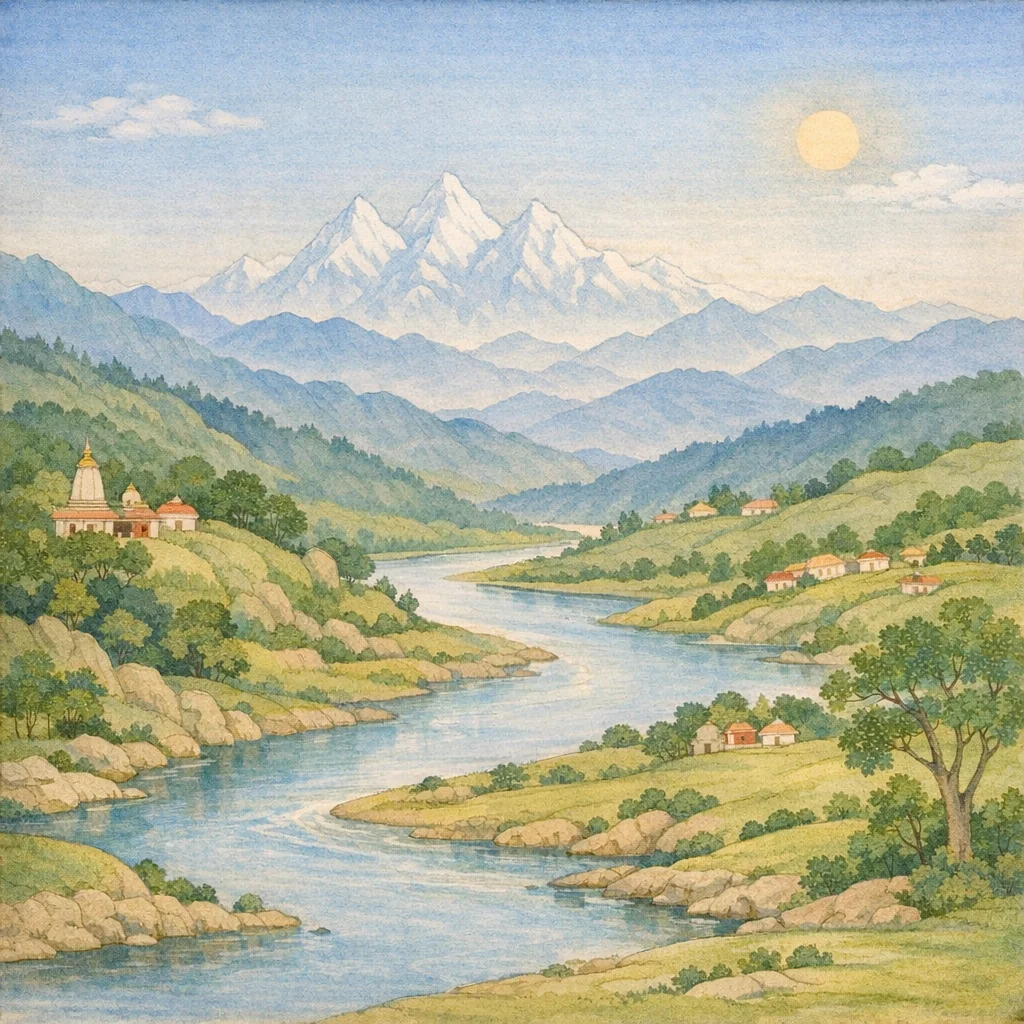
Adhyaya 8
मेरोर्दिग्वर्णनम् / Digvarṇana of Meru: Uttara-Kuru, Bhadrāśva, and Jambūdvīpa Motifs
Upa-parva: Jambū-khaṇḍa–Meru-digvarṇana (Northern Kuru and Eastern Meru Description Episode)
Dhṛtarāṣṭra asks Saṃjaya to describe the northern and eastern flanks of Meru and the Mālyavat mountain. Saṃjaya outlines Uttara-Kuru as a sanctified region frequented by siddhas, characterized by ever-flowering, fragrant, and taste-rich trees, including wish-fulfilling and ‘kṣīriṇa’ trees that exude nectar-like milk and yield garments and ornaments through their fruits. The terrain is depicted as gem-like, smooth, and free of mud; inhabitants are described as born from higher realms, paired as harmonious couples, free from illness and sorrow, and long-lived. The narration then turns eastward toward Bhadrāśva, noting distinctive groves and the Kālāmra tree and describing luminous inhabitants and accomplished women. A major cosmographic centerpiece follows: the ancient Sudarśana Jambū tree, whose fruit-juice becomes a river encircling Meru and flowing toward Uttara-Kuru; drinking it prevents aging, and it is associated with Jāmbūnada gold. The chapter concludes with Mālyavat’s peak featuring the fire ‘Saṃvartaka’ and with ascetic, brahma-oriented beings who accompany the Sun (divākara) and later enter the lunar sphere after prolonged austerity.
Chapter Arc: धृतराष्ट्र के प्रश्नों के उत्तर में संजय युद्धभूमि से दृष्टि हटाकर पृथ्वी के रहस्यमय विभागों का वर्णन आरम्भ करते हैं—मानो कुरुक्षेत्र के रक्त-धूल के पीछे सृष्टि का विशाल मानचित्र खुल रहा हो। → संजय श्वेत और निषध पर्वतों के बीच स्थित रमणक-वर्ष तथा नील और निषध के बीच स्थित हिरण्मय-वर्ष का परिचय देते हैं—वहाँ के मनुष्यों की अनुपम देह-दीप्ति, निष्पक्षता/निर्वैरता, और प्रकृति की विलक्षण समृद्धि (हैरण्यवती नदी) से कथा का विस्तार बढ़ता जाता है। → शृंगवान् पर्वत के तीन अद्भुत शिखरों का वर्णन चरम पर पहुँचता है—एक मणिमय, एक सुवर्णमय, और एक सर्वरत्नमय (भवनों से शोभित); तत्पश्चात ऐरावत-वर्ष की ऐसी अवस्था बताई जाती है जहाँ सूर्य का ताप नहीं पड़ता और मनुष्य जरा से अछूते रहते हैं। → संजय इस भौगोलिक-वैभव को एक उच्चतर सत्य से बाँधते हैं—यहाँ कुछ भी शाश्वत नहीं; वही परम प्रभु (नर-नारायण/विष्णु) सर्वज्ञ होकर सृष्टि का पुनः सृजन करता है, और उन लोकों में आयु-प्रमाण असाधारण (साढ़े बारह हजार वर्ष) है। → धृतराष्ट्र के मन में यह प्रश्न अनकहा रह जाता है कि जब लोक-व्यवस्था ही अनित्य है, तो कुरुक्षेत्र में पुत्र-मोह के लिए किया जा रहा यह आग्रह किस धर्म पर टिकेगा।
Shlokas
Verse 1
ऑपन-मा_ज बछ। अ<-छऋाल - पहुचीसे लेकर कनिष्ठिका अंगुलिके मूलभागतक एक मुट्ठीकी लंबाईको “अरत्नि' कहते हैं। अष्टमो<् ध्याय: रमणक, हिरण्यक, शंंगवान् पर्वत तथा ऐरावतवर्षका वर्णन ध्तराष्ट्र रवाच वर्षाणां चैव नामानि पर्वतानां च संजय । आचक्ष्व मे यथातत्त्वं ये च पर्वतवासिन:,धृतराष्ट्र बोले--संजय! तुम सभी वर्षों और पर्वतोंके नाम बताओ और जो उन पर्वतोंपर निवास करनेवाले हैं उनकी स्थितिका भी यथावत् वर्णन करो इस प्रकार श्रीमहाभारत भीष्मपर्वके अन्तर्गत जग्बूखण्डविनिर्माणपर्वमें धृतराष्ट्रवाक्यविषयक आठवाँ अध्याय पूरा हुआ ॥/ ८ ॥। ऑपन--माजल बछ। ्-ड: नवमो<्ध्याय: भारतवर्षकी नदियों, देशों तथा जनपदोंके नाम और भूमिका महत्त्व धृतराष्ट उवाच यदिदं भारतं वर्ष यत्रेदं मूर्च्छितं बलम् । यत्रातिमात्रलुब्धो<यं पुत्रो दुर्योधनो मम
Dhṛtarāṣṭra said: “Sañjaya, tell me—truthfully and in proper order—the names of all the regions (varṣas) and the mountains, and also describe those who dwell upon those mountains.”
Verse 2
संजय उवाच दक्षिणेन तु श्वेतस्य निषधस्योत्तरेण तु । वर्ष रमणकं नाम जायन्ते तत्र मानवा:,संजय बोले--राजन! श्वेतके दक्षिण और निषधके उत्तर रमणक नामक वर्ष है। वहाँ जो मनुष्य जन्म लेते हैं, वे उत्तम कुलसे युक्त और देखनेमें अत्यन्त प्रिय होते हैं। वहाँके सब मनुष्य शत्रुओंसे रहित होते हैं
Sañjaya said: “O King, to the south of Śveta and to the north of Niṣadha lies the region called Ramaṇaka. The people who are born there are of excellent lineage and pleasing to behold; all the inhabitants there live free from enemies.”
Verse 3
शुक्लाभिजनसम्पन्ना: सर्वे सुप्रियदर्शना: । निःसपत्नाक्ष ते सर्वे जायन्ते तत्र मानवा:,संजय बोले--राजन! श्वेतके दक्षिण और निषधके उत्तर रमणक नामक वर्ष है। वहाँ जो मनुष्य जन्म लेते हैं, वे उत्तम कुलसे युक्त और देखनेमें अत्यन्त प्रिय होते हैं। वहाँके सब मनुष्य शत्रुओंसे रहित होते हैं
Sañjaya said: “O King, in that region all who are born are endowed with noble lineage and are exceedingly pleasing to behold. All those humans are born there free from rivals and enmity.”
Verse 4
दश वर्षसहस्राणि शतानि दश पञठ्च च । जीवन्ति ते महाराज नित्यं मुदितमानसा:,महाराज! रमणकवर्षके मनुष्य सदा प्रसन्नचित्त होकर साढ़े ग्यारह हजार वर्षोंतक जीवित रहते हैं
Sañjaya said: “O King, the people there live for ten thousand years, plus ten hundreds, plus five more—ever cheerful and content in mind.”
Verse 5
दक्षिणेन तु नीलस्य निषधस्योत्तरेण तु । वर्ष हिरण्मयं नाम यत्र हैरण्वती नदी,नीलके दक्षिण और निषधके उत्तर हिरण्मयवर्ष है, जहाँ हैरण्यवती नदी बहती है
Sañjaya said: To the south of Nīla and to the north of Niṣadha lies the region called Hiraṇmaya, where the river Hairaṇvatī flows.
Verse 6
यत्र चायं महाराज पक्षिराट् पतगोत्तम: । यक्षानुगा महाराज धनिन: प्रियदर्शना:
Sañjaya said: “O great king, there too is this lord of birds, the finest among fliers. And there are Yakṣa-attendants—wealth-bearing, pleasing to behold—present in that region.”
Verse 7
इस प्रकार श्रीमह्ाभारत भीष्मपर्वके अन्तर्गत जम्बूखण्डविनिर्माणपर्वमें माल्यवान्का वर्णनविषयक सातवाँ अध्याय पूरा हुआ,महाबलास्तत्र जना राजन् मुदितमानसा: । महाराज! वहीं विहंगोंमें उत्तम पक्षिराज गरुड़ निवास करते हैं। वहाँके सब मनुष्य यक्षोंकी उपासना करनेवाले, धनवान्, प्रियदर्शन, महाबली तथा प्रसन्नचित्त होते हैं ।। ६६ || एकादश सहस्राणि वर्षाणां ते जनाधिप
Sañjaya describes a region where the people are exceptionally strong and live with joyful minds. There, among the birds, the supreme king of birds—Garuda—dwells. The inhabitants are devoted to the worship of the Yakshas; they are prosperous, pleasing in appearance, mighty in strength, and inwardly content.
Verse 8
शृज्भजाणि च विचित्राणि त्रीण्येव मनुजाधिप,मनुजेश्वर! वहाँ शृंगवान् पर्वतके तीन ही विचित्र शिखर हैं। उनमेंसे एक मणिमय है, दूसरा अद्भुत सुवर्णमय है तथा तीसरा अनेक भवनोंसे सुशोभित एवं सर्वरत्नमय है इति श्रीमहा भारते भीष्मपर्वणि जम्बूखण्डविनिर्माणपर्वणि धृतराष्ट्रवाक्येडष्टमो 5 ध्याय:
Sañjaya said: “O lord of men, O sovereign ruler, the mountain called Śṛṅgavān has only three remarkable peaks. Of these, one is made of gems, the second is wondrously made of gold, and the third is adorned with many mansions and is composed of every kind of jewel.”
Verse 9
एकं मणिमयं तत्र तथैकं रौक्ममद्धभुतम् । सर्वरत्नमयं चैक॑ भवनैरुपशोभितम्,मनुजेश्वर! वहाँ शृंगवान् पर्वतके तीन ही विचित्र शिखर हैं। उनमेंसे एक मणिमय है, दूसरा अद्भुत सुवर्णमय है तथा तीसरा अनेक भवनोंसे सुशोभित एवं सर्वरत्नमय है
Sañjaya said: “O lord among men, there are three wondrous peaks on that horned mountain. Of these, one is made of gems, another is marvelously golden, and the third—adorned with many mansions—shines as though composed of every kind of precious jewel.”
Verse 10
तत्र स्वयंप्रभा देवी नित्यं वसति शाण्डिली । उत्तरेण तु शृड्गस्य समुद्रान्ते जनाधिप,वहाँ स्वयंप्रभा नामवाली शाण्डिली देवी नित्य निवास करती हैं। जनेश्वर! शृंगवान् पर्वतके उत्तर समुद्रके निकट ऐरावत नामक वर्ष है। अतः इन शिखरोंसे संयुक्त यह वर्ष अन्य वर्षोकी अपेक्षा उत्तम है। वहाँ सूर्यदेव ताप नहीं देते हैं और न वहाँके मनुष्य बूढ़े ही होते हैं
Sañjaya said: “There, the goddess Śāṇḍilī, known as Svayaṃprabhā (‘Self-luminous’), dwells perpetually. And to the north of that peak, O lord of men, at the ocean’s edge, lies a region (varṣa) renowned in this account.”
Verse 11
वर्षमैरावतं नाम तस्माच्छूज़मत: परम् | न तत्र सूर्यस्तपति न जीर्यन्ते च मानवा:,वहाँ स्वयंप्रभा नामवाली शाण्डिली देवी नित्य निवास करती हैं। जनेश्वर! शृंगवान् पर्वतके उत्तर समुद्रके निकट ऐरावत नामक वर्ष है। अतः इन शिखरोंसे संयुक्त यह वर्ष अन्य वर्षोकी अपेक्षा उत्तम है। वहाँ सूर्यदेव ताप नहीं देते हैं और न वहाँके मनुष्य बूढ़े ही होते हैं
Sañjaya said: “North of that lies the region called Airāvata, surpassing the others in excellence. There the sun does not scorch, and the people do not grow old.”
Verse 12
चन्द्रमाश्न॒ सनक्षत्रो ज्योतिर्भूत इवावृत: । पद्मप्रभा: पद्मवर्णा: पद्मपत्रनिभेक्षणा:,नक्षत्रोंसहित चन्द्रमा वहाँ ज्योतिर्मय होकर सब ओर व्याप्त-सा रहता है। वहाँके मनुष्य कमलकी-सी कान्ति तथा वर्णवाले होते हैं। उनके विशाल नेत्र कमलदलके समान सुशोभित होते हैं
There, the moon—attended by the constellations—seems as though it has become pure radiance, pervading all around. The people there have the luster and hue of lotuses, and their wide eyes are like lotus petals.
Verse 13
पद्मपत्रसुगन्धाश्न जायन्ते तत्र मानवाः | अनिष्यन्दा इष्टगन्धा निराहारा जितेन्द्रिया:,वहाँके मनुष्योंके शरीरसे विकसित कमलदलोंके समान सुगन्ध प्रकट होती है। उनके शरीरसे पसीने नहीं निकलते। उनकी सुगन्ध प्रिय लगती है। वे आहार (भूख-प्याससे)- रहित और जितेन्द्रिय होते हैं
Sañjaya said: In that realm, human beings are born with a fragrance like that of fully blossomed lotus petals. They do not perspire; their scent is naturally pleasing. Free from the compulsion of hunger and thirst, they live with their senses mastered—signs of a purified, disciplined mode of existence rather than bodily striving.
Verse 14
देवलोकच्युता: सर्वे तथा विरजसो नृप । त्रयोदश सहस्त्राणि वर्षाणां ते जनाधिप
Sañjaya said: “O king, all of them have fallen away from the world of the gods; likewise, they are now free from passion and defilement. O lord of men, their span is thirteen thousand years.”
Verse 15
आयु:प्रमाणं जीवन्ति नरा भरतसत्तम । वे सब-के-सब देवलोकसे च्युत (होकर वहाँ शेष पुण्यका उपभोग करते) हैं! उनमें रजोगुणका सर्वथा अभाव होता है। भरतभूषण जनेश्वर! वे तेरह हजार वर्षोकी आयुतक जीवित रहते हैं || १४ $ ।। क्षीरोदस्य समुद्रस्य तथैवोत्तरत: प्रभु: । हरिवसति वैकुण्ठ: शकटे कनकामये,क्षीरसागरके उत्तर तटपर भगवान् विष्णु निवास करते हैं, वे वहाँ सुवर्णमय रथपर विराजमान हैं। उस रथमें आठ पहिये लगे हैं। उसका वेग मनके समान है। वह समस्त भूतोंसे युक्त, अग्निके समान कान्तिमान्ू, परम तेजस्वी तथा जाम्बूनद नामक सुवर्णसे विभूषित है
Sañjaya said: “O best of the Bharatas, those men live out the full measure of their allotted lifespan. All of them have fallen from the world of the gods and there consume the remainder of their merit. In them there is no trace of the quality of passion (rajas). O ornament of the Bharata line, lord of men, they live for a span of thirteen thousand years. To the north of the Ocean of Milk, O lord, Hari dwells in Vaikuṇṭha, seated upon a golden chariot. That chariot has eight wheels; its speed is like the mind. It is associated with all beings, radiant like fire, supremely resplendent, and adorned with gold called Jāmbūnada.”
Verse 16
अष्टचक्रं हि तद् यान॑ भूतयुक्तं मनोजवम् | अग्निवर्ण महातेजो जाम्बूनदविभूषितम्,क्षीरसागरके उत्तर तटपर भगवान् विष्णु निवास करते हैं, वे वहाँ सुवर्णमय रथपर विराजमान हैं। उस रथमें आठ पहिये लगे हैं। उसका वेग मनके समान है। वह समस्त भूतोंसे युक्त, अग्निके समान कान्तिमान्ू, परम तेजस्वी तथा जाम्बूनद नामक सुवर्णसे विभूषित है
Sañjaya said: “That celestial chariot indeed has eight wheels; it is drawn by wondrous beings and moves with the speed of thought. It shines with the hue of fire, is exceedingly radiant, and is adorned with Jāmbūnada gold.”
Verse 17
स प्रभु: सर्वभूतानां विभुश्न भरतर्षभ । संक्षेपो विस्तरश्षैव कर्ता कारयिता तथा,भरतश्रेष्ठ! वे सर्वशक्तिमान् सर्वव्यापी भगवान् विष्णु ही समस्त प्राणियोंका संकोच और विस्तार करते हैं। वे ही करनेवाले और करानेवाले हैं
Sañjaya said: O bull among the Bharatas, that Lord—omnipresent and sovereign over all beings—brings about both contraction and expansion of creation. He alone is the doer, and he alone causes others to act as well.
Verse 18
पृथिव्यापस्तथा55काशं वायुस्तेजश्न पार्थिव । स यज्ञ: सर्वभूतानामास्यं तस्य हुताशन:,राजन! पृथ्वी, जल, तेज, वायु और आकाश सब कुछ वे ही हैं। वे ही समस्त प्राणियोंके लिये यज्ञस्वरूप हैं। अग्नि उनका मुख है
Sanjaya said: O king, He is the earth, the waters, the sky, the wind, and the fire. He is the sacrifice itself for all beings; and fire is His mouth, through which offerings are received. In this vision, the elements and the sacrificial order are not apart from the Supreme, grounding duty and worship in a single cosmic reality.
Verse 19
वैशम्पायन उवाच एवमुक्त: संजयेन धृतराष्ट्रो महामना: । ध्यानमन्वगमद् राजन पुत्रान् प्रति जनाधिप,वैशम्पायनजी कहते हैं--महाराज जनमेजय! संजयके ऐसा कहनेपर महामना धृतराष्ट्र अपने पुत्रोंके लिये चिन्ता करने लगे
Vaiśampāyana said: O King (Janamejaya), when Sañjaya had spoken thus, the high-minded Dhṛtarāṣṭra fell into anxious reflection concerning his sons—his mind turning inward as a ruler confronted by the moral weight and peril of the coming war.
Verse 20
स विचिन्त्य महातेजा: पुनरेवाब्रवीद् वच: । असंशयं सूतपुत्र काल: संक्षिपते जगत्,कुछ देरतक सोच-विचार करनेके पश्चात् महा-तेजस्वी धृतराष्ट्रने पुन: इस प्रकार कहा --'सूतपुत्र संजय! इसमें संदेह नहीं कि काल ही सम्पूर्ण जगत्का संहार करता है
After reflecting for a while, the mighty Dhṛtarāṣṭra spoke again: “O Sañjaya, son of a sūta, there is no doubt of this—Time (Kāla) alone draws the whole world to its end.” In the ethical shadow of the coming slaughter, the king frames events not merely as human choice but as the overpowering sweep of Kāla, hinting at inevitability even as responsibility still hangs over the actors.
Verse 21
सृजते च पुन: सर्व विद्यते नेह शाश्वतम् । नरो नारायणश्चैव सर्वज्ञ: सर्वभूतहृत्,“फिर वही सबकी सृष्टि करता है। यहाँ कुछ भी सदा स्थिर रहनेवाला नहीं है। भगवान् नर और नारायण समस्त प्राणियोंके सुहृद् एवं सर्वज्ञ हैं। देवता उन्हें वैकुण्ठ और मनुष्य उन्हें शक्तिशाली विष्णु कहते हैं!
“Again he brings forth all creation. In this world nothing is everlasting or fixed. The Lord Nara and Nārāyaṇa—omniscient and the well-wisher dwelling in the hearts of all beings—are known among the gods as Vaikuṇṭha, and among men as the mighty Viṣṇu.”
Verse 22
देवा वैकुण्ठमित्याहुर्नरा विष्णुमिति प्रभुम्,“फिर वही सबकी सृष्टि करता है। यहाँ कुछ भी सदा स्थिर रहनेवाला नहीं है। भगवान् नर और नारायण समस्त प्राणियोंके सुहृद् एवं सर्वज्ञ हैं। देवता उन्हें वैकुण्ठ और मनुष्य उन्हें शक्तिशाली विष्णु कहते हैं!
Vaiśaṃpāyana said: The gods speak of that Supreme Lord as Vaikuṇṭha, while human beings call Him the mighty Viṣṇu. He is the ever-active source of creation, and in this world nothing remains permanently fixed. As Nara and Nārāyaṇa, He is the well-wisher of all beings and all-knowing—thus worthy of reverence beyond sectarian naming.
Verse 76
आयु:प्रमाणं जीवन्ति शतानि दश पञ्च च । जनेश्वर! वहाँके लोग साढ़े बारह हजार वर्षोंकी आयुतक जीवित रहते हैं
Sañjaya said: “O lord of men, their lifespan is fixed: they live for fifteen hundreds (that is, fifteen centuries). There, those people live up to an age of twelve and a half thousand years.”
Frequently Asked Questions
The chapter juxtaposes human conflict with idealized, merit-based realms, creating an interpretive tension between immediate political suffering and a cosmological schema that frames existence through order, merit, and exemplary models of life.
The imagery conveys that well-being, longevity, and social harmony are narrated as outcomes of ordered living and merit, and that knowledge of the world (space, direction, sacred ecology) functions as a stabilizing lens for judgment and conduct.
No explicit phalaśruti formula is stated here; the benefits are embedded descriptively (e.g., freedom from aging through Jambū-rasa, long life, and auspicious birth), serving as implicit valuation rather than a closing injunction.