Adhyaya 24
नारद-देवमत-संवादः (Nārada–Devamata Dialogue on Prāṇa, Apāna, and Udāna)
Upa-parva: Āśvamedhika-parva (Instructional Dialogues on Prāṇa and Udāna)
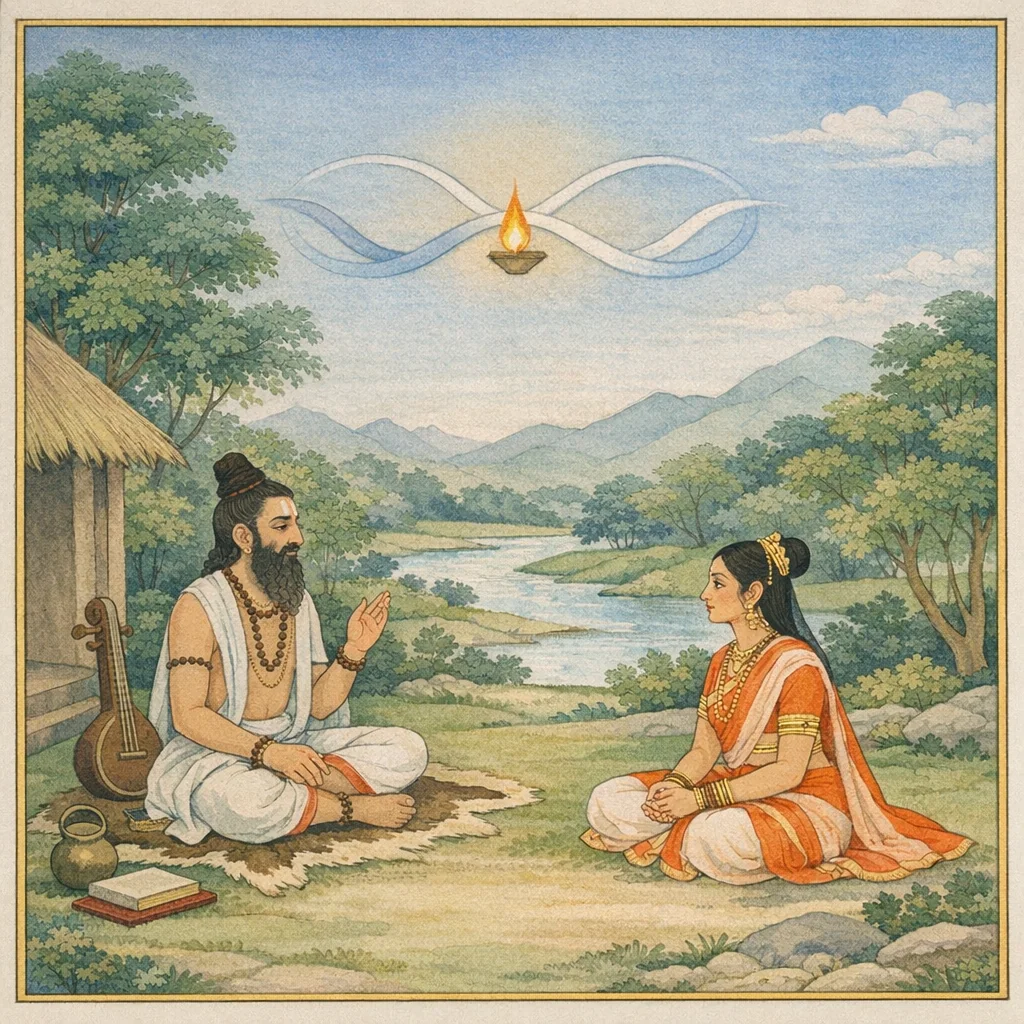
A brāhmaṇa introduces an old itihāsa: Devamata asks which vital function initiates first in a being being generated—prāṇa, apāna, samāna, vyāna, or udāna. Nārada replies that the factor by which the organism is formed is preceded by another, then specifies the ‘prāṇa-dvandva’ as the vertical pair: prāṇa and apāna moving upward and downward. He traces affective and sensory antecedents (saṃkalpa and the five sensory objects) culminating in ‘harṣa’ and identifies this as a form of udāna connected with procreative conjunction. Desire (kāma) generates semen and rasa; samāna and vyāna are said to participate in producing the common mixture of semen and blood. Prāṇa is stated to activate first in the mixed seed, followed by apāna once prāṇa modifies it. The chapter then expands dvandva logic: samāna and vyāna are treated as a lateral pair, while udāna is repeatedly described through a ritual schema—prāṇa and apāna as ghee-portions, samāna and vyāna as āghāra offerings, with hutāśana (fire) between them. Multiple dualities (day/night, solstitial courses, truth/untruth, auspicious/inauspicious, being/non-being) are mapped as dvandvas with an intervening ‘fire,’ presented as a ‘parama’ (highest) understanding of udāna known to brāhmaṇas. The close gestures to pacification (śānti) and Vāmadeva, aligning the teaching with a stabilizing, ritual-philosophical register rather than narrative action.
Chapter Arc: Ashvamedhika Parva’s reflective hush deepens: Deva-mata approaches Devarshi Narada with a question that turns the gaze inward—when a being is conceived and born, which vital force moves first? → Narada answers not with a single name but with a chain of causality: prana precedes and sets the field for the others; apana follows; the interplay of semen and blood, desire and embodiment, is mapped onto the five winds. The inquiry tightens as the discussion shifts from physiology to sacrificial symbolism—prana and apana as oblations, a fire between them. → The teaching crests in the Brahmana’s highest claim: between the dualities of sat and asat burns the inner fire, and this—known as the supreme form of udana—is what the wise recognize. The “breath-doctrine” becomes a metaphysical ladder from conception to Brahman. → Narada stabilizes the vision: samana and vyana are traced to sattva; vyana is singled out as oriented toward peace, and peace itself is declared the eternal Brahman. The chapter closes as a completed instruction within the Brahmana-gitas.
Shlokas
Verse 1
(दाक्षिणात्य अधिक पाठके १६ शलोक मिलाकर कुल २५३ श्लोक हैं) नशा (0) उस औअन+- चतुर्विशो5ध्याय: देवर्षि नारद और देवमतका संवाद एवं उदानके उत्कृष्ट रूपका वर्णन ब्राह्मण उवाच अत्राप्युदाहरन्तीममितिहासं पुरातनम् । नारदस्य च संवादमृषेर्देवमतस्य च,ब्राह्मणने कहा--प्रिये! इस विषयमें देवर्षि नारद और देवमतके संवादरूप प्राचीन इतिहासका उदाहरण दिया करते हैं
The Brāhmaṇa said: “Beloved, in this matter too people cite an ancient precedent—namely, the dialogue between the divine seer Nārada and the sage Devamata.”
Verse 2
देवमत उवाच जन्तो: संजायमानस्य कि नु पूर्व प्रवर्तते । प्राणो5पान: समानो वा व्यानो वोदान एव च,देवमतने पूछा--देवर्षे! जब जीव जन्म लेता है, उस समय सबसे पहले उसके शरीरमें किसकी प्रवृत्ति होती है? प्राण, अपान, समान, व्यान अथवा उदानकी?
Devamatā said: “O divine seer, when a living being is being born, which vital function begins to operate first within the body—prāṇa, apāna, samāna, vyāna, or udāna?”
Verse 3
नारद उवाच येनायं सृज्यते जन्तुस्ततो<न्यः पूर्वमेति तम् । प्राणद्वन्द्धं हि विज्ञेयं तिर्यगूर्धष्वमधश्च यत्,नारदजीने कहा--मुने! जिस निमित्त कारणसे इस जीवकी उत्पत्ति होती है, उससे भिन्न दूसरा पदार्थ भी पहले कारण-रूपसे उपस्थित होता है। वह है प्राणोंका द्वन्ध। जो ऊपर (देवलोक), तिर्यक् (मनुष्यलोक) और अधोलोक (पशु आदि)-में व्याप्त है, ऐसा समझना चाहिये
Nārada said: “That by which this living being is brought into existence—before that cause there arises another, distinct principle, already present as a prior condition. Know it to be the ‘pairing of the vital forces’ (the prāṇas in duality), pervading the realms above, the middle, and below.”
Verse 4
देवमत उवाच केनायं सृज्यते जन्तु: कश्चान्य: पूर्वमेति तम् । प्राणद्वन्द्धं च मे ब्रूहि तिर्यगूर्धष्यमधश्च॒ यत्,देवमतने पूछा--नारदजी! किस निमित्त कारणसे इस जीवकी सृष्टि होती है? दूसरा कौन पदार्थ पहले कारणरूपसे उपस्थित होता है तथा प्राणोंका द्वन्द्ध क्या है, जो ऊपर, मध्यमें और नीचे व्याप्त है?
Devamatā said: “By what cause is this living being brought into existence? And what other principle comes first, preceding it as the prior cause? Also tell me about the ‘pairing/duality of the vital breaths’—that which pervades the realms below, the middle, and above.”
Verse 5
नारद उवाच संकल्पाज्जायते हर्ष: शब्दादपि च जायते । रसात् संजायते चापि रूपादपि च जायते,नारदजीने कहा--मुने! संकल्पसे हर्ष उत्पन्न होता है, मनोनुकूल शब्दसे, रससे और रूपसे भी हर्षकी उत्पत्ति होती है
Nārada said: “Joy arises from one’s own mental resolve; it also arises from pleasing sounds. Joy is born as well from taste, and it is born from form (what is seen).”
Verse 6
शुक्राच्छोणितसंसृष्टात् पूर्व प्राण: प्रवर्तते । प्राणेन विकृते शुक्रे ततो5पान: प्रवर्तते,रजमें मिले हुए वीर्यसे पहले प्राण आकर उसमें कार्य आरम्भ करता है। उस प्राणसे वीर्यमें विकार उत्पन्न होनेपर फिर अपानकी प्रवृत्ति होती है
Nārada explained: “When semen (śukra) becomes mixed with blood (śoṇita), first the vital breath prāṇa begins its operation there. When that semen is transformed by prāṇa, then apāna, the downward-moving life-force, subsequently becomes active.”
Verse 7
शुक्रात् संजायते चापि रसादपि च जायते । एतद्ू रूपमुदानस्य हर्षो मिथुनमन्तरा,शुक्रसे और रससे भी हर्षकी उत्पत्ति होती है, यह हर्ष ही उदानका रूप है। उक्त कारण और कार्यरूप जो मिथुन है, उन दोनोंके बीचमें हर्ष व्याप्त होकर स्थित है
Nārada said: “Joy (harṣa) arises from semen (śukra) and also from bodily essence/juice (rasa). This joy is a manifestation of the vital current called udāna. Between the paired factors of cause and effect—likened here to a ‘couple’ (mithuna)—joy pervades and abides as the connecting presence.”
Verse 8
कामात् संजायते शुक्र शुक्रात् संजायते रज: । समानव्यानजनिते सामान्ये शुक्रशोणिते,प्रवृत्तिके मूलभूत कामसे वीर्य उत्पन्न होता है। उससे रजकी उत्पत्ति होती है। ये दोनों वीर्य और रज समान और व्यानसे उत्पन्न होते हैं। इसलिये सामान्य कहलाते हैं
Nārada said: From desire arises semen; from semen arises rajas (the generative or menstrual element). Both semen and blood—being produced through the vital functions called Samāna and Vyāna—are therefore termed “common” (shared constituents).
Verse 9
प्राणापानाविदं द्वन्द्भवाक् चोर्ध्व॑ च गच्छत: । व्यान: समानश्वैवोभौ तिर्यग् द्वन्द्धत्वमुच्यते,प्राण और अपान--ये दोनों भी द्वन्द्ध हैं। ये नीचे और ऊपरको जाते हैं। व्यान और समान--ये दोनों मध्यगामी द्वन्द्ध कहे जाते हैं
Nārada said: Prāṇa and Apāna form a paired opposition: they move in opposite directions—one upward and the other downward. Likewise, Vyāna and Samāna are also spoken of as a duality, moving laterally and pervading the middle. Thus the vital functions within the body are understood through complementary pairs, revealing an ordered balance.
Verse 10
अन्निर्व देवता: सर्वा इति देवस्प शासनम् | संजायते ब्राह्मणस्य ज्ञानं बुद्धिसमन्वितम्,अग्नि अर्थात् परमात्मा ही सम्पूर्ण देवता हैं। यह वेद उन परमेश्वरकी आज्ञारूप है। उस वेदसे ही ब्राह्मणमें बुद्धियुक्त ज्ञान उत्पन्न होता है
Narada said: “Agni is indeed all the deities”—such is the authoritative ordinance of the divine revelation. From that Vedic command there arises in a Brahmin a knowledge endowed with discernment, directing the mind toward the one supreme reality understood as Agni.
Verse 11
तस्य धूमस्तमो रूप॑ रजो भस्मसु तेजस: । सर्व संजायते तस्य यत्र प्रक्षिप्पते हवि:,उस अग्निका धुआँ तमोमय और भस्म रजोमय है। जिसके निमित्त हविष्यकी आहुति दी जाती है, उस अग्निसे (प्रकाशस्वरूप परमेश्वरसे) यह सारा जगत् उत्पन्न होता है
Nārada said: “Of that sacred Fire, the smoke takes on the nature of darkness, and the ash bears the quality of rajas; yet its very essence is radiance. And from that very Fire—into which the oblation is cast for the sake of the One—this entire world comes forth.”
Verse 12
सत्त्वात् समानो व्यानश्न इति यज्ञविदो विदु: । प्राणापानावाज्यभागौ तयोर्मध्ये हुताशनः,यज्ञवेत्ता पुरुष यह जानते हैं कि सत्त्गगुणसे समान और व्यानकी उत्पत्ति होती है। प्राण और अपान आज्यभाग नामक दो आहुतियोंके समान हैं। उनके मध्यभागमें अग्निकी स्थिति है। यही उदानका उत्कृष्ट रूप है, जिसे ब्राह्मणलोग जानते हैं। जो निर्द्धन्द्र कहा गया है, उसे भी बताता हूँ, तुम मेरे मुखसे सुनो
Nārada said: Those who know the inner meaning of sacrifice teach that from sattva arises Samāna and Vyāna. Prāṇa and Apāna are like two oblations of clarified butter, and between them stands the fire. Thus the body itself is understood as a sacrificial altar: the life-breaths become offerings, and the inner fire receives them.
Verse 13
एतद्ू रूपमुदानस्य परम॑ ब्राह्मणा विदु: । निर्दन्द्मिति यत् त्वेतत् तन्मे निगदत: शृणु,यज्ञवेत्ता पुरुष यह जानते हैं कि सत्त्गगुणसे समान और व्यानकी उत्पत्ति होती है। प्राण और अपान आज्यभाग नामक दो आहुतियोंके समान हैं। उनके मध्यभागमें अग्निकी स्थिति है। यही उदानका उत्कृष्ट रूप है, जिसे ब्राह्मणलोग जानते हैं। जो निर्द्धन्द्र कहा गया है, उसे भी बताता हूँ, तुम मेरे मुखसे सुनो
Nārada said: “This is the supreme form of Udāna, as the knowers among the Brāhmaṇas understand it. And as for what is called ‘free from the pairs of opposites’ (nirdvandva), listen as I explain it to you.”
Verse 14
अहोरात्रमिदं द्वद्ध॑ तयोर्मध्ये हुताशन: । एतद् रूपमुदानस्य परम॑ ब्राह्मणा विदु:,ये दिन और रात द्वन्द्द हैं, इनके मध्यभागमें अग्नि हैं। ब्राह्मगलोग इसीको उदानका उत्कृष्ट रूप मानते हैं
Nārada said: “Day and night form a pair of opposites; between them stands the sacred fire. The Brahmanas know this to be the highest manifestation of udāna—the upward-moving vital force—by which life is sustained and directed.”
Verse 15
सच्चासच्चैव तद् द्वन्ड तयोर्मध्ये हुताशन: । एतद् रूपमुदानस्य परम॑ ब्राह्मणा विदु:,सत् और असत--ये दोनों द्वन्द हैं तथा इनके मध्यभागमें अग्नि हैं। ब्राह्मणलोग इसे उदानका परम उत्कृष्ट रूप मानते हैं
Narada said: “Being and non-being—these two stand as a pair of opposites; and between them burns the fire. The Brahmanas know this to be the highest, most refined form of udāna—the upward-moving vital force—by which one rises beyond extremes.”
Verse 16
ऊर्ध्व॑ समानो व्यानश्न व्यस्यते कर्म तेन तत् तृतीयं तु समानेन पुनरेव व्यवस्यते,ऊर्ध्व अर्थात् ब्रह्म जिस संकल्प नामक हेतुसे समान और व्यानरूप होता है, उसीसे कर्मका विस्तार होता है। अत: संकल्पको रोकना चाहिये। जाग्रत् और स्वप्नके अतिरिक्त जो तीसरी अवस्था है, उससे उपलक्षित ब्रह्मका समानके द्वारा ही निश्चय होता है
Narada said: “The upward-moving principle, together with the vital functions called samāna and vyāna, becomes the basis by which action spreads and diversifies. Therefore, one should restrain the ‘saṅkalpa’ (impulsive resolve) that drives this outward expansion. And that Brahman which is indicated by the ‘third state’ beyond waking and dream is again ascertained through samāna—through inner equilibrium and assimilation rather than outward activity.”
Verse 17
शान्त्यर्थ व्यानमेकं च शान्तिर्त्रह्या सनातनम् । एतद् रूपमुदानस्य परम॑ ब्राह्मणा विदु:,एकमात्र व्यान शान्तिके लिये है। शान्ति सनातन ब्रह्म है। ब्राह्मगलोग इसीको उदानका परम उत्कृष्ट रूप मानते हैं
Nārada said: “For the sake of peace, the single (regulated) vital current called vyāna is to be understood; and Peace itself is the eternal Brahman. The Brahman-knowers regard this as the supreme, most excellent form of udāna.”
Verse 24
इति श्रीमहाभारते आश्वमेधिके पर्वणि अनुगीतापर्वणि ब्राह्मणगीतासु चतुर्विशोडध्याय:
Thus ends the twenty-fourth chapter of the Brāhmaṇa-gītā section within the Anugītā sub-parvan of the Aśvamedhika Parvan in the revered Mahābhārata.
Frequently Asked Questions
Devamata asks which vital function begins first in a being coming into existence—prāṇa, apāna, samāna, vyāna, or udāna—prompting a ranked explanation of life-process initiation.
Embodied life is presented as structured by coordinated ‘pairs’ (dvandvas) of forces and meanings; udāna is interpreted as a highest-order pattern that can be read through the sacrificial model of portions, offerings, and the mediating fire.
Rather than an explicit phalaśruti, it offers an internal authorization formula—‘paramaṃ brāhmaṇā viduḥ’—marking the udāna interpretation as a recognized, high-status doctrinal understanding within brāhmaṇa knowledge traditions.