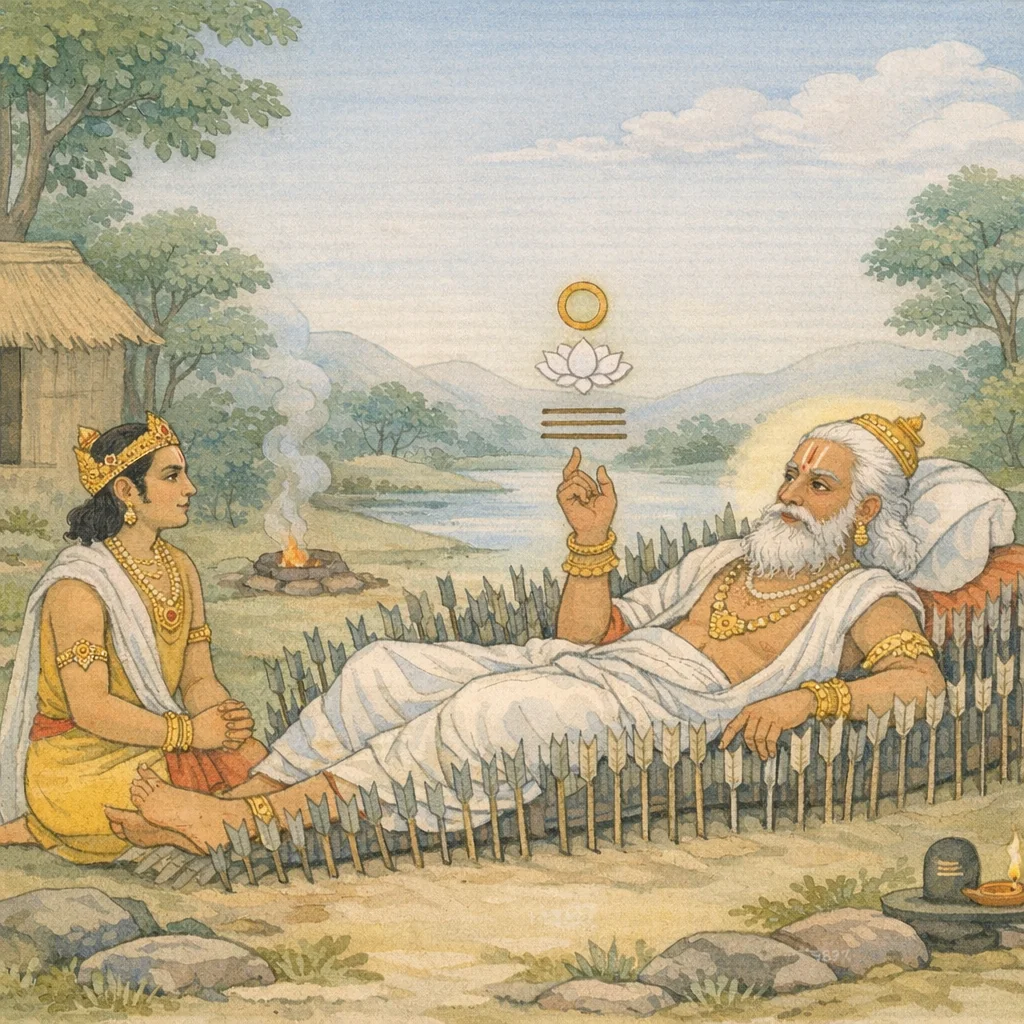
Adhyaya 118
Dvaipāyana–Kīṭa Saṃvāda: Karmic Memory, Fear of Death, and Embodied Pleasure
Upa-parva: Dvaipāyana–Kīṭa Saṃvāda (Episode on Yoni, Fear of Death, and Karmic Residue)
Yudhiṣṭhira questions Bhīṣma about the destination (yoni) of those who died in the great battle, noting the hardship of relinquishing life and asking why beings are born into prosperous or deprived, auspicious or inauspicious conditions. Bhīṣma affirms the question’s rigor and narrates an earlier episode: Vyāsa encounters a frightened insect running along a cart-track. Vyāsa asks the cause of its fear; the insect explains it hears the cart’s harsh sound and flees, valuing its rare life and fearing death. Vyāsa challenges the insect’s claim to happiness in an animal yoni, arguing it lacks refined sensory enjoyments and that death might be preferable. The insect counters that every being finds a form of happiness appropriate to its embodiment, and it desires to live. It then recounts a prior human life as a wealthy śūdra characterized by harsh speech, deceit, theft, envy, neglect of giving meant for gods and ancestors, and abandonment of those seeking refuge—followed by remorse. It also recalls limited meritorious acts: honoring an aged mother, revering a brāhmaṇa, and properly honoring a guest of good conduct, which sustains memory and a residual hope for well-being. The insect requests from Vyāsa instruction on what is truly beneficial (śreyas), framing the chapter as a case-study in mixed karma, death-anxiety, and the moral logic behind birth conditions.
Chapter Arc: जनमेजय के समक्ष वैशम्पायन कहते हैं कि शरतल्प पर पड़े पितामह भीष्म से युधिष्ठिर फिर प्रश्न करते हैं—मन, वाणी और कर्म से होने वाली हिंसा का बंधन मनुष्य को कैसे दुःख में डालता है और उससे मुक्ति कैसे मिले? → भीष्म ‘चतुर्विध’ अहिंसा का विधान रखते हैं और बताते हैं कि जीव मन- वाणी- कर्म—तीनों स्तरों पर हिंसा से लिप्त होता है; इसलिए केवल बाह्य कर्म रोकना पर्याप्त नहीं, पहले मन में त्याग, फिर वाणी में संयम, फिर कर्म में निवृत्ति आवश्यक है। मांसभक्षण को वे हिंसा-श्रृंखला का प्रत्यक्ष फल बताते हुए उसकी घोर निन्दा करते हैं। → भीष्म का निर्णायक उपदेश: जो पहले मन से, फिर वाणी से, फिर कर्म से हिंसा का त्याग कर मांस नहीं खाता, वह ‘त्रिविध’ दोष से मुक्त होता है; और जैसे माता-पिता के संयोग से पुत्र जन्मता है, वैसे ही हिंसा से पाप का पुनर्जन्म/वृद्धि होती है—अर्थात हिंसा स्वयं को जन्म देती रहती है। → अहिंसा को ‘सर्वधर्मानुसंहिता’—समस्त धर्मों का सार—बताकर भीष्म निष्कर्ष देते हैं कि चार कारणों/उपायों से सुरक्षित यह अहिंसा-धर्म लोक में प्राचीन काल से धर्मतः प्रतिष्ठित है; युधिष्ठिर के प्रश्न का उत्तर एक आचार-सूत्र में स्थिर हो जाता है: अंतःकरण की शुद्धि से ही बाह्य आचरण शुद्ध होता है।
Shlokas
Verse 1
भीकम (2 अमान चतुर्दशाधिकशततमो< ध्याय: हिंसा और मांसभक्षणकी घोर निन्दा वैशम्पायन उवाच ततो युधिछिरो राजा शरतल्पे पितामहम् | पुनरेव महातेजा: पप्रच्छ वदतां वर:
Vaiśampāyana said: Then King Yudhiṣṭhira again questioned the grandsire Bhīṣma, who lay upon the bed of arrows. The radiant king—foremost among speakers—sought further instruction, setting the stage for a stern ethical condemnation of violence and the eating of flesh.
Verse 2
वैशम्पायनजी कहते हैं--जनमेजय! तदनन्तर महातेजस्वी और वक्ताओंमें श्रेष्ठ राजा युधिष्ठिरने बाणशय्यापर पड़े हुए पितामह भीष्मसे पुनः प्रश्न किया ।। युधिछिर उवाच ऋष यो ब्राह्मणा देवा: प्रशंसन्ति महामते । अहिंसालक्षणं धर्म वेदप्रामाण्यदर्शनात्,युधिष्ठिरने पूछा--महामते! देवता, ऋषि और ब्राह्मण वैदिक प्रमाणके अनुसार सदा अहिंसा-धर्मकी प्रशंसा किया करते हैं। अतः नृपश्रेष्ठ! मैं पूछता हूँ कि मन, वाणी और क्रियासे भी हिंसाका ही आचरण करनेवाला मनुष्य किस प्रकार उसके दुःखसे छुटकारा पा सकता है?
Yudhiṣṭhira said: “O great-minded one! Sages, Brahmins, and the gods—on the authority of the Veda—continually praise that dharma whose mark is non-violence. Therefore, O best of kings, I ask: how can a mortal who, by mind, speech, and bodily action, practices violence alone ever be released from the suffering that follows from it?”
Verse 3
कर्मणा मनुज: कुर्वन् हिंसां पार्थिवसत्तम | वाचा च मनसा चैव कथं दु:खात् प्रमुच्यते,युधिष्ठिरने पूछा--महामते! देवता, ऋषि और ब्राह्मण वैदिक प्रमाणके अनुसार सदा अहिंसा-धर्मकी प्रशंसा किया करते हैं। अतः नृपश्रेष्ठ! मैं पूछता हूँ कि मन, वाणी और क्रियासे भी हिंसाका ही आचरण करनेवाला मनुष्य किस प्रकार उसके दुःखसे छुटकारा पा सकता है?
Yudhiṣṭhira said: “O best of kings, if a man commits violence through his actions—and also through his speech and even his mind—how can he ever be released from the suffering that such violence brings?”
Verse 4
भीष्म उवाच चतुर्विधियं निर्दिष्टा हाहिंसा ब्रह्मवादिभि: । एकैकतो<पि विश्रष्टा न भवत्यरिसूदन,भीष्मजीने कहा--शत्रुसूदन! ब्रह्मवादी पुरुषोंने (मनसे, वाणीसे तथा कर्मसे हिंसा न करना एवं मांस न खाना--इन) चार उपायोंसे अहिंसाधर्मका पालन बतलाया है। इनमेंसे किसी एक अंशकी भी कमी रह गयी तो अहिंसा-धर्मका पूर्णतः: पालन नहीं होता
Bhishma said: “The Brahma-speaking sages have prescribed non-violence as fourfold. O Arisudana, if even one of these parts is missing, it does not become the complete observance of the vow of non-violence.”
Verse 5
यथा सर्वश्षतुष्पाद वै त्रिभि: पादैर्न तिष्ठति । तथैवेयं महीपाल कारणै: प्रोच्यते त्रिभि:,महीपाल! जैसे चार पैरोंवाला पशु तीन पैरोंसे नहीं खड़ा रह सकता, उसी प्रकार केवल तीन ही कारणोंसे पालित हुई अहिंसा पूर्णतः: अहिंसा नहीं कही जा सकती
Bhishma said: “Just as a four-footed creature cannot stand firmly on only three feet, so too, O king, what is maintained or explained on merely three causes cannot be called complete non-violence. True ahiṃsā must rest on all its necessary supports, not on an incomplete foundation.”
Verse 6
यथा नागपदे<न्यानि पदानि पदगामिनाम् | सर्वाण्येवापिधीयन्ते पदजातानि कौज्जरे
Bhīṣma said: “Just as, in the footprint of an elephant, the other tracks of creatures that move on feet are all encompassed and covered—so too are the rest gathered within the foremost principle being taught here.”
Verse 7
कर्मणा लिप्यते जन्तुर्वाचा च मनसापि च,जीव मन, वाणी और क्रियाके द्वारा हिंसाके दोषसे लिप्त होता है, किंतु जो क्रमशः पहले मनसे, फिर वाणीसे और फिर क्रियाद्वारा हिंसाका त्याग करके कभी मांस नहीं खाता, वह पूर्वोक्त तीनों प्रकारकी हिंसाके दोषसे भी मुक्त हो जाता है
A creature is stained by the fault of violence through deed, through speech, and even through the mind. But one who, in due order, abandons violence first in thought, then in word, and then in action—and therefore never eats meat—is freed even from the taint of those three kinds of violence spoken of above.
Verse 8
पूर्व तु मनसा त्यक्त्वा तथा वाचाथ कर्मणा । न भक्षयति यो मांसं त्रिविधं स विमुच्यते,जीव मन, वाणी और क्रियाके द्वारा हिंसाके दोषसे लिप्त होता है, किंतु जो क्रमशः पहले मनसे, फिर वाणीसे और फिर क्रियाद्वारा हिंसाका त्याग करके कभी मांस नहीं खाता, वह पूर्वोक्त तीनों प्रकारकी हिंसाके दोषसे भी मुक्त हो जाता है
Bhīṣma said: “One who first renounces violence in the mind, then in speech, and then in action—and who therefore does not eat meat—is released from the taint of the threefold violence. The teaching emphasizes that ethical purity is graded and complete only when intention, words, and deeds are all restrained from harm.”
Verse 9
त्रिकारणं तु निर्दिष्ट श्रूयते ब्रह्मवादिभि: । मनो वाचि तथा<<स्वादे दोषा होषु प्रतिष्ठिता:,ब्रह्मवादी महात्माओंने हिंसादोषके प्रधान तीन कारण बतलाये हैं--मन (मांस खानेकी इच्छा), वाणी (मांस खानेका उपदेश) और आस्वाद (प्रत्यक्षरूपमें मांसका स्वाद लेना)। ये तीनों ही हिंसा-दोषके आधार हैं
Bhishma said: The teachers of Brahman declare that the fault (of violence) rests upon three principal causes: the mind (the intention or craving), speech (urging or instructing others), and taste (the direct enjoyment of eating). Thus, even before an act is completed outwardly, its ethical burden is grounded in these three—desire, endorsement, and indulgence.
Verse 10
न भक्षयन्त्यतो मांसं तपोयुक्ता मनीषिण: । दोषांस्तु भक्षणे राजन् मांसस्येह निबोध मे,इसलिये तपस्यामें लगे हुए मनीषी पुरुष कभी मांस नहीं खाते हैं। राजन! अब मैं मांसभक्षणमें जो दोष है, उनको यहाँ बता रहा हूँ, सुनो
Bhishma said: “Therefore, men of discernment who are devoted to austerity do not eat meat. O King, now understand from me the faults that attend the eating of meat in this world—listen.”
Verse 11
पुत्रमांसोपमं जानन् खादते यो<विचक्षण: । मांसं मोहसमायुक्त: पुरुष: सो5धम: स्मृत:,जो मूर्ख यह जानते हुए भी कि पुत्रके मांसमें और दूसरे साधारण मांसोंमें कोई अन्तर नहीं है, मोहवश मांस खाता है, वह नराधम है
Bhīṣma said: “Knowing that flesh is comparable to the flesh of one’s own son, the undiscerning man still eats it. A person who, deluded by infatuation and ignorance, consumes meat is therefore remembered as base and blameworthy.”
Verse 12
पितृमातृसमायोगे पुत्रत्वं जायते यथा । हिंसां कृत्वावश: पापो भूयिष्ठं जायते तथा,जैसे पिता और माताके संयोगसे पुत्रकी उत्पत्ति होती है, उसी प्रकार हिंसा करनेसे पापी पुरुषको विवश होकर बारंबार पापयोनिमें जन्म लेना पड़ता है
Bhīṣma said: “Just as sonship arises from the union of father and mother, so too a sinful man, having committed violence, is driven helplessly to be born again and again—most often in sinful wombs.”
Verse 13
रसं च प्रतिजिह्नाया ज्ञान प्रज्ञायते यथा । तथा शास्त्रेषु नियतं रागो ह्यास्वादिताद् भवेत्,जैसे जीभसे जब रसका ज्ञान होता है, तब उसके प्रति वह आकृष्ट होने लगती है, उसी प्रकार मांसका आस्वादन करनेपर उसके प्रति आसक्ति बढ़ती है। शास्त्रोंमें भी कहा है कि विषयोंके आस्वादनसे उनके प्रति आसक्ति उत्पन्न होती है
Bhishma said: “Just as the tongue, upon recognizing a taste, naturally becomes drawn toward it, so too it is a settled teaching of the scriptures that attachment arises from what has been tasted and enjoyed. Therefore, repeated indulgence in sense-objects—such as the relish of meat—strengthens craving rather than quieting it.”
Verse 14
संस्कृतासंस्कृता: पक्वा लवणालवणास्तथा | प्रजायन्ते यथा भावास्तथा चित्त निरुध्यते,संस्कृत (मसाले आदि डालकर संस्कृत किया हुआ) असंस्कृत (मसाला आदिके संस्कारसे रहित), पकक्व, केवल नमक मिला हुआ और अलोना--े मांसकी जो-जो अवस्थाएँ होती हैं, उन्हीं-उन्हींमें रुचिभेदसे मांसाहारी मनुष्यका चित्त आसक्त होता है
Bhīṣma said: “Meat comes to be in many conditions—prepared with seasonings, unprepared, cooked, merely salted, or unsalted. In whatever form such states arise, the mind of the meat-eater becomes held fast there, drawn by differences of taste.”
Verse 15
भेरीमृदंगशब्दांश्व तन्त्रीशब्दांश्ष पुष्कलान् | निषेविष्यन्ति वै मन्दा मांसभक्षा: कथं नरा:
Bhīṣma said: “How can men who are dull-witted and meat-eating truly take delight in the abundant sounds of kettledrums and mṛdaṅgas, and in the rich music of stringed instruments?”
Verse 16
मांसभक्षी मूर्ख मनुष्य स्वर्गमें पूर्णतः सुलभ होनेवाले भेरी, मृदंग और वीणाके दिव्य मधुर शब्दोंका सेवन कैसे कर सकेंगे; क्योंकि वे स्वर्गमें नहीं जा सकते ।। (परेषां धनधान्यानां हिंसकास्तावकास्तथा । प्रशंसका श्च॒ मांसस्य नित्यं स्वर्गे बहिष्कृता: ।।) दूसरोंके धन-धान्यको नष्ट करनेवाले तथा मांस-भक्षणकी स्तुति-प्रशंसा करनेवाले मनुष्य सदा ही स्वर्गसे बहिष्कृत होते हैं ।। अचिन्तितमनिर्दिष्टमसंकल्पितमेव च । रसगृद्धयाभिभूता ये प्रशंसन्ति फलार्थिन:,जो मांसके रसमें होनेवाली आसक्तिसे अभिभूत होकर उसी अभीष्ट फल मांसकी अभिलाषा रखते हैं तथा उसके बारंबार गुण गाते हैं, उन्हें ऐसी दुर्गति प्राप्त होती है, जो कभी चिन्तनमें नहीं आयी है। जिसका वाणीद्दारा कहीं निर्देश नहीं किया गया है तथा जो कभी मनकी कल्पनामें भी नहीं आयी है
Bhīṣma said: Those who destroy other people’s wealth and grain, and those who habitually praise the eating of meat, are forever excluded from heaven. Overpowered by craving for taste, they extol meat while longing for its desired ‘reward’; they fall into a fate so dreadful that it was never imagined, never specified, and never even conceived in the mind. Implicitly, such people cannot partake of the heavenly delights—like the divine, sweet sounds of drums and lutes—because they do not reach heaven at all.
Verse 17
(भस्म विष्ठा कृमिर्वापि निष्ठा यस्येदृशी ध्रुवा । स काय: परपीडाभि: कथं धार्यों विपश्चिता ।।) प्रशंसा होव मांसस्य दोषकर्मफलान्विता,जो मृत्युके पश्चात् चितापर जला देनेसे भस्म हो जाता है अथवा किसी हिंसक प्राणीका खाद्य बनकर उसकी विष्ठाके रूपमें परिणत हो जाता है, या यों ही फेंक देनेसे जिसमें कीड़े पड़ जाते हैं--इन तीनोंमेंसे यह एक-न-एक परिणाम जिसके लिये सुनिश्चित है, उस शरीरको विद्वान् पुरुष दूसरोंको पीड़ा देकर उसके मांससे कैसे पोषण कर सकता है? मांसकी प्रशंसा भी पापमय कर्मफलसे सम्बन्ध कर देती है
Bhishma said: “For this body, one of these outcomes is certain and inevitable: it will become ashes, or it will turn into excrement after being eaten by some creature, or it will be cast away and become infested with worms. Knowing this, how can a wise person sustain and maintain such a body by inflicting pain on others (for the sake of its flesh)? Even praising the eating of meat entangles one in sinful action and its consequences.”
Verse 18
जीवितं हि परित्यज्य बहव: साधवो जना: । स्वमांसै: परमांसानि परिपाल्य दिव॑ गता:,उशीनर शिबि आदि बहुत-से श्रेष्ठ पुरुष दूसरोंकी रक्षाके लिये अपने प्राण देकर, अपने मांससे दूसरोंके मांसकी रक्षा करके स्वर्गलोकमें गये हैं
Bhishma said: “Indeed, many virtuous people have renounced even their own lives. By protecting the flesh of others with their own flesh—sacrificing themselves for another’s safety—they attained heaven. Such is the exalted path of self-giving protection.”
Verse 19
एवमेषा महाराज चतुर्भि: कारणैर्वृता । अहिंसा तव निर्दिष्टा सर्वधर्मानुसंहिता,महाराज! इस प्रकार चार उपायोंसे जिसका पालन होता है, उस अहिंसा-धर्मका तुम्हारे लिये प्रतिपादन किया गया। यह सम्पूर्ण धर्मोमें ओतप्रोत है
Bhishma said: “Thus, O great king, this principle—sustained and upheld through four supporting causes—has been set forth for you as ahiṃsā (non-violence). It is interwoven with, and gathers within itself, the essence of all dharmas.”
Verse 66
एवं लोकेष्वहिंसा तु निर्दिष्टा धर्मत: पुरा । जैसे हाथीके पैरके चिह्ममें सभी पदगामी प्राणियोंके पदचिह्न समा जाते हैं, उसी प्रकार पूर्वकालमें इस जगत्के भीतर धर्मतः अहिंसाका निर्देश किया गया है अर्थात् अहिंसाधर्ममें सभी धर्मोंका समावेश हो जाता है। ऐसा माना गया है
“Thus, in the worlds, ahiṃsā was taught long ago as dharma. Just as within the footprint of an elephant all the footprints of creatures that walk can be contained, so too does the dharma of non-violence include all dharmas within itself—so it is held to be.”
Verse 114
इति श्रीमहाभारते अनुशासनपर्वणि दानधर्मपर्वणि मांसवर्जनक थने चतुर्दशशाधिकशततमो<ध्याय:
Thus, in the Śrī Mahābhārata, within the Anuśāsana Parva—specifically in the section on the dharma of giving—ends the one-hundred-and-fourteenth chapter, which treats the discourse on abstaining from meat. (This is a concluding colophon marking the close of the chapter.)
Frequently Asked Questions
Whether life in a lower embodiment is worth preserving despite suffering and limited pleasures, and how one should interpret one’s present condition when past conduct contains both harmful actions and occasional meritorious duties.
Happiness and desire to live are embodiment-relative, but karmic consequences remain ethically structured: neglect of duty and harm degrade outcomes, while even limited sincere acts (honoring elders, guests, and the worthy) can preserve moral continuity and open a path toward śreyas.
No explicit phalāśruti appears in the provided passage; the chapter functions instead as a didactic exemplum, positioning the narrative as interpretive guidance for understanding karma, rebirth, and ethical reform.