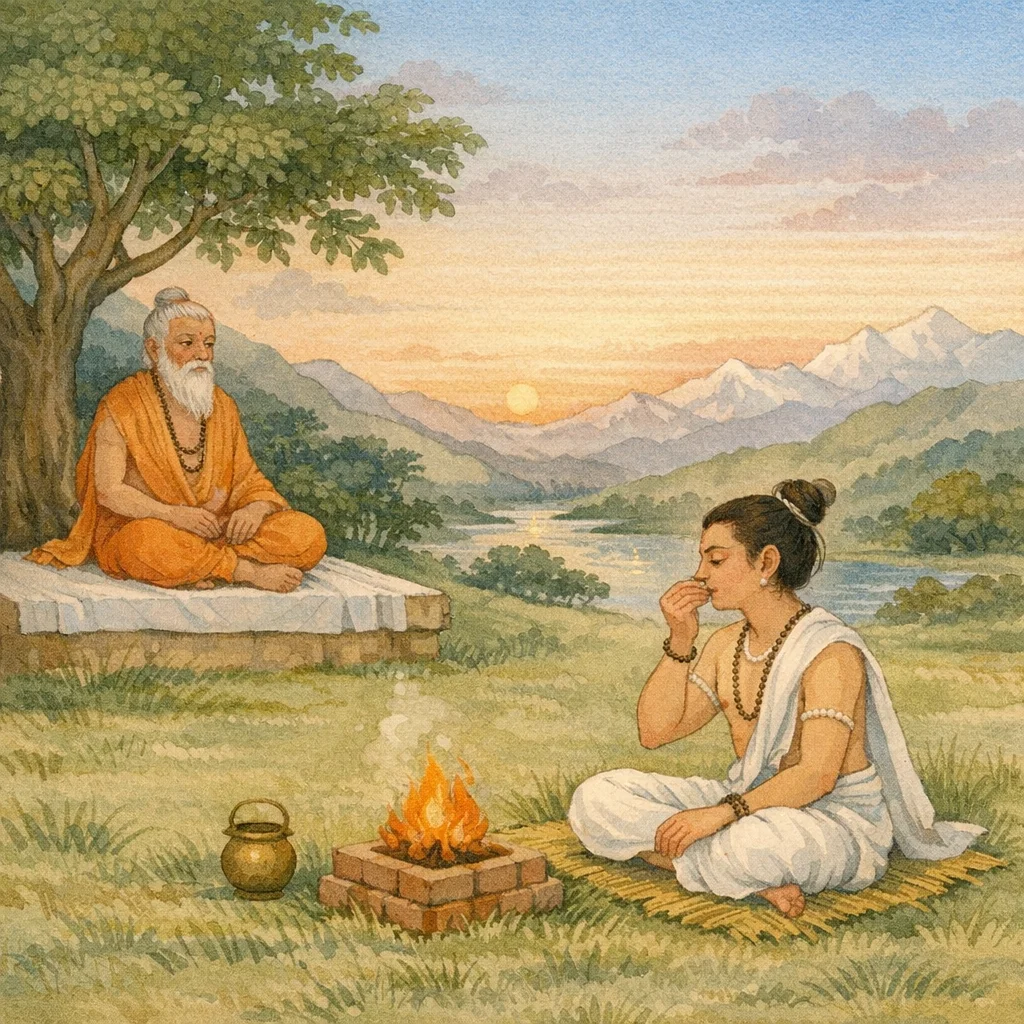
Adhyaya 94
Upanayana Timing, Brahmacarya Rules, Ācamana & Sandhyā Observance
Continuing the ācāra-based instruction, Yājñavalkya systematizes dvija discipline by fixing the proper ages for upanayana for brāhmaṇa, kṣatriya, and vaiśya lineages, and by linking initiation to training in śauca (purity) and sadācāra (right conduct). He sets out practical purity rules (directional etiquette, cleansing with earth and water) and the formal ācamana: how to sit and face, use of the Brahma-tīrtha, the hand-tīrtha classifications, and the required quality of water. The chapter then teaches the chief daily purifiers—bathing, mārjana, prāṇāyāma, Sūryopasthāna, and Gāyatrī-japa—explaining recitation with the vyāhṛtis, praṇava, and the Śiras, and placing fire-rites at both twilights. It concludes with guru-centered brahmacarya (bhikṣā, humility, food restraints), definitions of ācārya/upādhyāya/ṛtvik, warnings of vrātya status if initiation is missed, and the doctrine that daily offerings and Veda-recitation yield corresponding fruits, culminating in Brahmaloka for one who fulfills duties, even through authorized proxies when needed—grounding later conduct chapters in daily ritual-ethics.
Shlokas
Verse 1
नाम त्रिनवतितमो ऽध्यायः याज्ञवल्क्य उवाच / गर्भाष्टमे ऽष्टमे वाब्दे ब्राह्मणस्योपनायनम् / रज्ञामेकादशे सैके विशामेके यथाकुलम्
Yājñavalkya said: This is called the ninety-fourth chapter. For a brāhmaṇa, the upanayana—initiation with the sacred thread—should be performed in the eighth year from conception (or in the eighth year of age); for kings, the kṣatriyas, in the eleventh; and for vaiśyas in an appropriate year according to family tradition.
Verse 2
उपनीय कुरुः शिष्यं महाव्याहृतिपूर्वकम् / वेदमध्यापयेदेनं शौचाचारांश्च शिक्षयेत्
Having first invested the student with the sacred thread—preceded by the great utterances (bhūḥ, bhuvaḥ, svaḥ)—the teacher should teach him the Veda and also train him in the disciplines of purity and right conduct.
Verse 3
दिवा सन्ध्यासु कर्णस्थब्रह्मसूत्र उदड्मुखः / कुर्यान्मूत्रपुरीषे तु रात्रौ चेद्दक्षिणामुखः
In the daytime, and at the twilight junctions (sandhyās), with the sacred thread resting near the ear, one should face north while urinating or evacuating; but at night, one should do so facing south.
Verse 4
गृहीतशिश्रश्चोत्थाय मृद्भिरभ्युद्धृतैर्जलैः / गन्धलेपक्षयकरं शौचं कुर्यान्महाव्रतः
Having grasped the organ and then rising, the man of strict vow should perform purification (śauca) with earth and with drawn water, in a manner that removes any lingering smell and bodily residue.
Verse 5
अन्तर्जानुः शुचौ देश उपविष्ट उदङ्मुखः / प्राग्वा ब्राह्मेण तीर्थेन द्विजो नित्यमुपस्पृशेत्
A twice-born man should daily perform ācamana, seated in a clean place with knees drawn up, facing north—or else east—taking the water by the Brahma-tīrtha, the hand-position prescribed for Brahmanic rites.
Verse 6
कनिष्ठादेशिन्यङ्गुष्ठमूलान्यग्रं करस्य च / प्रजापतिपितृब्रह्मदेवतीर्थान्यनुक्रमात्
The roots of the little finger, the ring finger, and the thumb, and also the tip of the hand—these are, in due order, the sacred tīrthas of Prajāpati, the Pitṛs, Brahmā, and the Devas.
Verse 7
त्रिः प्राश्यापो द्विरुन्मृज्य खान्याद्भिः समुपस्पृशेत् / अद्भिस्तु प्रकृतिस्थाभिर्हेनाभिः फेनबुहुदैः
After sipping water three times and wiping the mouth twice, one should perform ācamana by touching the sense-openings with water. This is to be done with water in its natural state—clear, unmixed with foam, and free from excessive froth.
Verse 8
हृत्कण्ठतालुगाभिस्तु यथासंख्यं द्विजातयः / शुध्येरंस्त्री च शूद्रश्च सकृत्स्पृष्टाभिरन्ततः
By purificatory waters that have reached the heart, the throat, and the palate—according to the prescribed gradation—the twice-born become purified; and a woman and a Śūdra become purified when they are touched by that water once, at the end.
Verse 9
स्नानमब्दैवतैर्मन्त्रैर्मार्जनं प्राणसंयमः / सूर्यस्य चाप्युपस्थानं गायत्त्रयाः प्रत्ययं जपः
Bathing with mantras to the deities who preside over the waters, purificatory sprinkling (mārjana), restraint of the life-breath (prāṇāyāma), reverent attendance upon the Sun, and japa of the Gāyatrī with steady faith—these are the purifying observances.
Verse 10
गायत्त्रीं शिरसा सार्धं जपेद्व्याहृतिपूर्विकाम् / प्रतिप्रणवसंयुक्तां त्रिरयं प्राणसंयमः
With the “Śiras” (the head-formula of the Gāyatrī), one should recite the Gāyatrī preceded by the vyāhṛtis; each time joined with the praṇava “Oṃ”, it should be done three times, with the breath restrained.
Verse 11
प्राणानायम्य सम्प्रोक्ष्य त्र्यृचेनाब्दैवतेन तु / जपन्नासीत सावित्त्रीं प्रत्यगातारकोदयात्
Having restrained the breath by prāṇāyāma and performed the sprinkling purification, and then invoked the water-deity with the three ṛk-verses, one should sit and repeat the Sāvitrī (Gāyatrī) until the sun’s disc rises.
Verse 12
सन्ध्यां प्राक् प्रातरेवं हि तिष्ठेदासूर्यदर्शनात् / अग्निकार्यं ततः कुर्यात्सन्ध्ययोरुभयोरपि
Before the morning sandhyā, one should remain in observance from early dawn until the sun is seen. Thereafter one should perform the agni-kārya, the fire-rite; and this is to be done at both twilights, morning and evening.
Verse 13
ततो ऽभिवादयेद्वृद्वानसावहमिति ब्रुवन् / गुरुं चैवाप्युपासीत स्वाध्यायार्थं समाहितः
Then, with humility, he should offer reverent salutations (abhivādana), saying, “This is I,” and he should attend upon the guru with a focused mind, for the sake of svādhyāya, sacred study.
Verse 14
साहूतश्चाप्यधीयीत सर्वं चास्मै निवेदयेत् / हितं तस्याचरेन्नित्यं मनोवाक्रायकर्मभिः
When invited, he should also recite the sacred teaching and then report everything to him. He should always act for his welfare—through mind, speech, and bodily deeds.
Verse 15
दण्डाजिनोपवीतानि मेखलां चैव धारयेत् / ब्राह्मणेषु चरेद्भैक्षमनिन्द्येष्वात्मवृत्तये
He should bear the staff, wear the deerskin, the sacred thread (yajñopavīta), and the waist-girdle; and for his own livelihood he should go for alms among blameless brāhmaṇas.
Verse 16
आदिमध्यावसानेषु भवेच्छन्दोपलक्षिता / ब्राह्मणक्षत्त्रियविशां भैक्षचर्या यथाक्रमम्
At the beginning, in the middle, and at the end, it should be marked by the prescribed Vedic metre (chandas); and the practice of living on alms is to be undertaken, in due order, by the brāhmaṇa, kṣatriya, and vaiśya.
Verse 17
कृताग्निकार्यो भुञ्जीत विनीतो गुर्वनुज्ञया / आपोशानक्रियापूर्वं सत्कृत्यान्नमकुत्सयन्
Having completed the rites connected with the sacred fire, one should eat with humility, with the permission of one’s teacher. One should first perform āpośāna (purificatory sipping of water), and then partake of the food respectfully, without finding fault with it.
Verse 18
ब्रह्मचार्यास्थितो नैकमन्नमद्यादनापदि / ब्राह्मणः काममश्रीयाच्छ्राद्धे व्रतमपडियन्
One established in brahmacarya should not eat more than a single meal when there is no emergency. A brāhmaṇa may, however, accept a meal at a śrāddha according to rule, without violating his vow.
Verse 19
मधु मांसं तथा स्विन्नमित्यादि परिवर्जयेत् / स गुरुर्यः क्रियाः कृत्वा वेदमस्मै प्रयच्छति
One should avoid honey, meat, cooked or steamed foods, and other such items. He alone is a true guru who, having performed the prescribed rites, imparts the Veda to him.
Verse 20
उपनीय ददात्येनामाचार्यः स प्रकीर्तितः / एकदेशमुपाध्याय ऋत्विग्यज्ञकृदुच्यते
He who performs the rite of initiation (upanayana) and then imparts this knowledge to him is proclaimed the Ācārya. One who teaches only a portion of the Veda/śāstra is called an Upādhyāya; and the Ṛtvik is said to be the performer of the sacrifice (yajña).
Verse 21
एते मान्या यथापूर्वमेभ्यो माता गरीयसी / प्रतिवेदं ब्रह्मचर्यं द्वादशाब्दानि पञ्च वा
These elders are to be honored as before; among them, the mother is the most venerable. For each Veda, one should observe the discipline of brahmacarya—either for twelve years, or (at least) for five.
Verse 22
ग्रहणान्तिकमित्येके केशान्तश्चैव षोडशे / आषोडशाऽद्वाविंशाच्चाचतुर्विंशाच्च वत्सरात्
Some say the rite should be performed near the time of an eclipse; and the keśānta (first shaving of the beard) is prescribed in the sixteenth year—alternatively, after the sixteenth, in the twenty-second, or in the twenty-fourth year.
Verse 23
ब्रह्मक्षत्त्रविशां काल औपनायनिकः परः / अत ऊर्ध्वं पतन्त्येते सर्वधर्मविवर्जिताः
For Brahmins, Kshatriyas, and Vaishyas, the supreme and decisive time is that of receiving the upanayana (sacred-thread initiation). Beyond that—if it is missed—they fall, bereft of all dharma.
Verse 24
सावित्रीपतिता व्रात्या व्रात्यस्तोमादृते क्रतोः / मातुर्यदग्रे जायन्ते द्वितीयं मौञ्जबन्धनम्
Those who have fallen away from the Sāvitrī (the Gāyatrī initiation) are called vrātyas; for them, apart from the Vrātyastoma rite, no Vedic sacrifice is valid. And those who are first born from the mother (before the proper initiation), for them the tying of the muñja-girdle is to be performed a second time.
Verse 25
ब्राह्मणक्षत्त्रिय विशस्तस्मादेते द्विजातयः / यज्ञानां तपसां चैव शुभानां चैव कर्मणाम्
Therefore the Brāhmaṇas, Kṣatriyas, and Vaiśyas are called “twice-born” (dvija), for they are entitled to the sacred rites—sacrifices (yajña), austerities (tapas), and other auspicious duties.
Verse 26
वेद एव द्विजातीनां निः श्रेयसकरः परः / मधुना पयसा चैव स देवांस्तर्पयेद्द्विजः
For the twice-born, the Veda alone is the supreme source of the highest good. Therefore a dvija should propitiate the Devas with offerings of honey and milk.
Verse 27
पितॄन्मधुघृताभ्यां च ऋचो ऽधीते हि सो ऽन्वहम् / यजुः साम पठेत्तद्वदथर्वाङ्गिरसं द्विजः
He satisfies the Pitṛs with honey and ghṛta (ghee), and daily recites the hymns of the Ṛg Veda. Likewise, the dvija should recite the Yajur and Sāma Vedas, and in the same manner the Atharva-Aṅgirasa (Atharva Veda) as well.
Verse 28
सन्तर्पयेत्पितॄन्देवान्सो ऽन्वहं हि घृतामृतैः / वाकोवाक्यं पुराणं च नाराशंसीश्च गाथिकाः
He should daily satisfy the Pitṛs and the Devas with ghṛta and nectar-like offerings; and he should also recite sacred dialogues (vākovākya), Purāṇic passages, eulogistic hymns (narāśaṃsīs), and devotional verses (gāthās).
Verse 29
सन्तर्पयेत्पितॄन्देवान्मांसक्षीरोदनादिभिः
One should duly satisfy the Pitṛs and the Devas with offerings such as meat, milk, cooked rice (odana), and similar foods.
Verse 30
ते तृप्तास्तर्पयन्त्येनं सर्वकामफलैः शुभैः / यंयं क्रतुमधीतेसौ तस्यस्याप्नुयात्फलम्
When the Pitṛs (ancestors) are satisfied, they in turn gratify him with auspicious fruits that fulfill every desire. Whatever sacrifice (kratu) he studies or recites, he attains the fruit belonging to that rite.
Verse 31
भूमिदानस्य तपसः स्वाध्यायफलभाग्द्विजः / नेष्ठिको ब्रह्मचारी तु वसेदाचार्यसन्निधौ
A dvija (twice-born) should partake of the merit arising from the gift of land, from austerity (tapas), and from the fruit of Vedic self-study (svādhyāya); and, as a steadfast brahmacārī, he should dwell close in the presence of his teacher (ācārya).
Verse 32
तदभावे ऽस्य तनये पत्न्यां वैश्वानरे ऽपि वा / अनेन विधिना देहे साधयेद्विजितेन्द्रियः / ब्रह्मलोकमवाप्नोति न चेह जायते पुनः
If he is absent, then the rite may be performed through his son, or through his wife, or even in the sacred Vaiśvānara fire. Completing it in this manner while still embodied, one who has mastered the senses attains Brahmaloka and is not born here again.
Frequently Asked Questions
It states the brāhmaṇa upanayana should be in the eighth year from conception (often treated as the eighth year of age in practice), the kṣatriya in the eleventh, and the vaiśya according to appropriate family tradition—presenting initiation as time-sensitive for dharmic eligibility.
Ācamana is performed seated in a clean place, facing north or east, using the Brahma-tīrtha hand position; one sips three times, wipes the mouth twice, and then touches the sense-openings with water. The water should be clear and in a natural state—free from excessive foam/froth.
The chapter prescribes Gāyatrī with vyāhṛtis and the Śiras, joined with praṇava each time, performed three times with breath restraint, followed by continued Sāvitrī repetition until sunrise—making prāṇāyāma the internal support for sandhyā recitation.
The student should salute with humility, attend upon the guru with focused mind, recite when invited, report what was learned, and act for the teacher’s welfare through mind, speech, and body; livelihood is maintained through bhikṣā among blameless brāhmaṇas.
By daily satisfying Devas and Pitṛs with appropriate offerings (honey, milk, ghee, and other foods) and by reciting Vedic and related sacred materials, the practitioner receives auspicious fruits; the text explicitly states that whatever sacrifice (kratu) one studies/recites, one attains the corresponding fruit of that rite.