Adhyaya 88
Ruci and the Pitṛs: On Marriage, Debts (Ṛṇa), and Desireless Karma
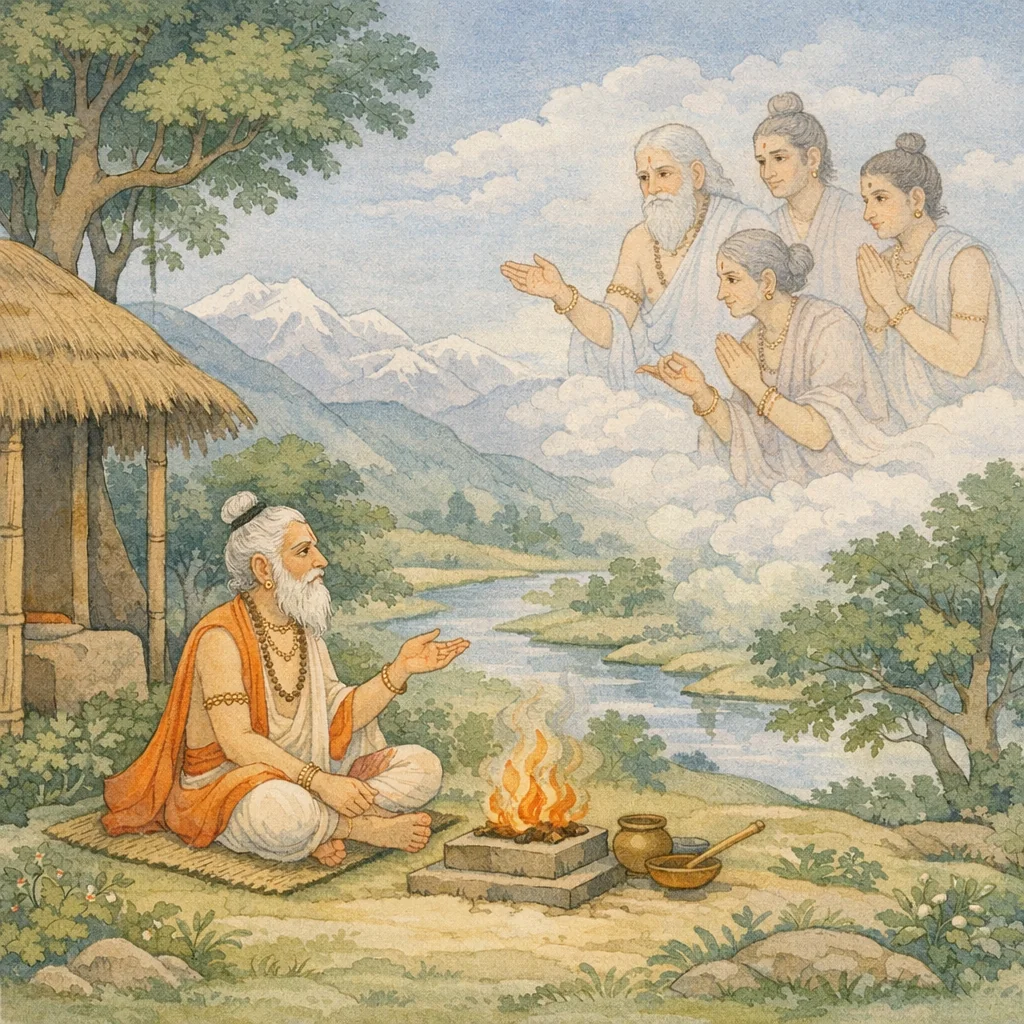
Sūta introduces this episode as a Pitṛ-centered teaching handed down by Mārkaṇḍeya. The sage Ruci, living detached and outside the usual āśrama marks, is confronted by his own Pitṛs, who question his refusal to marry. They argue from gṛhastha duty: honoring Devas, Pitṛs, Ṛṣis, guests, and dependents, and repaying daily debts (ṛṇa) through yajña, charity, and hospitality—signaled by “svāhā” and “svadhā.” Ruci replies with ascetic reasoning: possessiveness breeds suffering, and the self should be purified by jñāna rather than household accumulation. The Pitṛs acknowledge purity and knowledge, yet insist that neglecting enjoined duties itself creates fault; ritual alone does not grant mokṣa, but desireless karma supports the ripening of jñāna. The dialogue ends with a severe warning of impending downfall if he persists, after which the Pitṛs vanish and Mārkaṇḍeya closes the narration, turning toward practical dharma and ancestral rites as structured obligations, not optional piety.
Shlokas
Verse 1
नाम स्पताशीतितमो ऽध्यायः सूत उवाच / हरिर्मन्वन्तराण्याह ब्रह्मादिभ्यो हराय च / मार्कण्डेयः पितृस्तो त्रं क्रौञ्चुकिं प्राह तच्छृणु
Sūta said: “This is called the eighty-eighth chapter. Hari taught the Manvantaras to Brahmā and the other sages, and also to Hara (Śiva). Mārkaṇḍeya recited the hymn to the Pitṛs to Krauñcuki—listen to that.”
Verse 2
मार्कण्डेय उवाच / रुचिः प्रजापतिः पूर्वं निर्ममो निरहङ्कृतिः / अत्रस्तो ऽमितमायी च चचार पृथिवीमिमाम्
Mārkaṇḍeya said: Formerly, Prajāpati Ruci—free from possessiveness and ego—fearless and endowed with immeasurable power of manifestation (māyā), wandered upon this very earth.
Verse 3
अनग्निमनिकेतं तमेकाहारमनाश्रमम् / निमुक्तसंगं तं दृष्ट्वा प्रोचुः स्वपितरो मुनिम्
Seeing that sage—without a sacred fire, without a home, living on a single daily meal, belonging to no āśrama, and freed from all attachments—his own forefathers (Pitṛs) addressed him.
Verse 4
पितर ऊचुः / वत्स कस्मात्त्वया पुण्यो न कृतो दार संग्रहः / स्वर्गापवर्गहे (से)तुत्वाद्वन्धस्तेनानिशं (निमिषं) विना
The Pitṛs said: “Dear child, why did you not undertake the meritorious act of taking a wife? Since marriage is the bridge to both heaven and liberation, you remain without that support—bereft of it at every moment.”
Verse 5
गृही समस्तदेवानां पितॄणां च तथार्हणम् / ऋषीणामर्थिनां चैव कुर्वल्लो कानवाप्नुयात्
A householder who duly offers honor and worship to all the Devas, to the Pitṛs, and likewise to the Ṛṣis and those who seek help, attains the meritorious worlds.
Verse 6
स्वाहोच्चारणतो देवान्स्वधोच्चारणतः पितन् / विभजत्यन्नदानेन भृत्याद्यानतिथीनपि
By uttering “svāhā” one apportions offerings to the Devas; by uttering “svadhā” to the Pitṛs. And through the gift of food, one also properly shares with dependents and with guests.
Verse 7
स त्त्वं दैवादृणाद्वन्धमिममस्मदृणादपि / अवाप्तो ऽसि मनुष्यर्षे भूतेभ्यश्च दिनेदिने
Therefore, O best of men, you have entered this bondage: through the debt owed to the Devas, through the debt owed to us (the sages/ancestors), and also through the debt owed to all living beings—day after day.
Verse 8
अनत्पाद्य सुतान्देवानसन्तर्प्य पितॄस्तथा / अकृत्वा च कथं माण्ड्यं स्वर्गतिं प्राप्तुमिच्छसि
Without begetting sons, without duly satisfying the Devas, and likewise without offering satisfaction to the Pitṛs (ancestors)—and without performing the prescribed rites—how can you, O indolent one, wish to attain the path to heaven?
Verse 9
क्लेशबोधैककं पुत्र अन्यायेन भवेत्तव / मृतस्य नरकं त्यक्त्वा क्लेश एवान्यजन्मनि
O son, if you act unrighteously, you will gain only the awareness of suffering: after death, even if one leaves hell behind, suffering alone follows into another birth.
Verse 10
रुचिरुवाच / परिग्रहो ऽतिदुः खाय पापाया धोगतेस्तथा / भवत्यतो मया पूर्वंन कृतो दारसंग्रहः
Rucira said: “Possessiveness and hoarding lead to extreme suffering, and they become a sinful downward course as well. Therefore, from the beginning I have not taken a wife or entered household life.”
Verse 11
आत्मनः संशयोपायः क्रियते क्षणमन्त्रणात् / स्वमुक्तिहेतुर्न भवत्यसावपि परिग्रहात्
A moment’s consultation may provide a means to resolve one’s inner doubt; yet even that does not become a cause of one’s liberation, because it remains bound up with attachment and acquisition (parigraha).
Verse 12
प्रक्षाल्यते ऽनुदिवसं य आत्मा निष्परिग्रहः / मम त्वपङ्कदिग्धो ऽपि विद्याम्भोभिर्वरं हि तत्
The Self of one who is free from possessiveness is washed clean day after day. But as for me—though not smeared with mud—it is still better that I be cleansed by the waters of true knowledge.
Verse 13
अनेकभवसंभूतकर्मपङ्काङ्कितो बुधैः / आत्मा तत्त्वज्ञानतोयैः प्रक्षाल्यो नियतेन्द्रियैः
The wise say that the Self, stained by the mire of karma accumulated through many births, should be washed clean with the water of true knowledge, by one who has mastered the senses.
Verse 14
पितर ऊचुः / युक्तं प्रक्षालनं कर्तुमात्मनो ऽपि यतेन्द्रियैः / किं तु नोपायमार्गो ऽयं यतस्त्वं पुत्र वर्तसे
The Pitṛs said: “It is indeed proper for even self-controlled men to perform purification for themselves. Yet this is not the effective path for the goal at hand, for you, dear son, are proceeding along a different course.”
Verse 15
पञ्चयज्ञैस्तपोदानैरशुभं नुदतस्तव / फलाभिसन्धिरहितैः पूर्वकम शुभाशुभैः
By the five daily sacrifices, by austerity and by charity—when these are performed without any desire for reward—your inauspiciousness is driven away, along with the earlier deeds, whether good or bad.
Verse 16
एवं न बन्धो भवति कुर्वतः कारणात्मकम् / न च बन्धाय तत्कर्म भवत्यनतिसन्निभम्
Thus, for one who acts with right understanding of true causality, bondage does not arise; and that action, being not closely akin to attachment, does not become a cause of bondage.
Verse 17
पूर्वकर्म कृतं बोगैः क्षीयते ह्यनिशन्तथा / सुखदुः खात्मकैर्वत्स पुण्या पुण्यात्मकं नृणाम्
Past actions are ceaselessly exhausted through experience—enjoyment and suffering. Thus, dear child, by experiences that take the form of pleasure and pain, a person’s merit and demerit are worked off.
Verse 18
एवं प्रक्षाल्यते प्राज्ञैरात्मा बन्धाच्च रक्ष्यते / रक्ष्यश्च स्वविवेकैर्न पापपङ्केन दह्यते
Thus, the wise wash the Self clean and safeguard it from bondage; protected by one’s own discernment, it is not scorched by the mire of sin.
Verse 19
रुचिरुवाच / अविद्या पच्यते वेदे कर्ममार्गात्पितामहाः / तत्कथं कर्मणो मार्गे भवन्तो योजयन्ति माम्
Rucira said: “In the Veda it is said that ignorance is ‘cooked away,’ and that the forefathers (pitāmahas) are reached through the path of ritual action. If so, then why do you place me on the path of action (karma-mārga)?”
Verse 20
पितर उचुः / अविद्या सर्वमेवैतत्कर्मणैतन्मृषा वचः / किं तु विद्यापरिप्राप्तौ हेतुः कर्म न संशयः
The Pitṛs said: “All this is indeed ignorance; the claim that liberation comes merely from ritual action is false. Yet for the full attainment of true knowledge, action—performed rightly—is a cause; of this there is no doubt.”
Verse 21
विहिताकरणानर्थो न सद्भिः क्रियते तु यः / संयमो मुक्तये यो ऽन्यः प्रत्युताधोगतिप्रदः
The good do not practice a restraint that is harmful because it results in neglect of what is enjoined. Any other ‘restraint’ that is not for liberation instead becomes a cause of downward destiny.
Verse 22
प्रक्षालयामीति भवान्यदेतन्मन्यते वरम् / विहिताकरणोद्भूतैः पापैस्त्वमपि दह्यसे
If you think, “I shall wash it away,” and take that to be the best course—know that even you are scorched by sins born of failing to perform the duties that are enjoined.
Verse 23
अविद्याप्युपकाराय विषवज्जायते नृणाम् / अनुष्ठाना भ्युपायेन बन्धयोग्यापि नो हि सा
Even ignorance may appear to benefit people, like a poison that seems helpful at first. Yet through the means of proper, disciplined practice, it is not truly something that can bind them.
Verse 24
तस्माद्वत्स कुरुष्व त्वं विधिवद्दारसंग्रहम् / आजन्म विफलन्ते ऽस्तु असम्प्राप्यान्यलौकिकम्
Therefore, dear child, you should duly enter into marriage according to the prescribed rites; otherwise one’s life becomes fruitless from birth, failing to attain what is otherworldly—the higher spiritual goal.
Verse 25
रुचिरुवाच / वृद्धो ऽहं साम्प्रतं को मे पितरः सम्प्रिदास्यति / भार्यान्तथा दरिद्रस्य दुष्करो दारसंग्रहः
Rucira said: “I am now old—who will provide for me and support me? And for a poor man, taking (and maintaining) a wife is indeed difficult.”
Verse 26
पितर ऊचुः / अस्माकं पतनं वत्स भवतश्चाप्यधोगतिः / नूनं भावि भवित्री च नाभिनन्दसि नो वचः
The Pitṛs said: “Dear child, our downfall—and yours too, a descent to the lower state—is surely impending. It seems you do not welcome or heed our words, though they concern what is about to happen and what will come to pass.”
Verse 27
इत्युक्त्वा पितरस्तस्य पश्यतो मुनिसत्तम / बभूवुः सहसादृश्या दीपा वातहता इव
Having spoken thus, O best of sages, the Pitṛs—before his very eyes—vanished all at once, like lamps extinguished by the wind.
Verse 28
मुनिः क्रैञ्चुकये प्राह मार्कण्डेयो महातपाः / रुचिवृत्तान्तमखिलं पितृसंवादलक्षणम्
The great ascetic sage Mārkaṇḍeya narrated to Krañcukaya the entire account of Ruci—set forth as a discourse concerning the Pitṛs (ancestors).
Frequently Asked Questions
It is presented as a daily purification-and-reciprocity framework: when performed with no desire for reward, it removes inauspiciousness and weakens bondage by aligning one’s life with obligations to Devas, Pitṛs, Ṛṣis, humans/guests, and living beings.
The Pitṛs argue that omission itself produces sin-born scorching (a pratyavāya-like consequence): even if one claims ‘I will wash it away’ through austerity or inner purity, failure to do what is prescribed generates karmic fault and downward movement.