Adhyaya 8
Worship (Pūjā): Vajra-nābha Maṇḍala Construction, Lotus-Seat Design, and Vaiṣṇava Nyāsa
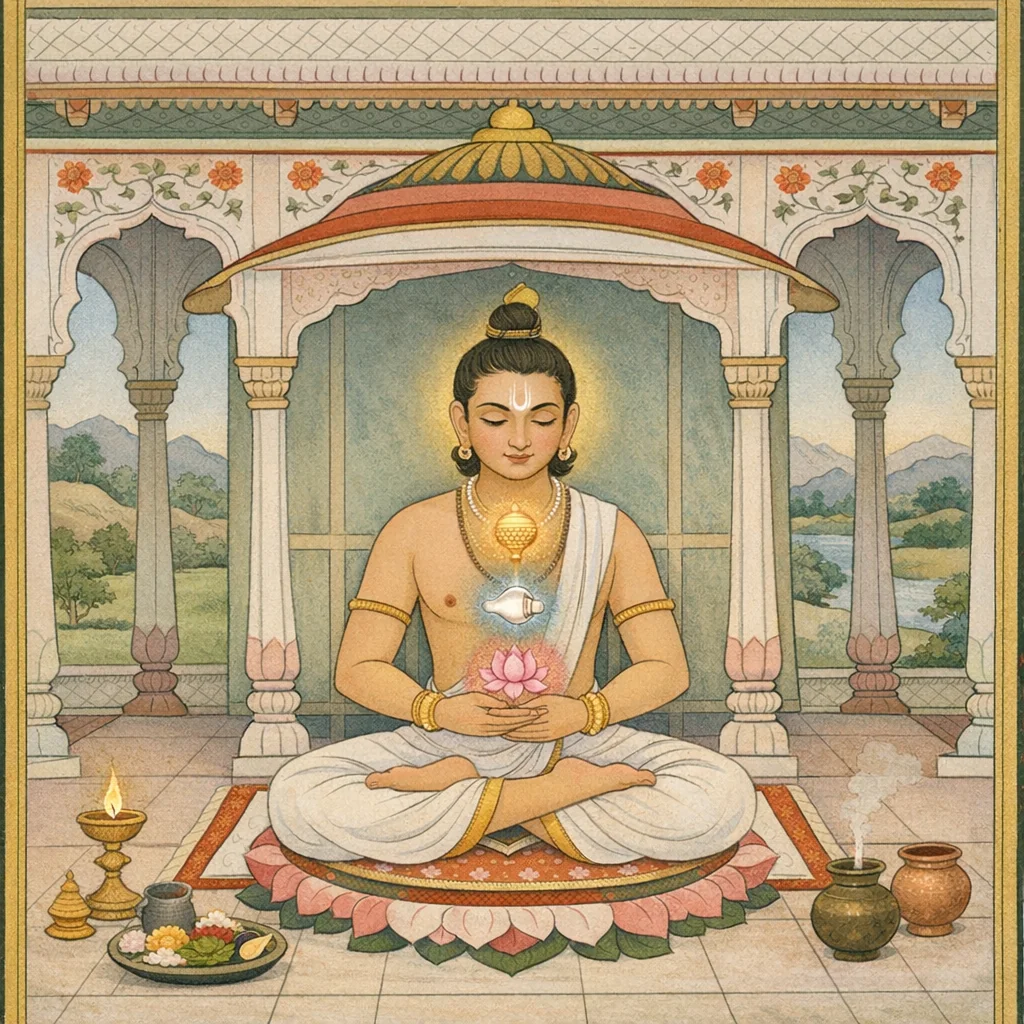
Continuing Khanda 1’s ācāra-based teaching, Hari sets out a complete pūjā procedure: beginning with purification by bathing, then building a ground pavilion and drawing the Vajra-nābha maṇḍala with five-colored powders. The chapter gives measured, stepwise geometry—sixteen compartments, guiding cords/lines, the central “navel” where lines meet, and the ordered turning that forms the hub and intermediate spaces. It then prescribes lotus-seat craftsmanship—stamens, pericarp divisions, petals—and the proportional design and ornamentation of doorways. Color doctrine is explicit: yellow pericarp, multicolored filaments, blue interior, dark petals, black fill, and white lines and doors. When the maṇḍala is finished, worship turns inward through nyāsa: Viṣṇu is installed in the heart, Saṅkarṣaṇa in the throat, Pradyumna on the head, Aniruddha in the śikhā, with Brahmā and Śrīdhara placed in limbs and hands. The sequence culminates in placement across directions and corners, concluding that worship with fragrances and offerings grants the supreme state and prepares the practitioner for the following chapters on greater ritual skill and devotional attainment.
Shlokas
Verse 1
पूजनं नाम सप्तमो ऽध्यायः हरिरुवाच / भूमिष्ठे मण्डपे स्नात्वा मण्डले विष्णुमर्चयेत् / पञ्चरङ्गिकचूर्णेन वज्रनाभं तु मण्डलम्
Hari said: “This is the chapter called ‘Worship.’ After bathing, in a pavilion (maṇḍapa) set upon the ground, one should worship Viṣṇu within a maṇḍala, forming the ‘vajra-nābha’ maṇḍala with powders of five colors.”
Verse 2
षोडशैः कोष्ठकैस्तत्र संमितं रुद्र? कारयेत् / चतुर्थपञ्चकोणेषु सूत्रपातं तु कारयेत्
There, one should construct it in measured form with sixteen compartments (koṣṭhakas); and in the fourth and fifth corners, one should have the guiding cord—the measuring line (sūtra)—laid down.
Verse 3
कोणसूत्रादुभयतः कोणा ये तत्र संस्थिताः / तेषु चैव प्रकुर्वीत सूत्रपातं विचक्षणः
From the corner-cord (koṇa-sūtra), on both sides, whatever corners are established there—upon those very points the skilled person should carefully cast and lay down the guiding cord-line (sūtra).
Verse 4
तदनन्तरकोणेषु एवमेव हि कारयेत् / प्रथमा नाभिरुद्दिष्टा मध्ये रेखाप्रसंगमे
Then, at the adjoining corners also, one should do it in the same manner. The first mark is declared to be the navel, at the central meeting-point of the lines.
Verse 5
अन्तरेषु च सर्वेषु अष्टौ चैव तुनाभयः / पूर्वमध्यमनाभि भ्यामथं सूत्रं तु भ्रामयेत्
In all the intervening spaces there are eight lines, and likewise a central hub. Then, from the earlier hub and the middle hub, one should have the thread wound around in proper order.
Verse 6
अन्तरा स द्विजश्रेष्ठः पादोनं भ्रामयेद्धर ! / अनेन नाभिसूत्रस्य कर्णिकां भ्रामयेच्छिव !
O Dhara, in the intermediate space the best of the twice-born—the officiating brāhmaṇa—should rotate it by a measure less than a foot. By this, O Śiva, he should rotate the central karṇikā of the navel-cord.
Verse 7
कर्णिकाया द्विभागेन केसराणि विचक्षणः / तदग्रेण सदा विद्वान्दलान्येव समालिखेत्
A skilled person should draw the stamens by dividing the flower’s central karṇikā into two; and with its tip, the learned should always sketch the petals as well.
Verse 8
सर्वेषु नाभिक्षेत्रषु मानेनानेन सुव्रत ! / पद्मानि तानि कुर्वीत देशिकः पर मार्थवित्
O noble-vowed one! In all the navel-centres, according to this very measure, the teacher (deśika) who knows the highest truth should form those padma lotus-diagrams, the lotus-seats.
Verse 9
आदिसूत्रविभागेन द्वाराणि परिकल्पयेत् / द्वारशोभां तथा तत्र तदर्धेन तु कल्पयेत्
By dividing according to the primary measuring cord, one should lay out the doorways; and there, the doorway’s ornamentation should be designed as half of that measure.
Verse 10
कर्णिकां पीतवर्णेन सितरक्तादिकेसरैः / अन्तरं नीलवर्णेन दलानि असितेन च
Its central pericarp (karnikā) is yellow; its filaments are white, red, and other hues; the inner space is blue; and its petals are dark in color.
Verse 11
कृष्णवर्णेन रजसा चतुरश्रं प्रपूरयेत् / द्वाराणि शुक्लवर्णेन रेखाः पञ्च च मण्डले
With black-colored powder, one should fill in a four-sided (square) figure; and in the maṇḍala, the doorways and the five lines should be drawn in white.
Verse 12
सिता रक्ता तथा पीता कृष्णा चैव यथाक्रमम् / कृत्वैव मण्डलञ्चादौ न्यासं कृत्वार्चयेद्धरिम्
Using white, red, yellow, and black in the proper order, one should first draw the ritual maṇḍala; then, having performed nyāsa, one should worship Lord Hari.
Verse 13
हृन्मध्ये तु न्यसेद्विष्णुं कण्ठे सङ्कर्षणं तथा / प्रद्युम्नं शिरसि न्यस्य शिखायामनिरुद्धकम्
One should place (by meditatively performing nyāsa) Viṣṇu in the center of the heart; likewise Saṅkarṣaṇa in the throat; placing Pradyumna upon the head, and Aniruddha in the crown-lock (śikhā).
Verse 14
ब्रह्माणं सर्वगात्रेषु करयोः श्रीधरं तथा / अहं विष्णुरिति ध्यात्वा कर्णिकायां न्यसेद्धरिम्
Meditating, “I am Viṣṇu,” one should place Brahmā in all the limbs, Śrīdhara in the hands, and then install Hari in the heart-lotus, at its pericarp (karnikā).
Verse 15
न्यसेत्सङ्कर्षणं पूर्वे प्रद्युम्नं चैव दक्षिणे / अनिरुद्धं पश्चिमे च ब्रिह्माणं चोत्तरे न्यसेत्
One should place Saṅkarṣaṇa in the east, Pradyumna in the south, Aniruddha in the west, and Brahmā in the north.
Verse 16
श्रीधरं रुद्रकोणेषु इन्द्रादीन्दिक्षु विन्यसेत् / ततो ऽभ्यर्च्य च गन्धाद्यैः प्राप्नुयात्परमं पदम्
One should place Śrīdhara in the Rudra-corners and in the directions presided over by Indra and the other guardians; then, having worshipped Him with fragrances and the like, one attains the supreme state.
Frequently Asked Questions
It is laid out with measured geometry: sixteen compartments, guiding cords/lines placed from corners, and a central meeting-point identified as the ‘navel.’ The intermediate spaces and central hub are generated by ordered winding/rotation of the thread, after which lotus elements and doorways are proportionally added.
The lotus-seat functions as a stable iconographic and meditative support (āsana) for divine presence. By standardizing pericarp, stamens, and petals according to measure, the practitioner creates a ritually valid locus for invocation and sustained dhyāna.
Through nyāsa, Viṣṇu and the Vyūhas are installed in specific bodily loci (heart, throat, head, śikhā) and then mapped onto directions (east, south, west, north) and corners/guardian directions. This establishes a microcosm–macrocosm correspondence: the body becomes an internal maṇḍala that resonates with the external diagram.