Adhyaya 56
Sapta-dvīpa Catalog: Plakṣa to Puṣkara, Mānasottara, and the Lokāloka Boundary
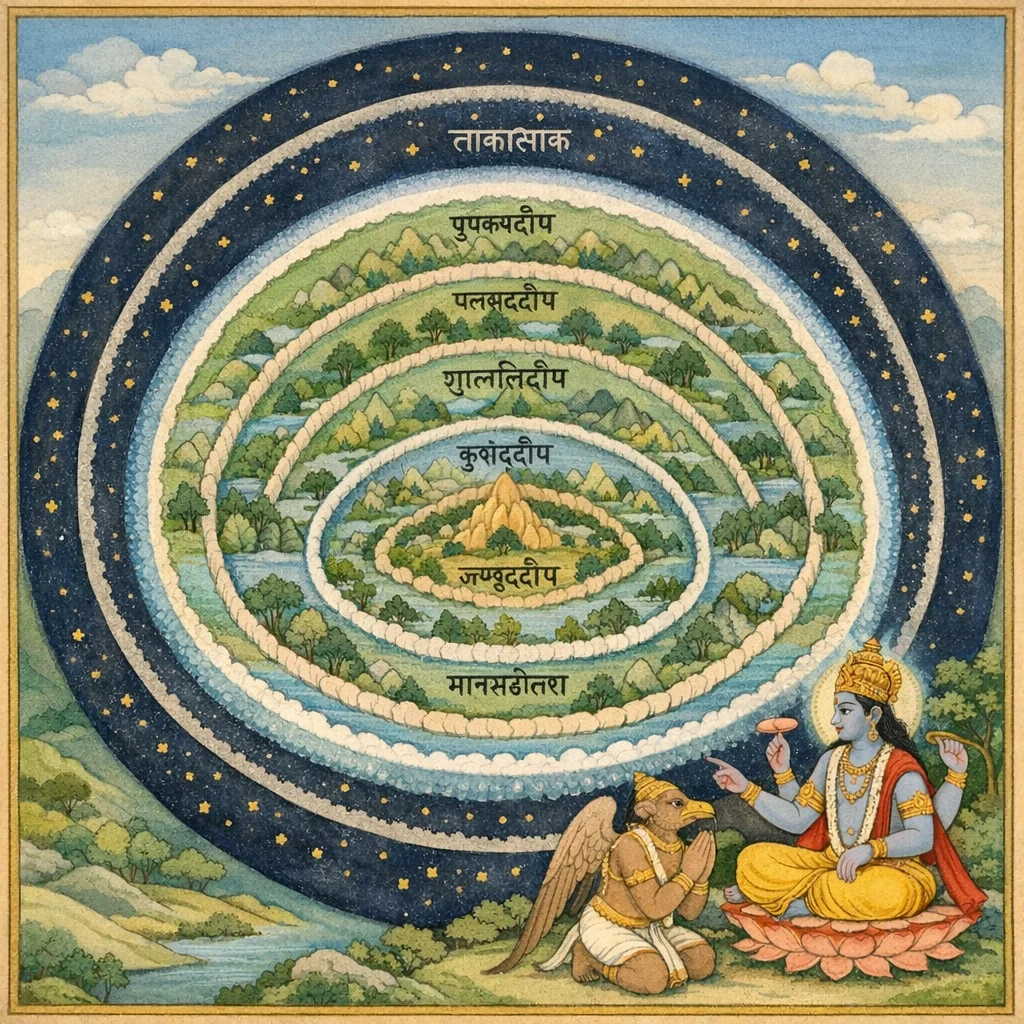
Hari describes the ordered structure of the middle world through successive dvīpas. Beginning with Plakṣa-dvīpa, he names Medhātithi’s seven sons as its rulers and lists its rivers. He then turns to Śālmali-dvīpa, giving its lord Vapuṣmān, the varṣa divisions, mountains, and rivers. The account continues through Kuśa-dvīpa (sons of Jyotiṣmat; mountains including Mandara; rivers said to remove sin), Krauñca-dvīpa (sons of Dyutimān; rivers and regional names), and Śāka-dvīpa (seven sons, followed by rivers/regions). The narrative then shifts from catalog to cosmic architecture: Mānasottara mountain is introduced with explicit yojana measurements, and Puṣkara-dvīpa is described as encircled by an ocean of sweet water. Finally, Hari points beyond to an uninhabited golden land, the Lokāloka mountain, the surrounding darkness, and the ultimate boundary—the shell of the brahmāṇḍa—preparing for the next cosmological teaching beyond the inhabited worlds.
Shlokas
Verse 1
नाम पञ्चपञ्चाशत्तमो ऽध्यायः हरिरुवाच / सप्त मेधातिथेः पुत्राः प्लक्षद्वीपेश्वरस्य च / ज्येष्ठः शान्तभवो नाम शिशिरस्तदन्तरः
Hari (Lord Viṣṇu) said: “There are seven sons of Medhātithi, the lord of Plakṣa-dvīpa. The eldest is named Śāntabhava, and after him comes Śiśira.”
Verse 2
सुखोदयस्तथा नन्दः शिवः क्षेमक एव च / ध्रुवश्च सप्तमस्तेषां प्लक्षद्वीपेश्वरा हि ते
Sukhodaya, Nanda, Śiva, and Kṣemaka—and Dhruva as the seventh—these indeed are the lords who rule Plakṣa-dvīpa.
Verse 3
गोमेदश्चैव चन्द्रश्च नारदो दुन्दुभिस्तथा / सोमकः सुमनाः शैलो बैभ्राजश्चात्र सप्तमः
Gomeda and Candra, Nārada and Dundubhi; Somaka, Sumanā, Śaila, and here as the seventh, Baibhrāja—these are the names that are recounted.
Verse 4
अनुतप्ता शिखी चैव विपाशा त्रिदिवा क्रमुः / अमृता सुकृता चैव सप्तैतास्तत्र निम्नगाः
There flow seven rivers there—Anutaptā, Śikhī, Vipāśā, Tridivā, Kramuḥ, Amṛtā, and Sukṛtā.
Verse 5
वपुष्माञ्छाल्मलस्येशस्तत्सुता वर्षनामकाः / श्वेतो ऽथ हरितश्चैव जीमूतो रोहितस्तथा
Vapuṣmān is the lord of Śālmali; his sons are known as the Varṣas—Śveta, Harita, Jīmūta, and Rohita.
Verse 6
वैद्युतो मानसश्चैव सप्रभशाचपि सप्तमः / कुमुदश्चोन्नतो द्रोणो महिषो ऽथ बलाहकः
‘Vaidyuta’ and ‘Mānasa’, and likewise ‘Saprabha’ as the seventh; then are named ‘Kumuda’, ‘Unnata’, ‘Droṇa’, ‘Mahiṣa’, and ‘Balāhaka’.
Verse 7
क्रौञ्चः ककुद्मान्ह्येते वै गिरयः सरितस्त्विमाः / योनितोया वितृष्णा च चन्द्रा शुक्ल विमोचनी
‘Krauñca’ and ‘Kakudmān’—these indeed are mountains; and these are the rivers: Yonitoyā, Vitṛṣṇā, Candrā, and Śukla-vimocanī.
Verse 8
विधृतिः सप्तमी तासां स्मृताः पापप्रशान्तिदाः / ज्योतिष्मतः कुशद्वीपे सप्त पुत्राः शृणुष्वतान्
Of those (divine mothers), Vidhṛti is remembered as the seventh, a bestower of the pacification of sins. In Kuśadvīpa, from Jyotiṣmat were born seven sons—listen to them.
Verse 9
उद्भिदो वेणुमांश्चैव द्वैरथो लम्बनो धृतिः / प्रभाकरो ऽथ कपिलस्तन्नामा वर्षपद्धतिः
Udbhida, Veṇumāṃśa, Dvairatha, Lambana, Dhṛti, Prabhākara, and Kapila—these are the names in that sequence of the yearly cycle (varṣa-paddhati).
Verse 10
विद्रुमो हेमशैलश्च द्युतिमान्पुष्पवांस्तथा / कुशेशयो हरिश्चैव सप्तमो मन्दराचलः
Vidrumā, Hemaśaila, Dyutimān, Puṣpavān, Kuśeśaya, and Hari—these (are mountains); and the seventh is the Mandara mountain.
Verse 11
धूतपापा शिवा चैव पवित्रा सन्मतिस्तथा / विद्युदभ्रा मही चान्या सर्वपापहरास्त्विमाः
Dhūtapāpā, Śivā, Pavitrā, and likewise Sanmati; also Vidyudabhrā, Mahī, and others—these are all removers of every sin.
Verse 12
क्रौञ्चद्वीपे द्युतिमतः पुत्राः सप्त महात्मनः / कुशलो मन्दगश्चोष्णः पीवरो ऽथोन्धकारकः
In Krauñca-dvīpa, Dyutimān had seven great-souled sons—Kuśala, Mandaga, Uṣṇa, Pīvara, and also Andhakāraka.
Verse 13
मुनिश्च दुन्दुभिश्चैव सप्तैते तत्सुता हर / क्रौञ्चश्च वामनश्चैव तृतीयश्चान्ध (थ) कारकः
Muni and Dundubhi as well—these seven are his sons, O Hara. Krauñca and Vāmana are also among them, and another is Andhakāraka (also read Athakāraka).
Verse 14
दिवावृत्पञ्चमश्चान्यो दुन्दुभिः पुण्डरीकवान् / गौरी कुमुद्वती चैव सन्ध्या रात्रिर्मनोजवा
Another is called Divāvṛtpañcama; another is Dundubhi; another is Puṇḍarīkavān; likewise there are Gaurī, Kumudvatī, Sandhyā, Rātri, and Manojavā.
Verse 15
ख्यातिश्च पुण्डरीका च सप्तैता वर्षनिम्नगाः / शाकद्वीपेश्वराद्भव्यात्सप्त पुत्राः प्रजज्ञिरे
Khyāti and Puṇḍarīkā—these are among the seven rivers of the regions (varṣas). And from Bhavyā, through the lord of Śākadvīpa, seven sons were born.
Verse 16
जलद्श्च कुमारश्च सुकुमारोरुणी बकः / कुसुमोदः समोदार्किः सप्तमश्च महाद्रुमः
‘Jalada’, ‘Kumāra’, ‘Sukumāra’, ‘Aruṇī’, and ‘Baka’; then ‘Kusumoda’, ‘Samodārki’; and as the seventh, ‘Mahādruma’—these are the names being enumerated.
Verse 17
सुकुमारी कुमारी च नलिनी धेनुका च या / इक्षुश्च वेणुका चैव गभस्ती सप्तमी तथा
Sukumārī, Kumārī, Nalinī, and Dhenukā; Ikṣū and Veṇukā as well—Gabhastī is the seventh, in that order.
Verse 18
शबलात्पुष्करेशाच्च महावीरश्च धातकिः / अभूद्वर्षद्वयं चैव मानसोत्तरपर्वतः
From Śabala and from Puṣkareśa, and from Mahāvīra and Dhātakī as well, there arose two varṣas; and (there is) the Mānasottara mountain.
Verse 19
योजनानां सहस्राणि ऊर्ध्वं पञ्चाशदुच्छ्रितः / तावच्चैव च विस्तीर्णः सर्वतः परिमण्डलः
Rising upward to a height of fifty thousand yojanas, it is spread out to the same extent in breadth, perfectly circular on every side.
Verse 20
स्वादूदकेनोदधिना पुष्करः परिवेष्टितः / स्वादूदकस्य पुरतो दृश्यते लोकसंस्थितिः
The lotus-like continent Puṣkara is encircled by an ocean of sweet water; and beyond that sweet-water ocean, the arrangement of the worlds is seen.
Verse 21
द्विगुणा काञ्चनी भूमिः सर्वजन्तुविवर्जिता / लोकालोकस्ततः शैलो योजनायुताविस्तृतः / तमसा पर्वतो व्याप्तस्तमो ऽप्यण्डकटाहतः
Beyond lies a golden land, twice in measure, devoid of all living beings. Next stands the Lokāloka mountain, spread across ten thousand yojanas. That mountain is enveloped in darkness, and even that darkness is bounded by the shell of the cosmic egg.
Frequently Asked Questions
The chapter explicitly traverses Plakṣa-dvīpa, Śālmali-dvīpa, Kuśa-dvīpa, Krauñca-dvīpa, Śāka-dvīpa, and Puṣkara-dvīpa, and then discusses Mānasottara and Lokāloka as structural cosmic features near the outer boundary.
Puṣkara is portrayed as lotus-like and encircled by an ocean of sweet water. The narration then uses Puṣkara as a pivot to describe what lies beyond the inhabited arrangement—an uninhabited golden tract, the Lokāloka mountain, and the darkness bounded by the brahmāṇḍa.