Adhyaya 45
Śālagrāma-lakṣaṇa: Viṣṇu Stotra, Vyūha/Avatāra Identification, and Temple-Fruition
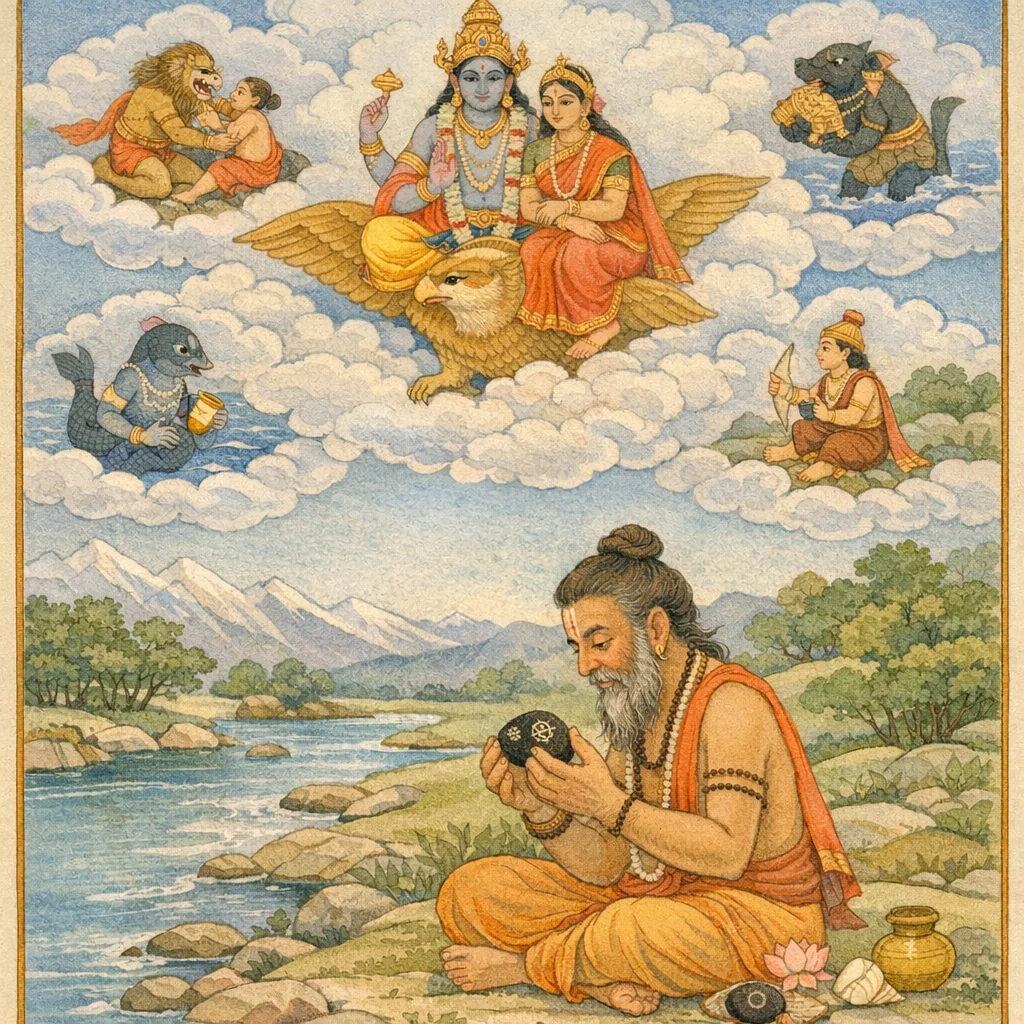
Continuing the Brahma Khanda’s ritual-theological teaching, Hari states this chapter’s aim: to describe Śālagrāma marks and the purifying power gained by touching the sacred stone. It opens with a flowing sequence of salutations to Viṣṇu’s chief names—Keśava, Nārāyaṇa, Mādhava, Govinda, Trivikrama, Śrīdhara, Hṛṣīkeśa, Dāmodara, and others—repeatedly highlighting the four emblems: śaṅkha, cakra, gadā, padma. The teaching then turns to practical iconography, correlating colors, shapes, perforations, lines (rekhā), dots (bindu), gateways (dvāra), and wheel-marks (cakra) with identifications such as the Caturvyūha and avatāras (Nṛsiṁha, Varāha, Vāmana, Kapila, Hayagrīva, Matsya, Vaikuṇṭha). Numerical schemes from 2 to 12 map the multiplicity of forms and titles, culminating in the claim that recitation bestows svarga. The chapter closes by extending consecration to other deities and declaring that proper worship within a ritually honored Vāstu yields the four puruṣārthas, preparing the way for fuller temple installation and worship traditions.
Shlokas
Verse 1
नाम चतुश्चत्वारिंशो ऽध्यायः हरिरुवाच / प्रसंगात्कथयिष्यामि शालग्रामस्य लक्षणम् / शालग्रामशिलास्पर्शात्कोटिजन्माघनाशनम्
Hari said: “This is the forty-fifth chapter. Since the occasion has arisen, I shall describe the marks of Śālagrāma. By merely touching the Śālagrāma stone, the sins amassed over ten million births are destroyed.”
Verse 2
शखचक्रगदापद्मी (हस्तः) (केशवाख्यो) गदाधरः / सब्जकौमादकीचक्रशङ्खी (नारायणो) विभुः
He who bears in His hands the conch, discus, mace, and lotus is called Keśava—Gadādhara, the wielder of the mace. The all-pervading Lord is Nārāyaṇa, bearing the radiant Kaumodakī mace, the discus, and the conch.
Verse 3
सचक्रशङ्खाब्जगदो (माधवः) श्रीगदाधरः / गदब्जशङ्खचक्री वा (गोविन्दो)ऽर्च्यो गदाधरः
Mādhava—Śrī Gadādhara—should be worshipped as the One who bears the discus, conch, lotus, and mace. Or, Govinda—Gadādhara—should be worshipped as the One who bears the mace, lotus, conch, and discus.
Verse 4
पद्मशङ्खारिगादिने (विष्णुरूपाय) ते नमः / सशङ्खाब्जगदाचक्र (मधुसूदनमूर्तये)
Salutations to You, whose form is Viṣṇu, bearing the lotus, conch, sword, and mace. Salutations to the embodiment of Madhusūdana, holding the conch, lotus, mace, and discus.
Verse 5
नमो गदारिशङ्खाब्जयुक्त(त्रैविक्रमाय) च / सारिकौमोदकीपद्मशङ्ख(वामनमूर्तये)
Salutations to Trivikrama, adorned with the mace, discus, conch, and lotus; and salutations to the Vāmana form, bearing Śrī (Lakṣmī), the Kaumodakī mace, the lotus, and the conch.
Verse 6
चक्राब्जशङ्खगादिने नमः (श्रीधरमूर्तये) / (हृषीकेशाया)ऽब्जगदाशङ्खिने चक्रिणे नमः
Salutations to the Lord who bears the discus, lotus, conch, and mace—salutations to Śrīdhara. Salutations to Hṛṣīkeśa, wielder of the discus, who holds the lotus, mace, and conch.
Verse 7
साब्जचक्रगदाशङ्ख(पद्मनाभस्वरूपिणे) / शङ्खचक्रगदापद्मिन् (दामोदर) मनोनमः
Mental salutations to Dāmodara—whose very form is Padmanābha—bearing the conch, discus, mace, and lotus.
Verse 8
सारिशङ्खगदाब्जाय (वासुदेवाय) वै नमः / शङ्खाब्जचक्रगादिने नमः (सङ्कर्षणाय) च
Salutations indeed to Vāsudeva, who bears the plough (or sword), conch, mace, and lotus. And salutations also to Saṅkarṣaṇa, who bears the conch, lotus, discus, and mace.
Verse 9
सुशङ्खसुगदाब्जारिधृते (प्रद्युम्नमूर्तये) / नमो(ऽनिरुद्धाय) गदाशङ्खाब्जारीविधारिणे
Salutations to the Pradyumna-form, bearer of the auspicious conch, excellent mace, lotus, and discus. Salutations to Aniruddha, who holds the mace, conch, lotus, and discus.
Verse 10
साब्जशङ्खगदाचक्र(पुरुषोत्तममूर्तये) / नमो(ऽधोक्षजरूपाय) गदाशङ्खारिपद्मिने
Salutations to the Supreme Person, Puruṣottama, whose form bears the lotus, conch, mace, and discus. Salutations to Adhokṣaja, the Transcendent One, whose form is adorned with the mace, conch, discus, and lotus.
Verse 11
(नृसिंहमूर्तये) पद्मगदाशङ्खारिधारिणे / पद्मारिशङ्खगदिने नमो ऽ(स्त्वच्युतमूर्तये)
Salutations to Him whose form is Narasiṁha, who bears the lotus, mace, conch, and discus; salutations to the infallible Acyuta, whose very form is Acyuta.
Verse 12
सशङ्कचक्राब्जगदं (जनार्दन) मिहानये / (उपेन्द्रः) सगदः सारिः पद्मशङ्खिन्नमोनमः
I bow again and again to Janārdana (Upendra), who comes here bearing the conch, discus, lotus, and mace—mace-bearer, guiding charioteer, lotus- and conch-holder: namo namah.
Verse 13
सुचक्राब्जगदाशङ्खयुक्ताय (हरिमूर्तये) / सगदाब्जारिशङ्खाय नमः (श्रीकृष्णमूर्तये)
Salutations to Hari’s form, endowed with the auspicious discus, lotus, mace, and conch. Salutations to Śrī Kṛṣṇa’s form, bearing the mace, lotus, enemy-destroying discus, and conch.
Verse 14
शालग्रामशिलाद्वारगतलग्नद्विचक्रधृक् / शुक्लाभो(वासुदेवाख्यः) सो ऽव्याद्वः श्रीगदाधरः
May Śrī Gadādhara—known as Vāsudeva, radiant white in hue, bearing the two discus-emblems affixed at the entrance of the Śālagrāma-stone shrine—protect you.
Verse 15
लग्नद्विचक्रो रक्ताभः पूर्वभागस्तुपुष्कलः / संकर्षणो ऽथ(प्रद्युम्नः) सूक्ष्मचक्रस्तु पीतकः
The one marked with a pair of wheels is reddish in hue; his forepart is broad and well-developed. Then Saṅkarṣaṇa—(or Pradyumna, in another reading)—has a subtle wheel and is yellowish.
Verse 16
स दीर्घः सशिरश्छिद्रो यो(ऽनिरुद्धस्तु) वर्तुलः / नीलो द्वारि त्रिरेखश्च अथ (नारायणो)ऽसितः
One is long; one bears a head and a perforation; another (Aniruddha) is circular. At the doorway stands the blue one marked with three lines; then comes Nārāyaṇa, dark-hued.
Verse 17
मध्ये गादकृती रेखा नाभिचक्रो (क्र) महोन्नतः / पृथुवक्षा (नृसिंहो) वः कपिलो ऽव्यात्त्रिबिन्दुकः
May Kapila protect you—marked by a central line shaped like a mace, with the navel-wheel greatly raised, broad-chested like Narasiṁha, and bearing three sacred dots.
Verse 18
(वराहः) शक्तिलिङ्गो ऽव्याद्विषमद्वयचक्रकः
May Varāha protect us—whose emblem is Power (Śakti), and who bears a pair of unequal discus-weapons.
Verse 19
नीलस्त्रिरेखः स्थूलो ऽथ (कूर्ममूर्तिः स बिन्दुमान् / (कृष्णः) स वर्तुलावर्तः पातु वो नतपृष्ठकः
May that dark-blue one protect you—marked with three lines, stout in form, turtle-shaped and bearing a central dot; dark in hue, with a rounded spiral—he whose back is bent (or bowed).
Verse 20
(श्रीधरः) पञ्चरेखो ऽव्या (द्वनमाली) गादाङ्कितः / (वामनो) वर्तुलो ह्रस्वो वा (रा) मचक्रः सुरेश्वरः
May Śrīdhara protect me, marked with five lines. May Vanamālī protect me, bearing the mace as his emblem. May Vāmana protect me, round in form and short in stature. May Rāma protect me, Lord of the gods, distinguished by the discus (cakra).
Verse 21
नानावर्णो ऽनेकमूर्तिर्नागभोगी (त्वनन्तकः) / स्थूलो (दामोदरो) नीलो मध्येवक्रः सुनीलकः
He is of many hues and of manifold forms; He bears the serpent as His couch (Anantaka). Mighty and full-bodied (Dāmodara), He is dark-blue in complexion, with a gentle curve at the waist, and radiant with deep sapphire-blue splendor.
Verse 22
संकीर्णद्वारकः सो ऽव्यादथ ब्रह्मा सुलोहितः / सदीर्घरेखः सुषिर एकचक्राम्बुजः पृथुः
May Saṅkīrṇadvāraka protect me; and then may Brahmā, the intensely red-hued One, protect me—He who bears long lines, has openings, is marked with a single wheel and lotus, and is broad in form.
Verse 23
पृथुच्छिद्रः स्थूलचक्रः(कृष्णो) (विष्णुश्च) बिल्ववत् / (हयग्रीवो) ऽङ्कुशाकारः पञ्चरेखः सकौस्तुभः
The mark of the discus (cakra) is broad-holed and thick-rimmed; the marks of Kṛṣṇa and of Viṣṇu are like the bilva fruit. The mark of Hayagrīva is goad-shaped (aṅkuśa), bearing five lines, and accompanied by the Kaustubha gem.
Verse 24
(वैकुण्ठो मणिरत्नाभ एकचक्राम्बुजो ऽसितः / (मत्स्यो) दीर्घो ऽम्बुजाकारो द्वाररेखश्च पातु वः
May Vaikuṇṭha, radiant like a jeweled gem; the dark-hued single-wheel-and-lotus mark; the Matsya mark, long and lotus-shaped; and the door-line mark protect you.
Verse 25
रामचक्रो दक्षरेखः श्यामोवो ऽव्या (त्त्रिविक्रमः) / शालग्रामे द्वारकायां स्थिताय गदिन नमः
Salutations to the Lord who bears the discus—marked with the auspicious rightward line—dark-hued, and as Trivikrama the Protector. Abiding as Śālagrāma and in Dvārakā, obeisance to that mace-bearing Lord.
Verse 26
एकद्वारश्चतुश्चक्रो वनमालाविभूषितः / स्वर्णरेखासमायुक्तो गोष्पदेन विराजितः
It has a single gateway and four wheels; it is adorned with a garland of forest-flowers, traced with golden lines, and shines with an emblem like a cow’s hoofprint.
Verse 27
कदम्बकुसुमाकारो (लक्ष्मीनारायणो)ऽवतु / एकेन लक्षितो योव्याद्रदाधारी (सुदर्शनः)
May Lakṣmī-Nārāyaṇa—whose form resembles the kadamba flower—protect us; and may Sudarśana, the discus-bearer, known by a single mark, also protect us.
Verse 28
(लक्ष्मीनारायणो) द्वाभ्यान्त्रिभिर्मूर्ति(स्त्रिविक्रमः) / चतुर्भिश्च (चतुर्व्यूहो) (वासुदेवश्च) पञ्चभिः
With two (forms/designations) He is Lakṣmī-Nārāyaṇa; with three, He is Mūrti and Trivikrama; with four, He is the Fourfold Emanation (Caturvyūha); and with five, He is Vāsudeva as well.
Verse 29
(प्रद्युम्नः) षडूभिरेव स्यात् (संकर्षण) इतस्ततः / (पुरुषोत्तमो)ऽष्टभिः स्या(न्नवव्यूहो) नवाङ्कितः
Pradyumna is to be denoted by six (syllables/letters); Saṅkarṣaṇa is indicated here and there accordingly. Puruṣottama is to be denoted by eight; thus the “ninefold emanation” (navavyūha) is marked by nine (designations).
Verse 30
(दशावतारो) दशभिरनिरुद्धो ऽवतादथ / (द्वादशात्मा) द्वादशबिरत ऊर्ध्व(मनन्तकः)
May Aniruddha, manifest in ten forms—the ten avatāras—protect us; and may Anantaka, whose nature is twelvefold, protect us from above.
Verse 31
विष्णोर्मूर्तिमयं स्तोत्रं यः पठेत्स दिवं व्रजेत् / (ब्रह्मा) चतुर्मुखो दण्डी कमण्डलुयुगान्वितः
Whoever recites this hymn, formed of the manifested forms of Viṣṇu, attains the heavenly realm. (Brahmā is) four-faced, bearing a staff, and endowed with a pair of kamaṇḍalus (water-pots).
Verse 32
(महेश्वरः) प्रञ्चवक्रो दशबाहुर्वृषध्वजः / यथायुधस्तथा गौरी चण्डिका च सरस्वती
(Maheśvara) is five-faced, ten-armed, bearing the bull as his emblem. In the same manner—armed as is fitting—are (the goddesses) Gaurī, Caṇḍikā, and Sarasvatī.
Verse 33
महालक्ष्मीर्मातरश्च पद्महस्तो (दिवाकरः) / गजास्यश्च गणः स्कन्दः षण्मुखोनेकधा गुणाः
Mahalakṣmī, the Divine Mothers, (Divākara—the Sun) with lotus in hand; the elephant-faced Lord Gaṇeśa, the hosts of Gaṇas, and Skanda—the six-faced one—(are invoked), together with virtues manifest in many forms.
Verse 34
एते ऽर्चिताः स्थापिताश्च प्रासादे वास्तुपूजिते / धर्मार्थकाममोक्षाद्याः प्राप्यन्ते पुरुषेण च
When these (deities/icons) are duly worshipped and installed in a temple where Vāstu (the sacred site and architecture) has been ritually honored, a person attains dharma, artha, kāma, and even mokṣa, along with other desired fruits.
Frequently Asked Questions
The chapter states that mere touch (sparśa) of Śālagrāma destroys accumulated sins across vast spans of births, presenting it as an exceptionally potent purifier within Vaiṣṇava ritual theology.
The text explicitly names Vāsudeva, Saṅkarṣaṇa, Pradyumna, and Aniruddha and then associates forms with distinguishing marks such as wheel-emblems, lines, hues, and shapes, enabling recognition of vyūha-presence in a given śilā.
It broadens the consecration context: within a properly established temple and ritually honored Vāstu, worship of installed deities—alongside Viṣṇu’s Śālagrāma presence—supports attainment of dharma, artha, kāma, and mokṣa.