Adhyaya 4
Sṛṣṭi–Pratisṛṣṭi: Viṣṇu as Kāla and the Ninefold Creation Schema
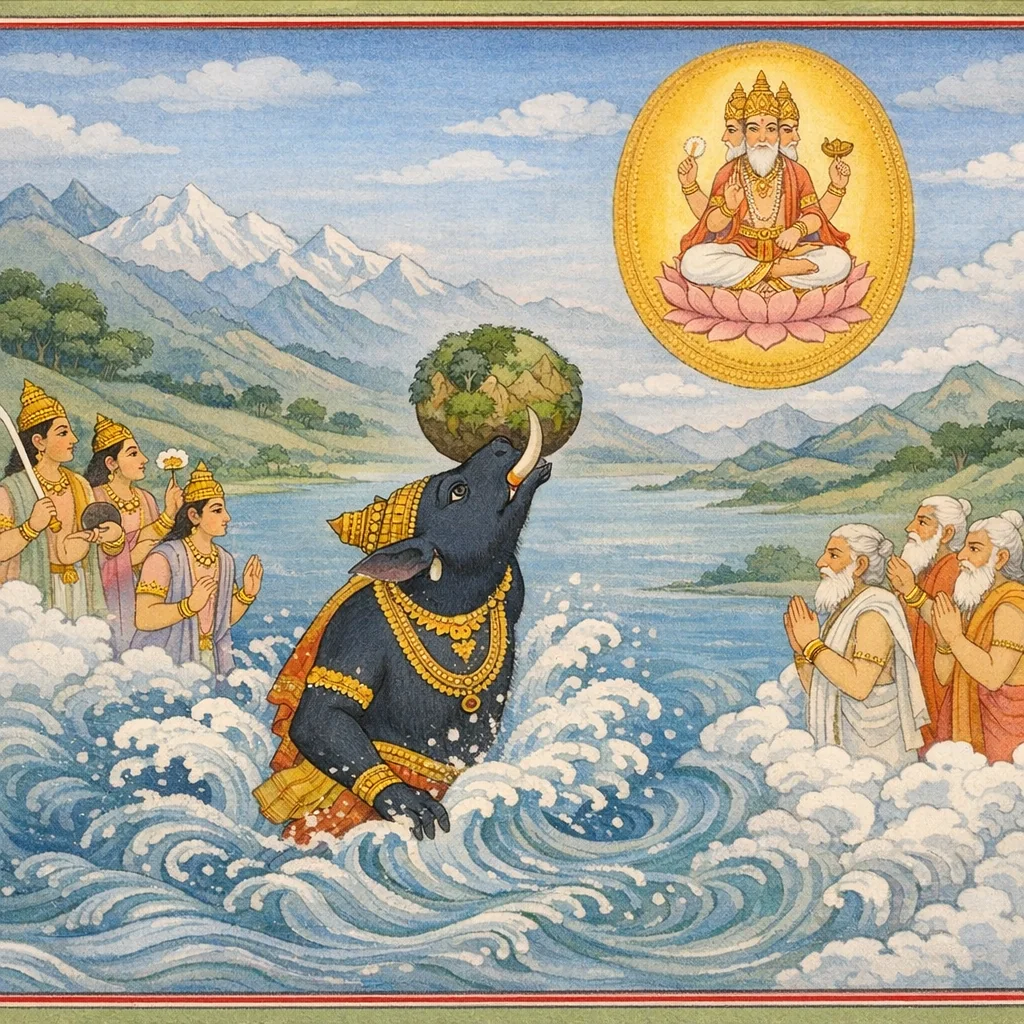
Rudra asks Hari for an ordered account of creation and re-creation, lineages, Manvantaras, and dynastic records. Hari replies by affirming Viṣṇu as the supreme reality—manifest and unmanifest, both Puruṣa and Kāla—whose līlā turns through creation, preservation, and dissolution. A Sāṃkhya-like emanation is set forth: from avyakta arise ātman, buddhi, and manas, followed by ether, wind, fire, water, and earth. Within the golden cosmic egg the Lord becomes four-faced Brahmā to generate moving and unmoving beings; the same Lord preserves the world and, as Rudra, withdraws it at the end of the aeon, exemplified by Varāha lifting up the earth. The chapter then lists prākṛta and vaikṛta creations (sensory, immovable, animal, divine, human, and anugraha), traces the birth of devas, asuras, pitṛs, humans, and other species from Brahmā’s bodies and cast-off forms (night/day/twilight), and concludes by linking varṇa–āśrama disciplines to particular lokas, preparing for later Purāṇic genealogies and Manvantara time-cycles.
Shlokas
Verse 1
तृतीयो ऽध्यायः रुद्र उवाच / सर्गश्च प्रतिसर्गश्च वंशो मन्वन्तराणि च / वंशानुचरितं चैव एतद् ब्रूहि जनार्दन
Rudra said: “O Janārdana, please explain to me creation and re-creation, the lineages, the Manvantaras, and also the chronicles of the dynasties.”
Verse 2
हरिरुवाच / शृणु रुद्र प्रवक्ष्यामि सर्गादीन्पापनाशनाम् / सर्गस्थितिलयान्तां तां विष्णोः क्रीडां पुरातनीम्
Hari said: “Listen, Rudra. I shall describe the cycles beginning with creation—destroyers of sin—culminating in creation, preservation, and dissolution: that ancient divine play (līlā) of Viṣṇu.”
Verse 3
नरनारायणो देवो वासुदेवो निरञ्जनः / परमात्मा परं ब्रह्म जगज्जनिलयादिकृत्
He is the divine Nara-Nārāyaṇa; He is Vāsudeva, the stainless One—the Supreme Self, the highest Brahman, the maker of the world’s birth, dissolution, and all else.
Verse 4
तदेतत्सर्वमेवैतव्द्यक्ताव्यक्तस्वरूपवत् / तथा पुरुषरूपेण कालरूपेण च स्थितम्
All of this indeed exists as That alone—having the nature of both the manifest and the unmanifest; and It abides also in the form of the Puruṣa and in the form of Time (Kāla).
Verse 5
व्यक्तं विष्णुस्तथाव्यक्तं पुरुषः काल एव च / क्रीडतो बालकस्येव चेष्टास्तस्य निशामय
Behold His play: He is Viṣṇu as the manifest, and also the unmanifest; He is the Puruṣa, and indeed Time itself—His movements are like those of a child at play.
Verse 6
अनादिनिधनो धाता त्वनन्तः पुरुषोत्तमः / तस्माद्भवति चाव्यक्तं तस्मादात्मापि जायते
You are the Ordainer, without beginning or end—Ananta, the Supreme Person. From You the Unmanifest (avyakta) arises, and from That the individual self (ātman) also comes forth.
Verse 7
तस्माहुद्धिर्मनस्तस्मात्ततः खं पवन स्ततः / तस्मात्तेजस्ततस्त्वापस्ततो भूमिस्ततो ऽभवत्
From that arose the intellect; from that, the mind. Then came ether, and from ether, wind. From wind arose fire; from fire, water; and from water, the earth came into being.
Verse 8
अण्डो हिरण्मयो रुद्र तस्यान्तः स्वयमेव हि / शरीरग्रहणं पूर्वं सृष्ट्यर्थं कुरुते प्रभुः
O Rudra, within that golden cosmic egg, the Lord Himself indeed first assumes a body, in order to accomplish creation.
Verse 9
ब्रह्मा चतुर्मुखो भूत्वा रजोमात्राधिकः सदा / शरीरग्रहणं कृत्वासृजदेतच्चराचरम्
Becoming four-faced Brahmā, ever predominated by the quality of rajas, he assumed a body and created this entire universe of the moving and the unmoving.
Verse 10
अण्डस्यान्तर्जगत्सर्वं सदेवासुरमानुषम् / स्रष्टा सृजति चात्मानं विष्णुः पाल्यं च पाति च
Within the cosmic egg is the entire universe—together with gods, demons, and human beings. Vishnu, as the Creator, brings forth even Himself, and as the Protector, He preserves all that is to be sustained.
Verse 11
अपसंह्रियते चान्ते संहर्ता च स्वयं हर / ब्रह्मा भूत्वासृजद्विष्णुर्जगत्पाति हरिः स्वयम्
At the end of a cosmic cycle it is withdrawn, and the Destroyer is Hara Himself. Becoming Brahmā, Viṣṇu creates, and Hari Himself sustains the world.
Verse 12
रुद्ररूपी च कल्पान्ते जगत्संहरते ऽखिलम् / ब्रह्मा तु सृष्टिकाले ऽस्मिञ्जमध्यगतां महीम्
At the end of an aeon, assuming the form of Rudra, he withdraws the entire universe; but at the time of creation, Brahmā again brings forth the earth, placing it in the midst of the cosmic order.
Verse 13
दंष्टूयोद्धरति ज्ञात्वा वारहीमास्थितस्तनूम् / देवादिसर्गान्वक्ष्ये ऽहं संक्षेपाच्छृणु शङ्कर !
Knowing that the Lord, having assumed the form of Varāhī (the Boar incarnation), lifted up the earth with His tusk, I shall now describe—in brief—the creation beginning with the Devas. Listen, O Śaṅkara!
Verse 14
(१)प्रथमो महतः सर्गो विरूपो ब्रह्मणस्तु सः / (२) नन्मात्राणां द्वितीयस्तु भूतसर्गो हि स स्मृतः
The first creation is that of Mahat (the cosmic intellect); it is called Brahmā’s “formless/undifferentiated” creation. The second, arising from the tanmātras (subtle elements), is remembered as the creation of the bhūtas—the gross elements and embodied forms.
Verse 15
(३)वैकारिकस्तृतीयस्तु सर्गस्त्वैन्द्रियकः स्मृतः / इत्येष प्राकृतः सर्गः सम्भूतो बुद्धिपूर्वकः
The third creation is called the Vaikārika (transformative) creation, remembered as the aindriyaka—sensory—creation. Thus this is the Prākṛta (material) creation, brought forth with intellect as its precursor.
Verse 16
(४)मुख्यसर्गश्चतुर्थस्तु मुख्या वै स्थावराः स्मृताः / (५)तिर्यक्स्रोतास्तु यः प्रोक्तस्तिर्यग्योन्यः स उच्यते
The fourth is called the mukhya-sarga, the ‘primary creation’; in it, the immovable beings are regarded as the principal ones. And that creation described as ‘having a horizontal current’ is termed tiryak-yoni—the animal womb/realm, the birth of creatures that move crosswise.
Verse 17
(६) तदूर्ध्वस्तोतसां षष्ठो देवसर्गस्तु स स्मृतः / (७) ततोर्ऽवाक्स्रोतसां सर्गः सप्तमः स तु मा नुषः
Among those whose vital current moves upward, the sixth creation is remembered as the creation of the gods (Devas). Thereafter, among those whose current moves downward, the seventh creation is that of human beings.
Verse 18
(८)अष्टमो ऽनुग्रहः सर्गः सात्त्विकस्तामसस्तु सः / पञ्चैते वैकृताः सर्गाः प्राकृतास्तु त्रयः स्मृताः
The eighth is the creation called “Anugraha,” born of divine grace, bearing both sāttvika and tāmasa qualities. These five are known as the vaikṛta (evolute, modified) creations, while three are remembered as the prākṛta (primordial) creations.
Verse 19
प्राकृतो वैकृतश्चापि (९) कौमारो नवमः स्मृतः / स्थावरान्ताः सुराद्यास्तु प्रजा रुद्र ! चतुर्विधाः
The “Prākṛta” and the “Vaikṛta” creations are also spoken of; and the “Kaumāra” is remembered as the ninth. O Rudra, beings—from the immobile (plants and the like) up to the gods—are of four kinds.
Verse 20
ब्रह्मणः कुर्वतः सृष्टिं जज्ञिरे मानसाः सुताः / ततो देवासुरपितॄन्मानुषांश्च चतुष्टयम्
As Brahmā set about the work of creation, mind-born sons came forth. From them arose the fourfold order—devas, asuras, pitṛs (ancestors), and human beings.
Verse 21
सिसृक्षुरम्भांस्येतानि स्वमात्मानमयूयुजत् / व्यक्तात्मनस्तमोमात्रादुद्रिक्तास्तत्प्रजापतेः
Wishing to create these primordial waters, Prajāpati united his own Self with them. From that manifest Self, in which the mere principle of darkness (tamas) predominated, those elements grew intense and expanded.
Verse 22
सिसृक्षेर्जघनात्पूर्वमसुरा जज्ञिरे ततः / उत्ससर्ज ततस्तां तु तमोमात्रात्मिकां तनूम्
Before the Creator proceeded with further creation, the asuras were born from his posterior part. Then he cast off that body of his which was constituted solely of the essence of darkness (tamas).
Verse 23
तमोमात्रा तनुस्त्यक्ता शङ्कराभूद्विभावरी / यक्षोपक्षांसि तद्देहे प्रीतिमापुस्ततः सुराः
When the body made of mere darkness was cast off, Night became auspicious (Śaṅkara). From that body arose the Yakṣas and the Upakṣas, and thereafter the Devas attained joy.
Verse 24
सत्त्वोद्रिक्तास्तु मुखतः संभूता ब्रह्मणो हर ! / सत्त्वप्राया तनुस्तेन सन्त्यक्ता साप्यभूद्दिनम्
O Hara, the beings in whom sattva predominated arose from Brahmā’s mouth. That sattva-filled form, once abandoned by him, itself became Day.
Verse 25
ततो हि बलिनो रात्रावसुरा देवता दिवा / सत्त्वमात्रां तनुं गृह्य पितरश्च ततो ऽभवन्
From that primordial condition, the Asuras became powerful at night and the Devas by day; and then the Pitṛs came into being, assuming a subtle body made only of essence (sattva).
Verse 26
सा चोत्सृष्टाभवत्सन्ध्या दिननक्तान्तरस्थितिः / रजोमात्रां तनुं गृह्य मनुष्यास्त्वभवंस्ततः
And she, once emitted, became Sandhyā—the twilight that stands between day and night. Taking on a subtle body constituted of rajas alone, human beings then came into being from her.
Verse 27
सा त्यक्ता चाभवज्ज्योत्स्ना प्राक्सन्ध्या याभिधीयते / ज्योत्स्ना रात्र्यहनी सन्ध्या शरीराणि तु तस्य वै
When she was abandoned, she became the moonlight known as “prāk-sandhyā,” the pre-dawn twilight. That moonlight is the junction of night and day; and those twilight phases indeed become its bodies (forms).
Verse 28
रजोमात्रां तनु गृह्य क्षुदभूत्कोप एव च / क्षुत्तृट्क्षामा अमृग्भक्षा राक्षसा रक्षणाच्च ये
Taking a body no more than a speck of dust, they blaze with anger through hunger; tormented by hunger and thirst and wasted by exhaustion, those rākṣasas—living by preying upon creatures unfit for the hunt—exist to assault and to guard the dreadful paths.
Verse 29
यक्षाख्या जक्षणाज्ज्ञेयाः सर्पा वै केशसर्पणात् / जाताः कोपेन भूतास्ते गन्धर्वा जज्ञिरे ततः
Know that those called Yakṣas are so named from ‘devouring’ (jakṣaṇa). Serpents indeed arose from the slithering of hair (keśa-sarpaṇa). From anger were born the Bhūtas; and thereafter the Gandharvas came into being.
Verse 30
गायन्तो जज्ञिरे वाचं गन्धर्वाप्सरसश्च ये / स्वर्गं द्यौर्वक्षसश्चक्रे सुखतो ऽजाः स मुष्टवान्
From the (cosmic) Voice (Vāc) were born the singers—the Gandharvas and the Apsarases. From His chest He fashioned svarga, heaven; from His mouth, the goats—He, the Lord, possessor of all.
Verse 31
सृष्टवानुदराद्राश्च पार्श्वाभ्यां च प्रजापतिः / पद्य्भां चैवान्त्यमातङ्गान्महिषोष्ट्राविकांस्तथा
Prajāpati created the rākṣasas from his belly; from his sides he brought forth other beings; and from his feet he produced the last-born—elephants, as well as buffaloes, camels, and sheep.
Verse 32
ओपध्यः फलमूलिन्यो रोमभ्यस्तस्य जज्ञिरे / गौरजः पुरुषो मेध्यो ह्यश्वाश्वतरगर्दभाः
From his body-hairs arose the medicinal herbs, fruit-bearing plants, and root-crops. From the dust of the cow (or the cow’s pure essence) came forth the human being—pure and auspicious; and also horses, mules, and donkeys.
Verse 33
एतान् ग्राम्यान्पशून्प्राहुरारण्यांश्च निबोध मे / श्वापदं द्विखुरं हस्तिवानराः पक्षिपञ्चमाः
These are declared to be the domesticated animals; and now learn from me those that are wild—beasts of prey, cloven-hoofed creatures, elephants and monkeys, and, as the fifth class, the birds.
Verse 34
औदकाः पशवः षष्ठाः सप्तमाश्च सरीसृपाः / पूर्वादिभ्यो मुखेभ्यस्तु ऋग्वेदाद्याः प्रजज्ञिरे
Aquatic creatures were the sixth creation, and reptiles the seventh; and from the mouths—beginning with the eastern one—the Vedas, starting with the Ṛgveda, came forth.
Verse 35
आस्याद्वै ब्राह्मणा जाता बाहुभ्यां क्षत्त्रियाः स्मृताः / ऊरुभ्यां तु विशः सृष्टाः शूद्रः पद्य्भाम जायत
From the mouth, indeed, the Brāhmaṇas were born; from the arms the Kṣatriyas are remembered to have arisen. From the thighs the Vaiśyas were created; from the feet the Śūdra came into being.
Verse 36
ब्रह्मलोको ब्राह्मणानां शाक्रः क्षत्त्रियजन्मनाम् / मारुतं च विशां स्थानं गान्धर्वं शूद्रजन्मनाम्
For those born as Brāhmaṇas, the realm is Brahmaloka; for those born as Kṣatriyas, it is Śākra’s (Indra’s) world. For those born as Vaiśyas, the abode is the world of the Maruts; and for those born as Śūdras, it is the Gandharva-world.
Verse 37
ब्रह्मचारिव्रतस्थानां ब्रह्मलोकः प्रजायते / प्राजापत्यं गृहस्थानां यथाविहितकारिणाम्
For those established in the vow and discipline of brahmacarya, the attainment of Brahmaloka arises. For householders who act exactly as enjoined, the Prajāpatya world is attained.
Verse 38
स्थानं सप्तऋषीणां च तथैव वनवासिनाम् / यतीनामक्षयं स्थानं यदृच्छागामिनां सदा
There is an abode for the Seven Ṛṣis, and likewise for those who dwell in the forests. For the yatīs, the renunciants, there is an imperishable realm—ever also for those who wander in holiness by yadṛcchā, without contrivance.
Frequently Asked Questions
The chapter presents an emanation: from the Unmanifest (avyakta) arises the individual self (ātman), then intellect (buddhi/mahat), then mind (manas), followed by ether (ākāśa), wind (vāyu), fire (agni), water (āpas), and finally earth (pṛthivī).
It treats them as functional modalities of the one Supreme (Viṣṇu): as Brahmā he initiates creation, as Hari he sustains, and as Rudra he withdraws at the end of the aeon—preserving theological unity while describing cosmic functions.
Anugraha sṛṣṭi is creation “through grace,” indicating a divinely-mediated differentiation in beings. It is described as having mixed qualities (sattva and tamas), reflecting that grace operates within nature’s guṇas to shape capacities, dispositions, and destinies.
Varṇa-based realms include Brahmaloka for brāhmaṇas, Śākra’s world for kṣatriyas, the Maruts’ world for vaiśyas, and the Gandharva-world for śūdras. Āśrama-based attainments include Brahmaloka for disciplined brahmacarya, Prajāpatya world for enjoined householdership, distinct abodes for forest-dwellers and the Seven Ṛṣis, and an imperishable realm for renunciants (yatīs) and holy wanderers (yadṛcchā-vṛtti).