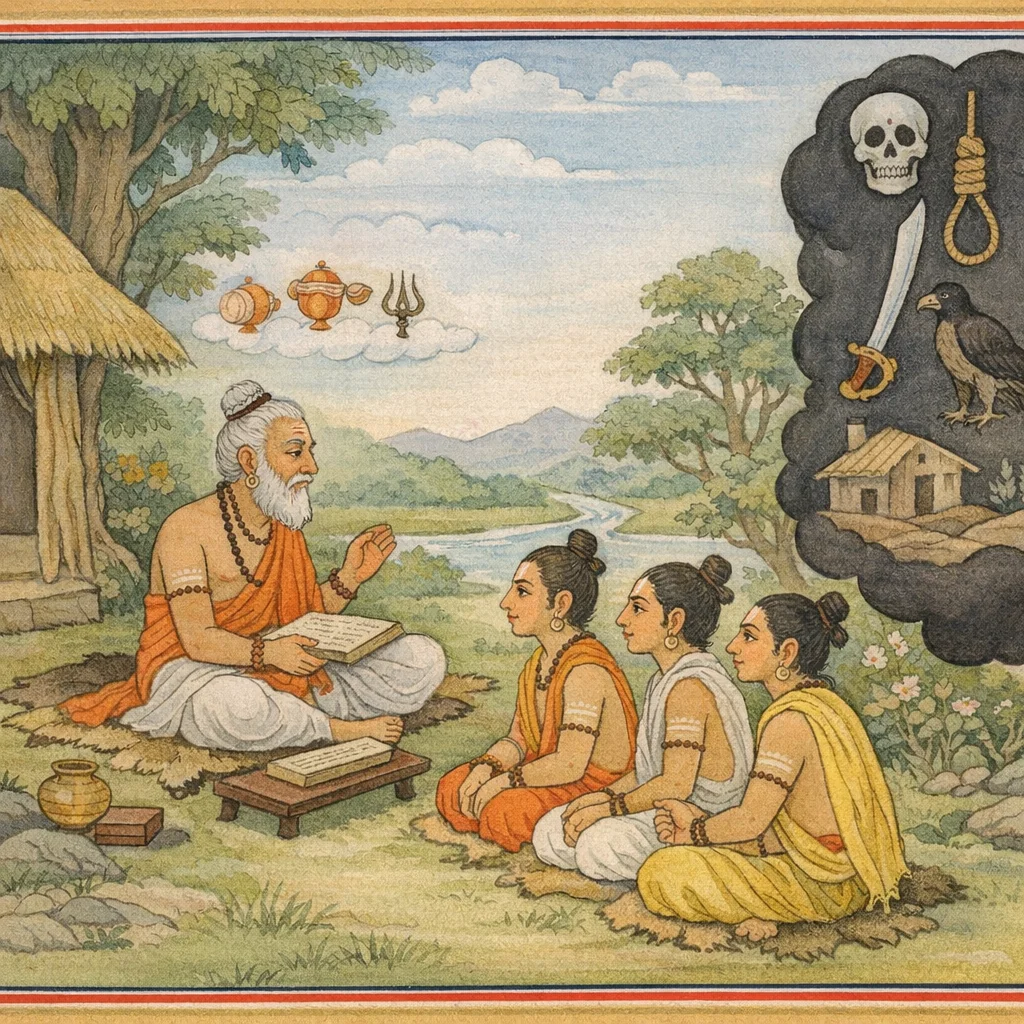
Adhyaya 209
Nāmāṣṭottara-dviśata: Gaṇa–Chandas–Yati Catalogue and Mnemonic Coding
Sūta introduces this chapter as a coded lesson in chandas (prosody), where syllables and gaṇas function as markers to identify metres and their variants. The teaching moves from basic identifications (including Gāyatrī) into extensions derived from Uṣṇik and Anuṣṭubh, then to Bṛhatī and Paṅkti patterns, and onward to Upajāti types defined by opening and closing gaṇas. It continues with Triṣṭubh classifications attributed to Piṅgala, followed by named vṛttas and rules of yati (regulated cadence/caesura) expressed through mnemonic, mantra-like sound strings. Throughout, metre names are repeatedly cross-indexed with gaṇa clusters—sometimes describing the aesthetic “gait” and rasa-bearing movement of metres, and sometimes linking yati with ascetic restraint (virati/yati). Near the end it expands to higher metres (Atidhṛti/Kṛti/Atikṛti) and mixed forms (saṃkṛti), then abruptly appends a list of fearsome, naraka-tinged terms (e.g., Caṇḍavṛtti-prapāta, Daṇḍaka), foreshadowing a return to moral-cosmological cataloguing in what follows.
Shlokas
Verse 1
नामाष्टोत्तरद्विशततमो ऽध्यायः सूत उवाच / श्रीरुक्था गेन सा ज्ञेया उत्युक्था स्त्री गुरुद्वयम् / मो नारी रो मृगी मध्या मगौ कन्या प्रतिष्ठया
Sūta said: “This is the two-hundred-and-ninth chapter, the ‘Nāmāṣṭottara-dviśata.’ By the syllable ‘ge’ she is to be known as Śrī-rukthā, and by ‘sa’ as Utyukthā. ‘Strī’ indicates the pair of gurus. ‘Mo’ denotes a woman; ‘ro’ a doe (female deer). ‘Madhyā’ (the middle one) is ‘magau’; and ‘kanyā’ (maiden) is spoken of with ‘pratiṣṭhā’ (establishment).”
Verse 2
भो गौ पङ्क्तिः सुप्रातिष्ठा तनुमध्या तयौ स्मृता / नयाभ्यां बालललिता गायत्रीच्छन्द एव हि
O revered Cow, she is remembered as ‘Paṅkti’, ‘Supratiṣṭhā’, and ‘Tanumadhyā’; and by these two guiding principles she is also known as ‘Bālalalitā’. Indeed, her metre is the Gāyatrī.
Verse 3
मसगैर्मदलेखा स्यादुष्णिक्छन्दः स्मृतं बुधैः / भौ गौ चित्रपदा ख्याता विद्युन्माला ममौ गगौ
When the gaṇa-pattern is ‘ma-sa-ga’, it is called the metre Madalekhā; the wise remember it as belonging to the Uṣṇik chandas. With the gaṇas ‘bhau-gau’ it is known as Citrapadā, and with ‘ma-mau-ga-gau’ it is called Vidyunmālā.
Verse 4
माणवकं भात्तलगा म्नौ गौ हंसरुतं स्मृतम् / समानिका रजगला जरला गः प्रमाणिका / आभ्यामन्यद्वितानं स्यादनुष्टुप्छन्द ईरितम्
The forms called Māṇavaka and Bhāttalagā are taught; likewise the patterns named Mnau, Gau, and Haṃsaruta are remembered. Also (there are) Samānikā, Rajagalā, Jaralā, and Pramāṇikā. Any other extended variant derived from these is declared to belong to the Anuṣṭubh metre.
Verse 5
रनसैः स्याद्धलमुखी नौ मः शिशुभृता भवेत् / बृहतीछन्द इत्युक्तं स्मौ जगौ स विराजितम्
With the syllabic sequence “ra–na–sa” it becomes the gaṇa called Dhalamukhī; with “nau–ma” it becomes the gaṇa called Śiśubhṛtā. Thus it is proclaimed to be the Bṛhatī metre; within it the two gaṇas “smau” and “jagau” shine forth.
Verse 6
पणवं स्यान्मनयगैर्मयूरसारिणी भवेत् / रजाभ्याञ्च रगाभ्याञ्च रुक्मवती भमौ सगौ
A metrical pattern is called “Paṇava” when it is formed with the gaṇas ma–na–ya–ga. When arranged in another way it is termed “Mayūrasāriṇī.” And when constituted by the gaṇas ra–jā and ra–gā, it is named “Rukmavatī,” with the closing feet described as bha–mau–sa–gau.
Verse 7
मत्ता मभसगैर्युक्ता नरजा गो मनोरमा / पङ्क्तिच्छन्दः समाख्यातं जसता गावुपस्थितम्
“Mattā,” joined with the gaṇas called “mabhasa,” together with “narajā,” “go,” and “manoramā”—this is declared to be the metre known as Paṅkti; it is set forth with the gaṇa-pattern termed “jasatā”.
Verse 8
तौ जो गाविन्द्रवज्रा स्याज्जतज्गा गुपपूर्विका
Those two—together with “Gāvindra-vajrā” (thunderbolt-like might) and “Gupapūrvikā” (that which is preceded by concealment or secret practice)—are said to arise in that very manner.
Verse 9
उपजातयो ऽन्याद्यन्ताः सुमुखी नजजा लगौ / भभभा गौ दोधकं स्याच्छालिनी मतता गगौ
The Upajāti metres differ according to their opening and closing patterns. “Sumukhī” has the gaṇas na-ja-jā with two laghus; “Dodhaka” is formed by bha-bha-bhā followed by two gurus; and “Śālinī” is constituted by ma-ta-tā with two gurus.
Verse 10
अब्धिलोकैश्च विच्छेदो वातोर्ंमो ममता गगौ / श्रीर्भतौ ननगाः प्रोक्ता पञ्चभिः षडूभिरेव च
Separation is spoken of with regard to the ocean-worlds; “Vātormma” is stated with reference to the wind; “Mamatā” (the sense of ‘mine’) is said to belong to the sky; and “Śrī” is declared to abide in the earth—these are taught through the sets of five and also of six.
Verse 11
मगना नो गो भ्रमरविलासितमुदाहृतम् / रथोद्धतार् नौ रलगाः स्वागता रनभा गगौ
This utterance is presented as a playful sound-pattern, like the humming of a bee (bhramara): “maganā, no, go …”; and again, like a chariot rushing onward, the syllables roll and rise—“nau, ralagāḥ”—as though proclaiming, “Welcome!”, while the sound resounds through the sky.
Verse 12
वृत्ता ननौ सगौ गः स्यान्नौ रलौ गः समद्रिका / रजरा ल्गौ श्येनिका स्याज्जसता गौ शिखण्डितम् / त्रिष्टुप्छन्दः समाख्यातं पिङ्गलेन महात्मना
The metrical patterns (vṛttas) are defined through gaṇa-sequences: with “na-na-u, sa-ga-u, gaḥ” it is called Syā; with “na-u, ra-la-u, gaḥ” it is Samadrikā; with “ra-ja-ra, la-gau” it becomes Śyenikā; and with “ja-sa-tā, gau” it is Śikhaṇḍitam. Thus the Triṣṭubh metre has been explained by the great Piṅgala.
Verse 13
रनौ भसौ चन्द्रवर्त्म वंशस्थं स्याज्जतौ जरौ / ततो जराविन्द्रवंशा वेदसैस्तोटकं स्मृतम् / न्भौ भ्रौ द्रुतविलम्बितं पुटश्च स्यान्ननौ मयौ
When the gaṇas “ra” and “na” and also “bha” occur, the metre is called Candravartman; and Vaṁśastha is formed when “ja” and “ta” are followed by “ja” and “ra”. From the sequence “ja–ra” arises Indravaṁśā, remembered by the Veda-knowers as Toṭaka. Likewise, with “nbha” and “bhra” it is Drutavilambita; and Puṭa is formed when “na–na” are followed by “ma–ya”.
Verse 14
वसुवेदैश्च विरतिर्मुदितवदना त्वियम् / ननररैः समाख्याता नयना यस्तथा भवेत्
This joyful-faced power called Virati—praised in the Vedas and among the Vasus—is declared to be “Nayanā”, the guiding vision; whoever becomes so, endowed with such restraint, truly attains that state.
Verse 15
सा तु कुसुमविचित्रा जलोद्धतगती रसैः / जसौ जसौ च पादेषु चतूरैः स्त्रग्विणी मता
That metre is held to be “Stragviṇī”: flower-variegated, moving with a wave-swift gait through its rasas, and bearing in its four pādas the gaṇa-pattern “jasau jasau”.
Verse 16
भुजङ्गप्रयातं वृत्तं चतुभिर्यैः प्रकीर्तितम् / प्रयंवदा नभज्रैश्च मणिमाला तयौ तयौ
The metre called “Bhujaṅga-prayāta” is declared to be made of four feet. Likewise, the metres named “Prayaṃvadā” and “Nabhajra”, and also “Maṇimālā”, are each of that same fourfold type.
Verse 17
गुहवक्त्रैश्च सन्निद्रा ललिता स्यात्तभौ जरौ / प्रमिताक्षरा सजससैरुज्ज्वला तु ननौ भरौ
With a face concealed like a cave-mouth and a heavy, sleep-laden stillness, she yet appears playful; in her form two marks of decline are seen. Her syllables are measured: joined with “sa–ja–sa–sai” she becomes radiant, and again with “na–nau” and “bha–rau”.
Verse 18
ममौ ययौ वैश्वदेवी पञ्चाश्वैश्च यतिर्भवेत् / मभौ समौ जलधरमालाब्ध्यन्त्यैर्यतिभवेत्
When the indications are “ma” and “mau”, and the presence of Vaiśvadevī together with the group of fifty (powers/letters) is there, one becomes a yati, a renunciate. Likewise, when “ma” and “bhau” are in balance, and attainment reaches to the end of the “water-bearing garland” (a cloud-and-water auspicious sign), one becomes a yati.
Verse 19
नौ ततौ गः क्षमावृत्तं तुरगैश्च रसैर्यतिः / प्रहर्षिणी मनौ ज्रौ गा वह्निभिर्दशभिर्यतिः
“nau”, “tatau”, and “gaḥ”; “kṣamā-vṛtta”; “yatiḥ” with the horses and the six tastes (rasas); “praharṣiṇī”; “manau”; “jrau”; “gā”; and again “yatiḥ” with the ten fires—these are the stated coded designations.
Verse 20
जभौ सजौ गो रुचिरा चतुर्भिश्च ग्रहैर्यतिः / मत्तमयूरं मतयाः सगौ देवग्रहैर्यतिः
“Jabhau” and “Sajau”, together with “Go” and “Rucirā”, are declared to be syllabic indicators; by four planetary influences the “yati” (caesura, measured pause) is determined. Likewise, “Mattamayūra” and “Matayāḥ”, along with “Sagau”, are stated as the “yati” when the planets are of divine, beneficent nature.
Verse 21
मञ्जुभाषिणी सज्सा ज्गौ सुनन्दिनी सजसा मगौ / ननौ ततौ चन्द्रिका गः सप्तभिश्च रसैर्यतिः
Here the text enumerates metrical and phonetic patterns and their combinations—such as Mañjubhāṣiṇī, Sunandinī, Candrikā, and others—declaring that the regulated cadence, the yati (measured pause), is formed through seven rasas (seven distinct segments or measures).
Verse 22
असम्बाधा मतनसा गगौ बाणग्रहैर्यतिः / ननराः सो लधुगुरुः स्वरैः प्रोक्तापराजिता
With an unobstructed course and a composed mind, the ascetic moved onward; grasping the arrows, he made them resound—light and heavy—through the uttered tones of the voice, proclaimed to be unconquered.
Verse 23
ननौ भनौ प्रहरणकलिकेयं लगौ तथा / वसन्ततिलका सिंहोन्नता तभ्जा जगौ गुरुः
“(This verse) contains the gaṇas ‘na-nau’ and ‘bha-nau’; it is to be applied to the metrical pattern called Praharaṇa-kalikā. Likewise it fits Vasantatilakā, Siṃhonnatā, and Tabh-jā, and it also corresponds to the pattern known as Jagau-guru.”
Verse 24
भजौ सनौ गगाविन्दुवदनाथ सुकेशरम् / नरना रलगाः पादे शर्करी प्रतिपादिता
By the prescribed method, the sacred utterance is voiced step by step, placing the syllables in their proper sequence; thus the mantric formulation called “Śarkarī” is set forth.
Verse 25
चतुर्दशलघुः स्याच्च श्रेष्ठा शशिकला सगा / रसग्रहयतिः स्रक्स्रा वसुशैलयतिस्तथा
There is also a metre called “Fourteen-light (syllables)”, and another esteemed as excellent; likewise the metres named “Moon-digit”, “With-gaṇa”, “Rasa–Graha-yati”, “Garlanded”, and “Vasu–Mountain-yati” as well.
Verse 26
स्यान्मणिगुणनिकरो मालिनी ननमा ययौ / वसुस्वरयतिः स्याच्च नजौ भज्राः प्रभद्रकम्
“Syān” forms a cluster of jewel-like qualities; this is the Mālinī metre. “Nanamā yayau”—and “vasu-svara-yatiḥ” as well—are identified; “najau bhajrāḥ” indicates Prabhadraka.
Verse 27
एला सयौ ननौ यःस्याच्चित्रलेखास्वराष्टकैः / मरौ मयौ यश्च भवेदुक्तेयमति शर्करी
That in which the syllables “elā”, “sayau”, and “nanau” occur—together with the eight vowel-signs (svaras) used in ornamental writing—and in which “marau” and “mayau” also appear: this is said to be atiśarkarī.
Verse 28
स्वरात्खं वृषभगजजृम्भितं भ्रनना नगौ / नजभजरा वाणिनी गः पिङ्गलेनाष्टिरीरिता
This mystic syllabic sequence—beginning with “svarāt-khaṃ” and including sounds such as “vṛṣabha”, “gaja”, and “jṛmbhita”—is taught as a measured phonetic formula; thus Piṅgala explains the utterance (vāṇī) in an eightfold manner.
Verse 29
रसरुद्रैः शिखरिणी यमौ नसभला गुरुः / वसुग्रयतिः पृथ्वी जसौ जसयला गुरुः
With the (gaṇa) counts “rasa” and “rudra”, the metre is Śikhariṇī; “yamau” is the pattern, and “na-sa-bha-lā” is heavy (guru). With the counts “vasu” and “grayati”, the metre is Pṛthvī; “jasau” is the pattern, and “ja-sa-ya-lā” is heavy (guru).
Verse 30
दशस्वरैर्वंशपत्रपतितं भ्रौन्नभा लगौ / षड्वेदाश्वैश्च हरिणी नसमा रसला गुरुः
With ten vowels, with letters like bamboo leaves fallen into due order, with the measures called bhrau, nna, bhā, la, gau; and with the six Vedas as horses—this is Hariṇī. None is its equal; it is filled with rasa and weighty with authority, like a guru.
Verse 31
मन्दाक्रान्तब्धिषड्नगैर्मभनास्ततगा गुरुः / नर्दटकं नजभजा जलौ गो यतिरेव च
“(The metrical patterns are indicated:) Mandākrāntā, Abdhiṣaḍnagā, Mābhanā, Tatagā, Guru; and also Nardaṭaka, Najabhajā, Jalau, Go, and Yati.”
Verse 32
सप्तर्त्वब्धिः कोकिलकमत्यष्टिः स्याच्च पूर्ववत् / भूतर्त्वश्वैः कुसुमितलता म्तौ न्यौ ययौ धृतिः
As before, one should construe this as a cryptic statement: “seven seasons and the ocean,” “the cuckoo, desire, and eight,” and likewise “beings, seasons, and horses.” Thus the “flowering creeper”—steadfastness (dhṛti)—proceeded, as though toward the pair mtau/nyau, according to the earlier method.
Verse 33
रसर्त्वश्वैर्यमौ न्सौ रौ मेघविस्फूर्जिता रगौ / शार्दूलविक्रीडितं मः सूर्यश्वैः सज्सतास्तगौ
By “rasa, seasons, and horses” are indicated yamau, nsau, rau; by Meghavisphūrjitā is indicated ragau; by Śārdūlavikrīḍita is indicated maḥ; and by “sun and horses” is indicated saj-satā-stagau. This is a metrical and phonetic catalogue, grouping gaṇa sound-patterns and the names of classical metres.
Verse 34
छन्दो ह्यतिधृतिः प्रोक्तमत ऊर्ध्वं कृतिर्भवेत् / सप्ताश्वर्तुः सुवदना भ्रौ मनौ यभला गुरुः
In prosody, this metre is said to be Atidhṛti; above it comes Kṛti. Its pattern is “seven horses” (the syllabic count), the “beautiful-faced” arrangement; in the two pādas the sequence is “ya-bha-la,” and the closing syllable is heavy, that is, guru.
Verse 35
वृत्तं रजौ रजौ पादे रजौ गो लः कृतिर्भवेत् / त्रिसप्तकैः स्नग्धरा स्यात्प्रकृतिर्म्नभनैस्त्रियैः
In this metrical scheme, when the gaṇas in each quarter are “ra-ja-u, ra-ja-u,” and then “ra-ja-u” again (followed by “go” and “la”), the metre is called Kṛti. When there are three sets of seven syllables, the metre becomes Snagdharā; and its underlying pattern (prakṛti) is formed by three occurrences of the sequence “ma-na-bha-na”.
Verse 36
दिगर्कैर्भद्रकं भ्रौ न्रौ नरना गो यथाकृतिः / नजौ भश्वाश्वललितं जभौ जभलगा भवेत्
With the syllabic groups “dig” and “arka” it becomes “bhadraka”; with “bhrau” and “nrau” it indicates “nara” and “nāga”; and “go” is to be formed according to the prescribed pattern. With “na-jau” it becomes “bhaśva”; with “aśva” it yields “aśva-lalita”; with “ja-bhau” it becomes “jabha”; and thus “jabha-lagā” is produced.
Verse 37
मत्ताक्रीडञ्चाष्टबाणदशकैर्मौ तनौ ननौ / नलौ गुरुश्च विकृतिश्छिन्ना संकृतिरुच्यते
In the metres called Mattākrīḍā, Aṣṭabāṇa, and Daśaka, the gaṇas are arranged as mau, tanau, nanau; and in the other variant, as nalau—where a heavy syllable (guru) brings about modification. When the regular pattern is cut or altered, this is said to be saṃkṛti, the mixed or modified form.
Verse 38
पञ्चाश्वार्कैर्भतौ तन्वी नसभा भनया गणाः / क्रौञ्चपदा बाणशरवसुशैलैर्भमौ सभौ
By “fifty” (as units or markers) together with the Sun and the two “Bhā”s, Tanvī (a lunar mansion) is indicated; and by “na-sabhā” along with “bha” and “nayā”, the gaṇas are reckoned. By “krauñca-pada”, and by Bāṇa, Śara, Vasu, and Śaila, the two positions “bha” and “mau” are designated—thus the sequence is stated.
Verse 39
नौ नौ गो ऽतिकृतिः प्रोक्ता च्छन्दो ह्युत्कृतिरुच्यते / वस्वीशाश्वैर्ममतनैः स्याद्भुजङ्गविजृम्भितम्
The metrical form called Atikṛti is described by the sequence “nau-nau-go”, and this metre is also termed Utkṛti. When arranged according to the pattern indicated by “vasvīśāśvaiḥ mamatanaiḥ”, it becomes the metrical configuration known as Bhujaṅga-vijṛmbhita, “the serpent’s unfolding”.
Verse 40
ननरसैर्लगयुक्तैश्च अपवाहाख्यकं यतिः / गुहैः षड्भी रसैर्बाणैर्मोनाः षट्सगगा गणाः
Joined with the various “rasas” and with the syllable “la”, the yati (ascetic) is denoted by the name “Apavāha”. By the code-terms “guhā”, the sixfold set, the “rasas”, and the “arrows”, the “monāḥ” (the silent ones) and the sixfold groups called “sagagā” are indicated.
Verse 41
चण्डवृत्तिप्रपातो ऽसौ दण्डको नौ ततो ऽगरः / रफेवृद्धान्तकादस्य व्यालजीमूतकादयः
This hell is called Caṇḍavṛtti-prapāta; then comes another named Daṇḍaka, and after that Agara. In this sequence are also hells such as Raphe, Vṛddhāntaka, Vyāla, Jīmūtaka, and others.
Frequently Asked Questions
The chapter references multiple chandas families including Gāyatrī, Uṣṇik, Anuṣṭubh (and its extensions), Bṛhatī, Paṅkti, Triṣṭubh, and Upajāti, alongside many named vṛttas used in classical Sanskrit poetry.
Yati appears as the regulated cadence or caesura within a pāda, expressed through coded indicators and mnemonic groupings; it is also metaphorically aligned with ascetic restraint (yati/virati), suggesting disciplined control over speech and rhythm.
They function as reference points in a metrical index: the text lists and clusters recognized vṛttas, associating them with gaṇa markers so that a reciter or student can identify, construct, or verify metre patterns in practice.