Adhyaya 163
Visarpa Nidāna-Lakṣaṇa (Causes, Types, and Prognosis of Rapidly Spreading Eruptive Disorders)
Continuing the medical‑ethical instruction attributed to Dhanvantari’s teaching to Suśruta, this chapter defines visarpa as an externally seated, swiftly spreading eruptive disorder that arises when provoked doṣas surge from within and manifest outwardly—often after exhaustion, fear, improper handling of natural bodily urges, and a sudden decline of agni (digestive fire) and strength. It distinguishes vāta‑, pitta‑, and kapha‑dominant forms by pain quality, speed, color, heaviness or itching, and fever‑like systemic signs, then describes mixed‑doṣa and sannipāta presentations that resemble small blisters yet behave like oozing wounds. Severe variants are detailed: agni‑visarpa spreading along marma with intense pain, disturbed sleep, dyspnea and possible fainting; granthi‑visarpa with garland‑like nodular swellings, bleeding, severe pain, fever and multi‑system decline; and kardama, a deep, suppurating, foul, sloughing condition with corpse‑like stench. The prognosis concludes that single‑doṣa cases are treatable, dual‑doṣa cases may be treatable without complications, while sannipāta and marma‑involved, tissue‑destroying forms are declared incurable, preparing for careful therapeutic discrimination in the next unit.
Shlokas
Verse 1
नाम द्विषष्ट्यधिकशततमो ऽध्यायः धन्वन्तीररुवाच / विसर्पादिनिदानन्ते वक्ष्ये सुश्रुत तच्छृणु / स्याद्विसर्पो विघातात्तु दोषैर्दुष्टैश्च शोथवत्
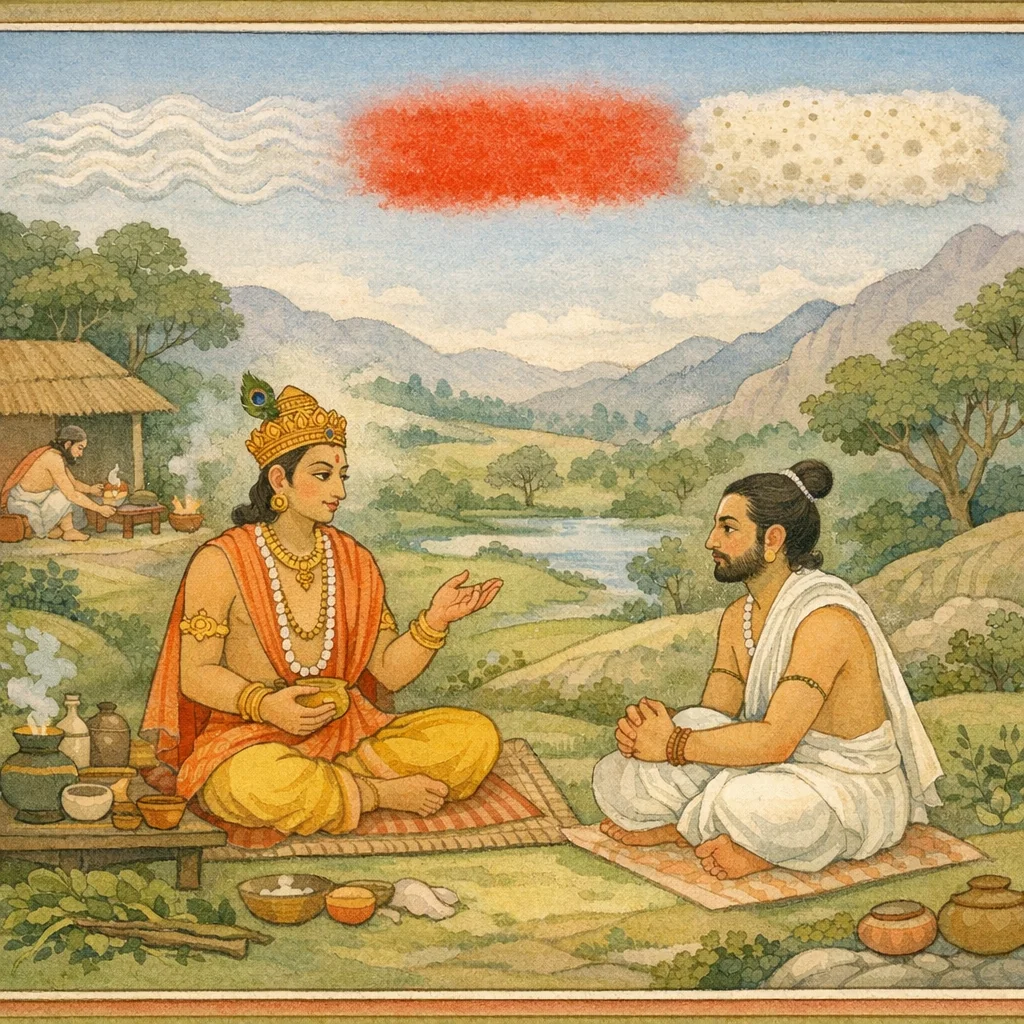
Dhanvantari said: “Now, O Suśruta, listen as I set forth the causes and signs of visarpa and related disorders. Visarpa arises from injury or disturbance; when the doṣas are vitiated, it produces a swelling-like condition.”
Verse 2
अधिष्ठानञ्च तं प्राहुर्बाह्यं तत्र भयाच्छ्रमात् / यथात्तरञ्च दुः साध्यस्तत्र दोषो यथायथम्
They declare its seat (adhiṣṭhāna) to be external, upon the outer body. In that state, through fear and exhaustion, it becomes progressively harder to cure, according to the doṣa involved in each case.
Verse 3
प्रकोपनैः प्रकुपिता विशेषेण विदाहिभिः / देहे शीघ्रं विशन्तीह ते ऽन्तरे हि स्थिता बहिः
Aggravated by provoking factors—especially those that bring burning and irritation—the doṣas swiftly enter and spread through the body, moving from within while manifesting outwardly.
Verse 4
तृष्णाभियोगाद्वेगानां विषमाच्च प्रवर्तनात् / आशु चाग्निबलभ्रंशादतो बाह्यं विसर्पयेत्
From the compulsion of intense thirst, from irregular or improper arousal of the bodily urges, and from a sudden decline of digestive fire (agni) and strength, the disorder called visarpa swiftly spreads outward over the body.
Verse 5
तत्र वातात्स वीसर्पो वातज्वरसमव्यथः / शोथस्फुरणनिस्तोदभेदायासार्तिहर्षवान्
In that context, visarpa arising from vāta resembles the pain-pattern of a vāta-fever, and is marked by swelling, throbbing, pricking pain, splitting pain, fatigue, distress, and bouts of agitation or exhilaration.
Verse 6
पित्ताद्द्रुतगतिः पित्तज्वरलिङ्गो ऽतिलोहितः / कफात्कण्डूयुतः स्निग्धः कफज्वरसमानरुक्
From pitta it moves swiftly, shows the signs of a pitta-fever, and becomes intensely red; from kapha it is accompanied by itching, is oily and heavy, and has pain similar to a kapha-fever.
Verse 7
सन्निपातसमुत्थाश्च सर्वलिङ्गसमन्विताः / स्वदोषलिङ्गैश्चीयन्ते सर्वैः स्फोटैरुपेक्षिताः / ते ऽपि स्वेदान्विमुञ्चति बिभ्रतो व्रणलक्षणम्
Those (eruptions) that arise from the simultaneous aggravation of all the doṣas (sannipāta) display every characteristic. Marked by the signs of their respective doṣas, they are disregarded as mere blisters by all. Yet they too ooze sweat-like fluid and present the features of a wound.
Verse 8
वातपित्ताज्ज्वरच्छर्दिमूर्छातीसारतृड्भ्रमैः / गन्थिभेदाग्निसदनतमकारोचकैर्युतः
From the aggravation of vāta and pitta arise fever, vomiting, fainting, diarrhea, thirst, and giddiness; accompanied by bursting of glandular swellings, loss of digestive fire, darkness/blackouts, and loss of appetite.
Verse 9
करोति सर्वमङ्गञ्च दीप्ताङ्गारावकीर्णवत् / यंयं देशं विसर्पश्च विसर्पति भवेत्ससः
It makes the whole body feel as though strewn with glowing embers; and whichever region the ‘visarpa’ spreads into, that very region becomes afflicted accordingly.
Verse 10
शान्ताङ्गारासितो नीलो रक्तो वासु च चीयते / अग्निदग्ध इव स्फोटैः शीघ्रगत्वाद्द्रुतं स च
Its hue becomes like quenched charcoal—dark, bluish, then reddish—and it spreads over the body. Blisters arise as though the flesh were scorched by fire, and because it runs swiftly, it quickly grows severe.
Verse 11
मर्मानुसारी वीसर्पः स्याद्वातो ऽतिबलस्ततः / व्यथते ऽङ्गं हरेत्संज्ञां निद्राञ्च श्वासमीरयेत्
The vīsarpa spreads along the vital points (marmas); then vāta grows exceedingly strong. The limbs ache fiercely, consciousness may be taken away, sleep is disturbed, and breathing becomes labored.
Verse 12
हिक्काञ्च स गतो ऽवस्थामीदृशीं लभते नरः / क्वचिन्मर्मारतिग्रस्तो भूमिशय्यासनादिषु
He is also seized by hiccups, and the man falls into such a state. At times, tormented by pain in the marmas, he finds no comfort even on the ground, on a bed, on a seat, and the like.
Verse 13
चेष्टमानस्ततः क्लिष्टो मनोदेहप्रमोहवान् / दुष्प्रबोधो ऽश्नुते निद्रां सो ऽग्निवीसर्प उच्यते
Thereupon he tosses about, distressed and bewildered in mind and body; hard to rouse, he falls into sleep. This condition is called agni-vīsarpa, the affliction that “spreads like fire”.
Verse 14
कफेन रुद्धः पवनो भित्त्वातं बहुधा कफम् / रक्तं वा वृद्धरक्तस्य त्वक्छिरास्नायुमांसगम्
When the vital wind (vāyu) is obstructed by kapha, it breaks through and disperses that kapha in many ways; or else, in one whose blood is aggravated, it disturbs the blood that courses through the skin, vessels, sinews, and flesh.
Verse 15
दूषयित्वा तु दीर्घानुवृत्तस्थूलखरात्मिकाम् / ग्रन्थीनां कुरुते मालां सरक्तान्तीव्ररुग्ज्वराम्
Having vitiated the tissues into a long-enduring, thick, and rough state, it produces a garland-like chain of glandular nodules (granthis), attended by bleeding, intense pain, and fever.
Verse 16
श्वासकासातिसारास्यशोषहिक्कावमिभ्रमैः / मोहवैवर्ण्यमूर्छाङ्गभङ्गग्निसदनैर्युताम् / इत्ययं ग्रन्थिवीसर्पः कफमारुतकोपजः
Marked by breathlessness, cough, diarrhea, dryness of mouth, hiccup, vomiting, and dizziness—together with delirium, discoloration, fainting, body-aches, and the waning of digestive fire—this is called “granthi-vīsarpa,” a spreading nodular affliction born of aggravated kapha and vāta.
Verse 17
कफपित्ताज्ज्वरः स्तम्भो निद्रा तन्द्रा शिरोरुजा / अङ्गावसादविक्षेंपौ प्रलापारोचकभ्रमाः
From kapha and pitta arise fever, stiffness, excessive sleep, drowsiness, and headache; bodily languor and restlessness—along with delirious speech, loss of appetite, and dizziness.
Verse 18
मूर्छाग्निहानिर्भेदो ऽस्थ्नां पिपासेन्द्रियगौरवम् / आमोपवेशनं लेपः स्रोतसां स च सर्पति
There is fainting, the loss of digestive fire, splitting pain in the bones, thirst, and heaviness of the senses; āma accumulates, forming an obstructive coating in the bodily channels (srotas), and that obstruction spreads.
Verse 19
प्रायेणामाशयं गृह्णन्नेकदेशं न चातिरुक् / पीडकैरवकीर्णो ऽतिपीतलोहितपाण्डुरैः
Generally it seizes an internal seat or organ only in one region and is not excessively painful; yet it becomes scattered over with pustules of intensely yellow, blood-red, and pale hues.
Verse 20
स्निध्नो ऽसितो मेचकाभो मलिनः शोथवान्गुरुः / गम्भीरपाकः प्रायोष्मस्पृष्टः क्लिन्नोंऽवदीर्यते
It is glossy, dark—having a cloud-blue hue—foul and swollen, heavy in nature; it suppurates deeply, and when touched by heat it usually becomes sodden and splits open.
Verse 21
पक्ववच्छीर्णमांसश्च स्पष्टस्नायुशिरागणः / सर्वगो लक्षणैः सर्वेः सर्वगत्वक्समर्पणः / शवगन्धी च वीसर्पः कर्दमाख्यमुशन्ति तम्
The flesh appears as if cooked and is sloughing away, with the tendons and clusters of veins clearly visible. Spreading everywhere with all these signs, consuming the skin throughout, it emits a corpse-like stench; this spreading affliction is called the disease known as “Kardama.”
Verse 22
बाह्यहेतोः क्षतात्क्रुद्ध्वः सरक्तं पित्तमीरयन् / वीसर्पं मारुतः कुर्यात्कुलत्थसदृशैश्चितम्
When, due to an external cause (such as injury), the wind (vāta) becomes aggravated and drives pitta mixed with blood into activity, it produces vīsarpa (a rapidly spreading skin disorder), marked by eruptions resembling kulattha (horse-gram).
Verse 23
स्फोटैः शोथज्वररुजादाहाढ्यं श्यावशोणितम् / पथग्दोषैस्त्रयः साध्या द्वन्द्वजाश्चानुपद्रवाः
It presents with blisters, swelling, fever, pain, and intense burning, along with darkened blood. The three forms arising from single doṣas are treatable; and those born of a dual-doṣa combination are also treatable when free from complications.
Verse 24
असाध्याः कृतसर्वोत्थाः सर्वे चाक्रान्तमर्मणः / शीर्णस्नायुशिरामांसाः क्लिन्नाश्चशवगन्धयः
Incurable are those arising from the involvement of all doṣas, and also those in which vital points (marmas) are affected. When tendons, vessels, and flesh are destroyed, the parts become sodden and emit a corpse-like odor.
Frequently Asked Questions
Vāta-type is described through swelling with throbbing/pricking/splitting pain, fatigue and agitation; pitta-type spreads swiftly with intense redness and burning-fever features; kapha-type shows itching, oiliness, heaviness, and kapha-fever-like pain—each indicating the dominant doṣa.
Agni-visarpa is associated with rapid spread along marmas, extreme vāta aggravation, intense limb pain, disturbed sleep, labored breathing, hiccups, mental distress, and possible loss of consciousness—signaling a dangerous, system-wide escalation.
Single-doṣa forms are stated to be treatable; dual-doṣa forms are treatable when free from complications; incurable are sannipāta forms and those involving marmas, especially when tendons, vessels, and flesh are destroyed with sodden parts and corpse-like odor.