Adhyaya 162
Pāṇḍu-Śotha Nidāna: Doṣa-wise Signs, Complications, and Prognosis
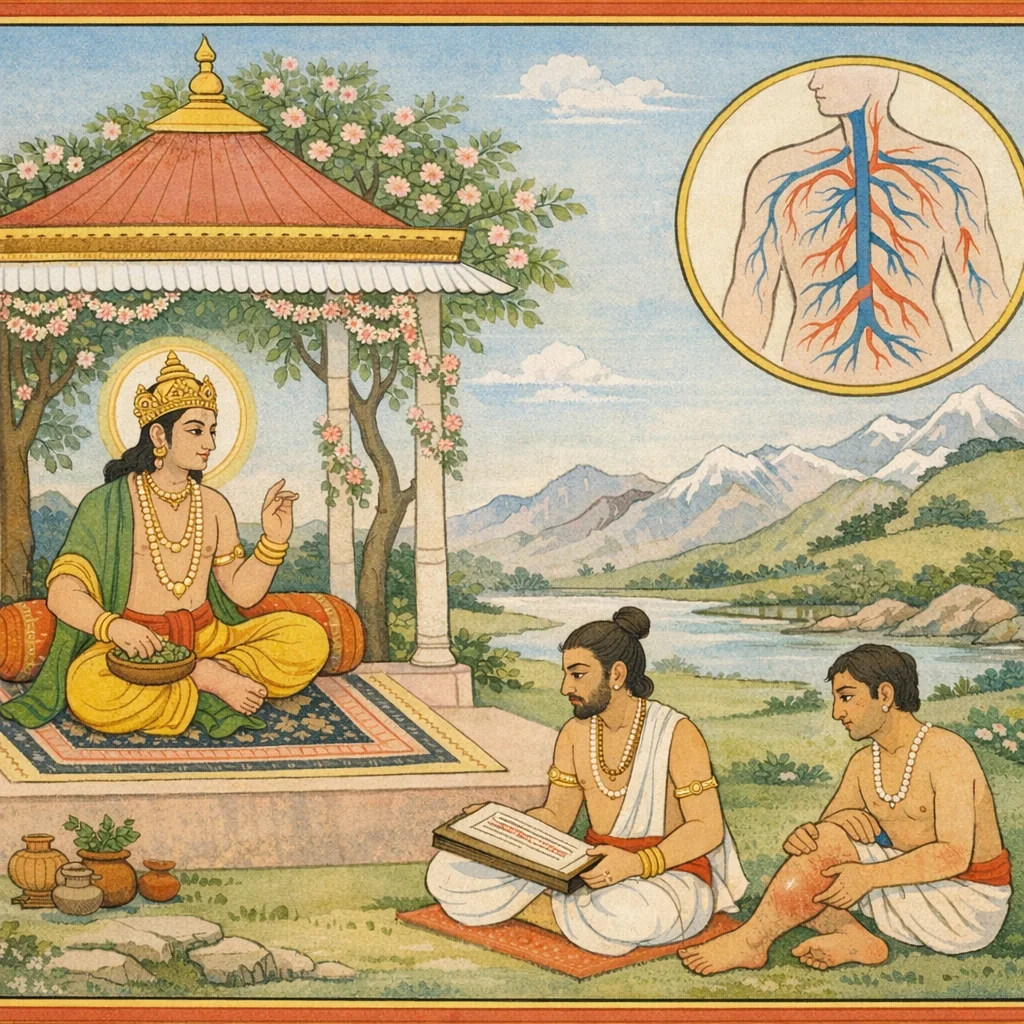
Continuing the Brahma Khanda’s Ayurveda instruction in the Garuda Purana, Dhanvantari teaches Suśruta the nidāna (causes) and lakṣaṇa (signs) of pāṇḍu and śotha. He explains how aggravated doṣas—especially pitta—move through the nāḍīs, vitiate rasa and other dhātus, and produce turmeric-yellow discoloration, heaviness, āma-related tissue laxity, and systemic weakness. He then distinguishes vāta-, pitta-, and kapha-dominant forms, notes mixed or obscured signs in severe cases, and warns of complications such as wasting, abnormal stools, pitta-following edema, and progression into kumbha-kāmalā and halīmaka. Turning to śotha as pāṇḍu’s chief associated feature, he defines it through channel obstruction and nicaya-type consolidated swelling, classifies edema into nine kinds (including traumatic and toxic), and lists dietary, behavioral, exertional, and poison-related causes. The chapter ends with prognosis: soft, mobile, recent swellings are curable, while deep-seated, internally driven edema tends toward incurability, preparing for the therapeutic chapters that follow.
Shlokas
Verse 1
ऽध्यायः धन्वन्तरिरुवाच / पाण्डुशोथनिदानञ्च शृणु सुश्रत वच्मि ते / पित्तप्रधानाः कुपिता यथोक्तैः कोपनैर्मलाः
Dhanvantari said: “Hear from me, O Suśruta, the causes of pāṇḍu (pallor, anemia-like) and śotha (swelling/edema). When the bodily doṣas—predominantly pitta—are provoked by the aggravating factors taught in the treatises, these conditions arise.”},{
Verse 2
नत्रानिलेन बलिना क्षिप्ताक्षिप्तं यदि स्थितम् / धमनीर्दशमीः प्राप्य व्याप्नुवन्सकलां तनुम्
There, if that subtle principle remains—tossed again and again by the powerful vital wind—then, reaching the ten nāḍīs (channels), it pervades the entire body.
Verse 3
त्वगसृक्छ्लेष्ममांसानि प्रदूष्यन्रसमाश्रितम् / त्वङ्मांसयोस्तु कुरुते त्वचि वर्णान् पृथग्विधान्
Residing in rasa (the bodily fluid), it vitiates the skin, blood, phlegm, and flesh; and, affecting skin and tissue, it produces upon the skin various distinct kinds of discoloration.
Verse 4
स्वयं हरिद्रा हारिद्रं पाण्डुत्वं तेषु चाधिकम् / यातो ऽयं प्रहतेदुग्रः स रोगस्तेन गौरवम्
The body itself turns yellow—deeply turmeric-hued—and pronounced pallor appears. When this fierce disorder has set in and struck a person, it brings heaviness and debility because of that disease.
Verse 5
धातूनां स्पर्शशैथिल्यमामजश्च गुणक्षयः / ततो ऽल्परक्तमेदो ऽस्थिनिः सारः स्याच्छ्लथेन्द्रियः
The bodily tissues grow loose and flaccid, and the qualities decline because of āma (toxic, undigested residue). From this come scant blood, diminished fat, and loss of the essence of bone; the senses become slack and weak.
Verse 6
शीर्यमाणैरिवाङ्गैस्तु द्रवता हृदयेन च / शूलोक्षिकूटवदने स्तैमित्यं तत्र लालया
The limbs feel as though they are wasting away, and the heart as if it were dissolving. There is pain in the eyes, temples, and face; and dull stiffness (torpor) arises, along with excessive salivation.
Verse 7
हीनतृट् शिशिरद्वेषी शीर्णलोभो हतानलः / मन्दशक्तिर्ज्वरी श्वासी कर्णशूली तथा भ्रमी
Thirst is diminished, cold is disliked, appetite wanes, and the digestive fire (agni) is weakened. Strength is low; there is fever and breathlessness, pain in the ear, and vertigo as well.
Verse 8
स पञ्चधा पृथग्दोषैः समस्तैर्मृत्तिकादनात् / प्राग्रूपमस्य हृदयस्पन्दनं रूक्षता त्वचि
When the doṣas, in five ways, become disturbed—separately and also together, as by eating earth or clay—its early signs are palpitations of the heart and dryness of the skin.
Verse 9
अरुचिः पीतमूत्रत्वं स्वेदाभावो ऽल्पमृत्रता / मेदः समानिलात्तत्र गाढरुक्क्लेदगात्रता
There is loss of taste and appetite, yellowish urine, absence of sweating, and scant urination. And because the wind (vāta), acting in concert, becomes deranged, the fat is affected—then the body grows heavily painful and damp, clammy.
Verse 10
कृष्णेक्षणं कृष्णशिरानखविण्मूत्रनेत्रता / शोथो नासास्यवैरस्यं विट्शोषः पार्श्वमूर्छना
When vāta predominates, the eyes grow dark; the head, veins, nails, stool, urine, and even the gaze appear blackened. Swelling arises; the nose and mouth take on an unpleasant, distorted taste; the stool dries up; there is pain in the flanks and fainting.
Verse 11
पित्ते हरितपित्ताभः शिरादिषु ज्वरस्तमः / तृट्शोषमूर्छादौर्गन्ध्यं शीतेच्छा कटुवक्रता
When pitta predominates, a greenish-yellow, bile-like hue appears; fever and a sense of darkness or confusion affect the head and related parts. Thirst, dryness, fainting, and foul odor arise; there is craving for cold, and a bitter, distorted taste in the mouth.
Verse 12
विड्भेदश्चाम्लको दाहः कफाच्च हृदयार्द्रता / तन्द्रा लवणवक्रत्वं रोमहर्षः स्वरक्षयः
There is looseness of the bowels, sour belching or acidic disturbance, and a burning sensation; and when kapha predominates there is heavy, moist oppression in the region of the heart. Drowsiness arises, a salty distorted taste appears, there is horripilation, and the voice becomes weakened.
Verse 13
काशश्छर्दिश्च निचयान्नष्टलिङ्गो ऽतिदुः सहः / उत्कृष्टेनिलपित्ताभ्या कटुर्वा मधुरः कफः
Cough and vomiting arise; through accumulation of the doṣas the characteristic signs become obscured, and the condition becomes exceedingly hard to endure. When vāta and pitta are intensely aggravated, kapha manifests as either pungent in quality or, at times, sweet.
Verse 14
दूषयित्वा वसादींश्च रौक्ष्याद्रक्तविमोक्षणम् / स्रोतसां संक्षयं कुर्यादनुरुध्य च पूर्ववत्
After vitiating vasa (fat) and related tissues, and through dryness causing depletion or discharge of blood, it brings about wasting of the bodily channels (srotas). It proceeds according to the previously described course, following the same pattern as before.
Verse 15
पाण्डुरोगेक्षयेजाते नाभिपादास्यमेहनम् / पुरीषं कृमिवन्मुञ्चेद्भिन्नं सास्त्रं कफान्वितम्
When wasting (kṣaya) arises in one afflicted with pāṇḍu, the navel region, feet, mouth, and urinary passage are distressed. The stool is passed as though full of worms—loose and broken, mixed with blood, and accompanied by kapha.
Verse 16
यः पित्तरोगी सेवेत पित्तलं तस्य कामलम् / कोष्ठशा खोद्गतं पित्तं दग्ध्वासृङ्मांसमाहरेत्
If one afflicted with pāṇḍu-roga indulges in what aggravates pitta (pittala), kāmalā (jaundice) arises. Pitta surging up from the koṣṭha burns the blood and flesh, bringing grievous harm.
Verse 17
हारिद्रमूत्रनेत्रत्वं मुखं रक्तं शकृत्तथा / दाही विपाकतृष्णावान् भेकाभो दुर्बलेन्द्रियः
His urine and eyes turn yellowish; his face becomes red, and his stool too is abnormal. He suffers burning and digestive distress, tormented by intense thirst—frog-like in appearance, with weakened senses.
Verse 18
भवेत्पित्तानुगः शोथः पाण्डुरोगावृतस्य च / उपेक्षया च शोथाद्याः सकृच्छ्राः कुम्भकामलाः
In one overwhelmed by pāṇḍu, swelling (śotha) arises in accordance with aggravated pitta. If such swelling and related conditions are neglected, they become hard to cure and develop into kumbha-kāmalā, a severe jaundice.
Verse 19
हरितश्यामपित्तत्वे पाण्डुरोगो यदा भवेत् / वातपित्ते भ्रमस्तृष्णा स्त्रीषु हर्षो मृदुज्वरः
When pitta turns greenish and dark, pāṇḍu-disease arises. In a disorder where vāta is joined with pitta, there occur dizziness and thirst, heightened desire toward women, and a mild fever.
Verse 20
तन्द्रा वा चानलभ्रंशस्तं वदन्ति हलीमकम् / आलस्यञ्चातिभवति तेषां पूर्वमुपद्रवः
When drowsiness arises and the digestive fire (agni) declines or fails, that state is called halīmaka. Excessive lethargy then manifests; for such persons these are the preceding disturbances (prodromal troubles).
Verse 21
शोथः प्रधानः कथितः स एवातो निगद्यते / पित्तरक्तकफान्वायुर्दुष्टो दुष्टान्बहिः शिराः
Swelling (śotha) has been declared the principal sign; therefore it is now described. When vāyu, associated with pitta, blood (rakta), and kapha, becomes vitiated, it also vitiates the outer channels/veins (śirā).
Verse 22
नीत्वा रुद्धगतिस्तैर्हि कुर्यात्त्वङ्मांससंश्रयम् / उत्सेधं संहतं शोथं तमाहुर्निचयादतः
When those factors obstruct the bodily channels and impede movement, they lodge in the skin and flesh and produce a compact, raised swelling. Such a consolidated edema is therefore called a nicaya—an accumulated swelling.
Verse 23
सर्वहेतुविशषैस्तु रूपभेदान्नवात्मकम् / दोषैः पृथग्विधैः सर्वैरभिघाताद्विषादपि
Because of the many specific causes and the differing manifestations, swelling is understood to be ninefold in nature—arising from the various doṣas, from all their distinct combinations, and also from injury and from poisoning.
Verse 24
तदेव नीयमानन्तु सर्वाङ्गे कामजम्भवेत् / पृथून्नताग्रग्रथितैर्विशेषैश्च त्रिधा विदुः
That same swelling, when it spreads throughout the entire body, becomes kāmaja—a body-wide, generalized swelling. By its distinguishing features—broad and diffuse, elevated, and nodular or knotted—they know it to be of three kinds.
Verse 25
सामान्यहेतुः शोथानां दोषजातो विशेषतः / व्याधिः कर्मोपवासादिक्षीणस्य भवति द्रुतम्
The general cause of swellings (śotha) is, in particular, the disturbance born of deranged bodily doṣas. The disease swiftly manifests in one weakened by overexertion, fasting, and other depleting practices.
Verse 26
अतिमात्रं यदासेवेद्गुरुमत्यन्तशीतलम् / लवणक्षारतीक्ष्णाम्लशाकाम्बुस्वप्नजागरम्
When one indulges to excess in heavy foods and in things that are extremely cold, and also in salty, alkaline, pungent and sour items, leafy vegetables, excessive water intake, and irregular sleep—too much sleep and too much wakefulness—such habits aggravate the condition.
Verse 27
रोधो वेगस्य वल्लूरमजीर्णश्रममैथुनम् / पच्यते मार्गगमनं यानेन क्षोभिणापि वा
Suppressing natural bodily urges, eating dried meat, indigestion, exertion, sexual activity, and travelling on the road—whether on foot or in a jolting vehicle—these factors aggravate and ‘cook up’ the disorder.
Verse 28
श्वासकासातिसारार्शोजठरप्रदरज्वराः / विष्टम्भालस्यकच्छर्दिहिक्कापाण्डुविसर्पकम्
Some produce swelling in the upper parts; some below, in the region of the bladder; those lodged in the middle cause it in the mid-region. When it pervades all limbs it is called “whole-body”; when it spreads everywhere it is “all-pervading”; and it may also move outward and inward, according to where it is lodged.
Verse 29
ऊर्ध्वशोथमधो बस्तौ मध्ये कुर्वन्ति मध्यगाः / सर्वाङ्गगः सर्वगतः प्रत्यप्रत्यगेति तदाश्रयः
Those that move through the middle region produce swelling above; below, disorders of the bladder; and afflictions in the body’s mid-part. That subtle principle pervades every limb and is present everywhere; it is said to move both outward and inward, being the support on which the body depends.
Verse 30
तत्पूर्वरूपं क्षवथुः शिरायामङ्गगौरवम् / वाताच्छोथश्चलो रूक्षः खररोमारुणो ऽसितः
Its preliminary signs are sneezing, pain of the head, and heaviness of the limbs. Thereafter, when vāta (wind) is deranged, a swelling arises—restless and dry—with hairs standing on end, appearing reddish and dark.
Verse 31
शङ्खबस्त्यन्त्रशोफर्तिमेदोभेदाः प्रसुप्तिता / वातोत्तानः क्लमः शीघ्रमुन्नमेत्पीडितां तनुम्
There is swelling and pain in the temples, the bladder, and the intestines; splitting pains in the fatty tissues; and numbness with lethargy. When vāta moves upward, exhaustion arises, and the afflicted body is swiftly driven into distress.
Verse 32
सिग्धस्तु मर्दनैः शाम्येद्रात्रावल्पो दिवा महान् / त्वक्सर्षपविलिप्ते च तस्मिंश्चिमिचिमायते
The ailment called sigdha is soothed by massage; it is mild at night but severe by day. And when the skin is smeared with mustard, a tingling, irritating sensation arises in that area.
Verse 33
पीतरक्तासिंताभासः पित्तजातश्च शोषकृत् / शीघ्रं नासौ वा प्रशमेन्मध्ये प्राग्दहते तनुम्
Yellowish and reddish in appearance, born of pitta (bile) and causing wasting, it does not quickly subside; rather, it burns the body from within, as though igniting it in the middle.
Verse 34
सतृट्दाहज्वरस्वेदो भ्रमक्लोदमदभ्रमाः / साभिलाषी शकृद्भेदो गन्धः स्पर्शसहो मृदुः
There arise thirst, burning sensation, fever and sweating; dizziness, moist clamminess, intoxication-like stupor and giddiness. There is craving and looseness of the bowels; the body gives off an odor, the sense of touch becomes more tolerant (less sensitive), and the body feels soft.
Verse 35
कण्डूमान्पाण्डुरोमा त्वक्कठिनः शीतलो गुरुः / स्निग्धःश्लक्ष्णः स्थिरः शूलो निद्राच्छर्द्यग्निमान्द्यकृत्
He is afflicted with itching; the hairs of his body turn pale; his skin grows hard; he feels cold and heavy. Though oily, he becomes smooth yet rigid and wracked with pain, and he is made prone to drowsiness, vomiting, and the weakening of the digestive fire (agni).
Verse 36
आघातेन च शस्त्रादिच्छेदभेदक्षतादिभिः / हिमानिलैर्दध्यनिलैर्भल्लातकपिकच्छजैः
They are afflicted by blows and by weapons—by cutting, splitting, and wounding; and they are further tormented by icy winds, harsh gusts, and irritants such as bhallātaka (marking-nut) and the stinging hairs of kapikacchu (cowhage).
Verse 37
रसैः शुष्कैश्च संस्पर्शाच्छ्वयथुः स्याद्विसर्पवान् / भृशोष्मा लोहिताभासः प्रायशः पित्तलक्षणः
From contact with fluids and with dry substances, swelling may arise, along with a spreading eruption (visarpa). There is intense heat and a reddish appearance—most often bearing the marks of pitta.
Verse 38
विषजः सविषप्राणिपरिसर्पणमूत्रणात् / दंष्ट्रादन्तनखाघातादविषप्राणिनामपि
Poison may arise from contact with the urine of venomous creatures that crawl about, and it may also arise from the strike of fangs, teeth, or nails—even of creatures that are not venomous.
Verse 39
विण्मूत्रशुक्रोपहतमलवद्वस्तुसंङ्करात् / विषवृक्षानिलस्पर्शाद्गरयोगावचूर्णनात्
Poisoning (or harmful contamination) arises from the mixing of impure substances—things tainted by feces, urine, semen, or filth; from contact with wind that has touched poisonous trees; and from the administration of compounded poisons (gara) or poisonous powders.
Verse 40
मृदुश्चलो ऽवलम्बी च शीघ्रो दाहरुजाकरः / नवो ऽनुपद्रवः शोथः साध्यो ऽसाध्यः पुरेरितः
A swelling that is soft, shifting, and pendulous—quick to arise and causing burning pain—when new and free from complications is held to be curable; but when driven by a disorder seated in the body’s inner region (pura), it is regarded as incurable.
Frequently Asked Questions
Early indicators include palpitations and dryness of skin, along with loss of taste/appetite, yellowish urine, reduced sweating, and scant urination—especially when doṣas are disturbed separately and collectively.
A new, uncomplicated swelling that is soft, shifting, and pendulous—though painful and burning—is considered curable; when it is driven by a deep-seated internal disorder (pura/inner region), it is regarded as incurable.