Adhyaya 129
Tithi-Vrata Vidhāna: Śikhī-vrata (Pratipadā), Tṛtīyā Devī/Śrīdhara rites, Gaṇeśa Caturthī Mantra-Nyāsa, and Nāga Pañcamī
Continuing the ācāra-based teaching on vratas, Brahmā instructs Vyāsa in observances arranged by lunar day. On Pratipadā he teaches the Śikhī-vrata: one-meal discipline, worship of Brahmā in the Caitra season, homa, and the concluding dāna of a tawny cow, promising attainment of Vaiśvānara’s realm. For Tṛtīyā he prescribes prosperity worship of Śrīdhara with Śrī (prayer and gifts such as a bed and fruits), alongside a parallel Umā–Śiva–Agni worship with haviṣya and damanaka, ending with major dānas (a bed and a furnished house) and remembrance of the Goddess’ many names. The chapter then gives a technical Gaṇeśa Caturthī regimen: Māgha fasting with sesame, a praṇava-linked root mantra, bīja-nyāsa placements, ordered offerings, Gaṇapati Gāyatrī, and gaṇa/kuṣmāṇḍaka oblations, promising learning, prosperity, progeny, heaven, and liberation. It closes with Nāga Pañcamī worship—naming key serpents, drawing signs at the doorway, offering milk and ghee as naivedya—and affirms protection from poison and snake-bite, preparing for further vrata cataloging.
Shlokas
Verse 1
ऽध्यायः ब्रह्मोवाच / वक्ष्ये प्रतिपदादीनि व्रतानि व्यास शृण्वथ / वाश्वानरपदं याति शिखिव्रतमिदं स्मृतम्
Brahmā said: “I shall describe the vratas beginning with those observed on Pratipadā, the first lunar day. O Vyāsa, listen. This is remembered as the Śikhī-vrata; by it one attains the state or realm of Vaiśvānara, the cosmic Fire.”
Verse 2
प्रतिपद्येकभक्ताशी समाप्ते कपिलाप्रदः / चैत्रादौ कारयेच्चैव ब्रह्मपूजां यथाविधि / गन्धपुष्पार्चनैर्दानैर्माल्याद्यैश्च मनोरमैः
On Pratipadā one should take only a single meal; and when the observance is completed, one should gift a tawny kapilā cow. At the beginning of the month of Caitra, one should also have the worship of Brahmā performed according to proper procedure—using fragrances, flowers, arcana (ritual offerings), charitable gifts, delightful garlands, and the like.
Verse 3
सहोमैः पूजयेद्देवं सर्वान्कामानवाप्नुयात् / कार्तिके त सिते ऽष्टम्यां पुष्पहारी च वत्सरम्
If one worships the Lord together with homa-offerings, one attains all desired aims. And in the bright fortnight of Kārtika, on the eighth lunar day (Aṣṭamī), one should undertake the vow of offering floral garlands for a year.
Verse 4
पुष्पादिदाता रूपेण रूपभागी भवेन्नरः / कृष्णपक्षे तृतीयायां श्रावणे श्रीधरं श्रिया
One who gives gifts such as flowers becomes endowed with beauty and a share in pleasing form. On the third lunar day (Tṛtīyā) of the dark fortnight in the month of Śrāvaṇa, one should worship Śrīdhara together with Śrī (Lakṣmī) for prosperity.
Verse 5
यजेदशून्यशय्यायां फलं दद्याद्द्विजातये / शय्यां दत्त्वा प्रार्थयेच्च श्रीधराय नमः श्रियै
One should perform worship upon a bed that is not empty, and give fruit as a gift to a twice-born (brāhmaṇa). Having donated a bed, one should then pray: “Salutations to Śrīdhara, and salutations to Śrī (Lakṣmī).”
Verse 6
उमांशिवं हुताशं च तृतीयायां च पूजयेत् / हविष्यमन्न नैवेद्य देय दमनकं तथा
On the third lunar day (Tṛtīyā), one should worship Umā and Śiva, and also Agni. As a food-offering (naivedya), one should present haviṣya-type fare, and likewise offer damanaka, the sacred fragrant herb/leaf.
Verse 7
चैत्रादौ फलमाप्नोति उमया मे प्रभाषितम् / फाल्गुनादितृतीयायां लवणं यस्तु वर्जयेत्
Beginning with the month of Caitra, one attains the promised fruit—this has been spoken to me by Umā. And whoever, beginning from the month of Phālguna, on the third lunar day (Tṛtīyā) refrains from salt, obtains the merit of that restraint.
Verse 8
समाप्ते शयनं दद्याद्गृहं चोपस्करान्वितम् / संपूज्य विप्रमिथनं भवानी प्रीयतामिति
At the close of the rite, one should donate a bed, and also a house furnished with household implements. Having duly honored the brāhmaṇa couple, one should say: “May Bhavānī, the Goddess, be pleased.”
Verse 9
गौरीलोके वसेन्नित्यं सौभाग्यकरमुत्तमम् / गौरी काली उमा भद्रा दुर्गा कान्तिः सरस्वती
May one dwell always in Gaurī’s realm—the supreme bestower of good fortune—remembering Gaurī, Kālī, Umā, Bhadrā, Durgā, Kānti, and Sarasvatī.
Verse 10
मङ्गला वैष्णवी लक्ष्मीः शिवा नारायणी क्रमात् / मार्गेतृतीयामारभ्य अवियोगादिमाप्नुयात्
In due order, she is Maṅgalā, Vaiṣṇavī, Lakṣmī, Śivā, and Nārāyaṇī. Beginning from the third stage on the path, one attains the commencement of non-separation—freedom from estrangement and the start of auspicious, unbroken union.
Verse 11
चतुर्थ्यां सितमाघादौ निराहारो व्रतान्वितः / दत्त्वा तिलांस्तु विप्राय स्वयं भुङ्क्ते तिलोदकम्
On the fourth lunar day, beginning in the bright fortnight of Māgha, one should observe a vow while fasting; after giving sesame seeds to a brāhmaṇa, one should oneself partake only of sesame-water.
Verse 12
वर्षद्वये समाप्तिश्च निर्विघ्नादिं समाप्नुयात् / गः स्वाहा मूलमन्त्रो ऽयं प्रणवेन समन्वितः
Within two years, one should attain completion and accomplish, without hindrance, the rites that begin with the removal of obstacles. This is the root-mantra—“gaḥ svāhā”—to be employed together with the praṇava (Oṁ).
Verse 13
ग्लैं ग्लांहृदये गां गीं हूं ह्रीं ह्रीं शिरः शिखा / गूं वर्म गों च गैं नेत्रं गों च आवाहनादिषु
Assign the seed-syllables: ‘glaiṃ, glāṃ’ in the heart; ‘gāṃ, gīṃ, hūṃ, hrīṃ, hrīṃ’ upon the head and the topknot; ‘gūṃ’ as the protective armour (varma); ‘goṃ’ and ‘gaiṃ’ in the eyes; and ‘goṃ’ in acts such as invocation (āvāhana) and the rest.
Verse 14
आगच्छोल्काय गनन्धोल्कः पुष्पोल्को धूपकोल्ककः / दीपोल्काय महोल्काय बलिश्चाथ विस (मार्) जनम्
Come—this is the offering called ‘Āgacchol-kā’; then follow the fragrant offering, the flower-offering, the incense-offering (dhūpa), the lamp-offering (dīpa), and the great offering; and also the bali-offering, and the act of dispelling poison or impurity.
Verse 15
सिदेधोल्काय च गायत्त्री (त्र) न्यासोंगुष्ठादिरीरितः / ॐ महाकर्णाय विद्महे--वक्रतुण्डाय धीमहि--तन्नो दन्तिः प्रचोदयात्
For this rite, the Gāyatrī-mantra and the nyāsa beginning with the thumb are prescribed. One should recite: “Oṁ. We know and contemplate the Great-Eared One; we meditate on the Curved-Trunked One. May that Tusked One impel and illumine us.”
Verse 16
पूजयोत्तिलहोमैश्च एते पूज्या गणास्तथा / गणाय गणपतये स्वाहा कूष्माण्डकाय च
These attendant hosts (gaṇas) are to be worshipped also with offerings and sesame-seed oblations (tilahoma). One should offer with the mantra: “svāhā to the Gaṇa, to Gaṇapati,” and also “svāhā to Kūṣmāṇḍaka.”
Verse 17
अमोघोल्कायैकदन्ताय त्रिपुरान्तकरूपिणे / ॐ श्याम (व) दन्तविकरालास्याहवेपाय वै नमः
Obeisance to the One who hurls the unfailing meteor-weapon (Amo-ghol-kā); to the One-Tusked Lord (Ekadanta); to Him whose very form is the destroyer of Tripura. Oṁ—salutations to the dark-hued One (Śyāma), with fearsome teeth and a dreadful mouth, the protector in battle.
Verse 18
पद्मदंष्टाय स्वाहान्ते मुद्रा वै नर्तनं गणे / हस्ततालश्च हसनं सौभाग्यादिफलं भवेत्
At the close of the mantra addressed to Padmadaṃṣṭā and ending with “svāhā,” one should form the mudrā and dance amid the attendant company; clapping the hands and joyful laughter are also enjoined—bringing blessings such as good fortune and related fruits.
Verse 19
मार्गशीर्षे तथा शुक्लचतुर्थ्यां पूजयेद्गण / अब्दं प्राप्नोति विद्याश्रीकीर्त्यायुः पुत्रसन्ततिम्
In the month of Mārgaśīrṣa, on the bright fortnight’s fourth lunar day (Śukla Caturthī), one should worship Gaṇeśa. By this, one gains a full year endowed with learning, prosperity, fame, longevity, and an unbroken line of offspring.
Verse 20
सोमवारे चतुर्थ्यां च समुपोष्यार्चयेद्गणम् / जपञ्जुह्वत्स्मरन्विद्या स्वर्गं निर्वाणतां व्रजेत्
On a Monday and on the fourth lunar day (Caturthī), observing a complete fast, one should worship Gaṇa (Gaṇeśa). By recitation, fire-offerings, and contemplation of sacred knowledge, one attains heaven and moves toward liberation (nirvāṇa).
Verse 21
यजेच्छुक्लचतुर्थ्यां यः खण्डलड्डुकमोद (मण्ड) कैः / विघ्नाचनेन सर्वान्स कामान्सौभाग्यमाप्नुयात्
Whoever, on the bright-fortnight Caturthī (Śukla Caturthī), worships the Remover of Obstacles (Vighnahara) with offerings such as pieces of sweets, laddūs, modakas, and mandakas, attains all desired aims and gains good fortune.
Verse 22
पुत्रादिकं दमनकैर्दमनाख्या चतुर्थ्यपि / आं गणपतये नमः चतुर्थ्यन्तं यजेद्गणम्
For the welfare of sons and all progeny, on the fourth lunar day known as Damanā—when the sacred durvā-grass is offered—one should worship Gaṇeśa throughout the Caturthī observance, reciting: “Āṃ, salutations to Gaṇapati.”
Verse 23
मासे तु यस्मिन्कस्मिंश्चिज्जुहुयाद्वा जपेत्स्मरेत् / सर्वान्कामानवाप्नोति सर्वविघ्नविनाशनम्
In whatever month one offers the sacred oblation, or repeats the mantra in japa, or even merely remembers this rite and deity, one attains all desired aims; it becomes the destroyer of every obstacle.
Verse 24
विनायकं मूर्तिकाद्यं यजेदेभिश्च नामभिः / सो ऽपि सद्गतिमाप्नोति स्वर्गमोक्षसुखानि च
One should worship Vināyaka—beginning with his mūrti (sacred image)—using these very names; even the worshipper attains a blessed destiny, and the joys of heaven (svarga) as well as the happiness of liberation (mokṣa).
Verse 25
गणपूज्यो वक्रतुण्ड एकदंष्ट्री त्रियम्बकः / नीलग्रीवो लम्बोदरो विकटो विघ्नराजकः
He is worshipped by the Gaṇas: Vakratuṇḍa, the Curved-trunked One; Ekadaṃṣṭrī, the One-tusked; Triyambaka, the Three-eyed; Nīlagrīva, the Blue-necked; Lambodara, the Pot-bellied; Vikaṭa, the Formidable; Vighnarājaka, the King of obstacles.
Verse 26
धूम्रवर्णो भालचन्द्रो दशमस्त विनायकः / गणपतिर्हस्तिमुखो द्वादशारे यजेद्गणम्
He is smoke-hued, with the moon upon his forehead; the ten-headed Vināyaka—Gaṇapati, elephant-faced. One should worship that Gaṇa in a twelve-spoked maṇḍala/cakra.
Verse 27
पृथक् समस्तं मधावी सर्वान्कामान वाप्नुयात् / श्रावणे चाश्विने भाद्रे पञ्चम्यां कात्तिक शुभे
Whether performed separately or together, the wise practitioner attains all desired aims—especially on the auspicious fifth lunar day (Pañcamī) in the months of Śrāvaṇa, Āśvina, Bhādrapada, and Kārtika.
Verse 28
वासुकिस्तक्षकश्चैव कालीयो मणिभद्रकः / ऐरावतो धृतराष्टः कर्कोटकधनञ्जयौ
Vāsuki, Takṣaka, Kāliya, and Maṇibhadraka; Airāvata, Dhṛtarāṣṭra, and also Karkoṭaka and Dhanañjaya—these are the Nāgas named.
Verse 29
घृताद्यैः स्नापिता ह्येते आयुरारोग्यसम्पदः / अनन्तं वासुकिं शङ्खं पद्मं कम्बलमेव च
Indeed, when these are bathed with ghee and similar substances, they bestow longevity, health, and prosperity—namely Ananta, Vāsuki, Śaṅkha, Padma, and Kambala as well.
Verse 30
तथा कर्काटकं नागं धृतराष्ट्रं च शङ्खकम् / कालीयं तक्षकं चैव पिङ्गलं मासिमासि च
Likewise, one should remember/recite the nāga-serpents Karkāṭaka, Dhṛtarāṣṭra and Śaṅkhaka; also Kāliya, Takṣaka, and Piṅgala—month after month.
Verse 31
यजेद्भाद्रसिते नागानष्टौ मुक्तिं दिवं व्रजेत् / द्वारस्योभयतो लेख्याः श्रावणे तु सिते यजेत्
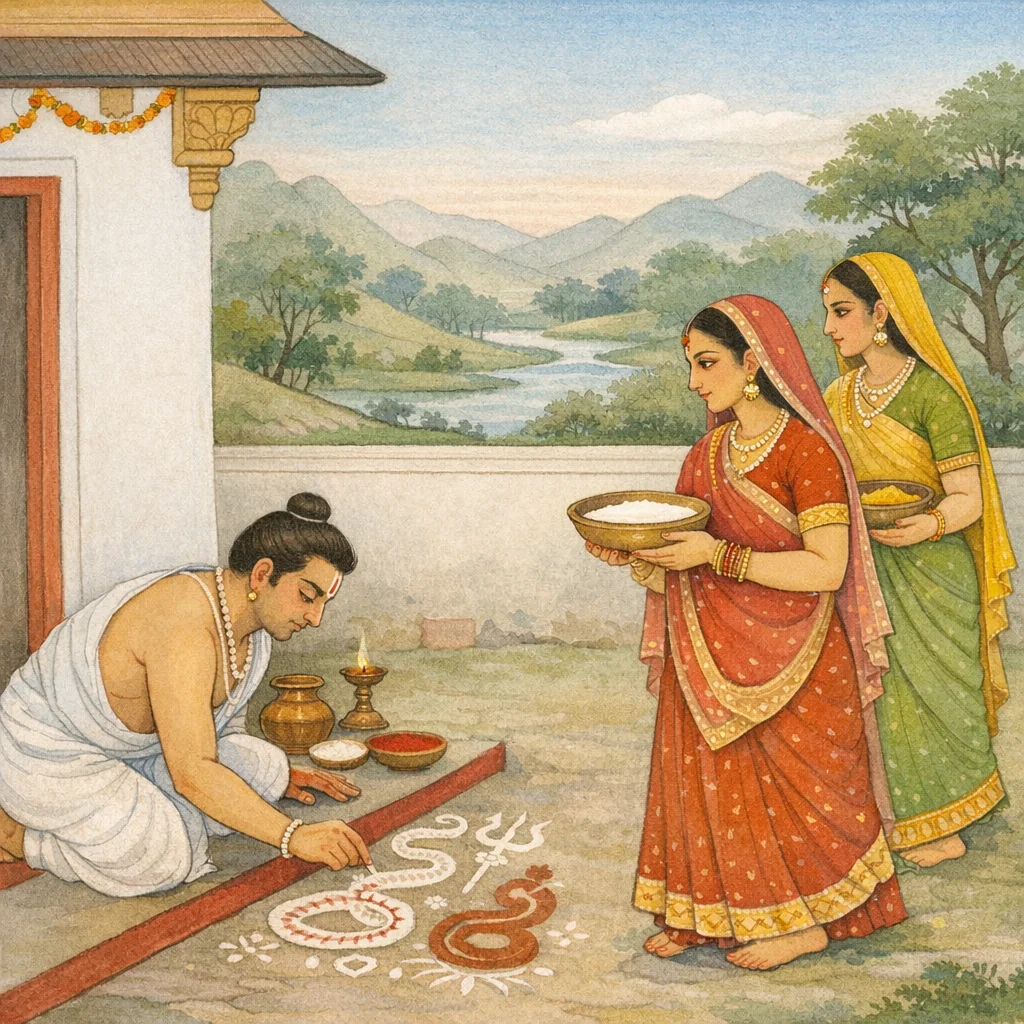
If, in the bright fortnight of Bhādrapada, one worships the eight Nāgas, one attains liberation and goes to heaven. One should have them drawn on both sides of the doorway; and in the bright fortnight of Śrāvaṇa as well, one should perform their worship.
Verse 32
पञ्चम्यां पूजयेन्नागाननन्तान्द्यान्महोरगान् / क्षीरं सर्पिश्च नैवेद्यं देयं सर्वविषापहम् / नागा अभयहस्ताश्च दष्टोद्धारातु पञ्चमी
On the fifth lunar day (Pañcamī), one should worship the Nāgas, meditating on Ananta and the great serpents. As naivedya, milk and ghee should be offered—this is said to remove every kind of poison. The Nāgas, with hands granting fearlessness, protect and rescue one from snake-bite; therefore Pañcamī is observed thus.
Frequently Asked Questions
Śikhī-vrata is a Pratipadā observance involving single-meal discipline, proper worship (especially in Caitra with fragrance, flowers, and dāna), and completion-gift of a tawny cow. The chapter states it leads to attainment of Vaiśvānara’s state/realm (cosmic Fire principle).
In this chapter, Caturthī practice begins with fasting and gifting sesame to a brāhmaṇa, then subsisting on sesame-water. Tila functions as a ritual purifier and a standard dāna substance in vrata contexts, supporting obstacle-removal rites and the Gaṇapati-centered mantra/oblation sequence.
The text specifies praṇava (Oṁ) with the root mantra “gaḥ svāhā,” prescribes bīja-nyāsa placements, an offering sequence (fragrance, flowers, incense, lamp, bali, etc.), Gaṇapati Gāyatrī (“We know the Great-Eared One… the Curved-Trunked One…”), and oblations to Gaṇa/Gaṇapati and Kūṣmāṇḍaka, along with worship by Vināyaka names.
On Pañcamī one worships Nāgas (notably Ananta and other great serpents), offers milk and ghee as naivedya, and in some months draws them at both sides of the doorway. The chapter explicitly states this removes poison and provides protection/rescue from snake-bite, along with longevity, health, prosperity, and even svarga/mukti claims in specific timings.