Adhyaya 12
Pūjā-Anukrama: Bīja-Śuddhi, Nyāsa, Homa, Vyūha-Nyāsa, and Dvārakā Cakra Rakṣā
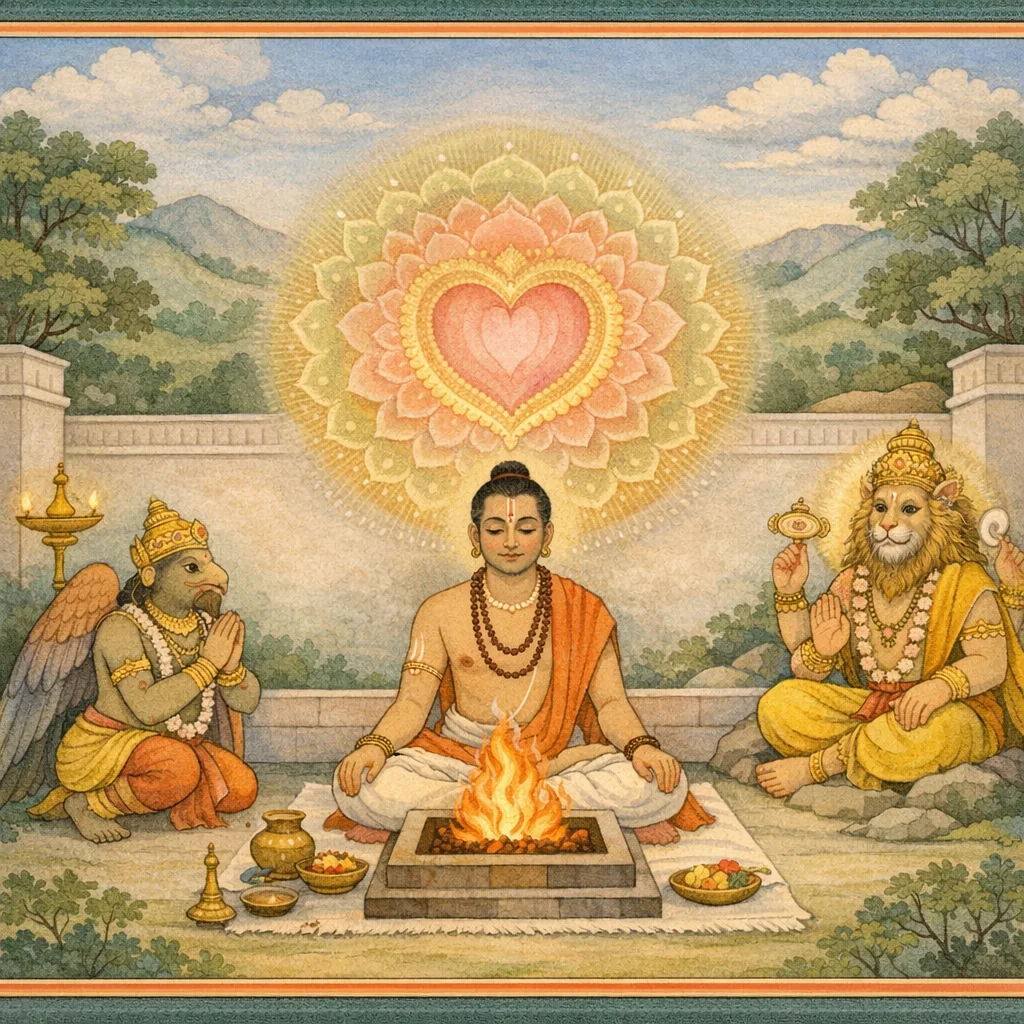
Continuing the practical thrust of the Ācāra Khaṇḍa, Hari sets out a stepwise anukrama (sequence) so worship may bear fruit. It begins with praṇava/namaḥ recollection and bīja-based bodily purification, then moves into threefold nyāsa and heart-lotus (yoga-seat) worship, offering salutations to supporting principles and to the negations that must be transcended. The rite expands through detailed mantra-installations of vowels and weapons, invoking the Vyūhas (Vāsudeva, Saṅkarṣaṇa, Pradyumna, Aniruddha) and protective deities (Nṛsiṃha, Varāha, Garuḍa, Sudarśana, dikpālas). Focus then turns outward to homa: inscribing Acyuta, kindling the fire, offering auspicious fruits, placing the rite within a maṇḍala, and performing 108 oblations with directional offerings and pūrṇāhuti. The chapter culminates in laya—dissolving the self into the supreme Reality beyond speech—followed by formal dismissal of the deities and a household-oriented close: Dvārakā Cakra mantras for ongoing protection, linking daily practice to special rites with doubled efficacy.
Shlokas
Verse 1
ऽध्यायः हरिरुवाच / पूजानुक्रमसिद्ध्यर्थं पूजानुक्रम उच्यते / ॐ नम इत्यादौ संस्मृतिः परमात्मनः
Hari said: To ensure the proper accomplishment of worship, the sequence (anukrama) of worship is taught. Beginning with “Oṁ” and “namaḥ” and the like, one should recollect the Supreme Self, the Paramātman.
Verse 2
यं रं वं लमिति कायशुद्धिः / ॐ नम इति चतुर्भुजात्मनिर्माणम्
By the seed-syllables “yaṃ, raṃ, vaṃ, lam” the body is purified; and by the mantra “oṃ namaḥ” the formation and visualization of one’s own four-armed divine form is accomplished.
Verse 3
ततस्त्रिविधः करकायन्यासः / ततो त्दृदिस्थयोगपीठपूजा / ॐ अनन्ताय नमः / ॐ धर्माय नमः / ॐ ज्ञानाय नमः / ॐ वैराग्याय नमः / ॐ ऐश्वर्याय नमः / ॐ अधर्ंमाय नमः / ॐ अज्ञानाय नमः / ॐ अवैराग्याय नमः / ॐ अनैश्वर्याय नमः / ॐ पद्माय नमः / ॐ आदित्यमण्डलाय नमः / ॐ चन्द्रमण्डलाय नमः / ॐ वह्निमण्डलाय नमः / ॐ विमलायै नमः / ॐ उत्कर्षिण्यै नमः / ॐ ज्ञानायै नमः / ॐ क्रियायै नमः / ॐ योगायै नमः / ॐ प्रह्व्यै नमः / ॐ सत्यायै नमः / ॐ ईशानायै नमः / ॐ सर्वतोमुख्यै नमः / ॐ संगोपाङ्गाय हरेरासनाय नमः / ततः कर्णिकायाम्-अं वासुदेवाय नमः / आं हृदयाय नमः / ईं शिरसे नमः / ऊं शिखायै नमः / ऐं कवचाय नमः / औं नेत्रत्रयाय नमः / अः फट् अस्त्राय नमः / आं सङ्कर्षणाय नमः / अं प्रद्युम्नाय नमः / अः अनिरुद्धाय नमः / ॐ अः नारायणाय नमः / ॐ तत्सब्दह्मणे नमः / ॐ हुं विष्णवे नमः / क्षैं नरसिंहाय भूर्वराह्य कं वैनतेयाय जं खं वं सुदर्शनाय खं चं फं षं गदायै वं लं मं क्षं पाञ्चजन्याय घं ढं भं हं श्रियै गं डं वं शं पुष्ट्यै धं वं वनमालायै दं शं श्रीवत्साय छं डं यं कौस्तुभाय शं शार्ङ्गाय इं इषुधिभ्यां चं चर्मणे खं खड्गाय इन्द्राय सुराय पर्तये अग्नये तेजोधिपतयेयमायधर्माधिपतयेक्षंनैरृतायरक्षोधिपतये वरुणाय जलाधिपतये यों वायवे प्राणाधिपतये धां धनदाय धनाधिपतये हां ईशानाय विद्याधिपतये ॐ वज्राय शक्त्यै ॐ दण्डाय खङ्गाय ॐ पाशाय ध्वजाय गदायै त्रिशूलाय लं अनन्ताय पातालाधिपतये खं ब्रह्मणे सर्वलोकाधिपतये ॐ नमो भगवते वासुदेवाय नमः / ॐ ॐ नमः / ॐ नं नमः / ॐ मों नमः / ॐ ॐ भं नमः / ॐ गं नमः / ॐ वं नमः / ॐ तें नमः / ॐ वां नमः / ॐ सुं नमः / ॐ दें नमः / ॐ वां नमः / ॐ यं नमः / ॐ ॐ नमः / ॐ नं नमः / ॐ मों नमः / ॐ नां नमः / ॐ रां नमः / ॐ णां नमः / ॐ यं नमः / ॐ नंनों भगवतें वांसुंदेवायं ॐ नमो नारायणाय नमः / ॐ पुरुषोत्तमाय नमः
Then one should perform the threefold nyāsa upon the hands and body; thereafter, worship the Yoga-seat established within the heart. Offer salutations to Ananta; to Dharma, Knowledge, Dispassion, and Sovereignty; and also (as opposites to be transcended) to Adharma, Ignorance, Non-dispassion, and Lack of sovereignty. Salutations to the Lotus; to the solar, lunar, and fire-circles; to Vimalā, Utkarṣiṇī, Jñānā, Kriyā, Yogā, Prahvī, Satyā, Īśānā, and Sarvatomukhyā; and to Hari’s seat together with its auxiliary limbs. Then, in the pericarp of the inner lotus, place “aṃ” and salute Vāsudeva; install “āṃ” in the heart, “īṃ” in the head, “ūṃ” in the crown-lock, “aiṃ” as armor, “auṃ” in the three eyes, and “aḥ phaṭ” as the missile; and salute Saṅkarṣaṇa, Pradyumna, and Aniruddha; Nārāyaṇa, the Brahman as sacred sound, and Viṣṇu. Further, invoke protective and empowering mantras connected with Narasiṃha, Varāha, Garuḍa, Sudarśana, the divine weapons and ornaments, and the guardians of the directions. Finally, repeatedly offer homage: “Salutations to Bhagavān Vāsudeva; salutations to Nārāyaṇa; salutations to Puruṣottama.”
Verse 4
नमस्ते पुण्डरीकाक्ष नमस्ते विश्वभावन / सुब्रह्मण्य नमस्ते ऽस्तु महापुरुष पूर्वज
Salutations to You, O Lotus-eyed One; salutations to You, O Sustainer of the universe. O Bestower of auspiciousness, salutations indeed to You—O Supreme Person, the Primordial Ancestor.
Verse 5
होमकर्णणि चैतेषां स्वाहान्तमुपकल्पयेत् / एवं जप्त्वा विधानेन शतमष्टोत्तरं तथा
For these (mantras/offerings), one should prepare the oblations for the fire-rite, ending each with the exclamation “svāhā”. Thus, having recited according to the prescribed rule, one should do so a hundred and eight times as well.
Verse 6
अर्घं दत्त्वा जितं तेन प्रणामं च पुनः पुनः / ततो ऽग्नावपि सम्पूज्यं तं यजेत यथाविधि
Having offered arghya, the reverent water-offering, and thus pleased Him, one should bow again and again; then, having duly worshipped Him also in the sacred fire, one should perform the rite for Him according to the prescribed procedure.
Verse 7
देवदेवं स्वबीजेन अङ्गादिभिरथाच्युतम् / पूर्वमुल्लिख्य चाभ्युक्ष्य प्रणवेन तु मन्त्रवित्
The knower of mantras should first inscribe the form of the God of gods—Acyuta—using his own seed-mantra, perform the aṅga-rites and the rest, and then sprinkle it while reciting the Praṇava (Oṁ).
Verse 8
भ्रामयित्वानलं कुण्डे पूजयेच्च शुभैः फलैः / पूर्वं तत्सकलं ध्यात्वा मण्डले मनसा न्यसेत्
Having kindled and made the sacred fire blaze within the ritual fire-pit, one should worship it with auspicious fruits; then, first meditating upon all of that in full, one should mentally place the rite and deities into the maṇḍala.
Verse 9
वासुदेवाख्यतत्त्वेन हुत्वा चाष्टोत्तरं शतम् / संकर्षणादिबीजेन यजेत्षट्कं तथैव च
Having offered oblations one hundred and eight times with the tattva known as Vāsudeva, one should likewise perform the ṣaṭka, the set of six rites, using the seed-mantra beginning with Saṅkarṣaṇa.
Verse 10
त्रयन्त्रयं तथाङ्गानामेकैकान्दिक्पतींस्तथा / पूर्णाहुतिं तथैवान्ते दद्यात्सम्यगुपस्थितः
Properly prepared and attentive, one should offer the prescribed threefold set; then make offerings to the presiding lords of each direction one by one; and finally perform the concluding full oblation, the pūrṇāhuti.
Verse 11
वागतीते परे तत्त्वे आत्मानं च लयं नयेत् / उपविश्य पुनर्मुद्रां दर्शयित्वा नमेत्पुनः
In the supreme Reality beyond speech, one should dissolve the self (mind and individuality) into absorption. Then, sitting again, one should once more display the prescribed mudrā and bow again.
Verse 12
नित्यमेवंविधं होमं नैमित्ते द्विगुणं भवेत् / गच्छगच्छ परं स्थानं यत्र देवो निरञ्जनः
One should perform this kind of fire-offering daily; when done on special rites, it becomes twice as efficacious. “Go on, go on to the supreme abode where the stainless Lord dwells.”
Verse 13
गच्छन्तु देवताः सर्वाः स्वस्थानस्थितिहेतवे / सुदर्शनः श्रीहरिश्च अच्युतः स त्रिविक्रमः
May all the deities depart, for the sake of remaining established in their own abodes. May protection be present through Sudarśana, Śrīhari, Acyuta, and that Trivikrama.
Verse 14
चतुर्भुजो वासुदेवः षष्ठः प्रद्युम्न एव च / संकर्षणः पूरुषो ऽथ नवव्यूहो दशात्मकः
Vāsudeva, four-armed, is the sixth; and Pradyumna as well. Then comes Saṅkarṣaṇa, the Puruṣa; thus the ninefold Vyūha—constituting a tenfold totality.
Verse 15
अनिरुद्धो द्वादशात्मा अथ ऊर्धमनन्तकः / एते एकादिभिश्चक्रैर्विज्ञेया लक्षिताः सुराः
Aniruddha is of the twelvefold nature; and above is Anantaka. These deities are to be understood as distinguished by the circles (cakras) beginning with the first and so on.
Verse 16
चक्राङ्कितैः पूजितः स्यान्द्रृहे रक्षेत्सदानरैः / ॐ चक्राय स्वाहा,ॐ विचक्राय स्वाहा,ॐ सुचक्राय स्वाहा,ॐ महाचक्राय स्वाहा,ॐ महाचक्राय असुरान्तकृत् हुं फट् ॐ हुं सहस्रार हुं फट्
When worship is performed with (items) marked with the Cakra, it becomes effective; within the home it ever protects the people. (One should recite:) “Oṁ cakrāya svāhā; Oṁ vicakrāya svāhā; Oṁ sucakrāya svāhā; Oṁ mahācakrāya svāhā; Oṁ mahācakrāya, slayer of asuras—huṁ phaṭ; Oṁ huṁ, O thousand-spoked One—huṁ phaṭ.”
Verse 17
द्वारकाचक्रपूजेयं गृहे रक्षाकरी शुभा
This worship of the Dvārakā Cakra, performed in one’s home, is auspicious and grants protective safeguarding.
Frequently Asked Questions
The salutations map the ritual cosmos: supportive principles (Dharma, Jñāna, Vairāgya, Aiśvarya) are honored as foundations of sādhana, while their opposites are acknowledged as forces to be transcended. The sequence functions as an inner audit, aligning the practitioner with the sattvic supports before proceeding to mantra-installation and homa.
In this chapter they are both. The Vyūhas are named as divine forms to be saluted, but also appear as operational nodes in nyāsa and homa (e.g., Vāsudeva-tattva oblations and seed-mantra sequences beginning with Saṅkarṣaṇa), turning doctrine into a repeatable ritual protocol.
Acyuta is Viṣṇu as the unfailing deity-form established for the rite. Inscribing with the deity’s seed-mantra and sprinkling while reciting Oṁ signals consecration: praṇava acts as the universal sanctifier that seals the installation and transitions the rite into the fire-offering phase.