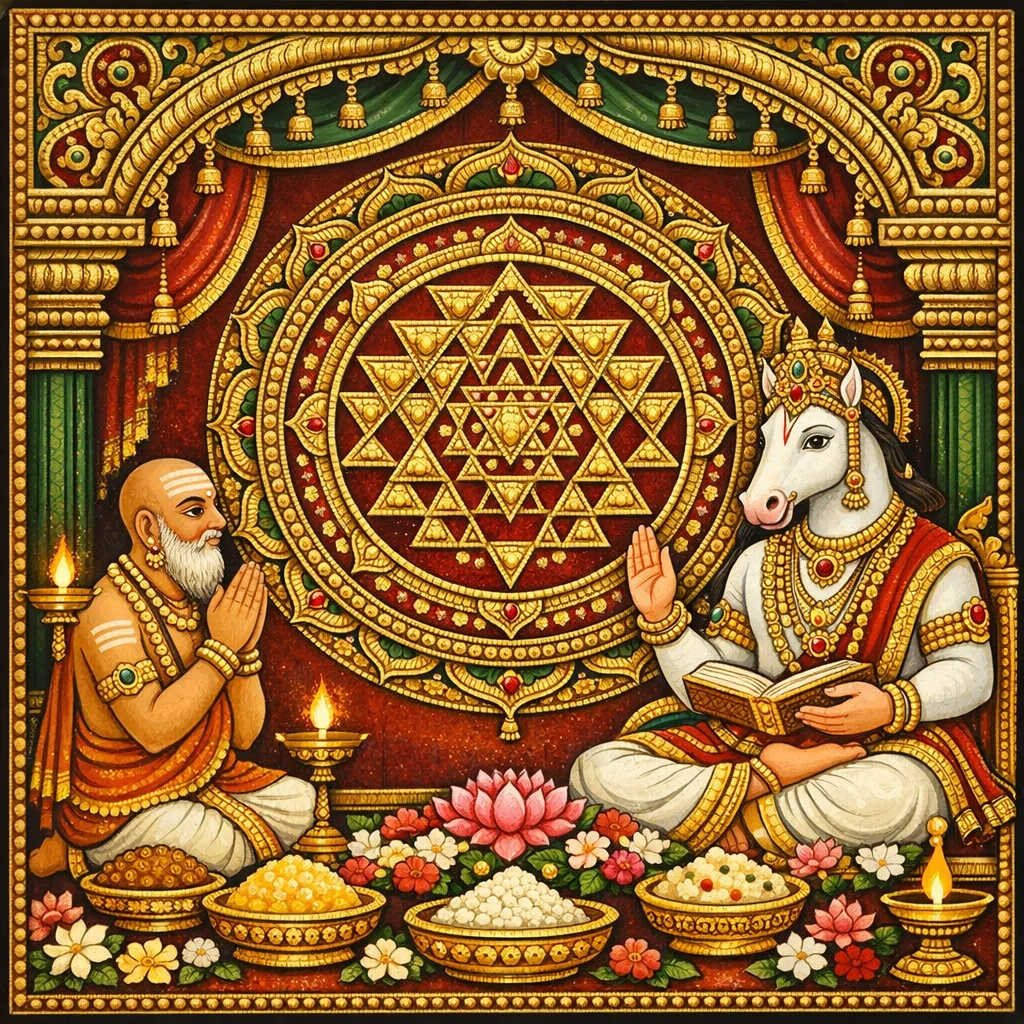
Adhyaya 41
Śrīcakra–Mantra–Pūjāvidhi: Agastya–Hayagrīva Saṃvāda (Lalitopākhyāna Context)
Adhyāya 41 begins with Agastya’s reverent inquiry into the defining features of the Śrīcakra: the nature of the yantra and mantra, the promised boon (vara), and the qualifications of the initiating teacher (upadeṣṭṛ) and disciple (śiṣya). Hayagrīva replies by identifying the mantra–yantra nexus with Tripurāmbikā and Mahālakṣmī, portraying the Śrīcakra as a radiant, immeasurable cosmogram beyond ordinary grasp. The chapter then turns to applied ritual theology, stating that exemplary deities—especially Viṣṇu, Īśāna, and Brahmā—attained specific powers or ranks through Śrīcakra worship, establishing a trans-sectarian authority for the practice. Practical rites are outlined: placing a metal cakra before the Goddess, offering auspicious fragrances, performing japa with the ṣoḍaśākṣarī vidyā, daily worship with tulasī leaves, and presenting naivedya such as honey, ghee, sugar, payasa, and more. It also links flower colors and the quality of offerings to results, stressing purity and sacred scent, and exalts Śrīvidyā as the supreme vidyā within a lineage-conscious initiation tradition.
Shlokas
Verse 1
इति श्रीब्रह्माण्डे महापुराणे उत्तरभागे हयग्रीवागस्त्यसंवादे ललितोपाख्याने चत्वारिंशो ऽध्यायः अगस्त्य उवाच कीदृशं यन्त्रमेतस्या मन्त्रोवा कीदृशो वरः / उपदेष्टा च कीदृक्स्याच्छिष्यो वा कीदृशः स्मृतः
Thus, in the holy Brahmāṇḍa Mahāpurāṇa, in the latter section, in the dialogue of Hayagrīva and Agastya, within the Lalitā narrative, begins the fortieth chapter. Agastya said: “What is the nature of Her yantra? What is the nature of Her mantra or boon? What should the instructor be like, and what kind of disciple is remembered as fit?”
Verse 2
सर्वज्ञस्त्वं हयग्रीव साक्षात्परमपूरुषः / स्वामिन्मयि कृपादृष्ट्या सर्वमेतन्निवेदय
O Hayagrīva, you are all-knowing, the very Paramapuruṣa made manifest. O Lord, cast upon me your compassionate glance and disclose to me all of this.
Verse 3
हयग्रीव उवाच मन्त्रं श्रीचक्रगेवास्याः सेयं हि त्रिपुरांबिका / सैषैव हि महालक्ष्मीः स्फुरच्चैवात्मनः पुरा
Hayagrīva said: “This is the mantra of the Śrīcakra, of the Goddess whose very face is the Cakra; she indeed is Tripurāmbikā. She herself is Mahālakṣmī, who in ancient times shone forth, radiant, from her own Self.”
Verse 4
पस्यति स्म तदा चक्रं ज्योतिर्मयविजृंभितम् / अस्य चक्रस्य माहात्म्यमपरिज्ञेयमेव हि
Then he beheld the Cakra, unfolding and expanding, formed wholly of light. The majesty of this Cakra is truly beyond complete knowing.
Verse 5
साक्षात्सैव महालक्ष्मीः श्रीचक्रमिति तत्त्वतः / यदभ्यर्च्य महाविष्णुः सर्वलोकविमोहनम् / कामसंमोहिनीरूपं भेजे राजीवलोचनः
In truth, the Śrīcakra is Mahālakṣmī herself, manifest. Having worshipped that Cakra, Mahāviṣṇu—lotus-eyed—assumed the form called Kāmasaṃmohinī, which enchants all the worlds.
Verse 6
अर्चयित्वा तदीशानः सर्वविद्येश्वरो ऽभवत् / तदाराध्य विशेषेण ब्रह्मा ब्रह्माण्डसूरभूत् / मुनीनां मोहनश्चासीत्स्मरो यद्वरिवस्यया
Having worshipped it, Īśāna became the Lord of all vidyās. By adoring it with special devotion, Brahmā became as the sun of the Brahmāṇḍa. And Smara (Kāmadeva) too became an enchanter of the sages, through that very rite of worship.
Verse 7
श्रीदेव्याः पुरतश्चक्रं हेमरौप्यादिनिर्मितम् / निधाय गन्धैरभ्यर्च्य षोडशाक्षरविद्यया
Placing before Śrī Devī the Cakra fashioned of gold, silver, and the like, and worshipping it with fragrant offerings, he adored her through the sixteen-syllabled Vidyā (Ṣoḍaśākṣarī).
Verse 8
प्रत्यहं तुलसीपत्रैः पवित्रैर्मङ्गलाकृतिः / सहस्रैर्मूलमन्त्रेण श्रीदेवीध्यानसंयुतः
Each day, with pure tulasī leaves in auspicious form, joined with meditation on Śrī Devī, one recites the root mantra a thousand times.
Verse 9
अर्चयित्वा च मध्वाज्यशर्करापायसैः शुभैः / अनवद्यैश्च नैवेद्यैर्माषापूपैर्मनोहरैः
Having worshiped, one offers auspicious honey, ghee, sugar, and pāyasa (milk-rice), and faultless naivedya as well—delightful māṣāpūpa cakes.
Verse 10
यः प्रीणति महालक्ष्मीं मतिमान्मण्डलत्रये / महसा तस्य सांनिध्यमाधत्ते परमेश्वरी
The wise one who gladdens Mahālakṣmī within the three maṇḍalas—upon him the Supreme Goddess, Parameśvarī, establishes her radiant nearness.
Verse 11
मनसा वाञ्छितं यच्च प्रसन्ना तत्प्रपूरयेत् / धवलै कुसुमैश्चक्रमुक्तरीत्या तु योर्ऽचयेत्
When she is pleased, she fulfills what the mind desires; and whoever worships the two according to the cakra-muktā rite, with white blossoms, does so rightly.
Verse 12
तस्यैव रसनाभागे नित्यं नृत्यति भारती / पाटलैः कुसुमैश्चक्रं योर्ऽचयेदुक्तमार्गतः / सार्वभौमं च राजानं दासवद्वशयेदसौ
Upon the very tip of his tongue Bhāratī (Sarasvatī) ever dances. Whoever worships the cakra with pāṭala blossoms in the prescribed way can bring even a sovereign king under sway, like a servant.
Verse 13
पीतवर्णैः शुभैः पुष्पैः पूर्ववत्पूजयेच्च यः / तस्य वक्षस्थले नित्यं साक्षाच्छ्रीर्वसति ध्रुवम्
Whoever, as before, worships with auspicious yellow flowers—upon that person’s chest the very Śrī (Lakṣmī) surely dwells forever.
Verse 14
दुर्गन्धैर्गन्धहीनैश्च सुवर्णैरपि नार्चयेत् / सुगन्धैरेव कुसुमैः पुष्पैश्चाभ्यर्चर्योच्छवाम्
One should not worship with foul-smelling or scentless flowers, not even with flowers of gold; the Goddess (Ucchavā) is to be adored only with fragrant blossoms.
Verse 15
कामाक्ष्यैव महालक्ष्मीश्चक्रं श्रीचक्रमेव हि / श्रीविद्यैषा परा विद्या नायिका गुरुनायिका
Kāmākṣī herself is Mahālakṣmī; her cakra is indeed the very Śrīcakra. This is Śrīvidyā, the supreme knowledge—the guiding Lady, the Lady of the gurus.
Verse 16
एतस्या मन्त्रराजस्तु श्रीविद्यैव तपोधन / कामराजान्तमन्त्रान्ते श्रीबीजेन समन्वितः
O one rich in austerity: the king of her mantras is Śrīvidyā itself; and at the mantra’s end stands the Kāmarāja portion, joined with the Śrī bīja (seed-syllable).
Verse 17
षोडशाक्षरविद्येयं श्रीविद्येति प्रकीर्तिता / इत्थं रहस्यमाख्यातं गोपनीयं प्रयत्नतः
This vidyā is of sixteen syllables and is renowned as Śrīvidyā. Thus the secret has been declared; it must be carefully guarded and kept hidden.
Verse 18
तिसृणामपि मूर्तीनां शक्तिर्विद्येयमीरिता / सर्वेषा मपि मन्त्राणां विद्यैषा प्राणरूपिणी
This Vidyā is declared to be the Śakti of the three forms; and for all mantras, this Vidyā is of the nature of prāṇa, the vital breath.
Verse 19
पारंपर्येण विज्ञाता विद्येयं बन्धमोचिनी / संस्मृता पापहरणी जरामृत्युविनाशिनी
Known through the lineage of tradition, this Vidyā is the liberator from bondage; when remembered, it removes sin and destroys old age and death.
Verse 20
पूजिता दुःखदौर्भाग्यव्याधिदारिद्रयनाशिनी / स्तुता विघ्नौघशमिनी ध्याता सर्वार्थसिद्धिदा
When worshipped, it destroys sorrow, ill fortune, disease, and poverty; when praised, it calms the host of obstacles; when meditated upon, it grants the fulfillment of all aims.
Verse 21
मुद्राविशेषतत्त्वज्ञो दीक्षाक्षपितकल्मषः / भजेद्यः परमेशानीमभीष्टफलमाप्नुयात्
One who knows the true principle of the special mudrās, whose impurities have been destroyed by dīkṣā, and who worships Parameśānī, attains the desired fruit.
Verse 22
धवलांबरसंवीतां धवलावासमध्यगाम् / पूजयेद्धवलैः पुष्पैर्ब्रह्मचर्ययुतो नरः
A man established in brahmacarya should worship Her, clad in white garments and abiding in the midst of a white abode, with white flowers.
Verse 23
धवलैश्चैव नैवेद्यैर्दधिक्षीरौदनादिभिः / संकल्पधवलैर्वापि पूजयेत्परमेश्वरीम्
With white and pure naivedya—curd, milk, milk-rice and the like—or with a spotless saṃkalpa, one should worship Parameśvarī, the Supreme Goddess.
Verse 24
श्रीर्वालन्त्र्यक्षीबीजैः क्रमात्खण्डेषु योजिताम् / षोडशाक्षरविद्यां तामर्चयेच्छुद्धमानसः
With the bīja “Śrī” and the bīja “Vālantryakṣī,” joined in sequence within its sections, that is the sixteen-syllabled Vidyā; one of purified mind should worship it with reverent arcana.
Verse 25
अनुलोमविलोमेन प्रजपन्मात्रिकाक्षरैः
Reciting in japa the Mātṛkā letters in forward and reverse order—anuloma and viloma.
Verse 26
भावयन्नेव देवाग्रे श्रीदेवीं दीपरूपिणीम् / मनसोपांशुना वापि निगदेनापि तापस
O ascetic, envisioning before the gods Śrī Devī in the form of a lamp-flame, one may recite mentally, in a low whisper, or even aloud.
Verse 27
श्रीदेवीन्याससहितः श्रीदेवीकृतविग्रहः / एकलक्षजपेनैव महापापैः प्रमुच्यते
One who performs the nyāsa of Śrī Devī and fashions oneself into the form of Śrī Devī is freed from great sins by japa of only one lakṣa (100,000) recitations.
Verse 28
लक्षद्वयेन देवर्षे सप्तजन्मकृतान्यपि / पापानि नाशयत्येव साधकस्य परा कला
O devarṣi, by two lakṣas of japa, the sādhaka’s supreme power indeed destroys sins, even those wrought through seven births.
Verse 29
लक्षत्रितयजापेन सहस्रजनिपातकैः / मुच्यते नात्र संदेहो निर्मलो नितरां मुने / क्रमात्षोडशलक्षेण देवीसांनिध्यमाप्नुयात्
O muni, by three lakṣas of japa one is freed from the grave sins of a thousand births—of this there is no doubt; and in due course, by sixteen lakṣas, one attains the nearness of the Devī.
Verse 30
पूजा त्रैकालिकी नित्यं जपस्तर्पणमेव च / होमो ब्राह्मणभुक्तिश्च पुरश्चरणमुच्यते
Daily worship at the three times, together with japa and tarpaṇa; homa and the feeding of brāhmaṇas—these are called puraścaraṇa.
Verse 31
होमतर्पणयोः स्वाहा न्यासपूजनयोर्नमः / मन्त्रान्ते पूजयेद्देवीं जपकाले यथोचितम्
In homa and tarpaṇa one utters “svāhā”; in nyāsa and pūjā, “namaḥ”. At the end of the mantra, one should worship the Devī during japa, as is proper.
Verse 32
जपाद्दशांशो होमः स्यात्तद्दशांशं तु तर्पणम् / तद्दशांशं ब्राह्मणानां भोजनं विन्ध्यमर्दन
From japa, a tenth should be homa; of that, a tenth is tarpaṇa; and a tenth of that is the feeding of brāhmaṇas, O Vindhyamardana.
Verse 33
देशकालोपघाते तु यद्यदङ्गं विहीयते / तत्संख्याद्विगुणं जप्त्वा पुरश्चर्यां समापयेत्
If, due to disturbance of place or time, any limb of the puraścaryā is omitted, one should perform japa in twice that number and thus complete the puraścaryā.
Verse 34
ततः काम्यप्रयोगार्थं पुनर्लक्षत्रयं जपेत् / व्रतस्थो निर्विकारश्च त्रिकालं पूजनेरतः / पश्चाद्वश्यादिकर्माणि कुर्वन्सिद्धिमवाप्स्यति
Then, for rites undertaken to fulfill specific desires (kāmya-prayoga), one should again perform three lakṣas of japa. Abiding in the vow, unperturbed, devoted to worship at the three times; thereafter, performing acts such as vaśya and the like, one attains siddhi.
Verse 35
अभ्यर्च्य चक्रमध्यस्थो मन्त्री चिन्तयते यदा / सर्वमात्मानमरुणं साध्यमप्यरुणीकृतम्
Having worshiped, when the mantra‑practitioner sits in the center of the cakra and contemplates, he beholds his whole self as aruṇa, the sacred dawn‑red; even the object to be accomplished becomes aruṇa‑tinted.
Verse 36
ततो भवति विन्ध्यारे सर्वसौभाग्यसुन्दरः / वल्लभः सर्वलोकानां वशयेन्नात्रसंशयः
Then, in the region of Vindhya, he becomes beautiful with all auspicious fortune, beloved of all worlds, and will bring them under his sway—of this there is no doubt.
Verse 37
रोचनाकुङ्कुमाभ्यां तु समभागं तु चन्दनम् / शतमष्टोत्तरं जप्त्वा तिलकं कारयेद् बुधः
Let the wise one mix rocanā and kuṅkuma with sandalwood in equal measure; having performed japa one hundred and eight times, he should apply the tilaka upon the forehead.
Verse 38
ततो यमीक्षते वक्ति स्पृशते चिन्तयेच्च यम् / अर्धेन च शरीरेण स वशं याति दासवत्
Thereafter, whom one beholds, speaks to, touches, and holds in thought—even with but half the body—he comes under one’s sway, like a servant.
Verse 39
तथा पुष्पं फलं गन्धं पानं वस्त्रं तपोधन / शतमष्टोत्तरं जप्त्वा यस्यै संप्रोष्यते स्त्रियै / सद्य आकृष्यते सा तु विमूढहृदया सती
Likewise, O rich in austerity: take a flower, a fruit, fragrance, drink, and a garment; having recited the mantra one hundred and eight times, send them to the woman intended—she, her heart deluded, is drawn at once.
Verse 40
लिखेद्रोचन यैकान्ते प्रतिमामवनीतले / सुरूपां च सशृङ्गारवेषाभरणमण्डिताम्
In a secluded place, with rocana pigment, draw upon the ground an image: fair in form, adorned with finery, garments, and ornaments.
Verse 41
तद्भालगलहृन्नाभिजानुमण्डलयोजितम् / जन्मनाममहाविद्यामङ्कुशान्तर्विदर्भितम्
Upon its forehead, throat, heart, navel, and the circle of its knees, set the birth-name and the Great Vidyā, with the aṅkuśa (goad) placed within.
Verse 42
सर्वाङ्गसंधिसंलीनामालिख्य मदनाक्षरैः / तदाशाभिमुखो भूत्वा त्रिपुरीकृतविग्रहः
Having drawn it so that Madana’s syllables sink into every joint of the whole body, face toward her direction, and let the form be made into Tripurī.
Verse 43
बद्ध्वा तु क्षोभिणीं मुद्रां विद्यामष्टशतं जपेत् / संयोज्य दहनागारे चन्द्रसूर्यप्रभाकुले
Then, having bound the Kṣobhiṇī mudrā, let him recite the vidyā eight hundred times; and unite it within the fire-chamber, filled with the radiance of moon and sun.
Verse 44
ततो विह्वलितापाङ्गीमनङ्गशरपीडिताम् / प्रज्वलन्मदनोन्मेषप्रस्फुरज्जघनस्थलाम्
Then, her sidelong glances wavering, tormented by the arrows of Ananga (Kāmadeva), the flare of passion blazed forth, and her hips quivered and throbbed.
Verse 45
शक्तिचक्रे लसद्रश्मिवलनाकवलीकृताम् / दूरीकृतसुचारित्रां विशालनयनाम्बुजाम्
Within the Śakti-cakra she was enfolded by whirling, gleaming rays; her virtuous restraint was driven far away, and her wide lotus-like eyes shone forth.
Verse 46
आकृष्टनयनां नष्टधैर्यसंलीनव्रीडनाम् / मन्त्रयन्त्रौषधमहामुद्रानिगडबन्धनाम् / दूरीकृतसुचारित्रां विशालनयनाम्बुजाम्
Her eyes were drawn in; her courage was lost and shame sank within. She was bound as with fetters by mantra, yantra, potent herbs, and the great mudrā. Her virtuous restraint was driven far away, and her wide lotus-like eyes shone forth.
Verse 47
मनो ऽधिकमहामन्त्रजपमानां हृतांशुकाम् / विमूढामिव विक्षुब्धामिव प्लुष्टामिवाद्भुताम्
Her mind, wholly intent on the japa of the great mantra, seemed to have her garments taken away; as if bewildered, as if shaken, as if scorched—wondrous indeed.
Verse 48
लिखितामिव निःसंज्ञामिव प्रमथितामिव / निलीनामिव निश्चेष्टामिवान्यत्वं गतामिव
As though inscribed, as though senseless, as though crushed; as though hidden, as though motionless, as though gone into another state.
Verse 49
भ्रमन्मन्त्रानिलोद्धूतवेणुपत्राकृतिं च खे / भ्रमन्तीं भावयेन्नारीं योजनानां शतादपि
In the sky she whirls, like a bamboo leaf lifted by the wind of mantra; one should visualize that woman spinning, even at a distance of a hundred yojanas.
Verse 50
चक्रमध्यगतां पृथ्वीं सशैलवनकाननाम् / चतुःसमुद्रपर्यन्तं ज्वलन्तीं चिन्तयेत्ततः
Then one should contemplate the Earth set in the wheel’s center, with mountains, forests, and wild groves, blazing up to the bounds of the four seas.
Verse 51
षण्मासाभ्यासयोगेन जायते मदनोपमः / दृष्ट्वा कर्षयते लोकं दृष्ट्वैव कुरुते वशम्
By six months of yogic practice, one becomes like Kāmadeva; by a mere glance he draws the world, by a mere glance he brings it under his sway.
Verse 52
दृष्ट्वा संक्षोभयेन्नारीं दृष्ट्वैव हरते विषम् / दृष्ट्वा करीति वागीशं दृष्ट्वा सर्वं विमोहयेत् / दृष्ट्वा चातुर्थिकादींश्च ज्वरान्नाशयते क्षणात्
By a glance he stirs a woman; by a glance he removes poison. By a glance he makes Vāgīśa, Lord of Speech, utter “karīti”; by a glance he deludes all. And by a glance he destroys, in an instant, fevers such as cāturthikā and the rest.
Verse 53
पीतद्रव्येण लिखितं चक्रं गूढं तु धारयेत् / वाक्स्तंभं वादिनां क्षिप्रं कुरुते नात्र संशयः
Let one secretly bear a cakra inscribed with a yellow substance; it swiftly brings about the stifling of speech in disputants—of this there is no doubt.
Verse 54
महानीलीरसेनापि शत्रुनामयुतं लिखेत् / दक्षिणाभिमुखो वह्नौ दग्ध्वा मारयते रिपून्
Even with the juice of Mahānīlī, let one write many names of enemies; facing south, having burned it in fire, one slays the foes.
Verse 55
महिषाश्वपुरीषाभ्यां गोमूत्रैर्नाम टङ्कितम् / आरनालस्थितं चक्रं विद्वेषं कुरुते द्विषाम्
With buffalo and horse dung, together with cow’s urine, let the name be inscribed; the cakra placed in the āranāla brings about enmity among adversaries.
Verse 56
युक्त्वा रोचनया नाम काकपक्षेण मध्यगम् / लंबमानस्तदाकारो उच्चाटनकरं परम्
Having joined the name with rocanā and set it in the middle with a crow’s wing-feather, let it hang down in that very form; it effects the supreme uccāṭana (expulsion).
Verse 57
दुग्धलाक्षारोचनाभिर्महानीलीरसेन च / लिखित्वा धारयंश्चक्रं चातुर्वर्ण्यं वशं नयेत्
With milk, lākṣā, rocanā, and the juice of Mahānīlī, having inscribed the cakra and bearing it, one may bring the cāturvarṇya (the four varṇa) under one’s sway.
Verse 58
अनेनैव विधानेन जलमध्ये यदि क्षिपेत् / सौभाग्यमतुलं तस्य स्नानपानान्न संशयः
By this very rite, if one casts it into the midst of the water, then through bathing and drinking therefrom he gains incomparable good fortune—of this there is no doubt.
Verse 59
चक्रमध्यगतं देशं नगरीं वा वराङ्गनाम् / ज्वलन्तीं चिन्तयेन्नित्यं सप्ताहात्क्षोभयेन्मुने
O muni, one should continually contemplate a land, a city, or a noble woman placed in the center of the cakra, as though blazing; within seven days it will stir up disturbance.
Verse 60
लिखित्वा पीतवर्णं तु चक्रमेतद्यदाचरेत् / पूर्वाशाभिमुखो भूत्वा स्तंभयेत्सर्ववादिनः
Having drawn this cakra in yellow and performed the practice facing the eastern quarter, one may restrain and silence all who speak and dispute.
Verse 61
सिंदूरवर्णलिखितं पूजयेदुत्तरामुखः / यदा तदा स्ववशगो लोको भवति नान्यथा
The cakra inscribed in sindūra-red should be worshiped facing north; whenever it is done, then and there the people come under one’s sway—never otherwise.
Verse 62
चक्रं गौरिकयालिख्यपूजयेत्पश्चिमामुखः / यः ससर्वाङ्गनाकर्षवश्यक्षोभकरो भवेत्
The cakra drawn with gaurikā (white or pale yellow) should be worshiped facing west; he becomes one who can attract all women, bring them under his influence, and cause agitation.
Verse 63
पूजयेद्विन्ध्यदर्पारे रहस्येकचरो गिरौ / अजरामरतां मन्त्री लभते नात्र संशयः
The bearer of the mantra, worshipping in the secret gorge of Vindhya, dwelling alone upon the mountain, attains the state beyond aging and death; of this there is no doubt.
Verse 64
रहस्यमेतत्कथितं गोपितव्यं महामुने / गोपनात्सर्वसिद्धिः स्याद्भ्रंश एव प्रकाशनात्
O great sage, this secret has been spoken; it must be kept concealed. By concealment all siddhis arise, but by disclosure there is only downfall.
Verse 65
अविधाय पुरश्चर्यां यः कर्म कुरुते मुने / देवताशापमाप्नोति न च सिद्धिं स विन्दति
O sage, whoever performs the rite without first undertaking the pūraścaryā incurs the deity’s curse and gains no siddhi.
Verse 66
प्रयोगदोषशान्त्यर्थं पुनर्लक्षं जपेद्बुधः / कुर्याच्च विधिवत्पूजां पुनर्योग्यो भवेन्नरः
To quell faults in the performance, the wise should again recite japa for another lakṣa; and, performing worship according to rule, the man becomes fit for yoga once more.
Verse 67
निष्कामो देवतां नित्यं योर्ऽचयेद्भक्तिनिर्भरः
Whoever, free of desire, worships the deity daily, wholly immersed in devotion…
Verse 68
तामेव चिन्तयन्नास्ते यथाशक्ति मनुं जपन्
He sits, contemplating Her alone, and to the best of his strength repeats in japa the mantra “Manu”.
Verse 69
सैव तस्यैहिकं भारं वहेन्मुक्तिं च साधयेत् / सदा संनिहिता तस्य सर्वं च कथयेत सा
She herself will bear his worldly burden and bring about liberation (mukti); ever present beside him, she will disclose all things.
Verse 70
वात्सल्यसहिता धेनु यथा वत्समनुव्रजेत् / तथानुगच्छेत्सा देवी स्वभक्तं शरणागतम्
As a cow, filled with tender love, follows her calf, so does the Goddess follow her own devotee who has come seeking refuge.
Verse 71
अगस्त्य उवाच शरणागतशब्दस्य कोर्ऽथो वद हया नन / वत्सं गौरिव यं गौरी धावन्तमनुधावति
Agastya said: “O Hayagrīva, tell me—what is the meaning of the word ‘śaraṇāgata’? Like a cow, Gaurī runs after the calf that is running.”
Verse 72
हयग्रीव उवाच यः पुमानखिलं भारमैहिकामुष्मिकात्मकम् / श्रीदेवतायां निक्षिप्य सदा तद्गतमानसः
Hayagrīva said: Whoever places the entire burden—of this world and of the world beyond—upon Śrī Devatā, and keeps the mind ever absorbed in Her…
Verse 73
सर्वानुकूलः सर्वत्र प्रतिकूलविवर्जितः / अनन्यशरणो गौरीं दृढं सम्प्रार्थ्य रक्षणे
Everywhere he embraces what is auspicious and shuns what is adverse; taking Gaurī as his sole refuge, he prays with steadfast heart for protection.
Verse 74
रक्षिष्यतीति विश्वासस्तत्सेवैकप्रयोजनः / वरिवस्यातत्परः स्यात्सा एव शरणागतिः
The faith, “She will surely protect,” is the sure conviction; to make her service the sole aim and to be wholly devoted to worship—this alone is śaraṇāgati, taking refuge.
Verse 75
यदा कदाचित्स्तुतिनिन्दनादौ निन्दन्तु लोकाः स्तुवतां जनो वा / इति स्वरूपं सुधिया समीक्ष्य विषादखेदौ न भजेत्प्रपन्नः
Whenever praise or blame arises—whether people revile or admirers extol—the surrendered devotee, seeing with wise discernment that this is the world’s way, should not fall into sorrow or dejection.
Verse 76
अनुकूलस्य संकल्पः प्रतिकूलस्य वर्जनम् / रक्षिष्यतीति विश्वासो गोप्तृत्ववरणं तथा
Resolve for what is favorable, renunciation of what is adverse; faith that “She will protect,” and choosing her as one’s guardian—so too.
Verse 77
आत्मनिक्षेपकार्पण्ये षड्विधा शरणागतिः / अङ्गीकृत्यात्मनिक्षेपं पञ्चाङ्गानि समर्पयेत् / न ह्यस्य सदृशं किञ्चिद्भुक्तिमुक्त्योस्तु साधनम्
Śaraṇāgati, taking refuge, is sixfold, grounded in self-surrender and humble helplessness. Having embraced self-offering, one should present the other five limbs as well. Truly, nothing equals this as a means to both worldly well-being and liberation (mukti).
Verse 78
अमानित्वमदंभित्वमहिंसा क्षान्तिरार्जवम् / आचार्योपासनं शौचं स्थैर्यमात्मविनिग्रहः
Humility and freedom from pretence; non-violence; forbearance and uprightness; reverent service to the ācārya (spiritual teacher); purity; steadfastness; and self-restraint.
Verse 79
इन्द्रियार्थेषु वैराग्यमनहङ्कार एव च / जन्ममृत्युजराव्याधिदुःखदोषानुदर्शनम् / असक्तिरनभिष्वङ्गः पुत्रदारगृहादिषु
Dispassion toward the objects of the senses, and freedom from ego; discerning the faults and sorrows of birth, death, old age, and disease; non-attachment and non-clinging to children, spouse, home, and the like.
Verse 80
नित्यं च समचित्तत्वमिष्टानिष्टोपपत्तिषु / मयि चानन्यभावेन भक्तिख्यभिचारिणी
And ever maintain evenness of mind amid the coming of the pleasant and the unpleasant; and toward Me, cherish unwavering bhakti with an undivided heart.
Verse 81
विविक्तदेशसेवित्वमरतिर्जनसंसदि / अध्यात्मज्ञाननित्यत्वं तत्त्वज्ञानार्थदर्शनम् / एतानि सर्वदा ज्ञानसाधनानि समभ्यसेत्
Dwelling in secluded places and taking no delight in the press of crowds; abiding constantly in inner spiritual knowledge (adhyātma-jñāna) and beholding the meaning of truth-knowledge (tattva-jñāna); these should ever be practiced as the means to wisdom.
Verse 82
तत्कर्मकृत्तत्परमस्तद्भक्तः संगवर्जितः / निर्वैरः सर्वभूतेषु यः स याति परां श्रियम्
Whoever performs deeds for Him, holds Him as the supreme goal, is His devotee free from attachment, and bears no enmity toward any being—such a one attains the highest glory.
Verse 83
गुरुस्तु मादृशो धीमान्ख्यातो वातापितापन / शिष्यो ऽपि त्वादृशः प्रोक्तो रहस्याम्नायदेशिकः
A wise Guru like me is famed as one who cools the burning of Vātāpi; and a disciple like you is also declared to be a teacher of the secret lineage (rahasyāmnāya).
Frequently Asked Questions
Hayagrīva equates Śrīcakra with the Goddess herself—Tripurāmbikā/Mahālakṣmī—presenting it not merely as a diagram but as a luminous, divine cosmogram whose essence is inseparable from Śakti.
Key elements include installing the cakra before the Goddess (often described as made of metals like gold/silver), offering fragrances and flowers, japa with the mūlamantra and ṣoḍaśākṣarī vidyā, daily tulasī-leaf worship, and auspicious naivedyas such as honey, ghee, sugar, and payasa.
Because Śrīvidyā is framed as parā vidyā requiring adhikāra: the efficacy and legitimacy of the practice depend on correct transmission, ethical/purity constraints, and a properly authorized initiation context.