Adhyaya 37
Cintāmaṇi-gṛha Antara-kathana (Account of the Inner Chambers of the Cintāmaṇi Palace) — Lalitopākhyāna Context
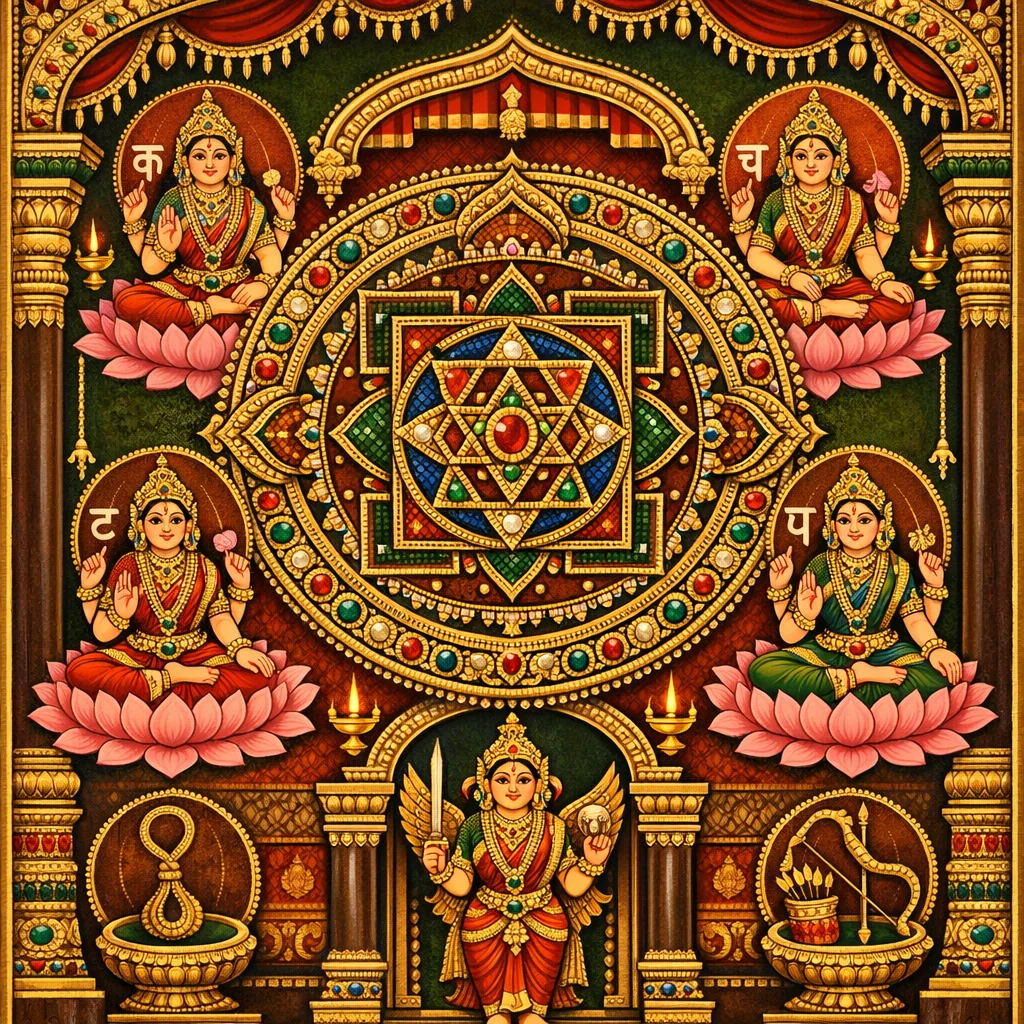
This adhyāya unfolds as a Hayagrīva–Agastya dialogue within the Lalitopākhyāna. It maps the inner chambers of the Cintāmaṇi Palace associated with Vaśinī and other Śakti-deities as a measured, bounded, functionally named sacred architecture. A cakra famed as “Sarvarogahara” (remover of all disease) is identified, and its resident goddesses are listed in directional and sequential order with mantra–phonetic links through varṇa-varga groupings (ka/ca/ṭa/ta/pa). The focus then turns to protection and warfare: Khecarī is named as the cakra’s guardian, and the chapter catalogs astras/āyudhas connected with Kāmeśvarī and Śrī-Maheśa—arrows, goads, bows, and nooses—set against the Bhaṇḍāsura war motif. Thus the palace–cakra scheme is presented not as ornament, but as an esoteric blueprint of power, protection, and ritual visualization.
Shlokas
Verse 1
इति श्रीब्रह्माण्डमहापुराणे उत्तरभागे हयग्रीवागस्त्यसंवादे ललितोपाख्याने चिन्तामणिगृहान्तरकथनं नाम षट्त्रिंशो ऽध्यायः हयग्रीव उवाच सर्वज्ञद्यन्तरालस्योपरिष्टात्कलशोद्भव / हस्तविंशतिरुन्नम्रं चतुर्नल्वप्रविस्तरम्
Thus, in the Śrī Brahmāṇḍa Mahāpurāṇa, in the latter section, in the dialogue of Hayagrīva and Agastya, within the Lalitā narrative, is the thirty-sixth chapter called “The Account of the Inner Chambers of the Cintāmaṇi Mansion.” Hayagrīva said: O Kalaśodbhava (Agastya), above the inner space of Sarvajñā it rises twenty hastas, and its breadth is four nalvas.
Verse 2
वशिन्याद्यन्तरं ज्ञेयं प्राग्वत्सोपानमन्दिरम् / सर्वरोगहरं नाम्ना तच्चक्रमिति विश्रुतम्
Know that the inner precinct beginning with Vaśinī and the rest is, as before, a stepped shrine. It is named Sarvarogahara, “the remover of all diseases,” and that cakra is famed as Taccakra.
Verse 3
वशिन्याद्यास्तत्र देव्यः पूर्वादिदिगनुक्रमात् / स्वरैस्तु रहितास्तत्र प्रथमा वशिनीश्वरी
There the Goddesses beginning with Vaśinī abide, arranged in the sequence of directions starting from the East. There they are set forth without vowels; the first is Vaśinīśvarī.
Verse 4
कवर्गसहिता पश्चात्कामेश्वर्याख्यवाह्मयी / चवर्गजुष्टा वागीशी मोदिनी स्यात्तृतीयका
Next is Vāhmayī, known as Kāmeśvarī, attended by the letters of the ka-varga. The third is Vāgīśī Modinī, associated with the ca-varga.
Verse 5
टवर्गमण्डिताकारा विमलाख्या सरस्वती / तवर्गेण तथोपेता पञ्चमी वाक्प्रधारणा
She whose form is adorned with the ṭa-varga is Sarasvatī, called Vimalā. And the fifth, likewise endowed with the ta-varga, is Vākpradhāraṇā, the bearer and support of sacred speech.
Verse 6
पवर्गेण परिस्फीता षष्ठी तु जयिनी मता / यादिवर्णचतुष्कोणे सर्वैश्वर्यादिवाङ्मयी
Expanded to fullness by the pavarga, the Sixth is held to be Jayinī, the Victorious. In the four-cornered station of the syllable “yā,” she is the very essence of sacred Speech, embodying all lordship and prosperity.
Verse 7
साधिकाक्षरषट्केन कौलिनी त्वष्टमी मता / एता देव्यो जपरता मुक्ताभरणमण्डिताः
With the six syllables endowed with vowels, the Eighth is held to be Kaulinī. These Goddesses delight in japa, adorned with ornaments of pearls.
Verse 8
सदा स्फुरद्गद्यपद्यलहरीलालिता मताः / काव्यैश्च नाटकैश्चैव मधुरैः कर्णहारिभिः / विनोदयन्त्यः श्रीदेवीं वर्तन्ते कुम्भसम्भवः
They are said to be ever caressed by shining waves of prose and verse. With sweet poems and dramas that enchant the ear, they delight Śrī Devī—O Kumbhasambhava.
Verse 9
एता रहस्यनाम्नैव ख्याता वातापितापन / नायिका स्वस्य चक्रस्य सिद्धानाम्ना प्रकीर्तिता
These are famed by a secret name, O Vātāpitāpana. She is the leading Lady of her own cakra and is celebrated by the name Siddhā, the Accomplished One.
Verse 10
अस्य चक्रस्य संरक्षाकारिणी खेचरी मता / वशिन्याद्यन्तरालस्योपरिष्टाद्विन्ध्यमर्दन
Khecarī is held to be the guardian who protects this cakra. And above the inner interval, beginning with Vaśinī and the rest—O Vindhyamardana.
Verse 11
हस्तविंशतिरुन्नम्रं चतुर्नल्वप्रविस्तरम् / अस्त्रं चक्रमितिज्ञेयं तत्र बाणादिदेवताः
The weapon known as the Cakra is to be understood as twenty hastas in height and four nalvas in breadth; there abide the deities presiding over arrows and the other weapons.
Verse 12
पञ्च बाणेश्वरीदेव्यः पञ्च कामेश्वराशुगाः / अङ्कुशद्वितयं दीप्तमादिस्त्रीपुंसयोर्द्वयोः
There are five Bāṇeśvarī goddesses and five swift Kāmēśvaras; and a radiant pair of aṅkuśas (goads) for the primal two—woman and man.
Verse 13
धनुर्द्वयं च विन्ध्यारे नव पुण्ड्रेषु कल्पितम् / पाशद्वयं च दीप्ताभं चत्वार्यस्त्राणि कुम्भज
In Vindhyāra two bows were set in the nine puṇḍras; and two radiant pāśas (nooses) as well. O Kumbhaja, thus there are four weapons.
Verse 14
कामेश्वर्यास्तु चत्वारि चत्वारि श्रीमहेशितुः / आहत्याष्टायुधानीति प्रज्वलन्ति विभान्ति च
Four belong to Kāmēśvarī, and four to Śrī-Maheśitu; together they are eight weapons, blazing and shining forth.
Verse 15
भण्डासुरमहायुद्धे दुष्टदानवशोणितैः / पीतैरतीव तृप्तानिदिव्यास्त्राण्यति जाग्रति
In the great war against Bhaṇḍāsura, the divine weapons drank the blood of the wicked dānavas; greatly sated thereby, those celestial arms stand ever more fully awakened.
Verse 16
एतेषामायुधानां तु परिवारायुधान्यलम् / वर्तन्ते ऽस्त्रान्तरे तत्र तेषां संख्या तु कोटिशः
To these weapons belong, moreover, abundant attendant weapons; within that realm between the astras they move, and their number is counted in koṭis.
Verse 17
वज्रशक्तिः शतघ्नी च भुशुण्डी मुसलं तथा / कृपाणः पट्टिशं चैव मुद्गरं भिन्दिपालकम्
Vajraśakti and Śataghnī, Bhuśuṇḍī and Musala as well; also Kṛpāṇa, Paṭṭiśa, Mudgara, and Bhindipālaka.
Verse 18
एवमादीनि शस्त्राणि सहस्राणां सहस्रशः / अष्टायुधमहाशक्तीः सेवन्ते मदविह्वलाः
Such weapons and others like them are thousands upon thousands; those bewildered by mada attend upon the great Śaktis of the eightfold weapons.
Verse 19
अथ शस्त्रान्तरालस्योपरि वातापितापन / हस्तविंशतिरुन्नम्रं चतुर्नल्वप्रविस्तरम् / धिष्ण्यं तु समयेशीनां स्थानं च तिसृणां मतम्
Then, above the interval amid the weapons, is a seat called Vātāpitāpana, rising twenty hastas and spreading four nalvas; it is the sacred throne of the Samayeśinīs, and is held to be the abode of the three Goddesses.
Verse 20
कामेशाद्यास्तत्र देव्यस्तिस्रो ऽन्या तु चतुर्थिका / सैव निःशेषविश्वानां सवित्री ललितेश्वरी
There dwell three Goddesses, beginning with Kāmeśī, and another as the fourth; she herself is Savitrī, Laliteśvarī, the Mother of all worlds without remainder.
Verse 21
तिसृणां शृणु नामानि कामेशी प्रथमा मता / वज्रेशी भगमाला च ताः सेवन्ते सहस्रशः
Hear the names of the three: Kāmeśī is held to be the first; Vajreśī and Bhagamālā as well—those Devīs are served and worshiped by the thousands.
Verse 22
सर्वेषां दर्शनानां च या देव्यो विविधाः स्मृताः / ताः सर्वास्तत्र सेवन्ते कामेशादिमहोदयाः
In all the darśanas, various Devīs are remembered; all of them there render service and worship, in great auspicious glory, beginning with Kāmeśī and the foremost ones.
Verse 23
एतासांच प्रसंगेषु नित्यानां च प्रसञ्जने / चक्रिणीनां योगिनीनां श्रीदेवी पूरणात्मिका
In the communion of these Devīs and in the gathering of the Nityās—among the Cakriṇīs and the Yoginīs—abides Śrī Devī, whose very nature is the power of perfect fulfillment.
Verse 24
या कामेश्वरदेवाङ्कशायिनी ललितांबिका / कामेश्यादिचतुर्थी सा नित्यानां षोडशी मता
Lalitāmbikā, who reclines upon the lap of the god Kāmeśvara—she is the fourth in the order beginning with Kāmeśī; and among the Nityās she is held to be Ṣoḍaśī, the Sixteenth.
Verse 25
योगिनी चक्रदेवीनां नवमी परिकीर्तिता / समयेश्यन्तरालस्योपरिष्टादिल्वलान्तक
Among the Devīs of the Yoginī-cakra she is proclaimed the ninth; and above the intermediate sphere of Samayeśī stands Ilvalāntaka, the ender and vanquisher of Ilvalā.
Verse 26
नाथान्तरमिति प्रोक्तं हस्तविंशतिरुन्नतम् / चतुर्नल्वप्रविस्तारं प्राग्वत्सोपानमण्डितम्
It is said to be called “Nāthāntara”: twenty hastas in height, four nalvas in breadth, adorned with a stairway facing the East.
Verse 27
तत्र नाथामहादेव्या योगशास्त्रप्रवर्त्तकाः / सर्वेषां मन्त्रगुरवः सर्वविद्यामहार्णवाः
There, Nāthā Mahādevī is the one who set the Yoga-śāstra in motion—guru of mantras for all, the vast ocean of every sacred knowledge.
Verse 28
चत्वारो यागनाथाश्च लोकानामिह गुप्तये / सृष्टाः कामंशदेवेन तेषां नामानि मे शृणु
To guard the worlds here, Kāmaṃśa-deva created four Yāga-nāthas; hear from me their names.
Verse 29
मित्री च शोडिशश्चैव चर्याख्यः कुम्भसम्भव / तैः सृष्टा बहवो लोकारक्षार्थं पादुकात्मकाः
They are Mitrī, Śoḍiśa, Caryākhya, and Kumbhasambhava. By them many worlds were brought forth in the form of Pādukā, for the safeguarding of the worlds.
Verse 30
दिव्यविद्या मानवौघसिद्धौघाः सुरतापसाः / प्राप्तसालोक्यसारूप्यसायुज्यादिकसिद्धयः
They possess divine vidyā, with hosts of men and hosts of siddhas—celestial ascetics. They have attained perfections such as sālokya, sārūpya, sāyujya, and the rest.
Verse 31
महान्तो गुरवस्तांस्तु सेवन्ते प्रचुरा गुरून् / अथ नाथान्तरालस्योपरिष्टाद्धिष्ण्यमुत्तमम्
The great and venerable gurus serve many gurus; and above the intermediate realm of the Nāthas lies the supreme abode.
Verse 32
हस्तविंशतिरुन्नमं चतुर्नल्वप्रविस्तरम् / नित्यान्तरमिति प्रोक्तं नित्याः पञ्चदशात्र वै
Its height is twenty hastas and its breadth four nalvas; this is called “Nityāntara”, and here indeed are the fifteen eternal Nityās.
Verse 33
अथ कामेश्वरी नित्या नित्या च भगमालिनी / नित्यक्लिन्ना अपि तथा भेरुण्डा वह्निवासिनी
Then come the eternal Kāmeśvarī and the eternal Bhagamālinī; likewise Nityāklinnā, and also Bheruṇḍā and Vahnivāsinī.
Verse 34
महावज्रेश्वरी दूती त्वरिता कुलसुन्दरी / नित्या नीलपताका च विजया सर्वमङ्गला
There is Mahāvajreśvarī as the dūtī (messenger), Tvaritā, and Kulasundarī; the eternal Nīlapatākā, Vijayā, and Sarvamaṅgalā.
Verse 35
ज्वालामालिनिका चित्रेत्येताः पञ्चदशोदिताः / एता देवीस्वरूपाः स्युर्महाबलपराक्रमाः
Jvālāmālinikā and Citrā—these are the fifteen that have been declared. They are forms of the Devī, endowed with great strength and mighty valor.
Verse 36
प्रथमा मुख्यतिथितां प्राप्ता व्याप्य जगत्त्रयाः / कालत्रितयरूपाश्च कालग्रासविचक्षणाः
First they attained the foremost rank of the sacred tithi, pervading the three worlds; taking the form of the threefold time, they are wise in the devouring power of Kāla.
Verse 37
ब्रह्मादीनामशेषाणां चिरकालमुपेयुषाम् / तत्तत्कालशतायुष्यरूपा देव्याज्ञया स्थिताः
For Brahmā and all the rest who pass through vast ages, they abide by the command of the Devī, assuming forms that measure out each time as spans of a hundred years.
Verse 38
नित्योद्यता निरान्तकाः श्रीपराङ्गसमुद्भवाः / सेवन्ते जगतामृद्ध्यै ललितां चित्स्वरूपिणीम्
Ever intent and without end, born from the radiant limb of Śrī, for the increase of the worlds they worship and serve Lalitā, whose very nature is Chit, pure Consciousness.
Verse 39
तासां भवनतां प्राप्ता दीप्ताः पञ्चदशेश्वराः / विसृष्टिबिन्दुचक्रे तु षोडश्या भवनं मतम्
The fifteen radiant Lords attained the status of their mansions; yet within the Visṛṣṭi-bindu cakra it is held to be the mansion of the Sixteenth.
Verse 40
अथ नित्यान्तरालस्योपरिष्टात्कुम्भसम्भव / अङ्गदेव्यन्तरं प्रोक्तं हस्तविंशातिरुन्नतम्
Then, O Kumbha-sambhava (Agastya), above the interval among the Nityās is spoken the space between the Aṅga-devīs, rising higher than twenty hastas.
Verse 41
चतुर्नल्वप्रविस्तारं प्राग्वत्सोपानमन्दिरम् / तस्मिन्हृदयदेव्याद्याः शक्तयः संति वै मुने
There is a shrine with steps facing the east, four nalva in breadth; within it, O Muni, abide the primal Śaktis, beginning with Hṛdaya-devī.
Verse 42
हृद्देवी च शिरोदेवी शिखादेवी तथैव च / वर्मदेवी दृष्टिदेवी शस्त्रदेवी षडीरिताः
Hṛd-devī and Śiro-devī, and likewise Śikhā-devī; Varma-devī, Dṛṣṭi-devī, and Śastra-devī—these six are proclaimed.
Verse 43
अत्यन्तसन्निकृष्टास्ताः श्रीकामेश्वरसुभ्रुवः / नवलावण्यपूर्णाङ्ग्यः सावधाना धृतायुधाः
They stand exceedingly near, with lovely brows like Śrī Kāmeśvara’s; their limbs are filled with ever-fresh beauty, alert and bearing weapons.
Verse 44
परितो बिन्दुपीठे च भ्राम्यन्तो दृप्तमूर्तयः / ललिताज्ञाप्रवर्तिन्यो वशीनां पीठवर्तिकाः
Around the Bindu-pīṭha they move about in proud forms; they act by Lalitā’s command and abide upon the pīṭha of the Vaśinīs.
Verse 45
अथाङ्गदेव्यन्तरस्योपरिष्टान्मण्डलाकृति / बिन्दुनाद महापीठं दशहस्तसमुन्नतम्
Then, above the inner sphere of the Aṅga-devīs, there appears a maṇḍala-like form; the great pīṭha called Bindu-nāda rises to a height of ten hastas.
Verse 46
नल्वाष्टकप्रविस्तारमुद्यदादित्यसंनिभम् / बिन्दुपीठमिदं ज्ञेयं श्रीपीठमपि चेष्यते
Know this to be the Bindupīṭha, expanded as the Nalvāṣṭaka and radiant like the rising sun; it is also revered as the Śrīpīṭha.
Verse 47
महापीठमिति ज्ञेयं विद्यापीठमपीष्यते / आनन्दपीठमपि च पञ्चाशत्पीठरूपधृक्
Know it as the Mahāpīṭha, acknowledged also as the Vidyāpīṭha; and as the Ānandapīṭha, bearing the form of the fifty Pīṭhas.
Verse 48
तत्र श्रीललितादेव्याः पञ्चब्रह्ममये महत् / जागर्ति मञ्चरत्नं तु प्रपञ्चत्रयमूलकम्
There, for Śrī Lalitā Devī, abides the great jeweled throne (mañca-ratna), formed of the Five Brahmas; it stands awakened, the root of the threefold cosmos.
Verse 49
तस्य मञ्चस्य पादास्तु चत्वारः परिकीर्तिताः / दशहस्तसमुन्नम्रा हस्तत्रितयविष्ठिताः
The legs of that throne are declared to be four; they rise to the height of ten hastas and are set upon a triple support of hands.
Verse 50
ब्रह्मविष्णुमहेशानेश्वररूपत्वमागताः / शक्तिभावमनुप्राप्ताः सदा श्रीध्यानयोगतः
They have assumed the forms of Brahmā, Viṣṇu, Maheśa, and Īśvara; and through ever-abiding Śrī-dhyāna-yoga they have attained the state of Śakti.
Verse 51
एकस्तु पञ्चपादः स्याज्जपाकुसुमसन्निभः / ब्रह्मात्मकः स विज्ञेयो वह्निदिग्भागमाश्रितः
One has five feet, resembling the red japa blossom; know him as of Brahmā’s very essence, abiding in the quarter of the Fire-direction.
Verse 52
चतुर्थो मञ्चपादस्तु कर्णिकारकसाररुक् / ईश्वरात्मा स विज्ञेय ईशदिग्भागमाश्रितः
The fourth is the foot of the sacred couch, shining like the essence of the karṇikāra flower; know him as of Īśvara’s own nature, abiding in the quarter of Īśāna.
Verse 53
एते सर्वे सायुधाश्च सर्वालङ्कारभूषिताः / उपर्यधःस्तंभरूपा मध्ये पुरुषरूपिणः
All of them bear weapons and are adorned with every ornament; above and below they are in the form of pillars, while in the middle they take the form of Puruṣa.
Verse 54
श्रीध्यानमीलिताक्षाश्च श्रीध्यानान्निश्चलाङ्गकाः / तेषामुपरि मञ्चस्य फलकस्तु सदाशिवः
With eyes closed in auspicious meditation, their limbs are motionless through that dhyāna; above them, the plank of the couch is Sadāśiva.
Verse 55
विकासिदाडिमच्छायश्चतुर्नल्वप्रविस्तरः / नल्वषट्कायामवांश्च सदाभास्वरमूर्तिमान्
With the hue of a blossoming pomegranate’s shade, it spreads to four nalva; and with limbs measuring six nalva, it bears a form ever radiant.
Verse 56
अङ्गदेव्यन्तरारंभान्मञ्चस्य फलकावधि / चिन्तामणिमयाङ्गानि तत्त्वरूपाणि तापस
From the inner beginning of the Goddess Aṅgā up to the edge of the couch’s plank, the limbs made of Cintāmaṇi are the very forms of the tattvas, O ascetic.
Verse 57
सोपानानि विभासंते षट्त्रिंशद्वै निवेशनैः / आरोहस्य क्रमेणैव सोपानान्यभिदध्महे
The steps shine forth as thirty-six abodes; and in the very order of ascent we shall declare those steps, one by one.
Verse 58
भूमिरापो ऽनलो वायुराकाशो गन्ध एव च / रसो रूपं स्पर्शसंब्दोपस्थपायुपदानि च
Earth, water, fire, wind, and ether, and also scent; taste, form, touch, and sound; and likewise the organs of generation and of excretion.
Verse 59
पाणिवाग्घ्राणजिह्वाश्चत्वक् चक्षुः श्रोत्रमेव च / अहङ्कारश्च बुद्धिश्च मनः प्रकृतिपूरुषौ
Hand, speech, nose, tongue, skin, eye, and ear; and also ahaṅkāra, buddhi, mind, Prakṛti, and Puruṣa.
Verse 60
नियतिः कालरागौ च कला विद्ये च मायया / शुद्धाविद्येश्वरसदाशिवशक्तिः शिवा इति
Niyati, Kāla, and Rāga; Kalā and Vidyā, together with Māyā; then Śuddhāvidyā, Īśvara, Sadāśiva, Śakti, and Śivā—thus they are named.
Verse 61
एताः षट्त्रिंशदाख्यातास्तत्त्वसोपानपङ्क्तयः / पूषा सोपानपङ्क्तिश्च मञ्चपूर्वदिशंश्रिताः
These are proclaimed as the thirty-six rows of steps, the ladder of the tattvas; and the row of steps of Pūṣā as well is set toward the eastern quarter, beside the couch (mañca).
Verse 62
अथ मञ्चस्योपरिष्टाद्धंसतूलिकतल्पकः / हस्तमात्रं समुन्नम्रं चतुर्नल्वप्रविस्तरम्
Then, upon the couch (mañca) was a soft mattress of hamsa-down; it rose to the measure of a cubit and spread to a breadth of four nalva.
Verse 63
पादोपधानमूर्धोपधान दन्द्वविराजितम् / गड्डकानां चतुः षष्टिशोभितं पाटलत्विषा
It shone with a pair of foot-cushions and a pair of head-cushions; and it was adorned with sixty-four gaḍḍaka ornaments, radiant with the rosy lustre of the pāṭala.
Verse 64
तस्योपरिष्टात्कौसुंभवसनेनोत्तरच्छदः / शुचिना मृदुना कॢप्तः पद्मरागमणित्विषा
Above it was spread an upper covering of kausuṃbha cloth; pure and soft, finely arranged, shining with the lustre of the padmarāga gem.
Verse 65
तस्योपरि वसन्पूर्वदिङ्मुखो दययान्वितः / शृङ्गारवेषरुचिरस्सदा षोडशवार्षिकः
Upon it he dwelt, facing the eastern quarter, filled with compassion; lovely in the adornment of śṛṅgāra, ever as one of sixteen years.
Verse 66
उद्यद्भास्करबिंबाभश्चतुर्हस्तस्त्रिलोचनः / हारकेयूरमुकुटकटकाद्यैरलङ्कृतः
Radiant like the orb of the rising sun, four-armed and three-eyed, He is adorned with necklace, armlets, crown, bracelets, and other sacred ornaments.
Verse 67
कमनीयस्मितज्योत्स्नामरिपूर्णकपोलभूः / जागर्ति भगवानादिदेवः कामेश्वरः शिवः
His cheeks are filled with moonlight born of a charming smile; the Blessed Lord, the Primal Deva—Kāmeśvara, Śiva—abides awake and watchful.
Verse 68
तस्योत्संगे समासीना तरुणादित्यपाटला / सदा षोडशवर्षा च नवयौवनदर्पिता
Seated upon His lap, she is rosy like the youthful sun; ever sixteen years of age, proud with the splendor of fresh youth.
Verse 69
अमृष्टपद्मरागाभा चन्दनाब्जनखच्छटा / यावकश्रीर्निर्व्यपेक्षा पादलौहित्यवाहिनी
She gleams like an unpolished padmarāga gem; the luster of her nails is like lotus touched with sandal; the beauty of yāvaka, needing no other aid, bears sacred redness upon her soles.
Verse 70
कलनिस्वानमञ्जीरपतत्कङ्कणमोहना / अनङ्गवरतूणीरदर्पोन्मथनजङ्घिका
The sweet chiming of her anklets and the enchanting clatter of her moving bangles bewitch the mind; her shapely legs stir and humble the pride of Ananga, as though she were the very quiver of the God of Love.
Verse 71
करिशुण्डदोः कदलिकाकान्तितुल्योरुशोभिनी / अरुणेन दुकूलेन सुस्पर्शेन तनीयसा / अलङ्कृतनितंबाढ्या जघनाभोगभासुरा
Her arms were like an elephant’s trunk, and her thighs shone with a radiance like the banana plant. She was clad in a crimson dukūla, fine and exquisitely soft to the touch. With ornamented, ample hips, her rounded loins gleamed in full splendor.
Verse 72
अर्धोरुकग्रन्थिमती रत्नकाञ्चीविराजिता / नतनाभिमहावर्तत्रि वल्यूर्मिप्रभासरित्
At mid-thigh was a graceful knot, and a jeweled girdle shone upon her waist. Her navel sank deep like a mighty whirlpool, and the three folds of her belly gleamed like rippling waves of light.
Verse 73
स्तनकुड्मलहिन्दोलमुक्तादामशतावृता / अतिपीवरवक्षोजभारभङ्गुरमध्यभूः
Her breasts were like swaying buds, encircled by hundreds of pearl strands. Beneath the weight of that exceedingly full bosom, her waist was slender and delicate, as though it might bend at the middle.
Verse 74
शिरीषदाममृदुलच्छदाभांश्चतुरो भुजान्
She bore four arms, radiant as the tender petals of the śirīṣa blossom.
Verse 75
केयूरकङ्कणश्रेणीमण्डितान्सोर्मिकाङ्गुलीन् / वहन्ती पतिसंसृष्टशङ्खसुन्दरकन्धरा
Her arms were adorned with rows of keyūra and bangles, and her fingers bore rings. Her neck was lovely as a sacred śaṅkha-conch, having been touched in loving union with her lord.
Verse 76
मुखदर्पण वृत्ताभचिबुका पाटलाधरा / शुचिभिः पङ्क्तिशुद्धैस्च विद्यारूपैर्विभास्वरैः / कुन्दकुड्मललक्ष्मीकैर्दन्तैर्दर्शितचन्द्रिका
Her chin is rounded and fair like a mirror of the face, her lips lotus-pink; her teeth, pure and perfectly aligned, shine like the very form of Vidyā, like kunda buds revealing the gentle moonlight.
Verse 77
स्थूलमौक्तिकसनद्धनानाभरणभासुरा / केतकान्तर्दलश्रोणी दीर्घदीर्घविलोचना
She gleams with many ornaments, adorned with strands of great pearls; her waist is like the inner petal of the ketakā flower; her eyes are long—exceedingly long and enchanting.
Verse 78
अर्धेन्दुललिते भाले सम्यक्कॢप्तालकच्छटा / पालीवतं समाणिक्यकुण्डलामण्डितश्रुतिः
Upon her brow, lovely as a half-moon, her tresses are perfectly arranged; her ears are adorned with maṇikya gem-earrings, like the leaves of pālīvata.
Verse 79
नवकर्पूरकस्तूरीसदामोदितवीटिका / शरच्चञ्चन्निशानाथमण्डलीमधुरानना
She bears a vīṭikā (betel) ever fragrant with fresh camphor and musk; her face is sweet as the moon’s orb, trembling in the clear nights of autumn.
Verse 80
चिन्तामणीनां सारेण कॢप्तचारुकिरीटिका / स्फुरत्तिलकरत्नाभभालनेत्रविराजिता
She wears a lovely crown fashioned from the very essence of Cintāmaṇi; upon her forehead the radiant brow-eye shines, adorned with a tilaka like a flashing jewel.
Verse 81
गाढान्धकारनिबिडक्षामकुन्तलसंहतिः / सीमन्तरेशाविन्यस्तकिन्दूरश्रेणिभासुरा
Her hair, black and dense like deep darkness, is gathered into a thick mass; and her central parting shines with a line of sindūra (sacred vermilion) set upon it.
Verse 82
स्फुरच्चन्द्रकलोत्तंसमदलोलविलोचना / सर्वशृङ्गारवेषाढ्या सर्वाभरणभूषिता
She bears the flashing crescent moon as a head-ornament; her eyes, swaying in the intoxication of beauty, are ever restless. Abounding in every śṛṅgāra attire, she is adorned with all ornaments.
Verse 83
समस्तलोकमाता च सदानन्दविवर्धिनी / ब्रह्मविष्णुगिरीशेशसदाशिवनिदानभूः
She is the Mother of all worlds, ever increasing eternal bliss; she is the primal cause from which Brahmā, Viṣṇu, Girīśa (Īśvara), and Sadāśiva arise.
Verse 84
अपाङ्गरिङ्खत्करुणानिर्झरीतर्पिताखिला / भासते सा भगवती पापघ्नी ललितांबिका
With the waterfall of compassion that streams from her sidelong glance, she satisfies all beings; thus shines that Bhagavatī, Lalitāmbikā, the destroyer of sin.
Verse 85
अन्यदैवतपूजानां यस्याः पूजाफलं विदुः / यस्याः पूजाफलं प्राहुयस्या एव हि पूजनम्
It is known that the fruit of worship offered to other deities is truly the fruit of worship of her; and what is declared to be the fruit of her worship is, indeed, nothing but worship of her alone.
Verse 86
तस्याश्च ललितादेव्या वर्णयामि कथं पुनः / वर्षकोटिसहस्रेणाप्येकांशो वर्ण्यते न हि
And how could I describe the Goddess Lalitā again? Even in thousands of koṭis of years, not even a single portion of Her can truly be told.
Verse 87
वर्ण्यमाना ह्यवाग्रूपा वाचस्तस्यां कुतो गतिः / यतो वाचो निवर्तन्ते अप्राप्य मनसा सह
When one tries to describe Her, words become formless—how could speech reach Her? For there, words turn back, unable to attain Her, along with the mind.
Verse 88
बहुना किमिहोक्तेन तत्त्वभूतमिदं शृणु / न पक्षपातान्न स्नेहान्न मोहाद्वा मयोच्यते
Why speak at length here? Hear this truth as it is. I say it not from bias, not from affection, nor from delusion.
Verse 89
संतु कल्पतरोः शाखा लेखिन्यस्तपसां निधे / मषीपात्राणि सर्वे ऽपि सप्त संतु महार्णवाः
O treasure of tapas, let the branches of the wish-fulfilling Kalpataru be pens for writing, and let all the seven great oceans be inkpots.
Verse 90
पञ्चाशत्कोटिविस्तीर्णा भूमिः पत्रत्वमृच्छतु / तस्य लेखनकालो ऽस्तु परार्ध्याधिकवत्सरैः
Let the earth, spread out to fifty koṭis in extent, become the writing-leaf; and let the time for writing it be years exceeding even a parārdha.
Verse 91
लिखन्तु सर्वे लोकाश्च प्रत्येकं कोटिबाहवः / सर्वे बृहस्पतिसमा वक्तारो यदि कुंभज
O Kumbhaja! Even if all the worlds were to write, each with arms in countless koṭis, and even if every speaker were equal to Bṛhaspati, they still could not describe it in full.
Verse 92
अथापि तस्याः श्रीदेव्याः पादाब्जैकाङ्गुलिद्युतेः / सहस्रांशेष्वेकैकांशवर्णना न हि जायते / अथ वा वृत्तिरखिला निष्फला तद्गुणस्तुतौ
Yet even the radiance of a single toe upon the lotus-feet of Śrī Devī cannot be described as even one part in a thousand; thus every effort to praise her virtues seems wholly fruitless.
Verse 93
बिन्दुपीठस्य परितश्चतुरस्रवया स्थिता / महामायाजवनिका लंबते मेचकप्रभा
Around the Bindu-pīṭha stands a four-sided enclosure; the curtain of Mahāmāyā hangs down, gleaming with a dark, dusky radiance.
Verse 94
देव्या उपरि हस्तानां विंशतिद्वितयोर्ध्वतः / इन्द्रगोपवितानं तु बद्धं त्रैलोक्यदुर्लभम्
Above the Goddess, higher than her hands by forty measures, a canopy the color of indragopa is fastened—rare indeed in the three worlds.
Verse 95
तत्रालङ्कारजालं तु वर्तमानं सुदुर्लभम् / मद्वाणी वर्णयिष्यन्ती कण्ठ एव ह्रिया हता
There appears a most rare web of adornments; my own speech, wishing to describe it, is struck down by modesty and dies within my throat.
Verse 96
सैव जानाति तत्सर्वं तत्रत्यमखिलं गुणम् / मनसो ऽपि हि दूरे तत्सौभाग्यं केनवर्ण्यते
She alone knows it all—the entire fullness of virtues that abide there; even the mind falls far short. Who can describe such blessed fortune?
Verse 97
इत्थं भण्डमहादैत्यवधाय ललितांबिका / प्रादुर्भुता चिदनलाद्दग्धनिःशेषदानवा
Thus, to slay the great daitya Bhaṇḍa, Mother Lalitāmbikā manifested; from the fire of pure Consciousness the dānavas were burned away without remainder.
Verse 98
दिव्यशिल्पिजनैः कॢप्तं षोडशक्षेत्रवेशनम् / अधिष्ठाय श्रीनगरं सदा रक्षति विष्टपम्
Śrīnagara, fashioned by divine artisans, contains dwellings of sixteen sacred precincts; enthroned there, She ever protects the heavenly realm (viṣṭapa).
Verse 99
इत्थमेव प्रकारेण श्रीपुराण्यन्यकान्यपि / न भेदको ऽपि विन्यासो नाममात्रं पुरां भिदा
In just the same manner are the other Śrīpuras as well; there is no difference in their design—among the cities, the distinction is only in name.
Verse 100
नानावृक्षमहोद्यानमारभ्येतिक्रमेण ये / वदन्ति श्रीपुरकथां ते यान्ति परमां गतिम्
Whoever, beginning with the great grove of many trees, recounts in due order the sacred tale of Śrīpura—such a one attains the supreme state.
Verse 101
आकर्णयन्ति पृच्छन्ति विचिन्वन्ति च ये नराः / ये पुस्तके धारयन्ति ते यान्ति परमां गतिम्
Those who listen with reverence, inquire and discern, and those who preserve it in a book—such people attain the supreme state.
Verse 102
ये श्रीपुरप्रकारेण तत्तत्स्थानविभेदतः / कृत्वा शिल्पिजनैः सर्वं श्रीदेव्यायतनं महत् / संपादयन्ति ये भक्तास्ते यान्ति परमां गतिम्
The devotees who, in the manner of Śrīpura and according to the divisions of its sacred sites, have the great shrine of Śrī Devī wholly fashioned by skilled artisans—such devotees attain the supreme state.
Frequently Asked Questions
No royal or r̥ṣi-vaṃśa list is foregrounded in the sampled passage; instead, the chapter catalogs a “divine roster” (Śakti-deities and functionaries) as an esoteric lineage of powers within Lalitā’s palace-cakra system.
The excerpt presents architectural-style measurements for the sacred interior (height/extent given in hasta-based dimensions) rather than planetary distances; the effect is a microcosmic ‘bhuvana-kośa’ rendered as palace geometry.
The Sarvarogahara Cakra functions as a ritual-visualization yantra: its deity-seating is indexed by phonemic groups (varṇa-vargas), guarded by Khecarī, and armed with astras—linking healing (sarva-roga-hara) with protection and the metaphysical conquest dramatized in the Bhaṇḍāsura conflict.