Adhyaya 31
Śrīpura-Nirmāṇa-Prastāva (Inquiry into Śrīpura and its Construction) / “The Proposal to Build Śrīpura”
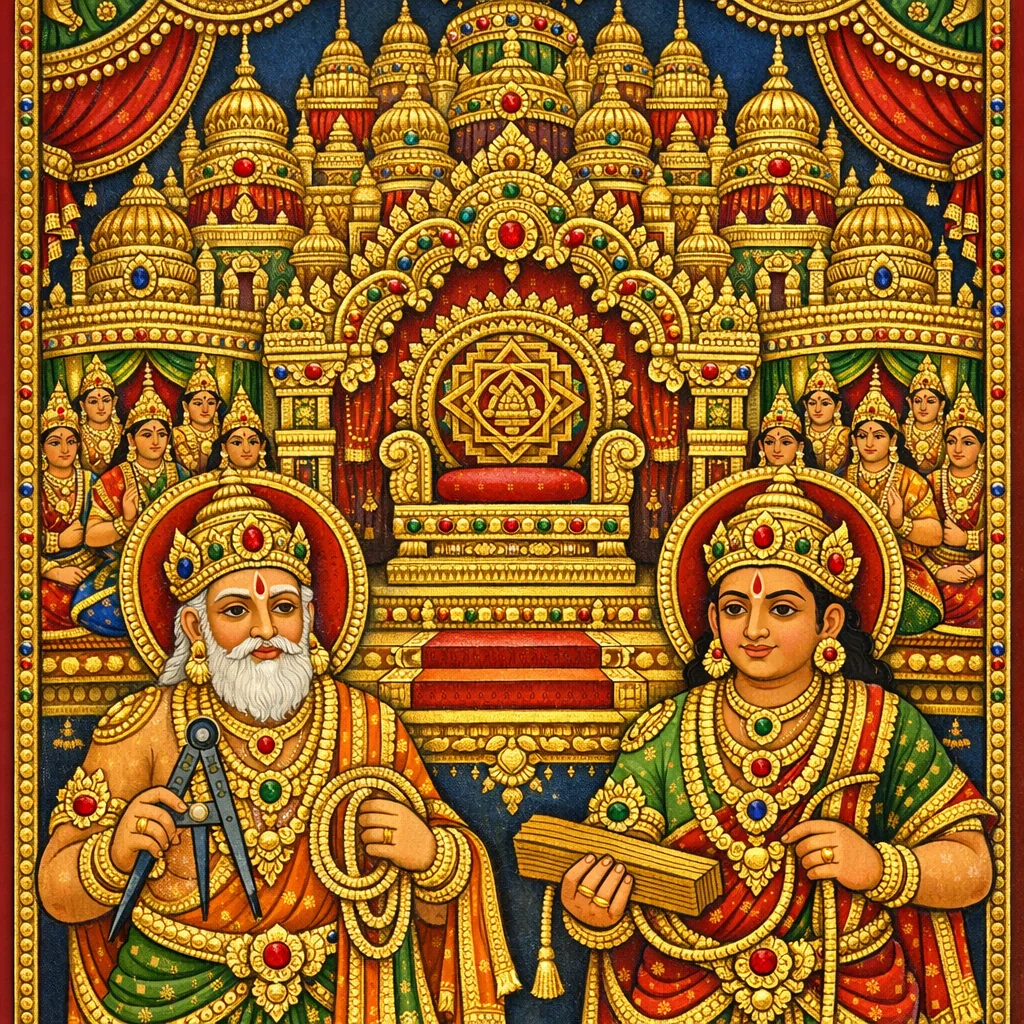
This adhyāya continues the Hayagrīva–Agastya dialogue in the Lalitopākhyāna. Agastya asks what “Śrīpura” is—its form, dimensions, color and splendor, and who first built it. Hayagrīva replies that after Śrī Lalitā’s victorious divine līlā, especially the defeat of Bhaṇḍa (Bhaṇḍāsura) and the restoration of cosmic order, the gods resolve to create a permanent, magnificent abode for Lalitā and Kāmeśvara: a “nityopabhoga-sarvārtha mandira,” a palace for sacred enjoyment and all purposes. The celestial administrators summon the master artisans Viśvakarman and Maya, praising their śāstric mastery and their power to manifest vast designs by mere intention. They are commanded to build multiple jewel-adorned Śrīnagarīs according to the ṣoḍaśī (sixteenfold) sacred-field logic, establishing Lalitā’s sixteenfold presence for the continual protection of the world. Thus mythic victory is transformed into sacred urbanism, where cosmic sovereignty appears as planned space aligned with ritual geography and emanational theology.
Shlokas
Verse 1
इति श्रीब्रह्माण्डमहापुराणे उत्तरभागे हयग्रीवागस्त्यसंवादे ललितोपाख्याने मदनपुनर्भवो नाम त्रिंशो ऽध्यायः अगस्त्य उवाच किमिदं श्रीपुरं नाम केन रूपेण वर्तते / केन वानिर्मितं पूर्व तत्सर्वं मे निवदय
Thus, in the Śrī Brahmāṇḍa Mahāpurāṇa, in the latter section, in the dialogue of Hayagrīva and Agastya, within the Lalitā narrative, is the thirtieth chapter called “Madanapunarbhava.” Agastya said: “What is this city named Śrīpura, and in what form does it abide? By whom was it formerly built? Tell me all of this.”
Verse 2
कियत्प्रमाणं किं वर्णं कथयस्व मम प्रभो / त्वमेव सर्वसन्देहपङ्कशोषणभास्करः
Tell me, O Lord: what is its measure, and what is its hue? You alone are the sun that dries up the mire of every doubt.
Verse 3
हयग्रीव उवाच यथा चक्ररथं प्राप्य पूर्वोक्तैर्लक्षणैर्युतम् / महायागानलोत्पन्ना ललिता परमेश्वरी
Hayagrīva said: “When She obtained the Cakraratha, endowed with the marks spoken of earlier, Lalitā Parameśvarī—arisen from the fire of the great sacrifice—…”
Verse 4
कृत्वा वैवाहिकीं लीलां ब्रह्माद्यैः प्रार्थिता पुनः / व्यजेष्ट भण्डनामानमसुरं लोककण्टकम्
Having enacted the sacred bridal līlā, and again entreated by Brahmā and the rest, She overcame the asura named Bhaṇḍa, the bane that choked the worlds.
Verse 5
तदा देवा महेन्द्राद्याः सन्तोषं बहु भेजिरे / अथ कामेश्वरस्यापि ललितायाश्च शोभनम् / नित्योपभोगसर्वार्थं मन्दिरं कर्तुमुत्सुकाः
Then the devas, led by Mahendra, were filled with great delight. Thereafter, eager to build a splendid temple-palace for Kāmeśvara and the radiant Lalitā, for perpetual enjoyment and every purpose, they set their hearts upon it.
Verse 6
कुमारा ललितादेव्या ब्रह्मविष्णुमहेश्वराः / वर्धकिं विश्वकर्माणं सुराणां शिल्पकोविदम्
Kumāra of Goddess Lalitā, together with Brahmā, Viṣṇu, and Maheśvara, summoned Viśvakarmā, the master builder, skilled in the divine arts of the suras.
Verse 7
सुराणां शिल्पनं च मयं मायाविचक्षणम् / आहूय कृतसत्कारानूचिरे ललिताज्ञया
They also summoned Maya, the craftsman of the suras, discerning in the workings of māyā; having honored and received them duly, they spoke in accordance with Lalitā’s command.
Verse 8
अधिकारिपुरुषा ऊचुः भो विश्वकर्मञ्छिल्पज्ञ भोभो मय महोदय / भवन्तौ सर्वशास्त्रज्ञौ घटनामार्गकोविदौ
The appointed officers said: “O Viśvakarmā, knower of sacred craft! O Maya, noble sir! You both are versed in all śāstras and skilled in the ways of designing and building.”
Verse 9
संकल्पमात्रेण महाशिल्पकल्पविशारदौ / युवाभ्यां ललितादेव्या नित्यज्ञानमहोदधेः
By mere resolve alone, the two youths—masters of the great art of divine making—served Goddess Lalitā, the vast ocean of eternal knowledge.
Verse 10
षोडशीक्षेत्रमध्येषु तत्क्षेत्रसमसंख्यया / कर्तव्या श्रीनगर्यो हि नानारत्नैरलङ्कृताः
Within the sixteen sacred fields, let cities of Śrī be built—equal in number to those fields—adorned with many kinds of jewels.
Verse 11
यत्र षोडशधा भिन्ना ललिता परमेश्वरी / विश्वत्राणाय सततं निवासं रचयिष्यति
There Lalitā Parameśvarī, manifested in sixteenfold form, will fashion an abiding dwelling for the ceaseless protection of the world.
Verse 12
अस्माकं हि प्रियमिदं मरुतामपिच प्रियम् / सर्वलोकप्रियं चैतत्तन्नाम्नैव विरच्यताम्
This is dear to us, and dear also to the Maruts; and it is beloved of all the worlds—therefore let it be fashioned by that very name.
Verse 13
इति कारणदेवानां वचनं सुनिशम्य तौ / विश्वकर्ममयौ नत्वा व्यभाषेतां तथास्त्विति
Thus, having heard well the words of the causal gods, the two—endowed with Viśvakarman’s power—bowed and replied, “So be it.”
Verse 14
पुनर्नत्वा पृष्टवन्तौ तौ तान्कारण पूरुषान् / केषु क्षेत्रेषु कर्तव्याः श्रीनगर्यो महोदयाः
Then, bowing once more, the two asked those Kāraṇa-Puruṣas: “In which sacred kṣetras should the auspicious cities of Śrī be founded—cities of great glory and prosperity?”
Verse 15
ब्रह्माद्याः परिपृष्टास्ते प्रोचुस्तौ शिल्पिनौ पुनः / क्षेत्राणां प्रविभागं तु कल्पयन्तौ यथोचितम्
When reverently questioned, Brahmā and the others spoke again to the two artisans, so that they might duly arrange the proper divisions of the sacred kṣetras.
Verse 16
कारणपुरुषा ऊचुः प्रथमं मेरुपृष्ठे तु निषधे च महीधरे / हेमकूटे हिमगिरौ पञ्चमे गन्धमादने
The Kāraṇa-Puruṣas said: “First upon the slopes of Meru, and upon the mountain Niṣadha; upon Hemakūṭa and Himagiri; and fifth, upon Gandhamādana.”
Verse 17
नीले मेषे च शृङ्गारे महेन्द्रे च महागिरौ / क्षेत्राणि हि नवैतानि भौमानि विदितान्यथ
And on Nīla, on Meṣa and Śṛṅgāra; on Mahendra and on the great mountain Mahāgiri—these are the nine earthly kṣetras, known as such.
Verse 18
औदकानि तु सप्तैव प्रोक्तान्यखिल सिन्धुषु / लवणो ऽब्धीक्षुसाराब्धिः सुराब्धिर्घृतसागरः
The watery kṣetras are declared to be seven, present throughout all the oceans: the Salt Sea, the Ocean of Sugarcane-juice, the Ocean of Surā, and the Sea of Ghṛta (sacred clarified butter).
Verse 19
दधिसिन्धुः क्षीरसिन्धुर्जलसिन्धुश्च सप्तमः / पूर्वोक्ता नव शैलेन्द्राः पश्चात्सप्त च सिन्धवः
The Ocean of curds, the Ocean of milk, and the Ocean of waters—these make the seventh. Earlier were spoken of the nine lordly mountains; thereafter are told the seven Sindhus (rivers/seas).
Verse 20
आत्दृत्य षोडश क्षेत्राण्यंबाश्रीपुरकॢप्तये / येषु दिव्यानि वेश्मानि ललिताया महौजसः / सृजतं दिव्यघटनापण्डितौ शिल्पिनौ युवाम्
With reverence, undertake the ordering of sixteen sacred kṣetras to establish the Śrīpura of Mother Ambā. There, you two—young artisans skilled in divine construction—create celestial mansions for Lalitā of mighty splendor.
Verse 21
येषु क्षेत्रेषु कॢप्तानि घ्नन्त्या देव्या महासुरान् / नामानि नित्यानाम्नैव प्रथितानि न संशयः
In those kṣetras, established as the Goddess smote the great asuras, the names became renowned by the very eternal Name “Nityā”—of this there is no doubt.
Verse 22
सा हि नित्यास्वरूपेण कालव्याप्तिकरी परा / सर्वं कलयते देवी कलनाङ्कतया जगत्
She indeed, in the very form of Nityā, is the Supreme who causes time to pervade all. The Goddess measures everything and marks the world with the sign of reckoning (kalanā).
Verse 23
नित्यानाच महाराज्ञी नित्या यत्र न तद्भिदा / अतस्तदीयनाम्ना तु सनामा प्रथिता पुरा
Among the Nityās, the great Queen is Nityā; where Nityā is, there is no division. Therefore, from of old, she has been renowned by her own Name, as the true name.
Verse 24
कामेश्वरीपुरी चैव भगमालापुरी तथा / नित्यक्लिन्नापुरीत्यादिनामानि प्रथितान्यलम्
Kāmeśvarīpurī indeed, and likewise Bhagamālāpurī; and names such as Nityaklinnāpurī and the rest are exceedingly renowned.
Verse 25
अतो नामानि वर्णेन योग्ये पुण्यतमे दिने / महाशिल्पप्रकारेण पुरीं रचयतां शुभाम्
Therefore, on a most meritorious and fitting day, in accordance with the letters of those names, let them fashion an auspicious city by the grand method of sacred craftsmanship.
Verse 26
इति कारणकृत्येन्द्रैर्ब्रह्मविष्णुमहेश्वरैः / प्रोक्तौ तौ श्रीपुरीस्थेषु तेषु क्षेत्रेषु चक्रतुः
Thus did Brahmā, Viṣṇu, and Maheśvara—lords of the causal rites—declare those two, and they carried them out in the holy seats of Śrīpurī and in those sacred kṣetras.
Verse 27
अथ श्रीपुरविस्तारं पुराधिष्ठातृदेवताः / कथयाम्यहमाधार्य लोपामुद्रापते शृणु
Now, taking this as my foundation, I shall recount the expanse of Śrīpura and the guardian deities who preside over the city; O lord of Lopāmudrā, listen.
Verse 28
यो मेरुरखिलाधारस्तुङ्गश्चानन्तयोजनः / चतुर्दशजगच्चक्रसंप्रोतनिजविग्रहः
Meru, the support of all existence, rises lofty to infinite yojanas; its very form is interwoven with the wheel of the fourteen worlds.
Verse 29
तस्य चत्वारि शृङ्गाणि शक्रनैरृतवायुषु / मध्यस्थलेषु जातानि प्रोच्छ्रायस्तेषु कथ्यते
It has four horns, born in the quarters of Śakra (Indra), Nairṛta, and Vāyu; in the intermediate regions their lofty height is spoken of.
Verse 30
पूर्वोक्तशृङ्गत्रितयं शतयोजनमुन्नतम् / शतयोजनविस्तारं तेषु लोकास्त्रयो मताः
The three horns spoken of earlier rise a hundred yojanas in height and spread a hundred yojanas in breadth; upon them are held to be the three worlds.
Verse 31
ब्रह्मलोको विष्णुलोकः शिवलोकस्तथैव च / एतेषां गृहविन्यासान्वक्ष्याम्यवसरान्तरे
There are Brahmaloka, Vishnuloka, and likewise Shivaloka; the arrangement of their dwellings I shall describe at another time.
Verse 32
मध्ये स्थितस्य शृङ्गस्य विस्तारं चोच्छ्रयं शृणु / चतुःशतं योजनानामुच्छ्रितं विस्तृतं तथा
Hear now the breadth and height of the horn that stands in the middle: it rises four hundred yojanas, and its spread is the same.
Verse 33
तत्रैव शृङ्गे महति शिल्पिभ्यां श्रीपुरं कृतम् / चतुःशतं योजनानां विस्तृत कुम्भसंभव
There, upon that mighty horn, two master artisans fashioned Śrīpura; it extends four hundred yojanas, O Kumbhasambhava (Agastya).
Verse 34
तत्रायं प्रविभागस्ते प्रविविच्य प्रदर्श्यते / प्राकारः प्रथमः प्रोक्तः कालायसविनिर्मितः
There, this division is carefully examined and set forth for you. The first enclosing wall (prākāra) is declared to be fashioned of black iron (kālāyasa).
Verse 35
षट्दशाधिकसाहस्रयोजनायतवेष्टनः / चतुर्दिक्षु द्वार्युतश्च चतुर्योजनमुच्छ्रितः
Its encircling extent measures sixteen thousand yojanas and more. In the four directions it has gates, and it rises to a height of four yojanas.
Verse 36
शालमूलपरीणाहो योजनायुतमब्धिप / शालाग्रस्य तु गव्यूतेर्नद्धवातायनं पृथक्
O lord of the ocean, the girth at the base of the śāla is ten thousand yojanas. At the śāla’s summit, the windows are firmly fastened, set apart from one another, at an interval of one gavyūti.
Verse 37
शालद्वारस्य चौन्नत्यमेकयोजनमाश्रितम् / द्वारेद्वारे कपाटे द्वे गव्यूत्यर्धप्रविस्तरे
The śāla-gate’s height is one yojana. At each gate there are two door-leaves, each of half a gavyūti in breadth.
Verse 38
एकयोजनमुन्नद्धे कालायस विनिर्मिते / उभयोरर्गला चेत्थमर्धक्रोशसमायता
The door-leaves are strengthened to the measure of one yojana and wrought of black iron (kālāyasa). The bolts (argalā) on both sides are thus, extending to half a krośa.
Verse 39
एवं चतुर्षु द्वारेषु सदृशं परिकीर्तितम् / गोपुरस्य तु संस्थानं कथये कुंभसंभव
Thus it has been declared that the four gateways are alike. Now I shall describe the layout of the gopura, O Kumbhasambhava.
Verse 40
पूर्वोक्तस्य तु शालस्य मूले योजनसंमिते / पार्श्वद्वये योजने द्वे द्वे समादाय निर्मिते
At the base of the hall described earlier, the measure is one yojana. On both sides, it is built by taking two yojanas on each side.
Verse 41
विस्तारमपि तावन्तं संप्राप्तं द्वारगर्भितम् / पार्श्वद्वयं योजने द्वे मध्ये शालस्य योजनम्
Its breadth too reaches that same measure, enclosing the space of the gate. Each side is two yojanas, and the middle of the hall is one yojana.
Verse 42
मेलयित्वा पञ्च मुने योजनानि प्रमाणतः / पार्श्वद्वयेन सार्धेन क्रोशयुग्मेन संयुतम्
O sage, when combined according to measure it comes to five yojanas, joined with the two sides and an added half, and connected with a pair of krośas.
Verse 43
मेलयित्वा पञ्चसंख्यायोजनान्यायतस्तथा / एवं प्राकारतस्तत्र गोपुरं रचितं मुने
Likewise, in length too it is combined to the measure of five yojanas. Thus, O sage, there the gopura is constructed along the prākāra, the encircling wall.
Verse 44
तस्माद्गोपुरमूलस्य वेष्टो विंशतियोजनः / उपर्युपरि वेष्टस्य ह्रास एव प्रकीर्त्यते
Therefore, from the base of the gopura, the enclosing circuit extends for twenty yojanas; and as the enclosure rises higher and higher, its measure is said to diminish.
Verse 45
गोपुरस्योन्नतिः प्रोक्तापञ्चविंशतियोजना / योजनेयोजने द्वारं सकपाटं मनोहरम्
The height of the gopura is declared to be twenty-five yojanas; and at every yojana there is a delightful doorway, furnished with doors.
Verse 46
भूमिकाश्चापि तावन्त्यो यथोर्ध्वं ह्राससंयुताः / गोपुराग्रस्य निस्तारो योजनं हि समाश्रितः
The tiers too are of that same number, each diminishing as they rise upward; and the span at the summit of the gopura is set at one yojana.
Verse 47
आयामो ऽपि च तावान्वै तत्र त्रिमुकुटं स्मृतम् / मुकुटस्य तु विस्तारः क्रोशमानो घटोद्भव
Its length too is the same; and there it is remembered as having a triple crown. O Pot-born one, the breadth of that crown is a krośa.
Verse 48
क्रोशद्वयं समुन्नद्धं ह्रासं गोपुरवन्मुने / मुकुटस्यान्तरे क्षोणी क्रोशार्धेन च संमिता
O sage, the crown rises to two krośas in height, tapering like the gopura; and the ground within the crown is measured as half a krośa.
Verse 49
मुकुटं पश्चिमे प्राच्यां दक्षिणे द्वारगोपुरे / दक्षोत्तरस्तु मुकुटाः पश्चिमद्वारगोपुरे
In the west and in the east, upon the gopura of the southern gate the sacred crown (mukuṭa) is set; and upon the gopura of the western gate, the crowns are arranged toward the south and toward the north.
Verse 50
दक्षिणद्वारवत्प्रोक्ता उत्तरद्वाःकिरीटिकाः / पश्चिमद्वारवत्पूर्वद्वारे मुकुटकल्पना
The diadems (kirīṭa) of the northern gate are declared to be as those of the southern gate; and at the eastern gate, the placing of the crowns is arranged as at the western gate.
Verse 51
कालायसाख्यशालस्यान्तरे मारुतयोजने / अन्तरे कांस्यशालस्य पूर्ववद्गोपुरो ऽन्वितः
Within the hall called Kālāyasa (dark iron) there is an interval of one yojana, like the course of the wind; and within the hall of Kāṃsya (bronze) too, a gopura is joined, as described before.
Verse 52
शालमूलप्रमाणं च पूर्ववत्परिकीर्तितम् / कांस्यशालो ऽपि पूर्वादिदिक्षु द्वारसमन्विन्तः
The measure of the halls’ base is likewise declared as before. The Kāṃsya (bronze) hall too, in the directions beginning with the east and onward, is furnished with gates in full.
Verse 53
द्वारेद्वारे गोपुराणि पर्वलक्षणभाञ्जि च / कालायसस्य कांस्यस्य योंऽतर्देशः समन्ततः
At every gate there are gopuras bearing the marks of their tiered form; and the inner region between Kālāyasa (dark iron) and Kāṃsya (bronze) extends all around on every side.
Verse 54
नानावृक्षमहोद्यानं तत्प्रोक्तं कुम्भसंभव / उद्भिज्जाद्यं यावदस्ति तत्सर्वं तत्र वर्तते
That great garden of many kinds of trees is called Kumbhasambhava; all that springs from the earth, indeed all that exists, abides there.
Verse 55
परंसहस्रास्तरवः सदापुष्पाः सदाफलाः / सदापल्लवशोभाढ्याः सदा सौरभसंकुलाः
There are trees beyond a thousand—ever in blossom, ever bearing fruit; ever adorned with the beauty of fresh shoots, ever filled with fragrance.
Verse 56
चूताः कङ्कोलका लोध्रा बकुलाः कर्णिकारकाः / शिंशपाश्च शिरीषाश्च देवदारुनमेरवः
There are cūta trees (mango), kaṅkolaka, lodhra, bakula, and karṇikāraka; also śiṃśapā and śirīṣa, with devadāru and nameru.
Verse 57
पुन्नागा नागभद्राश्च मुचुकुन्दाश्च कट्फलाः / एलालवङ्गास्तक्कोलास्तथा कर्पूरशाखिनः
There are punnāga and nāgabhadra, mucukunda and kaṭphala; elā and lavaṅga (clove), takkola, and trees whose branches are fragrant with karpūra (camphor).
Verse 58
पीलवः काकतुण्ड्यश्च शालकाश्चासनास्तथा / काञ्चनाराश्च लकुचाः पनसा हिङ्गुलास्तथा
There are pīlava, kākatuṇḍya, śālaka, and āsana; kāñcanāra and lakuca; panasa (jackfruit) and also hiṅgula.
Verse 59
पाटलाश्च फलिन्यश्च जटिल्यो जघनेफलाः / गणिकाश्च कुरण्टाश्च बन्धुजीवाश्च दाडिमाः
There are Pāṭalā trees and many fruit-bearing plants; tangled-rooted growths and those that bear fruit low upon the stem; Gaṇikā and Kuraṇṭa blossoms, Bandhujīva flowers, and pomegranate trees (Dāḍima).
Verse 60
अश्वकर्णा हस्तिकर्णाश्चांपेयाः कनकद्रुमाः / यूथिकास्तालपर्ण्यश्च तुलस्यश्च सदाफलाः
There are Aśvakarṇā and Hastikarṇā trees; Cāṃpeya and Kanakadruma, the golden trees; Yūthikā blossoms, Tālaparṇī plants, sacred Tulasi, and Sadāphalā that bears fruit evermore.
Verse 61
तालास्तमालहिन्तालखर्जूराः शरबर्बुराः / इक्षवः क्षीरिणश्चैव श्लेष्मान्तकविभीतकाः
There are tāla palms, tamāla and hintāla trees, and kharjūra date-palms; śara and barbara trees; sugarcane and milk-sapping trees (kṣīriṇa); and also Śleṣmāntaka, the dispeller of phlegm, and Vibhītaka.
Verse 62
हरीत्क्यस्त्ववाक्पुष्प्यो घोण्टाल्यः स्वर्गपुष्पिकाः / भल्लातकाश्च खदिराः शाखोटाश्चन्दनद्रुमाः
There are Harītakī and Avākpuṣpya; Ghoṇṭālī and Svargapuṣpikā, the heaven-flowering plants; Bhallātaka and Khadira, Śākhoṭa, and sandalwood trees (Candana).
Verse 63
कालागुरुद्रुमाः कालस्कन्धाश्चिञ्चा वदास्तथा / उदुंबरार्जुनाश्वत्थाः शमीवृक्षा ध्रुवाद्रुमाः
There are Kālāguru trees, fragrant agarwood, and Kālaskandha; ciñcā (tamarind) and vaḍa (banyan) as well; udumbara, arjuna, and aśvattha; śamī trees, and steadfast dhruva trees, firm and enduring.
Verse 64
रुचकाः कुटजाः सप्तपर्णाश्च कृतमालकाः / कपित्थास्तिन्तिणी चैवेत्येवमाध्याः सहस्रशः
By the thousands are named such trees as rucakā, kuṭajā, saptaparṇa, kṛtamālaka, kapittha, and tintiṇī, and many others besides.
Verse 65
नानाऋतुसमाविष्टा देव्याः शृङ्गारहेतवः / नानावृक्षमहोत्सेधा वर्तन्ते वरशाखिनः
O Goddess, those trees, pervaded by the many seasons, become the very cause of beauty and adornment; of diverse kinds and lofty stature, they flourish with excellent branches.
Verse 66
कांस्यशालस्यान्तरोले सप्तयोजनदूरतः / चतुरस्रस्ताम्रशालः सिंधुयोजनमुन्नतः
Within the interval of the bronze hall, at a distance of seven yojanas, stands a square hall of copper, rising to a height of one yojana like the Sindhu.
Verse 67
अनयोरन्तरक्षोणी प्रोक्ता कल्पकवाटिका / कर्पूरगन्धिभिश्चारुरत्नबीजसमन्वितैः
The ground between the two is called the Kalpaka-grove, lovely with the fragrance of camphor and endowed with exquisite jewel-like seeds.
Verse 68
काञ्चनत्वक्सुरुचिरैः फलैस्तैः फलिता द्रुमाः / पीतांबराणि दिव्यानि प्रवालान्येव शाखिषु
Those trees are laden with lovely fruits whose skins gleam like gold; upon their branches appear divine yellow garments and coral-red shoots like pravāla.
Verse 69
अमृतं स्यान्मधुरसः पुष्पाणि च विभूषणम् / ईदृशा वहवस्तत्र कल्पवृक्षाः प्रकीर्तिताः
There, many Kalpavṛkṣa wish-fulfilling trees are praised: their sap is sweet amṛta, and their blossoms are ornaments of splendor.
Verse 70
एषा कक्षा द्वितीया स्यान्कल्पवापीति नामतः / ताम्रशालस्यान्तराले नागशालः प्रकीर्तिताः
This second enclosure is named “Kalpavāpī”; and within the interval of the Tāmra-śālā, the Nāga-śālā is said to stand.
Verse 71
अनयोरुभयोस्तिर्यगदेशः स्यात्सप्तयोजनः / तत्र संतानवाटी स्यान्कल्पवापीसमाकृतिः
The transverse span between the two is seven yojanas; there lies the Saṃtāna-vāṭī garden, shaped like the Kalpavāpī.
Verse 72
तयोर्मध्ये मही प्रोक्ता हरिचन्दनवाटिका / कल्पवाटीसमाकारा फलपुष्पसमाकुला
Between them is the land called Haricandana-vāṭikā, shaped like a Kalpavāṭī and filled with fruits and blossoms.
Verse 73
एषु सर्वेषु शालेषु पूर्ववद्द्वारकल्पनम् / पूर्ववद्गोपुराणां च मुकुटानां च कल्पनम्
In all these śālās, the arrangement of the gateways is as before; likewise the gopuras and the crowning mukuṭas are fashioned as previously.
Verse 74
गोपुरद्वारकॢप्तं च द्वारे द्वारे च संमितिः / आरकूटस्यान्तराले सप्तयोजनदूरतः
Gopuras and gateways were duly set in place, and at each door the measure was well-proportioned. In the interval of Ārakūṭa, the distance was seven yojanas.
Verse 75
पञ्चलोहमयः शालः पूर्वशालसमाकृतिः / तयोर्मध्ये मही प्रोक्ता मन्दारद्रुमवाटिका
There stood a hall wrought of the five metals, fashioned like the eastern hall. Between the two lay the ground known as the grove of Mandāra trees.
Verse 76
पञ्चलोहस्यान्तराले सप्तयोजनदूरतः / रौप्यशालस्तु संप्रोक्तः पूर्वोक्तैर्लक्षणैर्युतः
Within the interval of the five-metal precinct, at a distance of seven yojanas, a silver hall is declared, endowed with the characteristics spoken of before.
Verse 77
तयोर्मध्यमही प्रोक्ता पारिजातद्रुवाटिका / दिव्यामोदसुसंपूर्णा फलपुष्पभरोज्ज्वला
The middle ground between the two is called the grove of the Pārijāta tree—filled with divine fragrance, radiant with the burden of fruits and blossoms.
Verse 78
रौप्यशालस्यान्तराले सप्तयोजनविस्तरः / हेमशालः प्रकथितः पूर्ववद्द्वारशोभितः
In the interval of the silver hall, spanning seven yojanas, a golden hall is spoken of, adorned with gateways as before.
Verse 79
तयोर्मध्ये महीप्रोक्ता कदम्बतरुवाटिका / तत्र दिव्या नीपवृक्षा योजनद्वयमुन्नताः
Between the two lay the land called the Kadamba grove; there stood divine nīpa trees, rising to the height of two yojanas.
Verse 80
सदैव मदिरास्पन्दा मेदुरप्रसवोज्ज्वलाः / येभ्यः कादंबरी नाम योगिनी भोगदायिनी
They ever quivered with the intoxicating pulse of madirā, radiant with abundant blossoms; from them arose a yoginī named Kādaṃbarī, bestower of enjoyments and boons.
Verse 81
विशिष्टा मदिरोद्याना मन्त्रिण्याः सततं प्रिया / ते नीपवृक्षाः सुच्छायाः पत्रलाः पल्लवाकुलाः / आमोदलोलभृङ्गालीझङ्कारैः पूरितोदराः
This excellent madirā-garden was ever dear to the Mantriṇī. Those nīpa trees gave fair shade, were thick with leaves and crowded with tender shoots, their depths filled with the humming of fragrance-drunken bees.
Verse 82
तत्रैव मन्त्रिणीनाथाया मन्दिरं सुमनोहरम् / कदंबवनवाट्यास्तु विदिक्षुज्वलनादितः
There itself stood a most enchanting shrine for the Nātha of the Mantriṇī; and the Kadamba forest-garden shone in every direction like blazing fire.
Verse 83
चत्वारि मन्दिराण्युच्चैः कल्पितान्यादिशिल्पिना / एकैकस्य तु गे७स्य विस्तारः पञ्चयोजनः
Four lofty shrines were fashioned by the primordial master-builder; the span of each was five yojanas.
Verse 84
पञ्चयोजनमायामः सप्तावरणतः स्थितिः / एवमन्यविदिक्षु स्युस्सर्वत्र प्रियकद्रुमाः / निवासनगरी सेयं श्यामायाः परिकीर्तिता
This city of dwelling extends five yojanas in length and stands within seven enclosing ramparts. So too in the other directions, everywhere are the beloved Priyaka trees. This is proclaimed as the residential city of the Goddess Śyāmā.
Verse 85
सेनार्थं नगरी त्वन्या महापद्माटवीस्थले / यदत्रैव गृह तस्या बहुयोजनदूरतः
For the sake of the army there is another city in the region of the great Mahāpadmā forest. Yet her own house there lies many yojanas away.
Verse 86
श्रीदेव्या नित्यसेवा तु मत्रिण्या न घटिष्यते / अतश्चितामणिगृहोपान्ते ऽपि भवनं कृतम् / तस्याः श्रीमन्त्रनाथायाः सुरत्वष्ट्रा मयेन च
Matriṇī’s daily service to the glorious Śrī Devī must not be hindered. Therefore, even beside the Cintāmaṇi mansion a residence was built—fashioned by Suratvaṣṭrā and by Maya for her Śrī Mantranāthā.
Verse 87
श्रीपुरे मन्त्रेणी देव्या मन्दिरस्य गुणान्बहुन् / वर्णयिष्यति को नाम यो द्विजिह्वासहस्रवान्
In Śrīpura, Matriṇī will speak of the many virtues of the Goddess’s temple. Yet who could ever recount them all—even one endowed with a thousand double tongues?
Verse 88
कादंबरीमदाताम्रनयनाः कलवीणया / गायन्त्यस्तत्र खेलन्ति मान्यमातङ्गकन्यकाः
There the honored Mātaṅga maidens, their eyes copper-red with the intoxication of kādambarī, sing to the gentle vīṇā and sport in that place.
Verse 89
अगस्त्य उवाच मातङ्गो नाम कःप्रोक्तस्तस्य कन्याः कथं च ताः / सेवन्ते मन्त्रिणीनाथां सदा मधुमदालसाः
Agastya said: “Who is he that is called Mātaṅga, and what manner of daughters has he? Why do they ever attend upon the Lady Mantriṇī as their mistress, always intoxicated with honeyed delight and sunk in languor?”
Verse 90
हयग्रीव उवाच मतङ्गो नाम तपसामेकराशिस्तपोधनः / महाप्रभावसंपन्नो जगत्सर्जनलंपटः
Hayagrīva said: “Mataṅga is a single vast store of austerity, a tapodhana—one rich in tapas. Endowed with mighty splendor, he delights in the creation of the worlds.”
Verse 91
तपः शक्त्यात्तधिया च सर्वत्राज्ञाप्रवर्त्तकः / तस्य पुत्रस्तु मातङ्गो मुद्रिणीं मन्त्रिनायिकाम्
By the power of tapas and by that wisdom, he caused his command to prevail everywhere. His son was Mātaṅga, who served the Goddess Mudriṇī, the Mantriṇī, sovereign lady of mantras.
Verse 92
। घोरैस्तपोभिरत्यर्थं पूरयामास धीरधीः / मतङ्गमुनिपुत्रेण सुचिरं समुपासिता
With dreadful and most intense austerities, that steadfast sage brought it to fulfillment. And the Goddess Mantriṇī was long worshiped and attended by the son of the muni Mataṅga.
Verse 93
मन्त्रिणी कृतसान्निध्या वृणीष्व वरमित्यशात् / सो ऽपिसर्वमुनिश्रेष्ठो मातङ्गस्तपसां निधिः / उवाच तां पुरो दत्तसान्निध्यां श्यामलांबिकाम्
The Goddess Mantriṇī, having granted her gracious presence, said: “Choose a boon.” Then Mātaṅga, best of all munis and a treasury of tapas, spoke to Śyāmalāmbikā, who had appeared before him and bestowed her nearness.
Verse 94
मातङ्गमहामुनिरुवाच देवी त्वत्स्मृतिमात्रेण सर्वाश्च मम सिद्धयः / जाता एवाणिमाद्यास्ताः सर्वाश्चान्या विभूतयः
The great sage Mātaṅga said: O Goddess, by the mere remembrance of You, all my siddhis have arisen; Anima and the rest, and every other vibhūti, have all manifested.
Verse 95
प्रापणीयन्न मे किञ्चिदस्त्यंबभुवनत्रये / सर्वतः प्राप्तकालस्य भवत्याश्चरितस्मृतेः
O Mother Ambā, in the three worlds there is nothing left for me to attain; for one whose destined time has arrived from every side, by Your wondrous remembrance all is already obtained.
Verse 96
अथापि तव सांनिध्यमिदं नो निष्फलं भवेत् / एवं परं प्रार्थये ऽहं तं वरं पूरयांबिके
Yet even so, may this nearness of Yours not be fruitless; therefore, O Ambikā, I make my highest supplication—fulfil that boon, O Mother.
Verse 97
पूर्वं हिमवता सार्थं सौहार्दं परिहासवान् / क्रीडामत्तेन चावाच्यैस्तत्र तेन प्रगल्भितम्
Formerly I shared a jocular friendship with Himavat; and, intoxicated by play, I spoke unseemly words, whereby he there grew overbold.
Verse 98
अहङ्गौरीगुरुरिति श्लाघामात्मनि तेनिवान् / तद्वाक्यं मम नैवाभूद्यतस्तत्राधिको गुणः
He boasted to himself, saying, “I am Gaurī’s guru,” in self-praise; yet those words did not move me, for there Your excellence of virtue surpasses all.
Verse 99
उभयोर्गुणसाम्ये तु मित्रयोरधिके गुणे / एकस्य कारणाज्जाते तत्रान्यस्य स्पृहा भवेत्
When two friends are equal in qualities, or when one surpasses the other in virtue—if that excellence arises through the cause of one, then in the other there will arise a longing for it.
Verse 100
गौरीगुरुत्वश्लाघार्थं प्राप्तकामो ऽप्यहं तपः / कृतवान्मन्त्रिणीनाथे तत्त्वंमत्तनया भव
Though my desire was already fulfilled, I performed tapas to extol the grave majesty of Gaurī. O Lord of the Mantriṇīs, in accordance with truth, become my daughter.
Verse 101
यतो मन्नामविख्याता भविष्यसि न संशयः / इत्युक्तं वचनं श्रुत्वा मातङ्गस्य महामुनेः / तथास्त्विति तिरोघत् स च प्रीतो ऽभवन्मुनिः
“For you shall become renowned by my name—of this there is no doubt.” Hearing these words of the great sage Mātaṅga, she replied, “So be it,” and he vanished from sight; and the muni was filled with joy.
Verse 102
मातङ्गस्य महर्षेस्तु तस्य स्वप्ने तदा मुदा / तापिच्छमञ्जरीमेकां ददौ कर्णावतंसतः
Then the great ṛṣi Mātaṅga, in a dream and in gladness, bestowed a single cluster of tāpiccha blossoms to be worn as an ear-ornament.
Verse 103
तत्स्वप्नस्य प्रभावेण मातङ्गस्य सधर्मिणी / नाम्ना सिद्धिमती गर्भे लघुश्यामामधारयत्
By the power of that dream, Mātaṅga’s dharma-abiding wife, named Siddhimatī, conceived and bore in her womb a gently dark-hued daughter.
Verse 104
तत एव समुत्पन्ना मातङ्गी तेन कीर्तिताः / लघुश्यामेति सा प्रोक्त श्यामा यन्मूलकन्दभूः
From that very source Mātangī arose; therefore she is thus celebrated. She is called “Laghu-Śyāmā,” for she is Śyāmā, born from the root-tuber (mūla-kanda).
Verse 105
मातङ्गकन्यका हृद्याः कोटीनामपि कोटिशः / लघुश्यामा महाश्यामामातङ्गी वृन्दसंयुताः / अङ्गशक्तित्वमापन्नाः सेवन्ते प्रियकप्रियाम्
The daughters of Mātaṅga, delightful to the heart, were koṭis upon koṭis in number. Laghu-Śyāmā and Mahā-Śyāmā Mātangī, together with their hosts, attained the state of limb-powers (aṅga-śakti) and serve Priyaka-priyā, the beloved of Priyaka.
Verse 106
इति मातङ्गकन्यानामुत्पत्तिः कुंभसंभव / कथिताः सप्तकक्षाश्च शाला लोहादिनिर्मिताः
Thus, O Kuṃbhasaṃbhava, the birth of the daughters of Mātaṅga has been related; and the seven chambers and the halls fashioned of iron and the like have also been described.
Frequently Asked Questions
The sampled portion is not a vaṃśa-catalogue chapter; its organizing data is spatial-theological rather than dynastic—focusing on the authorization of Śrīpura/Śrīnagarī and the divine artisan lineage of function (Viśvakarman/Maya) rather than royal descent lists.
The passage foregrounds architectural and kṣetra-based mapping (ṣoḍaśīkṣetra and corresponding Śrīnagarīs) and includes Agastya’s request for measurements (pramāṇa) and color (varṇa); detailed numeric measures are implied as part of the full chapter’s descriptive agenda, even if not present in the excerpted verses.
The key esoteric motif here is not a single named yantra but the ṣoḍaśī framework: Lalitā’s “sixteenfold” differentiation is mapped onto sixteen kṣetras and cities, expressing Śākta emanation theology as a spatial grid—divine protection becomes a distributed sacred topology (abodes/cities) rather than only a battlefield victory over Bhaṇḍa.