Adhyaya 32
चतुर्युगाख्यान (Caturyuga-Ākhyāna) — Yuga-wise Origins and Measurements of Beings
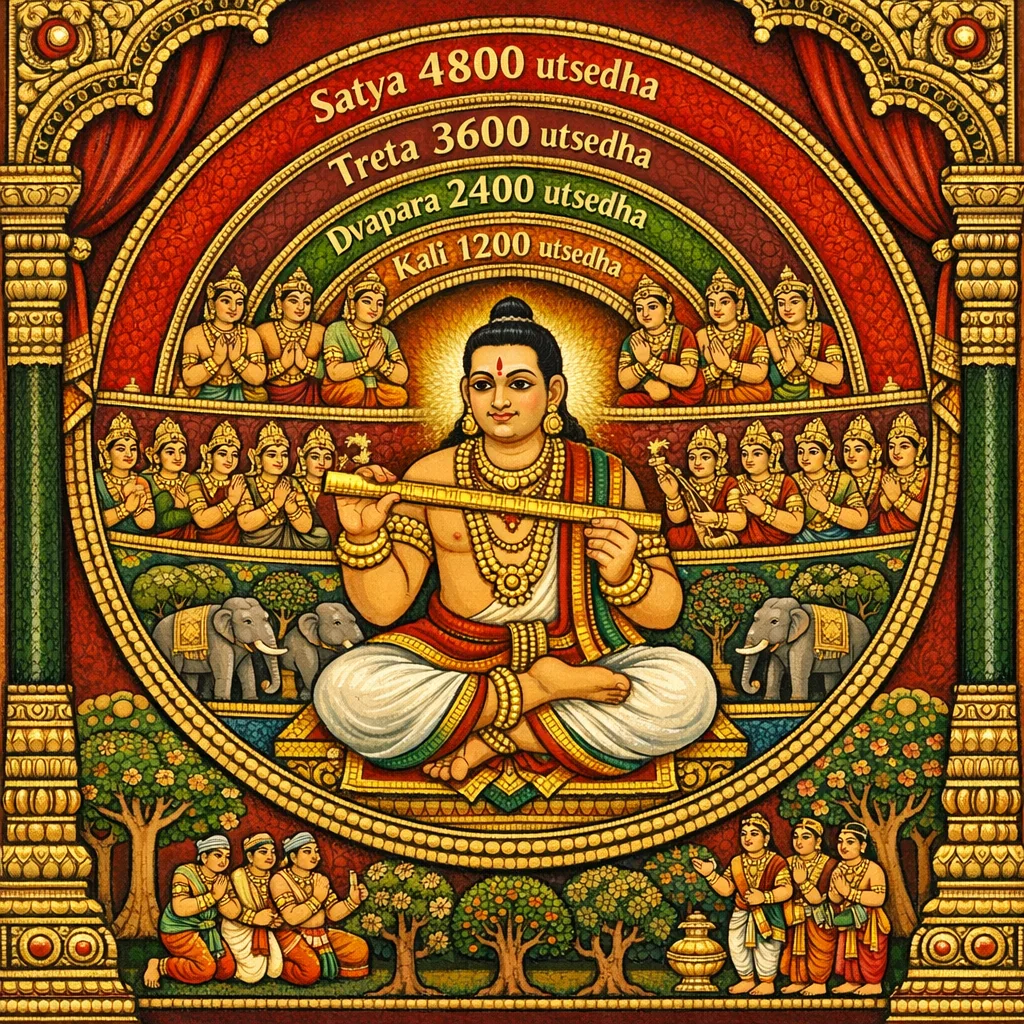
Spoken in Sūta’s voice, this chapter explains how classes of beings arise through the four Yugas and how their embodied measures (utsedha/height) and capacities change with each Yuga’s condition. In a technical mode it lists types of births—āsurī, sarpa/pannaga, gandharva, paiśācī, yakṣa, rākṣasa—and then turns to proportional measurements based on aṅgula standards. It emphasizes Yuga-linked diminution (hrāsa) and variation, comparing the bodily metrics of divine/āsuric and human forms, and also noting measures for animals and plants such as livestock, elephants, and trees. Read as cosmological anthropology, bodily scale and excellence (including heightened buddhi) are treated as signs of dharma’s temporal gradient, bridging caturyuga doctrine with observable forms in the world.
Shlokas
Verse 1
इति श्रीब्रह्माण्डे महापुराणे वायुप्रोक्ते पूर्वभागे द्वितीये ऽनुषङ्गपादे चतुर्युगाख्यानं नामैकत्रिंशत्तमो ऽध्यायः सूत उवाच युगेषु यास्तु जायन्ते प्रजास्ता मे निबोधत / आसुरी सर्पगान्धर्वा पैशाची यक्षराक्षसी
Thus, in the Śrī Brahmāṇḍa Mahāpurāṇa, spoken by Vāyu, in the former section, the second anuṣaṅga-pāda, is the thirty-first chapter called “The Account of the Four Yugas.” Sūta said: “Hear from me the beings born in the yugas—asuric, serpentine (nāga), gandharva, piśācī, and yakṣa-rākṣasī.”
Verse 2
यस्मिन्युगे च संभूति स्तासां यावच्च जीवितम् / पिशाचासुरगन्धर्वां यक्षराक्षसपन्नगाः
I shall tell in which yuga they arise and how long their lives endure: the piśācas, asuras, gandharvas, yakṣas, rākṣasas, and pannagas (nāgas).
Verse 3
परिणाहोच्छ्रयैस्तुल्या जायन्ते ह कृते युगे / षण्णवत्यङ्गुलो त्सेधो ह्यष्टानां देवजन्मनाम्
In the Kṛta Yuga they are born equal in breadth and height; the eight kinds of divine birth have a stature of ninety-six aṅgulas.
Verse 4
स्वेनाङ्गुलप्रमाणेन निष्पन्नेन च पौष्टिकात् / एतत्स्वाभाविकं तेषां प्रमाणमिति कुर्वते
By their own aṅgula-measure, made complete through nourishment, they determine their dimensions; this is held to be their natural standard.
Verse 5
मनुष्या वर्तमानास्तु युगं संध्याशकेष्विह / देवासुरप्रमाणं तु सप्तसप्तङ्गुलादसत्
As for humans living here in the twilight portions (sandhyā) of the yugas, their measure is thus; the measure of devas and asuras has diminished by seven aṅgulas at a time.
Verse 6
अङ्गुलानां शतं पूर्णमष्टपञ्चाशदुत्तरम् / देवासुरप्रमाणं तु उच्छ्रयात्कलिजैः स्मृतम्
A full hundred aṅgulas, with fifty-eight added—this is remembered in the Kali age as the measure of the stature of Devas and Asuras.
Verse 7
चत्वारश्चाप्यशीतिश्च कलिजैरङ्गुलैः स्मृतः / स्वेनाङ्गुलिप्रमाणेन ऊर्द्ध्वमापादमस्तकात्
By the aṅgula-measure of the Kali age it is said to be four and eighty (84); with one’s own finger-measure it is taken upward, from the feet to the head.
Verse 8
इत्येष मानुषोत्सेधो ह्रसतीह युगांशके / सर्वेषु युगकालेषु अतीतानागतेष्विह
Thus the stature of humankind here diminishes according to the portions of the yugas, in all yuga-times—those past and those yet to come.
Verse 9
स्वेनाङ्गुलिप्रमाणेन अष्टतालः स्मृतो नरः / आपादतलमस्तिष्को नवतालो भवेत्तु यः
By one’s own finger-measure a man is said to be eight tālas; but he who is measured from the soles of the feet to the crown of the head becomes nine tālas.
Verse 10
संहता जानुबाहुस्तु स सुरैरपि पूज्यते / गवाश्वहस्तिनां चैव महिष स्यावरात्मनाम्
He whose arms are well-knit and reach the knees is revered even by the Devas; and this mark is likewise held excellent among cows, horses, elephants, and buffaloes, and other beings of steady nature.
Verse 11
कर्मणैतेन विज्ञेये ह्रासवृद्धी युगे युगे / षट्सप्तत्यङ्गुलोत्सेधः पशूनां ककुदस्तु वै
By this measure of karma, decline and increase are known in every yuga; and the kakuda—the hump of beasts—is indeed said to be seventy-six angulas in height.
Verse 12
अङ्गुलाष्टशतं पूर्णमुत्सेधः करिणां स्मृतः / अङ्गुलानां सहस्रं तु चत्वारिंशाङ्गुलैर्विना
The height of elephants is remembered as a full eight hundred angulas; and (by another reckoning) a thousand angulas, yet lacking forty angulas.
Verse 13
पञ्चाशता यवानां च उत्सेधः शाखिनां स्मृतः / मानुषस्य शरीरस्य सन्निवेशस्तु यादृशः
The height of branching trees is remembered as fifty yavas; and as for the arrangement of the human body, such as it is, so it is (to be) described.
Verse 14
तल्लक्षणस्तु देवानां दृश्येत तत्त्वदर्शनात् / बुद्ध्यातिशययुक्तश्च देवानां काय उच्यते
Through the vision of truth (tattva-darśana), those marks of the Devas may be seen; and the body endowed with surpassing intelligence is called the kāya of the Devas.
Verse 15
तथा सातिशयस्छैव मानुषः काय उच्यते / इत्येते वै परिक्रान्ता भावा ये दिव्यमानुषाः
So too, the human body, when endowed with excellence (sātiśaya), is called a kāya; thus have been set forth these states that are both divine and human.
Verse 16
पशूनां पक्षिणां चैव स्थावराणां च सर्वशः / गावो ह्यजावयो ऽश्वाश्च हस्तिनः पक्षिणो नगाः
Among beasts, birds, and all immovable beings—cows, goats and sheep, horses, elephants, birds, and mountains: all are found.
Verse 17
उपयुक्ताः क्रियास्वेते यज्ञियास्विह सर्वशः / देवस्थानेषु जायन्ते तद्रूपा एव ते पुनः
Those who are wholly employed here in rites belonging to the yajña are born again in the abodes of the gods, in that very same form.
Verse 18
यथाशयोपभोगास्तु देवानां शुभमूर्त्तयः / तेषां रूपानुरूपैस्तु प्रमाणैः स्थाणुजङ्गमैः
As the auspicious forms of the gods accord with their intent and enjoyment, so too do immovable and moving beings bear measures and sizes suited to those forms.
Verse 19
मनोज्ञैस्तत्र भावैस्ते सुखिनो ह्युपपेदिरे / अतः शिष्टान्प्रवक्ष्यामि सतः साधूंस्तथैव च
There, through pleasing states of being, they attained happiness; therefore I shall now speak of the well-disciplined, the righteous, and the sādhus.
Verse 20
सदिति ब्रह्मणः शब्दस्तद्वन्तो ये भवन्त्युत / साजात्याद्ब्रह्मणस्त्वेते तेन सन्तः प्रचक्षते
“Sat” is a word of Brahman; those in whom that “sat” abides are called “sants”, for they are of the same nature as Brahman.
Verse 21
दशात्मके ये विषये कारणे चाष्टलक्षणे / न क्रुध्यन्ति न त्दृष्यन्ति जितात्मानस्तु ते स्मृताः
Those who, amid the tenfold objects and the cause marked by eight signs, neither grow angry nor thirst with craving—these are remembered as conquerors of the self.
Verse 22
सामान्येषु तु धर्मेषु तथा वैशेषिकेषु च / ब्रह्मक्षत्रविशो यस्माद्युक्तास्तस्मा द्द्विजातयः
In the common duties and in the specific duties as well, since Brahmins, Kshatriyas, and Vaishyas are joined to them, therefore they are called the twice-born (dvijāti).
Verse 23
वर्णाश्रमेषु युक्तस्य स्वर्गतौ सुखचारिमः / श्रौतस्मार्तस्य धर्मस्य ज्ञानाद्धर्मज्ञ उच्यते
One who is aligned with the duties of varṇa and āśrama and moves happily on the path to heaven is called a knower of dharma through knowledge of Śrauta and Smārta law.
Verse 24
विद्यायाः साधनात्साधुर्ब्रह्मचारी गुरोर्हितः / गृहाणां साधनाच्चैव गृहस्थः साधुरुच्यते
By the discipline of learning, the brahmacārin who acts for the guru’s good is called a sādhū; and by the discipline of household duties, the householder too is called a sādhū.
Verse 25
साधनात्तपसो ऽरण्ये साधुर्वैखानसः स्मृतः / यतमानो यतिः साधुः स्मृतो योगस्य साधनात्
By the discipline of austerity in the forest, the Vaikhānasa is remembered as a sādhū; and by the discipline of yoga, the striving yati too is remembered as a sādhū.
Verse 26
एवमाश्रमधर्माणां साधनात्साधवः स्मृताः / गृहस्थो ब्रह्मचारी च वानप्रस्थो यतिस्तथा
Thus, by practicing the dharmas of the āśramas, one is remembered as a holy person—whether a householder, a brahmacārin, a forest-dweller, or a renunciate yati.
Verse 27
अथ देवा न पितरो मुनयो न च मानुषाः / अयं धर्मो ह्ययं नेति विन्दते भिन्नदर्शनाः
Then neither the gods, nor the Pitṛs, nor the sages, nor men—those of differing views decide, saying, “This is dharma; this is not.”
Verse 28
धर्माधर्माविहप्रोक्तौ शब्दावेतौ क्रियात्मकौ / कुशलाकुशलं कर्म धर्माधर्माविह स्मृताम्
Here, ‘dharma’ and ‘adharma’ are spoken of as two action-based terms; wholesome (kuśala) and unwholesome (akuśala) deeds are remembered here as dharma and adharma.
Verse 29
धारणर्थो धृतिश्चैव धातुः शब्दे प्रकीर्त्तितः / अधारणामहत्त्वे च अधर्म इति चोच्यते
The verbal root dhṛ is famed to mean ‘to uphold’ and ‘steadfastness’; that which does not uphold and is devoid of true worth is called adharma.
Verse 30
अथेष्टप्रापको धर्म आचार्यैरुपदिश्यते / अधर्मश्चानिष्टफलोह्याचार्यैरुपदिश्यते
The ācāryas teach that dharma brings about the desired fruit; and that adharma yields an undesired fruit—so is it instructed by the teachers.
Verse 31
वृद्धाश्चालोलुपाश्चैव त्वात्मवन्तो ह्यदांभिकाः / सम्यग्विनीता ऋजवस्तानाचार्यान्प्रजक्षते
Those who are aged, free from greed, self-possessed and without pretence—rightly disciplined and upright—such persons are acknowledged and proclaimed as ācāryas.
Verse 32
स्वयमाचरते यस्मादाचारं स्थापयत्यपि / आचिनोति च शास्त्राणि आचार्यस्तेन चोच्यते
Because he himself practices right conduct, establishes that conduct, and gathers and studies the śāstras—therefore he is called an ācārya.
Verse 33
धर्मज्ञैर्विहितो धर्मः श्रौतः स्मार्त्तो द्विधा द्विजैः / दाराग्निहोत्रसम्बन्धाद्द्विधा श्रौतस्य लक्षणम्
Dharma, as laid down by the knowers of dharma for the twice-born, is twofold: śrauta and smārta. The mark of śrauta-dharma too is said to be twofold, by its connection with wife (dārā) and with the agnihotra rite.
Verse 34
स्मार्त्तो वर्णाश्रमाचारैर्यमैः सनियमैः स्मृतः / पूर्वेभ्यो वेदयित्वेह श्रौतं सप्तर्ष यो ऽब्रुवन्
Smārta-dharma is remembered as the observances of varṇa and āśrama, together with yamas and niyamas. Śrauta-dharma, having been made known to the ancients, was here proclaimed by the Saptarṣis.
Verse 35
ऋचो यजूंसामानि ब्रह्मणो ऽङ्गानि च श्रुतिः / मन्वन्तरस्यातीतस्य स्मृत्वाचारान्मनुर्जगौ
Ṛk, Yajus, and Sāman—this śruti is the very limbs of Brahman. Recalling the observances of a bygone manvantara, Manu spoke them forth.
Verse 36
तस्मा त्स्मार्त्तः धर्मो वर्णाश्रमविभाजकः / स एष विविधो धर्मः शिष्टाचार इहोच्यते
Therefore the Smārta Dharma, which apportions the varṇas and āśramas—this manifold Dharma is here called śiṣṭācāra, the conduct of the righteous.
Verse 37
शेषशब्दः शिष्ट इति शेषं शिष्टं प्रचक्षते / मन्वन्तरेषु ये शिष्टा इह तिष्ठन्ति धार्मिकाः
The word śeṣa means “śiṣṭa”; those who remain are called śiṣṭa. In the manvantaras, the dharmic śiṣṭas abide here.
Verse 38
मनुः सप्तर्षयश्चैव लोकसंतानकारमात् / धर्मार्थं ये च तिष्ठन्ति ताञ्छिष्टान्वै प्रचक्षते
Manu and the Saptarṣis—so that the world’s lineage may continue—those who stand for Dharma are indeed called śiṣṭa.
Verse 39
मन्वादयश्च ये ऽशिष्टा ये मया प्रागुदीरिताः / तैः शिष्टैश्चरितो धर्मः सम्यगेव युगे युगे
Manu and the other śiṣṭas whom I have spoken of before—the Dharma practiced by those righteous ones is rightly upheld, age after age.
Verse 40
त्रयी वार्त्ता दण्डनीतिरिज्या वर्णाश्रमास्तथा / शिष्टैराचर्यते यस्मान्मनुना च पुनः पुनः
The Trayī (the Vedas), vārttā, daṇḍanīti, ijyā, and the order of varṇa and āśrama—these are practiced by the śiṣṭas, and by Manu again and again.
Verse 41
पूर्वैः पूर्वगतत्वाच्च शिष्टाचारः स सात्वतः / दानं सत्यं तपो ज्ञानं विद्येज्या व्रजनं दया
Because it has been followed by the ancients, this is the sāttvika śiṣṭācāra: charity, truth, austerity, knowledge, sacred learning, ijyā (worship), pilgrimage to tīrthas, and compassion.
Verse 42
अष्टौ तानि चरित्राणि शिष्टाचारस्य लक्षणम् / शिष्टा यस्माच्चरन्त्येनं मनुः सप्तर्षयस्तु वै
These eight modes of conduct are the marks of śiṣṭācāra, for the noble live by them—Manu, and indeed the Saptarṣis as well.
Verse 43
मन्वन्तरेषु सर्वेषु शिष्टाचारस्ततः स्मृतः / विज्ञेयः श्रवणाच्छ्रौतः स्मरणात्स्मार्त्त उच्यते
In every manvantara, śiṣṭācāra is remembered thus: what is known through hearing (śruti) is called śrauta, and what is known through recollection (smṛti) is called smārta.
Verse 44
इज्यावेदात्मकः श्रौतः स्मार्त्तो वर्णाश्रमात्मकः / प्रत्यङ्गानि च वक्ष्यामि धर्मस्येह तु लक्षणम्
Śrauta dharma is founded on ijyā and the Veda; smārta dharma is founded on varṇa and āśrama. Now I shall also speak here of dharma’s subsidiary marks.
Verse 45
दृष्ट्वा तु भूतमर्थं यः पृष्टो वै न निगू हति / यथा भूतप्रवादस्तु इत्येतत्सत्यलक्षणम्
One who, having seen the matter as it truly is, when questioned does not conceal it but speaks exactly as it occurred—this is the mark of truth.
Verse 46
ब्रह्मचर्यं जपो मौनं निराहारत्वमेव च / इत्येतत्तपसो रूपं सुघोरं सुदुरा सदम्
Brahmacarya, japa, silence, and fasting—this is the form of tapas, ever most severe and hard to undertake.
Verse 47
पशूनां द्रव्यहविषामृक्सामयजुषां तथा / ऋत्विजां दक्षिणानां च संयोगो यज्ञ उच्यते
The conjunction of sacrificial beasts, material oblations (haviṣ), the Ṛk–Sāma–Yajus hymns, the officiating priests, and the dakṣiṇā gifts is called a yajña.
Verse 48
आत्मवत्सर्वभूतेषु या हितायाहिताय च / प्रवर्त्तन्ते समा दृष्टिः कृत्स्नाप्येषा दया स्मृता
To regard all beings as oneself and to act with equal vision in what helps and what harms—this, in its entirety, is remembered as dayā, compassion.
Verse 49
आक्रुष्टो निहतो वापि नाक्रोशेद्यो न हन्ति च / वाङ्मनःकर्मभिर्वेत्ति तितिक्षैषा क्षमा स्मृता
Even if abused or struck, one should not abuse in return nor harm; enduring in speech, mind, and deed—this forbearance is remembered as kṣamā, forgiveness.
Verse 50
स्वामिना रक्ष्यमाणानामुत्सृष्टानां च संभ्रमे / परस्वानामनादानमलोभ इति कीर्त्यते
Whether guarded by its owner or left behind in confusion, not taking another’s wealth is praised as alobha, freedom from greed.
Verse 51
मैथुनस्यासमाचारो न चिन्ता नानुजल्पनम् / निवृत्तिर्ब्रह्मचर्यं तदच्छिद्रं तप उच्यते
To abstain from sexual union, to be free from anxious thought, and to avoid idle speech—this withdrawal is brahmacarya; it is called austerity without breach.
Verse 52
आत्मार्थं वा परार्थं वा चेन्द्रियाणीह यस्य वै / मिथ्या न संप्रवर्त्तन्ते शामस्यैतत्तु लक्षमम्
He whose senses, whether for his own sake or another’s, do not run into false deeds—this is the mark of śama, inner tranquility.
Verse 53
दशात्मके यो विषये कारणे चाष्टलक्षणे / न क्रुद्ध्येत प्रतिहतः स जितात्मा विभाव्यते
He who, amid the tenfold objects and the causes marked by eight signs, does not grow angry when obstructed—he is deemed a conqueror of the self.
Verse 54
यद्यदिष्टतमं द्रव्यं न्यायेनैवागतं च यत् / तत्तद्गुणवते देयमित्येतद्दानलक्षणम्
Whatever dearest wealth is gained by righteous means, that should be given to the worthy and virtuous—this is the mark of dāna, sacred giving.
Verse 55
दानं त्रिविधमित्येतत्कनिष्ठज्येष्ठमध्यमम् / तत्र नैश्रेयसं ज्येष्ठं कनिष्ठं स्वार्थसिद्धये
Giving is said to be threefold—lower, middling, and highest. Of these, the highest leads to naiśreyasa, the supreme good; the lower is for one’s own gain.
Verse 56
कारुण्यात्सर्वभूतेषु संविभागस्तु मध्यमः / श्रुतिस्मृतिभ्यां विहितो धर्मो वर्माश्रमात्मकः
The just sharing born of compassion toward all beings is the middle way; the dharma enjoined by Śruti and Smṛti is rooted in the order of varṇa and āśrama.
Verse 57
शिष्टाचाराविरुद्धश्च धर्मः सत्साधुसंमतः / अप्रद्वेषोह्यनि ष्टेषु तथेष्टस्याभिनन्दनम्
Dharma is that which does not oppose the conduct of the refined and is approved by the holy and good; it is non-hatred toward the undesired and glad praise of the desired.
Verse 58
प्रीतितापविषादेभ्यो विनिवृत्तिर्विरक्तता / संन्यासः कर्मणां न्यासः कृतानामकृतैः सह
Turning away from delight, burning anguish, and sorrow is dispassion; saṃnyāsa is the laying down of actions—those done and those left undone alike.
Verse 59
कुशलाकुशलानां तु प्रहाणं न्यास उच्यते / व्यक्ता ये विशेषास्ते विकारे ऽस्मिन्नचेतने
The abandonment of both the wholesome and the unwholesome is called nyāsa; the distinctions that appear are found in this unconscious modification.
Verse 60
चेतनाचेतनान्यत्वविज्ञानं ज्ञानमुच्यते / प्रत्यङ्गानां तु धर्मस्य त्वित्येतल्लक्षणं स्मृतम्
Knowledge is said to be the discernment of the difference between the conscious and the unconscious; this is remembered as the mark of dharma’s subsidiary limbs.
Verse 61
ऋषिभिर्धर्मतत्त्वज्ञैः पूर्वं स्वायंभुवे ऽन्तरे / अत्र वो वर्णयिष्यामि विधिं मन्वन्तरस्य यः
The seers who know the truth of Dharma once declared this in the Manvantara of Svayambhuva; here I shall describe to you the sacred ordinance of that Manvantara.
Verse 62
तथैव चातुर्हेत्रस्य चातुर्विद्यस्य चैव हि / प्रतिमन्वन्तरे चैव श्रुतिरन्या विधीयते
So too, regarding cāturhetra and cāturvidyā: in each Manvantara a different śruti—its Vedic tradition—is ordained.
Verse 63
ऋचो यजूंषि समानि यथा च प्रतिदैवतम् / आभूतसंप्लवस्यापि वर्ज्यैकं शतरुद्रियम्
The Ṛk, the Yajus, and the Sāman hymns—together with the recitations for each deity—endure until the bhūta-saṃplava (cosmic dissolution), save for one alone: the Śatarudrīya.
Verse 64
विधिर्हैत्रस्तथा स्तोत्रं पूर्ववत्संप्रवर्तते / द्रव्यस्तोत्रं गुणस्तोत्रं फलस्तोत्रं तथैव च
The haitra ordinance and the stotras proceed as before: stotras of offerings (dravya), stotras of qualities (guṇa), and stotras of fruits (phala) likewise.
Verse 65
चतुर्थमाभिजनकं स्तोत्रमेतच्चतुर्विधम् / मन्वन्तरेषु सर्वेषु यथा देवा भवन्ति ये
This is the fourth stotra, called ābhijanaka, fourfold in form; in all Manvantaras it is observed according to the gods who arise in that age.
Verse 66
प्रवर्तयति तेषां वै ब्रह्मा स्तोत्रं चतुर्विधम् / एवं मन्त्रगणानां तु समुत्पत्तिश्चतुर्विधा
For them, Brahmā sets in motion a fourfold hymn of praise; thus the arising of the hosts of mantras is likewise fourfold.
Verse 67
अथर्वगर्यजुषां साम्नां वेदेष्विह पृथक्पृथक् / ऋषीणां तप्यतामुग्रं तपः परमदुष्करम्
Here within the Vedas, Atharva, Ṛg, Yajus, and Sāman stand each apart; and the fierce tapas of the rishis who endure it is supremely hard to perform.
Verse 68
मन्त्राः प्रादुर्बभूवुर्हि पूर्वमन्वन्तरेष्विह / असंतोषाद्भया द्दुःखात्सुखाच्छोकाच्च पञ्चधा
Mantras indeed appeared here in the earlier manvantaras; from discontent, fear, sorrow, joy, and grief they arose in fivefold ways.
Verse 69
ऋषीणां तारकाख्येन दर्शनेन यदृच्छया / ऋषीणां यदृषित्वं हि तद्वक्ष्यामीह लक्षणैः
By chance the rishis attained the vision called Tāraka; and what truly constitutes rishihood, I shall declare here through its marks.
Verse 70
अतीतानागतानां च पञ्चधा त्वृषिरुच्यते / अतस्त्वृषीणां वक्ष्यामि तत्र ह्यार्षसमुद्भवम्
With regard to past and future, the rishi is spoken of in five ways; therefore I shall describe there the āṛṣa origin of the rishis.
Verse 71
गुणसाम्ये वर्त्तमाने सर्वसंप्रलये तदा / अविभागे तु वेदानामनिर्देश्ये तमोमये
When the guṇas abide in perfect balance at the time of the total cosmic dissolution, the Vedas too remain undivided—an indescribable state, wholly steeped in tamas.
Verse 72
अबुद्धिबूर्वकं तद्वै चेतनार्थे प्रवर्त्तते / चेतनाबुद्धिपूर्वं तु चेतनेन प्रवर्त्तते
That principle first proceeds toward the aim of consciousness without buddhi preceding it; but when consciousness and buddhi are prior, it is set in motion by Consciousness itself.
Verse 73
प्रवर्त्तते तथा द्वौ तु यथा मत्स्योदके उभे / चेतनाधिष्ठितं सत्त्वं प्रवर्त्तति गुणात्मकम्
The two proceed together, like fish and water within the waters; sattva, upheld by Consciousness, functions as a nature constituted of the guṇas.
Verse 74
कारणत्वात्तथा कार्यं तदा तस्य प्रवर्त्तते / विषयो विषयित्वाच्च अर्थेर्ऽथत्वात्तथैव च
Because it is a cause, its effect then comes into operation; the object by virtue of objecthood, and meaning by virtue of meaningfulness, likewise manifest.
Verse 75
कालेन प्रापणीयेन भेदास्तु करणात्मकाः / संसिध्यन्ति तदा व्यक्ताः क्रमेण महदादयः
When time reaches its destined point, distinctions of an instrumental nature arise; then Mahat and the other principles become manifest and are accomplished in due order.
Verse 76
महतश्चाप्यहङ्कारस्तस्माद्भूतेद्रियाणि च / भूतभेदाश्च भूतेभ्यो जज्ञिरे स्म परस्परम्
From Mahat arose Ahaṅkāra; from that, the bhūtas and the indriyas came forth. And from the bhūtas themselves, the distinctions among the elements were born, each from the other.
Verse 77
संसिद्धकार्यकरणः सद्य एव व्यवर्त्तत / यथोल्मुकात्तु त्रुटयः एककालाद्भवन्ति हि
Perfected in function and instrument, it set forth at once—just as sparks leap forth from a glowing ember in a single instant.
Verse 78
तथा विवृत्ताः क्षेत्रज्ञाः कालेनैकेन कारणात् / यथान्धकारे खद्योतः सहसा संप्रदृश्यते
So too, the Kṣetrajñas unfolded from the cause in a single moment—like a firefly suddenly seen within the darkness.
Verse 79
तथा विवृत्तो ह्यव्यक्तात्खद्योत इव सञ्ज्वलन् / स माहन्सशरीरस्तु यत्रैवायमवर्त्तत
Thus, from the Unmanifest (Avyakta) it unfolded, blazing like a firefly; and that Mahān, endowed with a body, remained right there where this motion had begun.
Verse 80
तत्रैव संस्थितो विद्वान्द्वारशालामुखे विभुः / महांस्तु तमसः पारे वैलक्षण्याद्विभाव्यते
There itself, at the threshold of the gateway hall, the all-pervading wise one stood. Yet Mahat-tattva is discerned as beyond tamas, known by its own distinctive nature.
Verse 81
तत्रैव संस्थिते विद्वांस्तमसोंऽत इति श्रुतिः / बुद्धिर्विवर्त्तमानस्य प्रादुर्भूता चतुर्विधा
There itself, as the wise one stood established, the Śruti declares: “this is the end of darkness”; and the transforming intellect (buddhi) arose in fourfold form.
Verse 82
ज्ञानं वैराग्यमैश्वर्यं धर्मश्चेति चतुष्टयम् / सांसिद्धिकान्यथैतानि विज्ञेयानि नरस्य वै
Knowledge, dispassion, lordly power (aiśvarya), and dharma—this is the fourfold set; know these as the innate perfections of a human being.
Verse 83
स महात्मा शरीरस्य वैवर्त्तात्सिद्धिरुच्यते / अनुशेते यतः सर्वान्क्षेत्रज्ञानमथापि वा
That Mahātman is called “siddhi” through the body’s transformation; for he lies latent within all beings—he is also the Knower of the Field (kṣetrajña).
Verse 84
पुरिषत्वाच्च पुरुषः क्षत्रेज्ञानात्स उच्यते / यस्माद्वुद्ध्यानुशेते च तस्माद्वोधात्मकः स वै
Because he dwells in the “city” (the body), he is called Puruṣa; because he knows the Field (kṣetra), he is called Kṣetrajña; and because he lies within along with the intellect, he is truly of the nature of awakening (bodha).
Verse 85
संसिद्धये परिगतं व्यक्ताव्यक्तमचेतनम् / एवं विवृत्तः क्षेत्रज्ञः क्षेत्रज्ञानाभिसंहितः
For perfect attainment he encompasses the manifest and the unmanifest, even what is insentient; thus unfolded, the Kṣetrajña stands conjoined with knowledge of the Field.
Verse 86
विवृत्तिसमकालं तु बुद्ध्याव्यक्तमृषिः स्वयम् / परं ह्यर्षयते यस्मात्परमर्षित्वमस्य तत्
At the time of unfolding (vivṛtti), the ṛṣi himself, through buddhi, reveals the unmanifest Supreme; because he makes the Highest shine forth, his state is remembered as that of a Paramarṣi.
Verse 87
गत्यर्थादृषतेर्धातोर्नाम निर्वृतिरादितः / यस्मादेव स्वयं भूतस्तस्माच्चाप्यृषिता स्मृता
From the root ṛṣ, bearing the sense of movement, the name “nirvṛti” was first spoken; and because he came to be of himself, he is also remembered as “ṛṣitā”.
Verse 88
ईश्वरात्स्वयमुद्भूता मानसा ब्रह्मणः सुताः / यस्मादुत्पद्यमानैस्तैर्महान्परिगतः परः
They are Brahmā’s mind-born sons, arisen of themselves from Īśvara; as they came forth, the Great Supreme spread forth, encompassing all directions.
Verse 89
यस्माद-षन्ति ते धीरा महान्तं सर्वतो गुणैः / तस्मान्महर्षयः प्रोक्ता बुद्धेः परम दर्शिना
Because those steadfast ones make the Great One shine forth and praise him on every side through his virtues, the seer of the highest through buddhi declared them to be Mahārṣis.
Verse 90
ईश्वराणां सुतास्तेषां मानसा औरसाश्च वै / अहङ्कारं तपश्चैव ऋषन्ति ऋषितां गताः
They are sons of the Īśvaras—mind-born and also directly born; they subdue ego (ahaṅkāra) and even tapas, having attained the state of ṛṣis.
Verse 91
तस्मात्सप्तर्षयस्ते वै भूतादौ तत्त्वदर्शनात् / ऋषिपुत्रा ऋषीकास्तु मैथुनाद्गर्भसंभवाः
Therefore those Saptarṣis became renowned, for at the beginning of beings they beheld the true principles. And the Ṛṣīkas, known as the sons of Ṛṣis, were born from the womb through union.
Verse 92
तन्मात्राणि च सत्यं च ऋषन्ते ते महौजसः / सप्तषर्यस्त तस्ते च परसत्यस्य दर्शनाः
Those mighty Ṛṣis inquire into the tanmātras and into truth itself. Those Saptarṣis are seers of the Supreme Truth.
Verse 93
ऋषीकाणां सुतास्ते स्युर्विज्ञेया ऋषिपुत्रकाः / ऋषन्ति ते ऋतं यस्माद्विशेषांश्चैव तत्त्वतः
The sons of the Ṛṣīkas are to be known as Ṛṣiputrakas. For they seek ṛta—the dharmic truth—and discern distinctions in accord with tattva.
Verse 94
तस्मात्सप्तर्षयस्तेपि श्रुतेः परमदर्शनात् / अव्यक्तात्मा महानात्माहङ्कारात्मा तथैव च
Therefore those Saptarṣis too, through the supreme vision of Śruti, behold the Unmanifest Self (Avyakta), the Great Self (Mahān), and likewise the Self as Ahaṅkāra.
Verse 95
भूतात्मा चेन्द्रियात्मा च तेषां तज्ज्ञानमुच्यते / इत्येता ऋषिजातीस्ता नामभिः पञ्च वै शृणु
Bhūtātman and Indriyātman—such is the knowledge ascribed to them. Thus are these lineages of Ṛṣis; now hear their five names.
Verse 96
भृगुर्मरीचिरत्रिश्च ह्यङ्गिराः पुलहः क्रतुः / मनुर्दक्षो वसिष्टश्च पुलस्त्यश्चेति ते दश
Bhrigu, Marichi, Atri, Angiras, Pulaha, Kratu, Manu, Daksha, Vasistha, and Pulastya—these are the ten.
Verse 97
ब्रह्मणो मानसा ह्येते उद्भूताः स्वयमीश्वराः / परत्वेनर्षयो यस्मात्स्मृतास्तस्मान्महर्षयः
Born from Brahma’s mind, they arose as self-luminous lords; and since they are remembered as rishis of highest rank, they are therefore called Maharishis.
Verse 98
ईश्वराणां सुता ह्येते ऋषयस्तान्निबोधत / काव्यो बृहस्पतिश्चैव कश्यपश्व्यवनस्तथा
These rishis are the sons of the divine lords—know them: Kavya (Shukra), Brihaspati, Kashyapa, and Vyavana.
Verse 99
उतथ्यो वामदेवश्च अपा स्यश्चोशिजस्तथा / कर्दमो विश्रवाः शक्तिर्वालखिल्यास्तथार्वतः
Also: Utathya, Vamadeva, Apasya, and Ushij; Kardama, Vishrava, and Shakti; and likewise the Valakhilyas and Arvata.
Verse 100
इत्येते ऋषयः प्रोक्तास्तपसा चर्षितां गताः / ऋषिपुत्रानृ षीकांस्तु गर्भोत्पन्नान्निबोधत
Thus have these rishis been declared—those who, through austerity, attained the state of rishi; now learn also of the rishis’ sons and the rishikas born from the womb.
Verse 101
वत्सरो नगृहूश्चैव भरद्वाजस्तथैव च / ऋषिदीर्घतमाश्चैव बृहदुक्थः शरद्वतः
Vatsara, Nagṛhū, and Bharadvāja; likewise the seer Dīrghatamā, Bṛhaduktha, and Śaradvata—these too are named.
Verse 102
वाजश्रवाः शुचिश्चैव वश्याश्वश्च पराशरः / दधीचः शंशपाश्चैव राजा वैश्रवणस्तथा
Vājaśravā, Śuci, Vaśyāśva, and Parāśara; also Dadhīca, Śaṃśapa, and King Vaiśravaṇa are spoken of.
Verse 103
इत्येते ऋषिकाः प्रोक्तास्ते सत्यादृषितां गताः / ईश्वरा ऋषयश्चैव ऋषिकाश्चैव ते स्मृताः
Thus these were declared to be ṛṣikas; they attained the seerhood born of the vision of Truth. They are remembered as ṛṣis and ṛṣikas, divine in nature.
Verse 104
एते मन्त्रकृतः सर्वे कृत्स्नशस्तान्निबोधत / भृगुः काव्यः प्रचेताश्च ऋचीको ह्यात्मवानपि
All these are composers of sacred mantras—know this in full, O listeners. Bhṛgu, Kāvya, Pracetas, and Ṛcīka too, steadfast in spirit, are among them.
Verse 105
और्वाथ जमदग्निश्च विदः सारस्वतस्तथा / आर्ष्टिषेणो युधाजिच्च वीतहव्यसुवर्चसौ
And Aurva, Jamadagni, Vida, and Sārasvata; likewise Ārṣṭiṣeṇa, Yudhāji, Vītahavya, and Suvarcasa—these too are among the mantra-makers.
Verse 106
वैन्यः पृथुर्दिवोदासो बाध्यश्वो गृत्सशौनकौ / एकोनविशतिर्ह्येतेभृगवो मन्त्रवादितः
Vainya Pṛthu, Divodāsa, Bādhyāśva, Gṛtsa, and Śaunaka—these are remembered as nineteen Bhṛgus renowned for mastery of sacred mantras.
Verse 107
अङ्गिरा वैद्यगश्चैव भरद्वाजो ऽथ बाष्कलिः / ऋतवाकस्तथा गर्गः शिनिः संकृतिरेव च
Aṅgirā, Vaidyaga, Bharadvāja, Bāṣkali, Ṛtavāk, Garga, Śini, and Saṃkṛti—these too are revered names remembered in the sacred lineage.
Verse 108
पुरुकुत्सश्च मान्धाता ह्यंबरीषस्तथैव च / युवनाश्वः पौरकुत्सस्त्रसद्दस्युश्च दस्युमान्
Purukutsa, Māndhātā, Ambarīṣa, Yuvanāśva, Paurakutsa, Trasaddasyu, and Dasyumān—these too are names radiant with the glory of Dharma.
Verse 109
आहार्यो ह्यजमीढश्च तुक्षयः कपिरेव च / वृषादर्भो विरूपाश्वः कण्वश्चैवाथ मुद्गलः
Āhārya, Ajamīḍha, Tukṣaya, Kapi, Vṛṣādarbha, Virūpāśva, Kaṇva, and Mudgala—these too are counted in the succession of blessed names.
Verse 110
उतथ्यश्च सनद्वाजस्तथा वाजश्रवा अपि / अयास्यश्चक्रवर्त्ती चवामदेवस्तथैव च
Utathya, Sanadvāja, Vājaśravā, Ayāsya, Cakravartī, and Vāmadeva—these too are reverently remembered within the holy lineage.
Verse 111
असिजो बृहदुक्थश्च ऋषिर्दीर्घतमास्तथा / कक्षीवांश्च त्रयस्त्रिंशत्स्मृता ह्याङ्गिरसा वराः
Asijo, Bṛhaduktha, the rishi Dīrghatamā, and Kakṣīvān—these are remembered as the thirty-three excellent sages of the Āṅgirasa line.
Verse 112
एते मन्त्रकृतः सर्वे काश्यपांस्तु निबोधत / काश्यपश्चैव वत्सारो नैध्रुवो रैभ्य एव च
All these are composers of sacred mantras from the Kāśyapa lineage; know them as Kāśyapa, Vatsāra, Naidhruva, and Raibhya.
Verse 113
असितो देव लश्चैव षडेते ब्रह्मवादिनः / अत्रिरर्वसनश्चैव श्यावाश्वश्च गविष्ठिरः
Asita and Devala—these are six proclaimers of Brahman; and also Atri, Arvasana, Śyāvāśva, and Gaviṣṭhira.
Verse 114
आविहोत्र ऋषिर्द्धीमांस्तथा पूर्वातिथिश्च सः / इत्येते चा त्रयः प्रोक्ता मन्त्रकारा महर्षयः
The wise rishi Āvihotra, and Pūrvātithi—thus these three great seers are declared to be makers of sacred mantras.
Verse 115
वसिष्ठश्चैव शक्तिश्च तथैव च पराशरः / चतुर्थ इन्द्रप्रमतिः पञ्चमश्च भरद्वसुः
Vasiṣṭha, Śakti, and Parāśara; the fourth is Indrapramati, and the fifth is Bharadvasu.
Verse 116
षष्ठश्च मैत्रावरुणिः कुण्डिनः सप्तमस्तथा / इति सप्त वशिष्ठाश्च विज्ञेया ब्रह्मवादिनः
The sixth is Maitrāvaruṇi, and the seventh is Kuṇḍina. Thus these seven Vasiṣṭhas are to be known as proclaimers of Brahman.
Verse 117
विश्वामित्रस्तु गाधेयो देवरातस्तथोद्गलः / तथा विद्वान्मधुच्छन्दा ऋषिश्चान्यो ऽघमर्षणः
Viśvāmitra, known as Gādheya, Devarāta, and Udgala; likewise the learned Madhucchandā, and another ṛṣi, Aghamarṣaṇa.
Verse 118
अष्टको लोहितश्चैव कतः कोलश्च तावुभौ / देवश्रवास्तथा रेणुः पूरणो ऽथ धनञ्जयः
Aṣṭaka and Lohita; also Kata and Kola—those two; then Devaśravā, Reṇu, Pūraṇa, and Dhanañjaya.
Verse 119
त्रयोदशैते धर्मिष्ठा विज्ञेयाः कुशिकावराः / अगस्त्यो ऽयो दृढायुश्च विध्मवाहस्तथैव च
These thirteen are to be known as the most righteous among the Kuśikas, steadfast in dharma; and also Agastya, Aya, Dṛḍhāyu, and Vidhmavāha.
Verse 120
ब्रह्मिष्ठागस्तपा ह्येते त्रयः परमकीर्त्तयः / मनुर्वैवस्वतश्चैव एलो राजा पुरूखाः
These three are steadfast in Brahman and devoted to tapas, of supreme renown. Also mentioned are Manu Vaivasvata, King Ela, and Purūkhā.
Verse 121
क्षत्र्रियाणां चरावेतौ विज्ञेयौ मन्त्रवादिनौ / भलन्दनश्च वत्सश्च संकीलश्चैव ते त्रयः
Among the Kṣatriyas, these two ‘cara’ (founders of gotra-lines) are to be known as reciters of mantras. Bhalandana, Vatsa, and Saṃkīla—these are the three.
Verse 122
एते मन्त्रकृतश्चैव वैश्यानां प्रवराः स्मृताः / इत्येषा नवतिः प्रोक्ता मन्त्रा यैरृषिभिः कृताः / ब्राह्यणाः क्षत्रिया वैश्या ऋषिपुत्रान्निबोधत
These are remembered as the mantrakṛta and the foremost pravaras of the Vaiśyas. Thus it is declared that the mantras composed by the ṛṣis are ninety in number. O Brāhmaṇas, Kṣatriyas, and Vaiśyas, know the sons of the ṛṣis by their names.
Frequently Asked Questions
It explains Yuga-wise manifestation of different being-classes (asura, gandharva, piśāca, yakṣa, rākṣasa, sarpa/pannaga, etc.) and correlates Yuga phases with bodily measurements and decline/increase across time.
Aṅgula-based pramāṇa/utsedha (height and proportional standards), applied comparatively to devas/āsuras, humans, and also extended to animals (e.g., cattle/horse/elephant) and even trees.
Primarily cosmological and temporal: it operationalizes caturyuga theory by showing how embodied forms and capacities track Yuga conditions, rather than cataloging dynastic lineages.