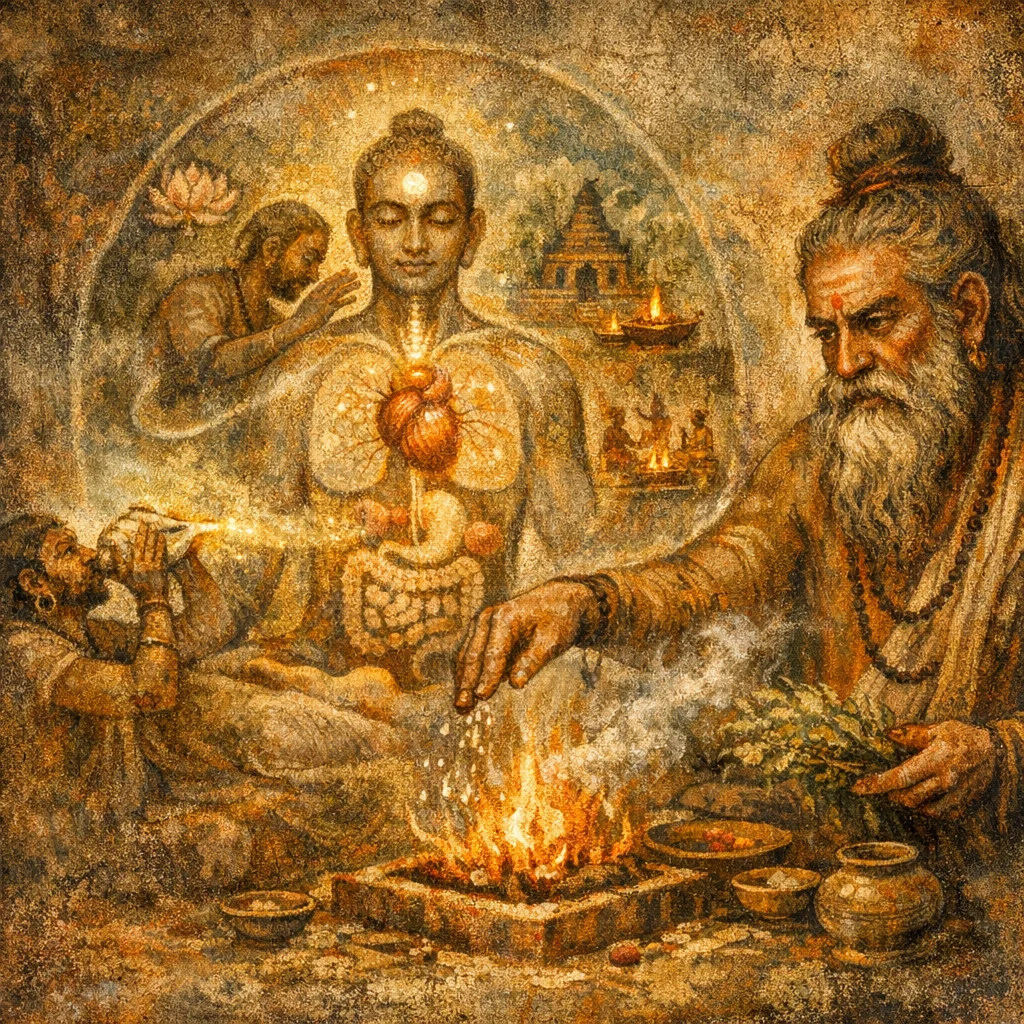
Sukta 2
Rishi: Atharvan (traditional attribution for this physiologico-cosmological section)
Devata: Pavamāna (purifying power; Soma-like), and the embodied Purusha as ritual subject
Chandas: Anuṣṭubh (predominant; some pādas show Atharvanic flexibility)
Mantras
Mantra 1
ब्रह्मप्रकाशनम्। केन पार्ष्णी आभृते पूरुषस्य केन मांसं संभृतं केन गुल्फौ। केनाङ्गुलीः पेशनीः केन खानि केनोच्छ्लङ्खौ मध्यतः कः प्रतिष्ठाम्
A revelation of the sacred power. By whom were the two heels brought and set for the Person? By whom was the flesh compacted, by whom the two ankles? By whom were the fingers deftly fashioned, by whom the openings? By whom were the two shanks raised in the midst—who established the firm standing?
Mantra 2
कस्मान्नु गुल्फावधरावकृण्वन्नष्ठीवन्तावुत्तरौ पुरुषस्य । जङ्घे निरऋत्य न्यऽदधुः क्वऽस्विज्जानुनोः संधी क उ तच्चिकेत
From whom, indeed, did they fashion the two ankles as the lower parts, and the bony upper parts of the Person? Having measured out, they set the two legs in place: where, pray, is the jointing of the two knees—who has discerned that?
Mantra 3
चतुष्टयं युज्यते संहितान्तं जानुभ्यामूर्ध्वं शिथिरं कबन्धम्। श्रोणी यदूरू क उ तज्जजान याभ्यां कुसिन्धं सुदृढं बभूव
A fourfold set is joined, ending in a junction; upward from the knees the pliant trunk. The hips—those thighs—who, indeed, produced that, by which the pelvis-seat became exceeding firm?
Mantra 4
कति देवाः कतमे त आसन् य उरो ग्रीवाश्चिक्युः पुरुषस्य । कति स्तनौ व्यऽदधुः कः कफोडौ कति स्कन्धान् कति पृष्टीरचिन्वन्
How many gods, and which of them, were they who marked out the chest and the necks of the Person? How many set the two breasts apart in place? Who (set) the two shoulder-supports? How many arranged the shoulders, how many piled up the back-structures?
Mantra 5
को अस्य बाहू समभरद् वीर्यं करवादिति । अंसौ को अस्य तद् देवः कुसिन्धे अध्या दधौ
Who furnished him with the two arms, with vigour—‘that he may perform’—thus? Who (furnished) his two shoulders? What god set that endowment in place upon the firm seat?
Mantra 6
कः सप्त खानि वि ततर्द शीर्षाणि कर्णाविमौ नासिके चक्षणी मुखम्। येषां पुरुत्रा विजयस्य मह्ननि चतुष्पादो द्विपदो यन्ति यामम्
Who hath bored out the seven openings, the head—these two ears, the nostrils, the eyes, the mouth—of whom, in many a place, by the mighty power of victory, the four-footed and the two-footed go their ordered course?
Mantra 7
हन्वोर्हि जिह्वामदधात् पुरूचीमधा महीमधि शिश्राय वाचम्। स आ वरीवर्ति भुवनेष्वन्तरपो वसानः क उ तच्चिकेत
For in the two jaws he set the far-ranging tongue; then, thereon, he established mighty Speech. He ranges within the worlds, within, clothed in the Waters: who indeed hath understood that?
Mantra 8
मस्तिष्कमस्य यतमो ललाटं ककाटिकां प्रथमो यः कपालम्। चित्वा चित्यं हन्वोः पूरुषस्य दिवं रुरोह कतमः स देवः
Which is his brain, which his forehead, which his nape—who was the first that fashioned the skull? Having built the builded frame of the man from the two jaws, to heaven he mounted: which god was he?
Mantra 9
प्रियाप्रियाणि बहुला स्वप्नं संबाधतन्द्यः । आनन्दानुग्रो नन्दांश्च कस्माद् वहति पूरुषः
Pleasant and unpleasant things, manifold; sleep, oppression and drowsiness; joys that follow on, and gladnesses—whence is it that the Person bears these along?
Mantra 10
आर्तिरवर्तिर्निरृतिः कुतो नु पुरुषेऽमतिः । राद्धिः समृद्धिरव्यृद्धिर्मतिरुदितयः कुतः
Distress and ill-course, Destruction—whence, pray, are these in the Person, and folly? Success and full prosperity, and non-prospering; thought and its uprisings—whence are they?
Mantra 11
को अस्मिन्नापो व्यऽदधाद् विषूवृतः पुरूवृतः सिन्धुसृत्याय जाताः । तीव्रा अरुणा लोहिनीस्ताम्रधूम्रा ऊर्ध्वा अवाचीः पुरुषे तिरश्चीः
Who in this man disposed the Waters—born to run like rivers, with courses turned diversely, with many a circuit?—the keen, the ruddy, the blood-red, the copper-smoky; upward, downward, and athwart, within the Person.
Mantra 12
को अस्मिन् रूपमदधात् को मह्मानं च नाम च । गातुं को अस्मिन् कः केतुं कश्चरित्राणि पूरुषे
Who in this man set form, who greatness, and name? Who in this established the path, who the sign of thought, and who the modes of conduct within the Person?
Mantra 13
को अस्मिन् प्राणमवयत् को अपानं व्यानमु । समानमस्मिन् को देवोऽधि शिश्राय पुरुषे
Who in this man wove in the Breath—who the Down-breath, the Pervading-breath, yea, the Equalizing-breath? What god, within the Person, hath fixed them there as lordly stay?
Mantra 14
को अस्मिन् यज्ञमदधादेको देवोऽधि पुरुषे । को अस्मिन्त्सत्यं कोऽनृतं कुतो मृत्यृः कुतोऽमृतम्
Who in this man established sacrifice—one god presiding within the Person? Who in him set truth, who untruth? Whence is death, and whence is immortality?
Mantra 15
को अस्मै वासः पर्यदधात् को अस्यायुरकल्पयत्। बलं को अस्मै प्रायच्छत् को अस्याकल्पयज्जवम्
Who round about him put the garment? who apportioned him his life? Who to him granted strength in full, and who for him made ready vigour and swift force?
Mantra 16
केनापो अन्वतनुत केनाहरकरोद् रुचे। उषसं केनान्वैन्द्ध केन सायंभवं ददे
By whom were the Waters stretched forth in order? by whom was Day made for shining? By whom was Dawn kindled in her course? by whom was the being of Evening set in place?
Mantra 17
को अस्मिन् रेतो न्यऽदधात् तन्तुरा तायतामिति । मेधां को अस्मिन्नध्यौहत् को बाणं को नृतो दधौ
Who in this set down the seed—‘Let the thread, the giver, be stretched forth’? Who in this over-wove intelligence? who set the arrow? who established the human (office/act)?
Mantra 18
केनेमां भूमिमौर्णोत् केन पर्यभवद् दिवम्। केनाभि मह्ना पर्वतान् केन कर्माणि पुरुषः
By whom was this Earth covered over? by whom did Heaven come to be encompassed? By whom, with mighty power, were the mountains set upon? by whom were the deeds—the works—of the Person established?
Mantra 19
केन पर्जन्यमन्वेति केन सोमं विचक्षणम्। केन यज्ञं च श्रद्धां च केनास्मिन् निहितं मनः
By whom is Parjanya followed in his course? by whom is Soma, the clear-seeing, (made manifest)? By whom are sacrifice and faith (upheld)? by whom in this is mind deposited and set?
Mantra 20
केन श्रोत्रियमाप्नोति केनेमं परमेष्ठिनम्। केनेममग्निं पूरुषः केन संवत्सरं ममे
By whom doth one attain the Śrotriya? by whom this Paramesthin (highest Lord)? By whom doth the Person (obtain/maintain) this Agni? by whom was the Year measured out?
Mantra 21
ब्रह्म श्रोत्रियमाप्नोति ब्रह्मेमं परमेष्ठिनम्। ब्रह्मेममग्निं पूरुषो ब्रह्म संवत्सरं ममे
By Brahman the Veda-knower wins his goal; by Brahman he attains this Paramesthin. By Brahman the Man hath fashioned this Agni; by Brahman the year is meted out and made.
Mantra 22
केन देवाँ अनु क्षियति केन दैवजनीर्विशः । केनेदमन्यन्नक्षत्रं केन सत्क् क्षत्रमुच्यते
By what do Gods abide in ordered course? by what do the god-born peoples stand? By what is this other realm—the starry host—upheld? by what is rightful sovereignty called to be?
Mantra 23
ब्रह्म देवाँ अनु क्षियति ब्रह्म दैवजनीर्विशः । ब्रह्मेदमन्यन्नक्षत्रं ब्रह्म सत् क्षत्रमुच्यते
Brahman it is whereby the Gods abide in ordered course; Brahman whereby the god-born peoples stand. Brahman upholds this other realm, the starry host; Brahman is that whereby rightful sovereignty is named.
Mantra 24
केनेयं भूमिर्विहिता केन द्यौरुत्तरा हिता। केनेदमूर्ध्वं तिर्यक् चान्तरिक्षं व्यचो हितम्
By what was this Earth set forth in order? by what was Heaven, the higher, firmly placed? By what was this mid-air disposed—upward and athwart, spread wide in its expanse?
Mantra 25
ब्रह्मणा भूमिर्विहिता ब्रह्म द्यौरुत्तरा हिता। ब्रह्मेदमूर्ध्वं तिर्यक् चान्तरिक्षं व्यचो हितम्
By Brahman was Earth disposed in ordered fashion; by Brahman Heaven, the higher, was firmly set. By Brahman was this mid-air established—upward and athwart, spread wide in its expanse.
Mantra 26
मूर्धानमस्य संसीव्याथर्वा हृदयं च यत्। मस्तिष्कादूर्ध्वः प्रैरयत् पवमानोऽधि शीर्षतः
Atharvan, having as it were sewn fast his head, and that heart of his, impelled upward from the brain the self-purifying power, upon the summit of the head.
Mantra 27
तद् वा अथर्वणः शिरो देवकोशः समुब्जितः । तत् प्राणो अभि रक्षति शिरो अन्नमथो मनः
That, verily, is Atharvan’s head—a divine casket, firmly compacted. That the Breath guards round about: the head, the food, and also the mind.
Mantra 28
ऊर्ध्वो नु सृष्टा३स्तिर्यङ् नु सृष्टाः३ सर्वा दिशः पुरुष आ बभूवाँ३ । पुरं यो ब्रह्मणो वेद यस्याः पुरुष उच्यते
Upward now are creations sent forth, and sideways now are creations sent forth: in all the quarters the Person hath come to be. He who knoweth the fortress of Brahman, of which the Person is named the indweller—
Mantra 29
यो वै तां ब्रह्मणो वेदामृतेनावृतां पुरम्। तस्मै ब्रह्म च ब्राह्माश्च चक्षुः प्राणं प्रजां ददुः
Whoso, in very truth, knoweth that fortress of Brahman, covered round with immortality—to him Brahman and the Brahmā-priests have given sight, and breath, and progeny.
Mantra 30
न वै तं चक्षुर्जहाति न प्राणो जरसः पुरा। पुरं यो ब्रह्मणो वेद यस्याः पुरुष उच्यते
Verily, sight forsaketh him not, nor doth the Breath abandon him before old age—who knoweth the fortress of Brahman, whereof the Person is called the indweller.
Mantra 31
अष्टाचक्रा नवद्वारा देवानां पूरयोध्या। तस्यां हिरण्ययः कोशः स्वर्गो ज्योतिषावृतः
Eight-wheeled, nine-doored, the Gods’ invincible stronghold: within it is a golden casket, heavenly, wrapped round with light.
Mantra 32
तस्मिन् हिरण्यये कोशे त्र्यऽरे त्रिप्रतिष्ठिते । तस्मिन् यद् यक्षमात्मन्वत् तद् वै ब्रह्मविदो विदुः
In that golden casket, three-spoked, established on three supports—in it, what wondrous Power is self-possessed, that verily the knowers of Brahman know.
Mantra 33
प्रभ्राजमानां हरिणीं यशसा संपरीवृताम्। पुरं हिरण्ययीं ब्रह्मा विवेशापराजिताम्
The shining, golden-hued, with glory wholly compassed round—the unconquered golden city: into it Brahmā hath entered.
Frequently Asked Questions
It is used for healing and protection—especially to stabilize head/heart and restore prāṇa, strength (bala), vigour (java), and lifespan (āyus) after illness, shock, or depletion.
It is a ritual-physiological image: the person is treated as something that can come ‘loose’ in crisis, and mantra plus gesture symbolically re-bind the vital centers so life-force stays integrated.
It points to an inner locus (kośa) where a mysterious, self-possessed Power resides—identified with Brahman/Ātman—so the hymn frames deep inner knowledge as a form of ultimate protection.