Adhyaya 69
Śakuntalā’s Satya-Discourse and the Recognition of Bharata (शकुन्तला–सत्योपदेशः; भरतप्रतिग्रहः)
Upa-parva: Śakuntalopākhyāna (Duḥṣanta–Śakuntalā Episode)
Chapter 69 presents Śakuntalā’s structured ethical critique of Duḥṣanta’s refusal to acknowledge their son. She opens with a perception-based rebuke—seeing others’ minor faults while ignoring one’s own—then develops illustrative analogies (mirror imagery; the swine and the swan separating impurity from essence) to distinguish the foolish from the discerning in moral speech. The discourse shifts to rājadharma and filial duty: abandoning one’s son undermines prosperity, reputation, and posthumous welfare, while truth is elevated above ritual magnitude (truth outweighing vast sacrificial merit). Śakuntalā warns that falsehood severs association and asserts her son’s capacity to rule even without Duḥṣanta. The narrative then introduces Vaiśaṃpāyana’s frame: a bodiless celestial voice validates Śakuntalā’s claim, instructs acceptance, and assigns the name Bharata (linked to “bearing/supporting”). Duḥṣanta explains his earlier hesitation as concern for public doubt, then formally embraces the child and honors Śakuntalā. The chapter concludes with Bharata’s consecration and a genealogical-ideological bridge: Bharata’s fame becomes an eponym for the Bhārata lineage and the epic’s civilizational identity.
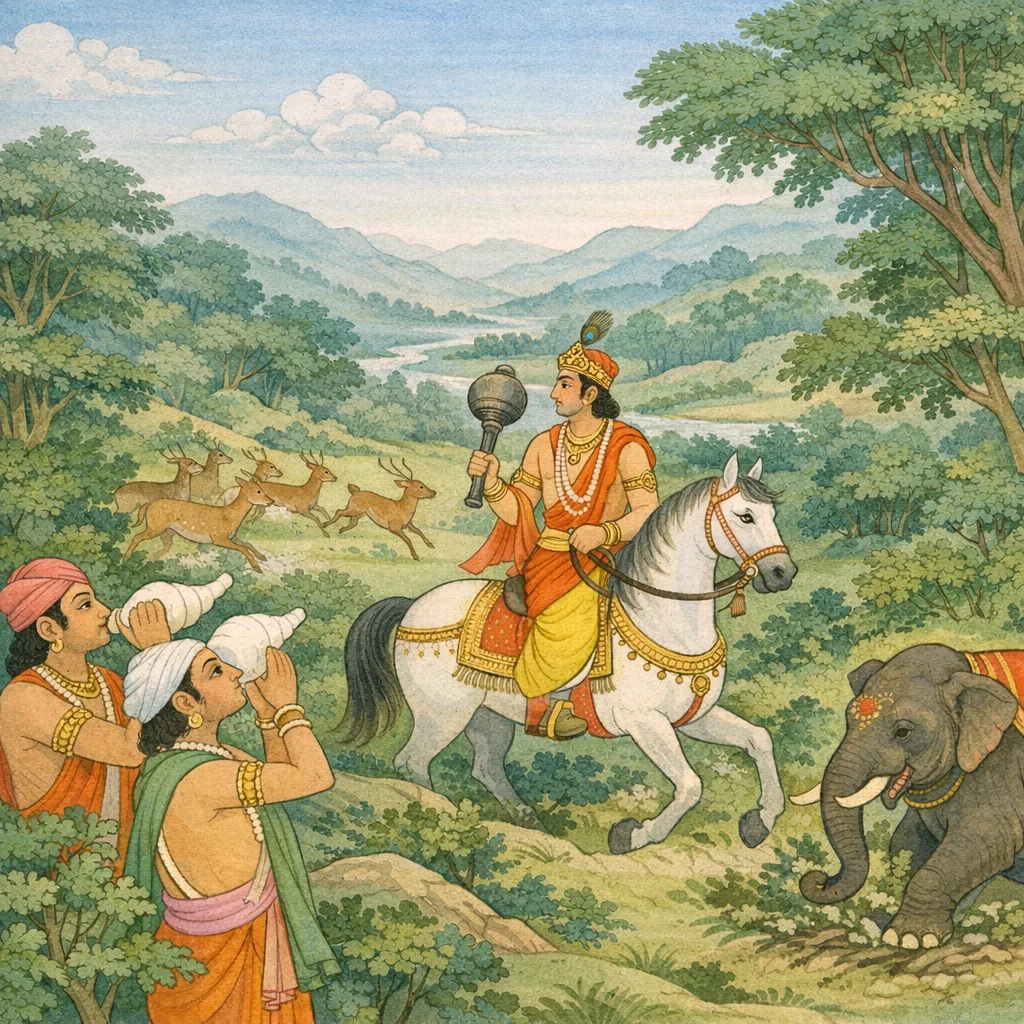
Chapter Arc: Janamejaya, eager to know how the lion among men obtained Shakuntala, asks Vaishampayana for the full account—thus the tale turns from genealogy to a living scene of pursuit and fate. → Vaishampayana describes King Dushyanta setting out with a vast retinue—warriors in varied arms and attire, conches and kettledrums resounding—entering the forest for the royal hunt. The chase scatters herds, dries throats with dust and thirst, and turns the woodland into a tumult where beasts and men collide. → In the thick of the hunt, Dushyanta’s prowess blazes: he cuts down charging threats with sword and spear, whirls the mace with practiced mastery, and the forest itself seems overrun by elephants and storm-like volleys—until the king stands as the axis of the chaos, feared by beasts and admired by onlookers who liken him to Indra. → The chapter settles with the image of Dushyanta’s irresistible might and royal momentum established—his hunt has become the narrative engine that will carry him toward the encounter destined to change his lineage. → The king’s onward movement into the forest points toward the imminent meeting with Shakuntala, left just beyond the chapter’s threshold.
Shlokas
Verse 1
अपन बक। है २ >> $. दूरवर्ती शत्रुपर गदा फेंकना 'प्रक्षे' कहलाता है। २. समीपवर्ती शत्रुपर गदाकी कोटिसे प्रहार करना “विक्षेप” कहा गया है। ३. जब शत्रु बहुत हों तो सब ओर गदाको घुमाते हुए शत्रुओंपर उसका प्रहार करना “परिक्षेप” है। ४. गदाके अग्रभागसे मारना “अभिक्षेप” कहलाता है। एकोनसप्ततितमो<ध्याय: दुष्पन्तका शिकारके लिये वनमें जाना और विविध हिंसक वन-जन्तुओंका वध करना जनमेजय उवाच सम्भवं भरतस्याहं चरितं च महामते: । शकुन्तलाय श्रोत्पत्तिं श्रोतुमिच्छामि तत्त्वतः,जनमेजय बोले--ब्रह्मन! मैं परम बुद्धिमान् भरतकी उत्पत्ति और चरित्रको तथा शकुन्तलाकी उत्पत्तिके प्रसंगको भी यथार्थरूपसे सुनना चाहता हूँ
Janamejaya said: “O great-minded sage, I wish to hear in truth the birth of Bharata and the account of his life, and also the circumstances of Śakuntalā’s origin.”
Verse 2
दुष्यन्तेन च वीरेण यथा प्राप्ता शकुन्तला | त॑ वै पुरुषसिंहस्य भगवन् विस्तरं त्वहम्
Janamejaya said: “Revered sir, please tell me in full detail how Śakuntalā came to be obtained (won as wife) by the heroic Duṣyanta—that lion among men; for I wish to hear the complete account.”
Verse 3
वैशम्पायन उवाच स कदाचिन्महाबाहु: प्रभूतनलवाहन:,वैशम्पायनजीने कहा--एक समयकी बात है, महाबाहु राजा दुष्यन्त बहुत-से सैनिक और सवारियोंको साथ लिये सैकड़ों हाथी-घोड़ोंसे घिरकर परम सुन्दर चतुरंगिणी सेनाके साथ एक गहन वनकी ओर चले
Vaiśampāyana said: Once, the mighty-armed King Duṣyanta, accompanied by abundant troops and conveyances, surrounded by hundreds of elephants and horses, set out with a splendid fourfold army toward a dense forest. The scene frames a ruler’s worldly power and order—yet it also foreshadows how royal duty (kṣātra-dharma) can lead one into encounters that test judgment, restraint, and responsibility.
Verse 4
वनं जगाम गहनं हयनागशतैर्वृत: । बलेन चतुरज्जेण वृत: परमवल्गुना,वैशम्पायनजीने कहा--एक समयकी बात है, महाबाहु राजा दुष्यन्त बहुत-से सैनिक और सवारियोंको साथ लिये सैकड़ों हाथी-घोड़ोंसे घिरकर परम सुन्दर चतुरंगिणी सेनाके साथ एक गहन वनकी ओर चले
Vaiśampāyana said: Once, the mighty-armed King Duṣyanta set out toward a dense forest, surrounded by hundreds of horses and elephants, and accompanied by a splendid fourfold army—an expedition that frames royal power as disciplined movement rather than mere display.
Verse 5
खड्गशक्तिधरैवीरिर्गदामुसलपाणिभि: । प्रासतोमरहस्तैश्व ययौ योधशतैर्वृत:,जब राजाने यात्रा की, उस समय खड्ग, शक्ति, गदा, मुसल, प्रास और तोमर हाथमें लिये सैकड़ों योद्धा उन्हें घेरे हुए थे
Vaiśampāyana said: When the king set out on his journey, he proceeded surrounded by hundreds of warriors—heroes bearing swords and spears, with maces and pestles in hand, and others holding lances and javelins. The scene underscores royal duty and the ethic of protection: a ruler’s movement is safeguarded not for display alone, but to uphold order and security in a world where power must be restrained by responsibility.
Verse 6
सिंहनादैश्व योधानां शड्खदुन्दुभिनि:स्वनै: । रथनेमिस्वनैश्वैव सनागवरबूंहितैः,महाराज दुष्यन्तके यात्रा करते समय योद्धाओंके सिंहनाद, शंख और नगाड़ोंकी आवाज, रथके पहियोंकी घरघराहट, बड़े-बड़े गजराजोंकी चिग्घाड़, घोड़ोंकी हिनहिनाहट, नाना प्रकारके आयुध तथा भाँति-भाँतिके वेष धारण करनेवाले योद्धाओंद्वारा की हुई गर्जना और ताल ठोंकनेकी आवाजोंसे चारों ओर भारी कोलाहल मच गया था। महलके श्रेष्ठ शिखरपर बैठी हुई स्त्रियाँ उत्तम राजोचित शोभासे सम्पन्न शूरवीर दुष्यन्तको देख रही थीं। वे अपने यशको बढ़ानेवाले, इन्द्रके समान पराक्रमी और शत्रुओंका नाश करनेवाले थे। शत्रुरूपी मतवाले हाथीको रोकनेके लिये उनमें सिंहके समान शक्ति थी
Vaiśampāyana said: As King Duṣyanta set out, a great tumult rose on every side—warriors’ lion-roars, the blare of conches and kettledrums, the rumbling of chariot-wheels, and the trumpeting of mighty elephants. The scene proclaims royal power and disciplined martial order: the king’s departure is not mere display, but a public assurance of protection, the subduing of hostile forces, and the upholding of the realm’s dharma.
Verse 7
नानायुधधरैश्वापि नानावेषधरैस्तथा । ह्षितस्वनमिश्रैश्न क्षेगेडितास्फोटितस्वनै:,महाराज दुष्यन्तके यात्रा करते समय योद्धाओंके सिंहनाद, शंख और नगाड़ोंकी आवाज, रथके पहियोंकी घरघराहट, बड़े-बड़े गजराजोंकी चिग्घाड़, घोड़ोंकी हिनहिनाहट, नाना प्रकारके आयुध तथा भाँति-भाँतिके वेष धारण करनेवाले योद्धाओंद्वारा की हुई गर्जना और ताल ठोंकनेकी आवाजोंसे चारों ओर भारी कोलाहल मच गया था। महलके श्रेष्ठ शिखरपर बैठी हुई स्त्रियाँ उत्तम राजोचित शोभासे सम्पन्न शूरवीर दुष्यन्तको देख रही थीं। वे अपने यशको बढ़ानेवाले, इन्द्रके समान पराक्रमी और शत्रुओंका नाश करनेवाले थे। शत्रुरूपी मतवाले हाथीको रोकनेके लिये उनमें सिंहके समान शक्ति थी
Vaiśampāyana said: Even through warriors bearing many kinds of weapons and wearing many kinds of disguises and costumes, and through the mingled sounds of excited shouts—together with the noises of playful cries and the clapping and snapping of arms—there arose, on every side, a great tumult. The scene conveys the charged energy of a royal expedition: martial display, disciplined force, and the public spectacle by which a king’s fame and authority are made visible.
Verse 8
आसीत् किलकिलाशब्दस्तस्मिन् गच्छति पार्थिवे । प्रासादवरशृज्गभस्था: परया नृपशो भया,महाराज दुष्यन्तके यात्रा करते समय योद्धाओंके सिंहनाद, शंख और नगाड़ोंकी आवाज, रथके पहियोंकी घरघराहट, बड़े-बड़े गजराजोंकी चिग्घाड़, घोड़ोंकी हिनहिनाहट, नाना प्रकारके आयुध तथा भाँति-भाँतिके वेष धारण करनेवाले योद्धाओंद्वारा की हुई गर्जना और ताल ठोंकनेकी आवाजोंसे चारों ओर भारी कोलाहल मच गया था। महलके श्रेष्ठ शिखरपर बैठी हुई स्त्रियाँ उत्तम राजोचित शोभासे सम्पन्न शूरवीर दुष्यन्तको देख रही थीं। वे अपने यशको बढ़ानेवाले, इन्द्रके समान पराक्रमी और शत्रुओंका नाश करनेवाले थे। शत्रुरूपी मतवाले हाथीको रोकनेके लिये उनमें सिंहके समान शक्ति थी
Vaiśampāyana said: As that king was proceeding, a great tumult arose—an uproar of clamor and martial noise. From the finest palace-towers, women, seized with intense excitement and awe, looked on as the royal procession moved, the city resounding with the commotion that accompanies a mighty ruler on the march.
Verse 9
ददृशुस्तं स्त्रियस्तत्र शूरमात्मयशस्करम् | शक्रोपमममित्रघ्नं परवारणवारणम्,महाराज दुष्यन्तके यात्रा करते समय योद्धाओंके सिंहनाद, शंख और नगाड़ोंकी आवाज, रथके पहियोंकी घरघराहट, बड़े-बड़े गजराजोंकी चिग्घाड़, घोड़ोंकी हिनहिनाहट, नाना प्रकारके आयुध तथा भाँति-भाँतिके वेष धारण करनेवाले योद्धाओंद्वारा की हुई गर्जना और ताल ठोंकनेकी आवाजोंसे चारों ओर भारी कोलाहल मच गया था। महलके श्रेष्ठ शिखरपर बैठी हुई स्त्रियाँ उत्तम राजोचित शोभासे सम्पन्न शूरवीर दुष्यन्तको देख रही थीं। वे अपने यशको बढ़ानेवाले, इन्द्रके समान पराक्रमी और शत्रुओंका नाश करनेवाले थे। शत्रुरूपी मतवाले हाथीको रोकनेके लिये उनमें सिंहके समान शक्ति थी
Vaiśampāyana said: There the women beheld that hero—one who enhanced his own renown—Indra-like in prowess, a slayer of foes, and a check upon the enemy’s maddened elephants. The scene underscores royal charisma and martial virtue: the king’s visible strength and discipline are presented as a protective force that restrains hostile violence and upholds the order expected of righteous kingship.
Verse 10
पश्यन्तः स्त्रीगणास्तत्र वज्रपाणिं सम मेनिरे । अयं स पुरुषव्यात्रो रणे वसुपराक्रम:
Vaiśampāyana said: There, as they watched, the gathered women took him to be like Vajrapāṇi (Indra, wielder of the thunderbolt). “This is that tiger among men,” they thought—one whose prowess in battle is as formidable as that of the Vasus—thus expressing awe at heroic strength and the martial ideal celebrated in the epic’s narrative world.
Verse 11
इति वाचो ब्रुवन्त्यस्ता: स्त्रिय: प्रेमणा नराधिपम्,ऐसी बातें करती हुई वे स्त्रियाँ बड़े प्रेमसे महाराज दुष्यन्तकी स्तुति करतीं और उनके मस्तकपर फूलोंकी वर्षा करती थीं। यत्र-तत्र खड़े हुए श्रेष्ठ ब्राह्मण सब ओर उनकी स्तुति- प्रशंसा करते थे
Vaiśampāyana said: Speaking in this manner, those women, filled with affection, praised the king; and from every side the foremost brāhmaṇas, standing here and there, likewise offered him eulogy and acclaim. The scene presents a public honoring of royal conduct through loving speech and ritual celebration, underscoring how social approval and priestly praise function as markers of a ruler’s perceived righteousness and worthiness.
Verse 12
तुष्ठवुः पुष्पवृष्टी क्ष ससृजुस्तस्य मूर्थनि । तत्र तत्र च विप्रेन्द्रै: स््तूयमान: समन््ततः,ऐसी बातें करती हुई वे स्त्रियाँ बड़े प्रेमसे महाराज दुष्यन्तकी स्तुति करतीं और उनके मस्तकपर फूलोंकी वर्षा करती थीं। यत्र-तत्र खड़े हुए श्रेष्ठ ब्राह्मण सब ओर उनकी स्तुति- प्रशंसा करते थे
They praised him and showered flowers upon his head. And in various places, eminent Brahmins all around continued to extol him—an atmosphere of public acclaim that frames the king’s conduct as worthy of honor and social approval.
Verse 13
निर्ययौ परमप्रीत्या वनं मृगजिघांसया । त॑ं देवराजप्रतिमं मत्तवारणधूर्गतम्,इस प्रकार महाराज वनमें हिंसक पशुओंका शिकार खेलनेके लिये बड़ी प्रसन्नताके साथ नगरसे बाहर निकले। वे देवराज इन्द्रके समान पराक्रमी थे। मतवाले हाथीकी पीठपर बैठकर यात्रा करनेवाले उन महाराज दुष्यन्तके पीछे-पीछे ब्राह्मण, क्षत्रिय, वैश्य और शूद्र सभी वर्णोके लोग गये और सब आशीर्वाद एवं विजयसूचक वचनोंद्वारा उनके अभ्युदयकी कामना करते हुए उनकी ओर देखते रहे
Vaiśampāyana said: With great delight he set out for the forest, intent on hunting wild game. Resembling Indra, king of the gods, in majesty and prowess, he rode forth mounted on a rutting elephant. As King Duṣyanta proceeded, people of all the four social orders followed behind, gazing upon him and voicing blessings and words of victory, wishing for his prosperity and success.
Verse 14
द्विजक्षत्रियविट्शूद्रा निर्यान्तमनुजग्मिरे । ददृशुर्वर्धभानास्ते आशीर्भिश्च॒ जयेन च,इस प्रकार महाराज वनमें हिंसक पशुओंका शिकार खेलनेके लिये बड़ी प्रसन्नताके साथ नगरसे बाहर निकले। वे देवराज इन्द्रके समान पराक्रमी थे। मतवाले हाथीकी पीठपर बैठकर यात्रा करनेवाले उन महाराज दुष्यन्तके पीछे-पीछे ब्राह्मण, क्षत्रिय, वैश्य और शूद्र सभी वर्णोके लोग गये और सब आशीर्वाद एवं विजयसूचक वचनोंद्वारा उनके अभ्युदयकी कामना करते हुए उनकी ओर देखते रहे
Vaishampayana said: As the king set out from the city, people of all four social orders—Brahmins, Kshatriyas, Vaishyas, and Shudras—followed behind him. They kept looking upon him with auspicious blessings and cries of victory, expressing their hope for his success and well-being as he departed on his royal expedition.
Verse 15
सुदूरमनुजग्मुस्तं पौरजानपदास्तथा । न्यवर्तन्त ततः पश्चादनुज्ञाता नृपेण ह,नगर और जनपदके लोग बहुत दूरतक उनके पीछे-पीछे गये। फिर महाराजकी आज्ञा होनेपर लौट आये
The townspeople and the folk of the countryside followed him for a very long distance. Thereafter, having received the king’s permission, they turned back—showing both their deep attachment and their disciplined respect for royal command.
Verse 16
सुपर्णप्रतिमेनाथ रथेन वसुधाधिप: । महीमापूरयामास घोषेण त्रिदिवं तथा,उनका रथ गरुडके समान वेगशाली था। उसके द्वारा यात्रा करनेवाले नरेशने घरघराहटकी आवाजसे पृथ्वी और आकाशको गुँँजा दिया। जाते-जाते बुद्धिमान् दुष्यन्तने एक नन्दनवनके समान मनोहर वन देखा, जो बेल, आक, खैर, कैथ और धव (बाकली) आदि वृक्षोंसे भरपूर था
Vaiśampāyana said: Then the lord of the earth rode in a chariot swift as Garuḍa. As he sped along, the rumbling of its motion made the earth resound and seemed to echo even up to the heavens—signaling the king’s power and purposeful advance as he moved through the world in search of what fate would place before him.
Verse 17
स गच्छन् ददृशे धीमान् नन्दनप्रतिमं वनम् । बिल्वार्कखदिराकीर्ण कपित्थधवसंकुलम्,उनका रथ गरुडके समान वेगशाली था। उसके द्वारा यात्रा करनेवाले नरेशने घरघराहटकी आवाजसे पृथ्वी और आकाशको गुँँजा दिया। जाते-जाते बुद्धिमान् दुष्यन्तने एक नन्दनवनके समान मनोहर वन देखा, जो बेल, आक, खैर, कैथ और धव (बाकली) आदि वृक्षोंसे भरपूर था
Vaiśampāyana said: As he proceeded on his way, the wise king beheld a forest as delightful as Nandana itself—thickly filled with bilva, arka, and khadira trees, and crowded with kapittha and dhava. The scene underscores the king’s onward journey into a space of natural abundance and auspicious beauty, a setting that often precedes significant encounters and tests of conduct in the epic’s narrative flow.
Verse 18
विषमं पर्वतस्रस्तैरश्मभिश्व समावृतम् । निर्जलं निर्मनुष्यं च बहुयोजनमायतम्,पर्वतकी चोटीसे गिरे हुए बहुत-से शिला-खण्ड वहाँ इधर-उधर पड़े थे। ऊँची-नीची भूमिके कारण वह वन बड़ा दुर्गग जान पड़ता था। अनेक योजनतक फैले हुए उस वनमें कहीं जल या मनुष्यका पता नहीं चलता था
Vaiśampāyana said: The region was rugged, strewn and covered with rocks that had fallen from the mountains. With its uneven ground it appeared exceedingly difficult to traverse. Spreading for many yojanas, that wilderness showed no sign of water and no trace of human presence—an austere, forbidding landscape that tests endurance and resolve.
Verse 19
मृगसिंहैर्व॒तं घोरैरन्यैश्वापि वनेचरै: । तद् वन॑ मनुजव्याघ्र: सभृत्ययलवाहन:,वह सब ओर मृग और सिंह आदि भयंकर जन्तुओं तथा अन्य वनवासी जीवोंसे भरा हुआ था। नरश्रेष्ठ राजा दुष्यन्तने सेवक, सैनिक और सवारियोंके साथ नाना प्रकारके हिंसक पशुओंका शिकार करते हुए उस वनको रौंद डाला। वहाँ बाणोंके लक्ष्यमें आये हुए बहुत-से व्याप्रोंको महाराज दुष्यन्तने मार गिराया और कितनोंको सायकोंसे बींध डाला। शक्तिशाली पुरुषोंमें श्रेष्ठ नरेशने कितने ही दूरवर्ती हिंसक पशुओंको बाणोंद्वारा घायल किया। जो निकट आ गये, उन्हें तलवारसे काट डाला और कितने ही एण जातिके पशुओंको शक्ति नामक शस्त्रद्वारा मौतके घाट उतार दिया
Vaiśampāyana said: That forest was thronged with dreadful beasts—deer and lions—and with other creatures that roamed the wild. Then King Duṣyanta, tiger among men, entered it with his attendants, troops, and mounts, and pressed through the woodland while hunting fierce animals. The scene underscores the royal kṣatriya ethos of the hunt—both as a display of prowess and as a means of subduing danger—yet it also hints at the moral tension between protection and violence within the natural world.
Verse 20
लोडयामास दुष्यन्त: सूदयन् विविधान् मृगान् । बाणगोचरसपम्प्राप्तांस्तत्र व्याप्रगणान् बहूनू,वह सब ओर मृग और सिंह आदि भयंकर जन्तुओं तथा अन्य वनवासी जीवोंसे भरा हुआ था। नरश्रेष्ठ राजा दुष्यन्तने सेवक, सैनिक और सवारियोंके साथ नाना प्रकारके हिंसक पशुओंका शिकार करते हुए उस वनको रौंद डाला। वहाँ बाणोंके लक्ष्यमें आये हुए बहुत-से व्याप्रोंको महाराज दुष्यन्तने मार गिराया और कितनोंको सायकोंसे बींध डाला। शक्तिशाली पुरुषोंमें श्रेष्ठ नरेशने कितने ही दूरवर्ती हिंसक पशुओंको बाणोंद्वारा घायल किया। जो निकट आ गये, उन्हें तलवारसे काट डाला और कितने ही एण जातिके पशुओंको शक्ति नामक शस्त्रद्वारा मौतके घाट उतार दिया
Vaiśampāyana said: King Duṣyanta ranged through the forest, hunting and killing many kinds of wild animals. There he brought down numerous tigers that came within the range of his arrows. The scene underscores the royal pastime of the hunt—an assertion of power and protection in the wilderness—while also raising an ethical tension: the king’s prowess is celebrated, yet the taking of life for sport stands in contrast to later Mahābhārata reflections on restraint and compassion.
Verse 21
पातयामास दुष्यन्तो निर्बिभेद च सायकै: । दूरस्थान् सायकै: कांश्चिदभिनत् स नराधिप:,वह सब ओर मृग और सिंह आदि भयंकर जन्तुओं तथा अन्य वनवासी जीवोंसे भरा हुआ था। नरश्रेष्ठ राजा दुष्यन्तने सेवक, सैनिक और सवारियोंके साथ नाना प्रकारके हिंसक पशुओंका शिकार करते हुए उस वनको रौंद डाला। वहाँ बाणोंके लक्ष्यमें आये हुए बहुत-से व्याप्रोंको महाराज दुष्यन्तने मार गिराया और कितनोंको सायकोंसे बींध डाला। शक्तिशाली पुरुषोंमें श्रेष्ठ नरेशने कितने ही दूरवर्ती हिंसक पशुओंको बाणोंद्वारा घायल किया। जो निकट आ गये, उन्हें तलवारसे काट डाला और कितने ही एण जातिके पशुओंको शक्ति नामक शस्त्रद्वारा मौतके घाट उतार दिया
Vaiśampāyana said: King Duṣyanta struck down many creatures and pierced them with arrows. Even those at a distance he wounded with his shafts. The passage portrays the king’s vigorous hunt in a forest teeming with fierce animals—an assertion of royal prowess and control over the wild—while also inviting ethical reflection on violence undertaken for sport versus protection and governance.
Verse 22
अभ्याशमागतांश्वान्यान् खड्गेन निरकृन्तत । कांश्चिदेणान् समाजघ्ने शक््त्या शक्तिमतां वर:,वह सब ओर मृग और सिंह आदि भयंकर जन्तुओं तथा अन्य वनवासी जीवोंसे भरा हुआ था। नरश्रेष्ठ राजा दुष्यन्तने सेवक, सैनिक और सवारियोंके साथ नाना प्रकारके हिंसक पशुओंका शिकार करते हुए उस वनको रौंद डाला। वहाँ बाणोंके लक्ष्यमें आये हुए बहुत-से व्याप्रोंको महाराज दुष्यन्तने मार गिराया और कितनोंको सायकोंसे बींध डाला। शक्तिशाली पुरुषोंमें श्रेष्ठ नरेशने कितने ही दूरवर्ती हिंसक पशुओंको बाणोंद्वारा घायल किया। जो निकट आ गये, उन्हें तलवारसे काट डाला और कितने ही एण जातिके पशुओंको शक्ति नामक शस्त्रद्वारा मौतके घाट उतार दिया
Vaiśampāyana said: The king—foremost among the mighty—cut down with his sword the dogs and other beasts that came close. Some antelopes he struck down with the spear (śakti). The passage portrays Duṣyanta’s royal hunt: a display of prowess and control over a dangerous wilderness, yet also a scene that raises an ethical tension between kṣatriya valor and the taking of animal life for sport rather than necessity.
Verse 23
श्रोतुमिच्छामि तत्त्वज्ञ सर्व मतिमतां वर । भगवन! वीरवर दुष्यन्तने शकुन्तलाको कैसे प्राप्त किया? मैं पुरुषसिंह दुष्यन्तके उस चरित्रको विस्तारपूर्वक सुनना चाहता हूँ। तत्त्वज्ञ मुने! आप बुद्धिमानोंमें श्रेष्ठ हैं। अतः ये सब बातें बताइये,गदामण्डलतत्त्वज्ञक्ष॒चारामितविक्रम: । तोमरैरसिभिश्वापि गदामुसलकम्पनै: असीम पराक्रमवाले राजा गदा घुमानेकी कलामें अत्यन्त प्रवीण थे। अतः वे तोमर, तलवार, गदा तथा मुसलोंकी मारसे स्वेच्छापूर्वक विचरनेवाले जंगली हाथियोंका वध करते हुए वहाँ सब ओर विचरने लगे। अदभुत पराक्रमी नरेश और उनके युद्ध-प्रेमी सैनिकोंने उस विशाल वनका कोना-कोना छान डाला। अतः सिंह और बाघ उस वनको छोड़कर भाग गये। पशुओंके कितने ही झुंड, जिनके यूथपति मारे गये थे, व्यग्र होकर भागे जा रहे थे और कितने ही यूथ इधर-उधर आर्तनाद करते थे। वे प्याससे पीड़ित हो सूखी नदियोंमें जाकर जब जल नहीं पाते, तब निराशासे अत्यन्त खिन्न हो दौड़नेके परिश्रमसे क्लान्तचित्त होनेके कारण मूर्च्छित होकर गिर पड़ते थे। भूख, प्यास और थकावटसे चूर-चूर हो बहुत-से पशु धरतीपर गिर पड़े
Janamejaya said: “O knower of truth, best among the wise! I wish to hear everything. Revered sir—how did the heroic Duṣyanta obtain Śakuntalā? I desire to hear, in full detail, the life and conduct of Duṣyanta, the lion among men. O sage who knows reality, you are foremost among the intelligent; therefore tell me all these matters.” (Continuing the narrative:) The king, of boundless prowess, was skilled in the art of whirling the mace; with spears, swords, and blows from mace and club he ranged about, striking down wild elephants that roamed at will. The wondrously valorous monarch and his battle-loving troops searched every corner of that vast forest. Lions and tigers fled the woodland; herds of animals, their leaders slain, ran in agitation, while other groups cried out in distress. Tormented by thirst, they went to dried riverbeds and, finding no water, fell into despair; exhausted by frantic running, they fainted and collapsed. Many beasts, crushed by hunger, thirst, and fatigue, lay strewn upon the ground.
Verse 24
चचार स विनिष्नन् वै स्वैरचारान् वनद्विपान् । राज्ञा चाद्भुतवीर्येण योधेश्व समरप्रियै:,असीम पराक्रमवाले राजा गदा घुमानेकी कलामें अत्यन्त प्रवीण थे। अतः वे तोमर, तलवार, गदा तथा मुसलोंकी मारसे स्वेच्छापूर्वक विचरनेवाले जंगली हाथियोंका वध करते हुए वहाँ सब ओर विचरने लगे। अदभुत पराक्रमी नरेश और उनके युद्ध-प्रेमी सैनिकोंने उस विशाल वनका कोना-कोना छान डाला। अतः सिंह और बाघ उस वनको छोड़कर भाग गये। पशुओंके कितने ही झुंड, जिनके यूथपति मारे गये थे, व्यग्र होकर भागे जा रहे थे और कितने ही यूथ इधर-उधर आर्तनाद करते थे। वे प्याससे पीड़ित हो सूखी नदियोंमें जाकर जब जल नहीं पाते, तब निराशासे अत्यन्त खिन्न हो दौड़नेके परिश्रमसे क्लान्तचित्त होनेके कारण मूर्च्छित होकर गिर पड़ते थे। भूख, प्यास और थकावटसे चूर-चूर हो बहुत-से पशु धरतीपर गिर पड़े
Vaiśampāyana said: He ranged about there, striking down wild forest-elephants that roamed at will. That king, of astonishing prowess, together with his battle-loving warriors, scoured the great woodland in every direction—an image of royal might that, in its excess, turns the forest into a field of fear for its creatures.
Verse 25
लोड्यमानं महारण्यं तत्यजु: सम मृगाधिपा: । तत्र विद्रुतयूथानि हतयूथपतीनि च,असीम पराक्रमवाले राजा गदा घुमानेकी कलामें अत्यन्त प्रवीण थे। अतः वे तोमर, तलवार, गदा तथा मुसलोंकी मारसे स्वेच्छापूर्वक विचरनेवाले जंगली हाथियोंका वध करते हुए वहाँ सब ओर विचरने लगे। अदभुत पराक्रमी नरेश और उनके युद्ध-प्रेमी सैनिकोंने उस विशाल वनका कोना-कोना छान डाला। अतः सिंह और बाघ उस वनको छोड़कर भाग गये। पशुओंके कितने ही झुंड, जिनके यूथपति मारे गये थे, व्यग्र होकर भागे जा रहे थे और कितने ही यूथ इधर-उधर आर्तनाद करते थे। वे प्याससे पीड़ित हो सूखी नदियोंमें जाकर जब जल नहीं पाते, तब निराशासे अत्यन्त खिन्न हो दौड़नेके परिश्रमसे क्लान्तचित्त होनेके कारण मूर्च्छित होकर गिर पड़ते थे। भूख, प्यास और थकावटसे चूर-चूर हो बहुत-से पशु धरतीपर गिर पड़े
Vaiśampāyana said: As that vast forest was being violently scoured and harried, the lords of beasts—lions and tigers—abandoned it and fled. There, many herds ran in panic, their leaders slain; other groups, scattered and distressed, cried out as they fled. The passage underscores how unchecked martial force, when turned upon the natural world, produces fear, disorder, and suffering among the innocent—an implicit ethical warning about the collateral harm of power used without restraint.
Verse 26
मृगयूथान्यथौत्सुक्याच्छब्दं चक्रुस्ततस्तत: । शुष्काश्चापि नदीर्गत्वा जलनैराश्यकर्शिता:,असीम पराक्रमवाले राजा गदा घुमानेकी कलामें अत्यन्त प्रवीण थे। अतः वे तोमर, तलवार, गदा तथा मुसलोंकी मारसे स्वेच्छापूर्वक विचरनेवाले जंगली हाथियोंका वध करते हुए वहाँ सब ओर विचरने लगे। अदभुत पराक्रमी नरेश और उनके युद्ध-प्रेमी सैनिकोंने उस विशाल वनका कोना-कोना छान डाला। अतः सिंह और बाघ उस वनको छोड़कर भाग गये। पशुओंके कितने ही झुंड, जिनके यूथपति मारे गये थे, व्यग्र होकर भागे जा रहे थे और कितने ही यूथ इधर-उधर आर्तनाद करते थे। वे प्याससे पीड़ित हो सूखी नदियोंमें जाकर जब जल नहीं पाते, तब निराशासे अत्यन्त खिन्न हो दौड़नेके परिश्रमसे क्लान्तचित्त होनेके कारण मूर्च्छित होकर गिर पड़ते थे। भूख, प्यास और थकावटसे चूर-चूर हो बहुत-से पशु धरतीपर गिर पड़े
Vaiśaṃpāyana said: Then the herds of deer, thrown into agitation, raised cries again and again in different places. And some, tormented by despair for water, went even to dried-up riverbeds; finding no water there, they were worn down by hopelessness and exhaustion.
Verse 27
व्यायामक्लान्तह्ृदया: पतन्ति सम विचेतस: । क्षुत्पिपासापरीताश्र श्रान्ताश्न॒ पतिता भुवि,असीम पराक्रमवाले राजा गदा घुमानेकी कलामें अत्यन्त प्रवीण थे। अतः वे तोमर, तलवार, गदा तथा मुसलोंकी मारसे स्वेच्छापूर्वक विचरनेवाले जंगली हाथियोंका वध करते हुए वहाँ सब ओर विचरने लगे। अदभुत पराक्रमी नरेश और उनके युद्ध-प्रेमी सैनिकोंने उस विशाल वनका कोना-कोना छान डाला। अतः सिंह और बाघ उस वनको छोड़कर भाग गये। पशुओंके कितने ही झुंड, जिनके यूथपति मारे गये थे, व्यग्र होकर भागे जा रहे थे और कितने ही यूथ इधर-उधर आर्तनाद करते थे। वे प्याससे पीड़ित हो सूखी नदियोंमें जाकर जब जल नहीं पाते, तब निराशासे अत्यन्त खिन्न हो दौड़नेके परिश्रमसे क्लान्तचित्त होनेके कारण मूर्च्छित होकर गिर पड़ते थे। भूख, प्यास और थकावटसे चूर-चूर हो बहुत-से पशु धरतीपर गिर पड़े
Vaiśaṃpāyana said: Worn out at heart by relentless exertion, their senses dulled and unsteady, the creatures collapse. Beset by hunger and thirst, and exhausted, they fall upon the earth—an image of how unchecked violence and disturbance of the wild drives living beings into helpless suffering.
Verse 28
केचित् तत्र नरव्याप्रैरभक्ष्यन्त बुभुक्षितै: । केचिदग्निमथोत्पाद्य संसाध्य च वनेचरा:,वहाँ कितने ही व्याप्र-स्वभावके नृशंस जंगली मनुष्य भूखे होनेके कारण कुछ मृगोंको कच्चे ही चबा गये। कितने ही वनमें विचरनेवाले व्याध वहाँ आग जलाकर मांस पकानेकी अपनी रीतिके अनुसार मांसको कूट-कूटकर राँधने और खाने लगे। उस वनमें कितने ही बलवान् और मतवाले हाथी अस्त्र-शस्त्रोंके आघातसे क्षत-विक्षत होकर सूँड़को समेटे हुए भयके मारे वेगपूर्वक भाग रहे थे। उस समय उनके घावोंसे बहुत-सा रक्त बह रहा था और वे मल-मूत्र करते जाते थे
Vaiśampāyana said: Some there, driven by hunger and possessed of a tiger-like, savage nature, began to eat what ought not be eaten. Others—forest-dwellers—first kindled fire and, having prepared it, cooked their food in the wilderness according to their customary way. The scene underscores how, when order collapses, hunger and fear can push people toward brutality and away from restraint.
Verse 29
भक्षयन्ति सम मांसानि प्रकुट्य विधिवत् तदा । तत्र केचिद् गजा मत्ता बलिन: शस्त्रविक्षता:,वहाँ कितने ही व्याप्र-स्वभावके नृशंस जंगली मनुष्य भूखे होनेके कारण कुछ मृगोंको कच्चे ही चबा गये। कितने ही वनमें विचरनेवाले व्याध वहाँ आग जलाकर मांस पकानेकी अपनी रीतिके अनुसार मांसको कूट-कूटकर राँधने और खाने लगे। उस वनमें कितने ही बलवान् और मतवाले हाथी अस्त्र-शस्त्रोंके आघातसे क्षत-विक्षत होकर सूँड़को समेटे हुए भयके मारे वेगपूर्वक भाग रहे थे। उस समय उनके घावोंसे बहुत-सा रक्त बह रहा था और वे मल-मूत्र करते जाते थे
Vaiśaṃpāyana said: Then, in that wilderness, some ate flesh—having prepared it in their customary manner and according to their rough rules. There, certain powerful, rut-maddened elephants, torn and mangled by blows of weapons, drew in their trunks and fled in terror. The scene conveys a collapse of ordinary restraint: hunger and violence drive beings into frantic survival, and the forest becomes a theatre of cruelty and fear.
Verse 30
संकोच्याग्रकरान् भीता: प्रद्रवन्ति सम वेगिता: । शकृन्मूत्रं सृजन्तश्च क्षरन्तः शोणितं बहु,वहाँ कितने ही व्याप्र-स्वभावके नृशंस जंगली मनुष्य भूखे होनेके कारण कुछ मृगोंको कच्चे ही चबा गये। कितने ही वनमें विचरनेवाले व्याध वहाँ आग जलाकर मांस पकानेकी अपनी रीतिके अनुसार मांसको कूट-कूटकर राँधने और खाने लगे। उस वनमें कितने ही बलवान् और मतवाले हाथी अस्त्र-शस्त्रोंके आघातसे क्षत-विक्षत होकर सूँड़को समेटे हुए भयके मारे वेगपूर्वक भाग रहे थे। उस समय उनके घावोंसे बहुत-सा रक्त बह रहा था और वे मल-मूत्र करते जाते थे
Vaiśampāyana said: Terrified, they drew in their foreparts (their trunks) and fled at equal speed. As they ran, they voided dung and urine, and from their wounds much blood streamed forth—an image of the forest’s violence and the pitiless consequences of armed assault upon living beings.
Verse 31
वन्या गजवरास्तत्र ममृदुर्मनुजान् बहून् । तद् वनं बलमेघेन शरधारेण संवृतम् | व्यरोचत मृगाकीर्ण राज्ञा हतमृगाधिपम्,बड़े-बड़े जंगली हाथियोंने भी वहाँ भागते समय बहुत-से मनुष्योंको कुचल डाला। वहाँ बाणरूपी जलकी धारा बरसानेवाले सैन्यरूपी बादलोंने उस वनरूपी व्योमको सब ओरसे घेर लिया था। महाराज दुष्यन्तने जहाँके सिंहोंको मार डाला था, वह हिंसक पशुओंसे भरा हुआ वन बड़ी शोभा पा रहा था
Vaiśampāyana said: There, mighty wild elephants trampled many men as they fled. That forest—like a sky—was hemmed in on every side by the cloud-like army, pouring down a rain of arrows. Teeming with beasts, it shone all the more, for the king had already slain its lordly predators (the lions).
Verse 69
इति श्रीमहाभारते आदिपर्वणि सम्भवपर्वणि शकुन्तलोपाख्याने एकोनसप्ततितमो< ध्याय:,इस प्रकार श्रीमह्याभारत आदिपर्वके अन्तर्गत सम्भवपर्वमें शकुन्तलोपाख्यानविषयक उनहत्तरवाँ अध्याय पूरा हुआ
Thus, in the Śrī Mahābhārata, within the Ādi Parva, in the Sambhava Parva, in the episode concerning Śakuntalā, the sixty-ninth chapter is concluded. This closing colophon marks the completion of the Śakuntalā narrative section and signals a transition back to the broader account of origins and lineage that frames the epic’s ethical and dynastic concerns.
Verse 103
यस्य बाहुबलं प्राप्प न भवन्त्यसुहृदूगणा: । वहाँ देखती हुई स्त्रियोंने उन्हें वज्रपाणि इन्द्रके समान समझा और आपसमें वे इस प्रकार बातें करने लगीं--“सखियो! देखो तो सही, ये ही वे पुरुषसिंह महाराज दुष्यन्त हैं, जो संग्रामभूमिमें वसुओंके समान पराक्रम दिखाते हैं, जिनके बाहुबलमें पड़कर शत्रुओंका अस्तित्व मिट जाता है”
Vaiśampāyana said: Seeing him there, the women took him to be like Indra of the thunderbolt in hand, and they spoke among themselves: “Friends, look—this is that lion among men, King Duṣyanta. On the battlefield he displays valor like the Vasus; and when enemies fall within the reach of his mighty arms, their very standing is wiped out.”
Frequently Asked Questions
The dilemma concerns whether a ruler may deny a privately established relationship and child due to public doubt; the text evaluates this as a conflict between reputation-management and the non-negotiable duty of satya and पुत्रधर्म.
Truth is treated as the highest dharma and a stabilizing public good: discernment in speech, self-scrutiny, and fidelity to one’s obligations are presented as superior to mere external prestige or ritual magnitude.
A formal phalaśruti is not stated; instead, the chapter offers meta-validation through narrative authority (celestial testimony) and genealogical consequence: Bharata’s recognition becomes the legitimizing hinge for the Bhārata lineage and the epic’s historical self-identification.