Adhyaya 25
Garuḍa, the Brāhmaṇa’s Release, and Kaśyapa’s Counsel (Gajakacchapa-ākhyāna Prelude)
Upa-parva: Garuḍa-Ākhyāna (Episode of Garuḍa’s Quest and Auxiliary Legends)
This chapter presents a tightly linked sequence of ethical constraint and strategic action. Garuḍa, encountering a brāhmaṇa within reach, explicitly refuses to harm him, articulating a norm that brāhmaṇas are not to be slain even when morally compromised. The brāhmaṇa requests that his Niṣādī companion be released alongside him; Garuḍa consents, emphasizing urgency and the overwhelming force of his own radiance. After their departure, Garuḍa seeks out his father Kaśyapa and reports his mission and predicament: he has been instructed to consume Niṣādas but remains unsated and requires additional sustenance to accomplish the retrieval of amṛta for his mother’s liberation. Kaśyapa responds with an instructive embedded history: two ascetics, Vibhāvasu and Supratīka, driven by disputes over division of wealth, exchange curses and fall into animal births as a great elephant and a massive tortoise, continuing mutual hostility. Kaśyapa directs Garuḍa to utilize these two combatants as food. Garuḍa seizes each with a talon, flies to a celestial grove, and, when the divine trees fear damage from his weight, he approaches a vast branch offered by a great tree—only to break it under the strain, closing the chapter on a note of controlled power and environmental consequence.
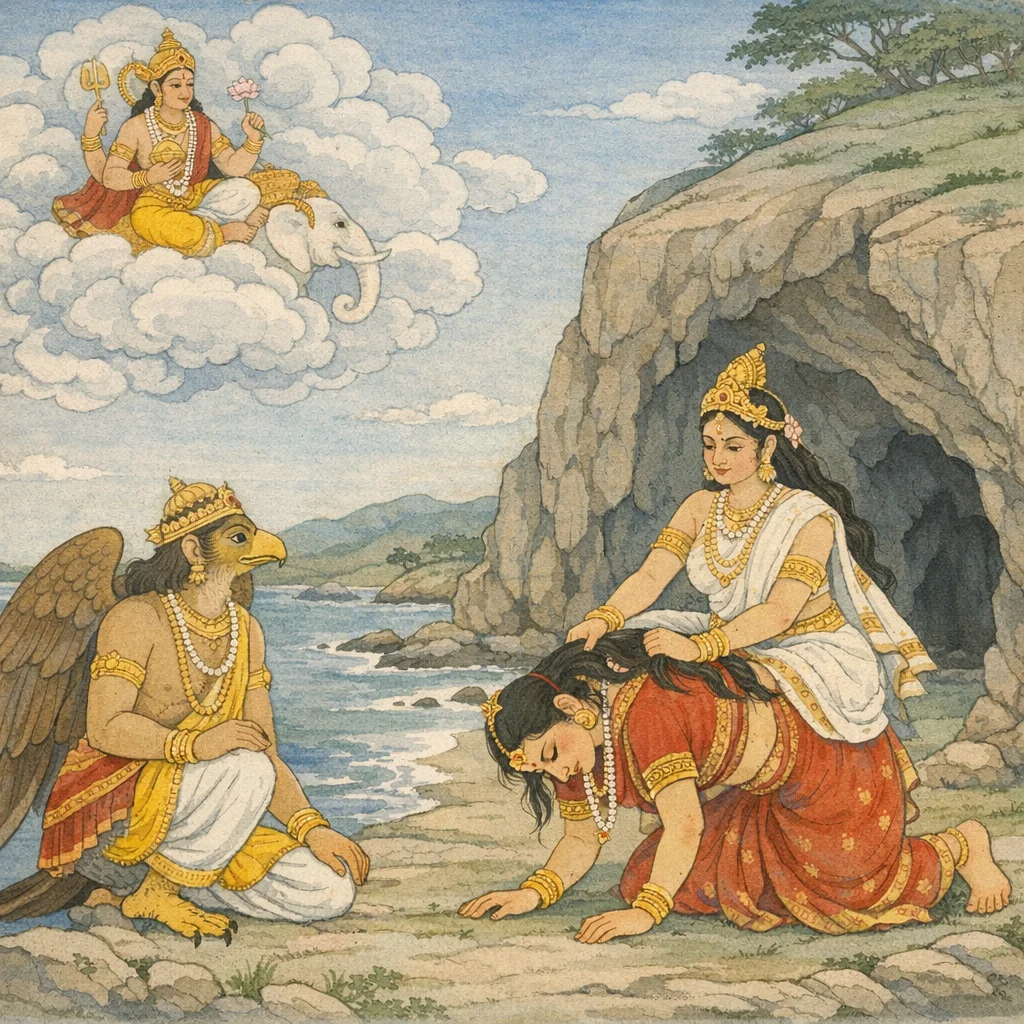
Chapter Arc: सौतिरुवाच—विनता, पण में पराजित होकर, अपने ही पुत्र गरुड के सामने दासी-भाव को प्राप्त होती है; उसी अपमान की छाया में कथा आगे बढ़ती है। → कद्रू अवसर पाकर विनता को बुलाती है और आदेश देती है कि वह उसे नागों के रमणीय निवास-स्थान तक ले चले—समुद्र के गर्भ में, एकान्त प्रदेश में। विनता विवश होकर कद्रू को ढोती है; गरुड भी मातृ-वचन से बँधकर साथ चलता है। → नागों की रक्षा और अपने पक्ष की विजय के लिए कद्रू इन्द्रदेव की स्तुति करती है—इन्द्र को वज्र, बलाहक, सृष्टा-संहर्ता, और काल के सूक्ष्म विभागों (मुहूर्त, तिथि, लव, क्षण, मास, ऋतु, संवत्सर) का अधिष्ठाता कहकर पुकारती है; देव-शक्ति को साक्षात् बुलाने वाली यह प्रार्थना अध्याय का शिखर बनती है। → स्तुति के साथ कद्रू का उद्देश्य स्पष्ट होता है—नागों की सुरक्षा सुनिश्चित करना और विनता-गरुड की विवशता को और कस देना; देव-आश्रय लेकर वह अपने अधिकार को वैध ठहराती है। → इन्द्र की कृपा/हस्तक्षेप से नागों की रक्षा कैसे होगी, और गरुड इस दास्य-बंधन को तोड़ने के लिए कौन-सा प्रतिकार करेगा—यह प्रश्न अगले प्रसंग पर छोड़ दिया जाता है।
Shlokas
Verse 1
है ० बछ। ] अ्णऑकाडह पञ्चविशो< ध्याय: सूर्यके तापसे मूर्च्छित हुए सर्पोकी रक्षाके लिये कद्रद्वारा इन्द्रदेवकी स्तुति सौतिरुवाच तत: कामगम: पक्षी महावीर्यों महाबल: । मातुरन्तिकमागच्छत् परं पारं महोदथधे:,उग्रश्रवाजी कहते हैं--शौनकादि महर्षियो! तदनन्तर इच्छानुसार गमन करनेवाले महान् पराक्रमी तथा महाबली गरुड समुद्रके दूसरे पार अपनी माताके समीप आये
Then Garuḍa—the bird who could travel at will, mighty in valor and immense in strength—came to his mother, reaching the far shore of the great ocean. The narrative continues to frame Garuḍa’s extraordinary power as being directed toward a filial and ethical purpose: approaching his mother in the course of securing her freedom and fulfilling his duty to her.
Verse 2
यत्र सा विनता तस्मिन् पणितेन पराजिता । अतीव दु:ःखसंतप्ता दासीभावमुपागता,जहाँ उनकी माता विनता बाजी हार जानेसे दासी-भावको प्राप्त हो अत्यन्त दुःखसे संतप्त रहती थीं
There, Vinatā—having been defeated in the wager—fell into servitude, and, scorched by intense sorrow, lived in the condition of a slave. The passage underscores how reckless gambling and pride can bind a person into humiliation and suffering, turning a moment of error into prolonged ethical and social bondage.
Verse 3
ततः कदाचिद् विनतां प्रणतां पुत्रसंनिधौ । काले चाहूय वचन कद्रूरिदमभाषत,एक दिन अपने पुत्रके समीप बैठी हुई विनय-शील विनताको किसी समय बुलाकर कद्गूने यह बात कही--
Then, on a certain occasion, Kadrū, at the proper time, summoned Vinatā—who was seated near her son and was respectfully bowed—and spoke these words to her. The scene frames a relationship marked by deference and power, setting the stage for a morally charged request and its consequences.
Verse 4
नागानामालयं भद्रे सुरम्यं चारुदर्शनम् समुद्रकुक्षावेकान्ते तत्र मां विनते नय,“कल्याणी विनते! समुद्रके भीतर निर्जन प्रदेशमें एक बहुत रमणीय तथा देखनेमें अत्यन्त मनोहर नागोंका निवासस्थान है। तू वहाँ मुझे ले चल”
Pitāmaha said: “O gentle one, there is a dwelling of the Nāgas—exceedingly beautiful and delightful to behold—hidden away in a solitary recess within the ocean’s womb. O Vinatā, auspicious lady, take me there.”
Verse 5
ततः सुपर्णमाता तामवहत् सर्पमातरम् | पन्नगान् गरुडश्चापि मातुर्वचनचोदित:,तब गरुडकी माता विनता सर्पोकी माता कद्गूको अपनी पीठपर ढोने लगी। इधर माताकी आज्ञासे गरुड भी सर्पोंको अपनी पीठपर चढ़ाकर ले चले
Then Suparṇā’s mother (Vinatā) carried the mother of the serpents (Kadrū) upon her back. And Garuḍa too, urged by his mother’s command, bore the nāgas along, carrying them as they went. The episode underscores filial obedience and the painful cost of bondage born from a prior wager, even as duty is performed under humiliation.
Verse 6
स सूर्यमभितो याति वैनतेयो विहंगम: । सूर्यरश्मिप्रतप्ताश्न मूर्च्छिता: पन्नगा भवन्,पक्षिराज गरुड आकाशमें सूर्यके निकट होकर चलने लगे। अतः सर्प सूर्यकी किरणोंसे संतप्त हो मूर्च्छित हो गये
Then Vainateya, the great bird Garuḍa, flew circling close about the Sun. Scorched by the Sun’s rays, the serpents were overcome and fell into a swoon—showing how overwhelming power, when brought too near, can subdue even the fierce, and how the strong may restrain the dangerous without direct slaughter.
Verse 7
तदवस्थान् सुतान् दृष्टवा कद्रू: शक्रमथास्तुवत् नमस्ते सर्वदेवेश नमस्ते बलसूदन,अपने पुत्रोंको इस दशामें देखकर कद्रू इन्द्रकी स्तुति करने लगी--“सम्पूर्ण देवताओंके ईश्वर! तुम्हें नमस्कार है। बलसूदन! तुम्हें नमस्कार है
Seeing her sons reduced to that pitiable condition, Kadrū began to praise Indra: “Homage to you, Lord of all the gods; homage to you, slayer of Bala.” The scene underscores a mother’s distress turning into supplication before divine power, and frames Indra as the upholder of cosmic order who can restrain or punish when beings fall into a degraded state.
Verse 8
नमुचिघ्न नमस्ते<स्तु सहस्राक्ष शचीपते । सर्पाणां सूर्यतप्तानां वारिणा त्वं प्लवो भव,“सहस्र नेत्रोंवाले नमुचिनाशन! शचीपते! तुम्हें नमस्कार है। तुम सूर्यके तापसे संतप्त हुए सर्पोको जलसे नहलाकर नौकाकी भाँति उनके रक्षक हो जाओ
The Grandsire said: “O slayer of Namuci, O thousand-eyed Indra, lord of Śacī—salutations to you. For these serpents, scorched by the sun’s heat, become with water a raft as it were: bathe and protect them, serving as their saving support.”
Verse 9
त्वमेव परमं त्राणमस्माकममरोत्तम । ईशो हासि पय: स्रष्टं त्वमनल्पं पुरन्दर,“अमरोत्तम! तुम्हीं हमारे सबसे बड़े रक्षक हो । पुरन्दर! तुम अधिक-से-अधिक जल बरसानेकी शक्ति रखते हो
‘You alone are our highest refuge and protector, O best among the immortals. O Purandara, you have the sovereign power to bring forth the waters—your capacity to send rain is boundless.’
Verse 10
त्वमेव मेघस्त्वं वायुस्त्वमन्निर्विद्युतो 5म्बरे । त्वमभ्रगणविक्षेप्ता त्वामेवाहुर्महाघनम्,“तुम्हीं मेघ हो, तुम्हीं वायु हो और तुम्हीं आकाशमें बिजली बनकर प्रकाशित होते हो। तुम्हीं बादलोंको छिन्न-भिन्न करनेवाले हो और दविद्वान् पुरुष तुम्हें ही महामेघ कहते हैं
Verse 11
त्वं वज़मतुलं घोरं घोषवांस्त्वं बलाहक:ः । स््रष्टा त्वमेव लोकानां संहर्ता चापराजित:,'संसारमें जिसकी कहीं तुलना नहीं है, वह भयानक वच्न तुम्हीं हो, तुम्हीं भयंकर गर्जना करनेवाले बलाहक (प्रलयकालीन मेघ) हो। तुम्हीं सम्पूर्ण लोकोंकी सृष्टि और संहार करनेवाले हो। तुम कभी परास्त नहीं होते
The Grandsire said: “You are the incomparable, dreadful thunderbolt; you are the roaring Balāhaka-cloud of dissolution. You alone are the creator of all worlds, and you are also their destroyer—ever unconquered.”
Verse 12
त्वं ज्योति: सर्वभूतानां त्वमादित्यो विभावसु: । त्वं महद्धूतमाश्चर्य त्वं राजा त्वं सुरोत्तमः,“तुम्हीं समस्त प्राणियोंकी ज्योति हो। सूर्य और अग्नि भी तुम्हीं हो। तुम आश्वर्यमय महान् भूत हो, तुम राजा हो और तुम देवताओंमें सबसे श्रेष्ठ हो
The Grandsire said: “You are the light within all beings; you are the Sun, and you are the Fire. You are a wondrous, mighty presence; you are the king, and the highest among the gods.” In this praise, the speaker frames the addressed one as the inner source of illumination and order in the world, grounding authority and sovereignty in a cosmic, dharmic radiance rather than mere power.
Verse 13
त्वं विष्णुस्त्वं सहस्राक्षस्त्वं देवस्त्वं परायणम् | त्वं सर्वममृतं देव त्वं सोम: परमार्चित:,“तुम्हीं सर्वव्यापी विष्णु, सहस्नलोचन इन्द्र, द्युतिमान् देवता और सबके परम आश्रय हो। देव! तुम्हीं सब कुछ हो। तुम्हीं अमृत हो और तुम्हीं परम पूजित सोम हो
The Grandsire said: “You are Viṣṇu; you are Sahasrākṣa (Indra of a thousand eyes). You are the radiant deity and the supreme refuge of all. O Deva, you are everything. You are immortality itself, and you are Soma, the most highly worshipped.”
Verse 14
त्वं मुहूर्तस्तिथिस्त्वं च त्वं लवस्त्वं पुन: क्षण: । शुक्लस्त्वं बहुलस्त्वं च कला काष्ठा त्रुटिस्तथा । संवत्सरर्तवों मासा रजन्यश्न दिनानि च,“तुम मुहूर्त हो, तुम्हीं तिथि हो, तुम्हीं लव तथा तुम्हीं क्षण हो। शुक्लपक्ष और कृष्णपक्ष भी तुमसे भिन्न नहीं हैं। कला, काष्ठा और त्रुटि सब तुम्हारे ही स्वरूप हैं। संवत्सर, ऋतु, मास, रात्रि तथा दिन भी तुम्हीं हो
The Grandsire said: “You are the very measure of time itself—you are the muhūrta and the lunar day; you are the lava and again the kṣaṇa. You are the bright fortnight and the dark fortnight as well. You are the subdivisions of time—kalā, kāṣṭhā, and truṭi. The year, the seasons, the months, the nights, and the days are also you.” In ethical and devotional terms, the verse affirms the all-pervading sovereignty of the addressed being: even the structures by which life is ordered—time and its divisions—are not independent realities but expressions of the one supreme principle.
Verse 15
त्वमुत्तमा सगिरिवना वसुन्धरा सभास्करं वितिमिरमम्बरं तथा । महोदधि: सतिमितिमिंगिलस्तथा महोर्मिमान् बहुमकरो झषाकुल:,“तुम्हीं पर्वत और वनोंसहित उत्तम वसुन्धरा हो और तुम्हीं अन्धकाररहित एवं सूर्यससहित आकाश हो। तिमि और तिमिंगिलोंसे भरपूर, बहुतेरे मगरों और मत्स्योंसे व्याप्त तथा उत्ताल तरंगोंसे सुशोभित महासागर भी तुम्हीं हो
The Grandsire said: “You are the excellent earth, complete with mountains and forests; and you are also the sky—free from darkness and radiant with the sun. You are the great ocean as well, filled with timi and timiṅgila sea-creatures, teeming with many crocodiles and shoals of fish, and adorned with towering waves.”
Verse 16
महायशास्त्वमिति सदाभिपूज्यसे मनीषिभिम्मुदितमना महर्षिशि: । अभिष्टृत: पिबसि च सोममध्वरे वषट्कृतान्यपि च हवींषि भूतये,“तुम महान् यशस्वी हो। ऐसा समझकर मनीषी पुरुष सदा तुम्हारी पूजा करते हैं। महर्षिगण निरन्तर तुम्हारा स्तवन करते हैं। तुम यजमानकी अभीष्टसिद्धि करनेके लिये यज्ञमें मुदित मनसे सोमरस पीते हो और वषटकारपूर्वक समर्पित किये हुए हविष्य भी ग्रहण करते हो
Pitāmaha says: “Because you are understood to be greatly renowned, discerning people continually honor you. The great seers, with joyful hearts, keep praising you. In the sacrifice you drink the soma, and for the sake of the sacrificer’s welfare and fulfillment you also accept the oblations that are offered with the vaṣaṭ-call.”
Verse 17
त्वं विप्रै: सततमिहेज्यसे फलार्थ वेदाड्रेष्वतुलबलौघ गीयसे च । त्वद्धेतोर्यजनपरायणा द्िजेन्द्रा वेदाड़ान्यभिगमयन्ति सर्वयत्नै:,“इस जगतमें अभीष्ट फलकी प्राप्तिके लिये विप्रगण तुम्हारी पूजा करते हैं। अतुलित बलके भण्डार इन्द्र! वेदांगोंमें भी तुम्हारी ही महिमाका गान किया गया है। यज्ञपरायण श्रेष्ठ द्विज तुम्हारी प्राप्तिके लिये ही सर्वथा प्रयत्न करके वेदांगोंका ज्ञान प्राप्त करते हैं (यहाँ कद्रुके द्वारा ईश्वररूपसे इन्द्रकी स्तुति की गयी है)”
Pitāmaha said: “For the sake of obtaining desired results in this world, the Brahmins continually worship you. O Indra, a reservoir of incomparable might, your glory is also sung in the Vedāṅgas. Indeed, the foremost twice-born, devoted to sacrifice, strive in every way to master the Vedāṅgas precisely to attain you.” (Here, Kadru praises Indra as a divine power worthy of worship.)
Verse 24
इस प्रकार श्रीमयह़्ा भातत आदिपव॑के अन्तर्गत आस्तीकपव॑र्में गरुडचरित्रविषयक चौबीसवाँ अध्याय पूरा हुआ
Thus ends the twenty-fourth chapter on the account of Garuḍa, within the Āstīka section of the Ādi Parva of the revered Mahābhārata. The colophon signals the completion of a narrative unit, inviting the listener to reflect on how exemplary deeds and their consequences are framed as moral instruction within the epic’s larger dharma-centered design.
Verse 25
इति श्रीमहाभारते आदिपर्वणि आस्तीकपर्वणि सौपर्णे पजचविंशो5ध्याय:
Thus, in the Śrī Mahābhārata, within the Ādi Parva—specifically the Āstīka section, in the Sauparṇa episode—ends the twenty-fifth chapter. This is a colophon marking the close of a narrative unit, situating the listener within the larger ethical frame of the epic where lineage, vows, and the consequences of actions are carefully tracked across chapters.
Frequently Asked Questions
Garuḍa must reconcile mission-driven necessity (securing capability to obtain amṛta) with a clear ethical boundary: the brāhmaṇa is declared non-killable, requiring release even when Garuḍa is in urgent need of sustenance.
The chapter teaches that legitimate aims do not suspend normative limits; instead, one should seek counsel and alternative means. It also frames divisive greed as a generator of long-term degradation, symbolized by curse-driven rebirth and continuing hostility.
No explicit phalaśruti appears here; the meta-instruction is implicit, delivered through narrative causality—ethical restraint, consultation, and the karmic cost of rivalry function as the chapter’s interpretive guidance within the epic’s larger soteriological horizon.