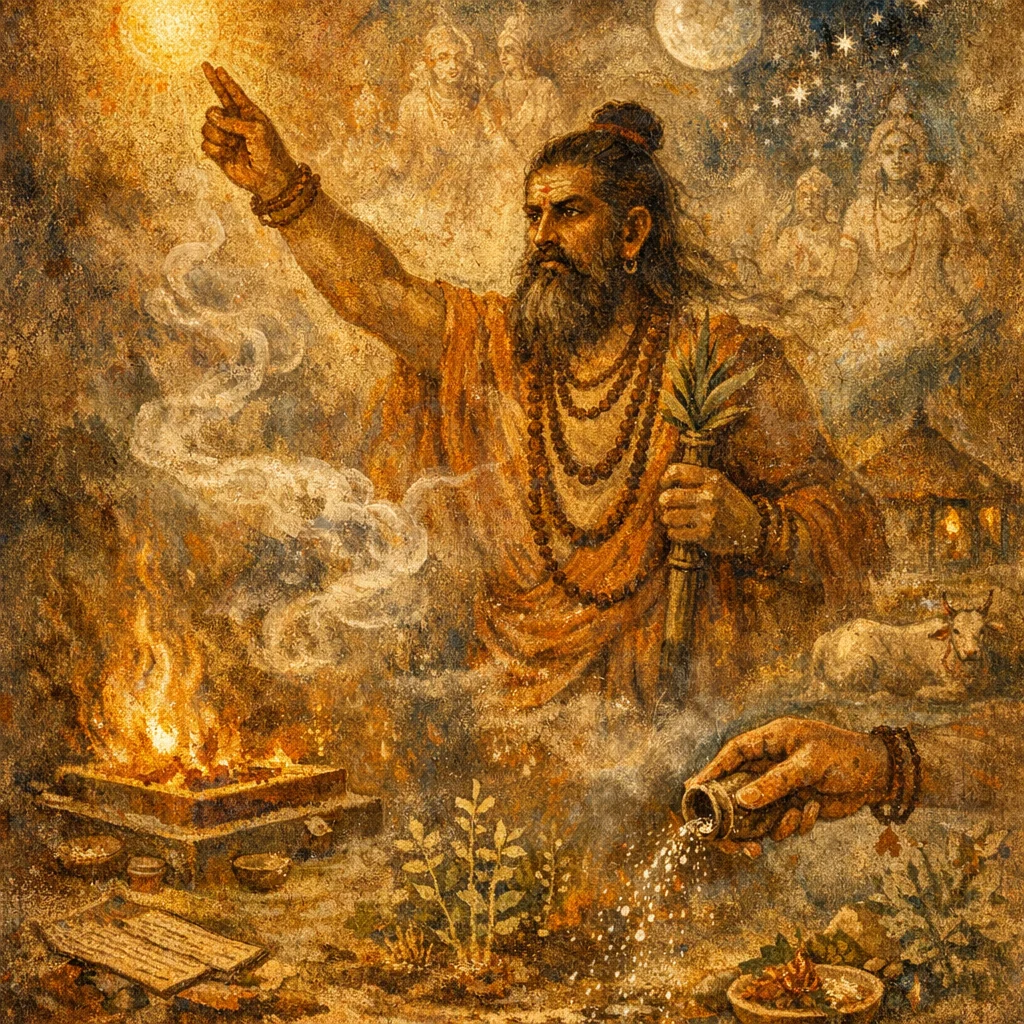
Sukta 6
Rishi: Traditionally associated with late Atharvanic/Brāhmaṇa-style compilers (sectional tradition rather than a single named ṛṣi).
Devata: Brahman / Vāc (implicit: the Vedic speech-forms Ṛc, Sāman, Yajus).
Chandas: Mixed/Brāhmaṇa-prose cadence (not a strict classical chandas; late AV style).
Mantras
Mantra 1
स ध्रुवां दिशमनु व्यऽचलत्
He went forth, following the steadfast quarter.
Mantra 2
तं भूमिश्चाग्निश्चौषधयश्च वनस्पतयश्च वानस्पत्याश्च वीरुधश्चानुव्यऽचलन्
After him moved Earth and Agni; the herbs moved, and the forest-lords, and the forest-growths, and the creeping plants moved after him.
Mantra 3
भूमेश्च वै सो३ग्नेश्चौषधीनां च वनस्पतीनां च वानस्पत्यानां । च वीरुधां च प्रियं धाम भवति य एवं वेद
Verily he becometh a dear abode of Earth, and of Agni, and of the herbs, and of the forest-lords, and of the forest-growths, and of the creeping plants—who knoweth thus.
Mantra 4
स ऊर्ध्वां दिशमनु व्यऽचलत्
He advanced along the upward quarter.
Mantra 5
तमृतं च सत्यं च सूर्यश्च चन्द्रश्च नक्षत्राणि चानुव्यचलन्
After him moved Ṛta and Satya; the Sun and the Moon, and the constellations, followed on.
Mantra 6
ऋतस्य च वै स सत्यस्य च सूर्यस्य च चन्द्रस्य च नक्षत्राणां च । प्रियं धाम भवति य एवं वेद
Verily he is of Ṛta and of Satya, of the Sun and of the Moon, and of the constellations: a dear abode he becomes—who knoweth thus.
Mantra 7
स उत्तमां दिशमनु व्यऽचलत्
He advanced along the highest quarter.
Mantra 8
तमृचश्च सामानि च यजूंषि च ब्रह्म चानुव्यऽचलन्
After him moved the Ṛc-verses, the Sāmans, the Yajus-formulas, and Brahman followed on.
Mantra 9
ऋचां च वै स साम्नां च यजुषां च ब्रह्मणश्च प्रियं धाम भवति य एवं वेद
Verily he who thus knoweth becometh a dear abode—beloved station—of the Ṛc-verses, and of the Sāman-chants, and of the Yajus-formulas, and of holy brahman.
Mantra 10
स बृहतीं दिशमनु व्यऽचलत्
He went forth along the Bṛhatī direction—the great quarter.
Mantra 11
तमितिहासश्च पुराणं च गाथाश्च नाराशंसीश्चानुव्यऽचलन्
After him moved Itihāsa and Purāṇa, and the Gāthās, and the Nārāśaṃsī praises, following in his train.
Mantra 12
इतिहासस्य च वै स पुराणस्य च गाथानां च नाराशंसीनां च प्रियं धाम भवति य एवं वेद
Verily he who thus knoweth becometh a dear abode—a beloved station—of Itihāsa and of Purāṇa, and of the Gāthās, and of the Nārāśaṃsī praises.
Mantra 13
स परमां दिशमनु व्यऽचलत्
He advanced along unto the supreme direction—the highest quarter.
Mantra 14
तमाहवनीयश्च गार्हपत्यश्च दक्षिणाग्निश्च यज्ञश्च यजमानश्च पशवश्चानुव्यऽचलन्
After him moved the Āhavanīya, and the Gārhapatya, and the Southern Fire; the Sacrifice, the Sacrificer, and the Cattle likewise followed on.
Mantra 15
आहवनीयस्य च वै स गार्हपत्यस्य च दक्षिणाग्नेश्च यज्ञस्य च यजमानस्य च पशूनां च प्रियं धाम भवति य एवं वेद
Verily he becomes the beloved seat of the Āhavanīya, and of the Gārhapatya, and of the Southern Fire; of the Sacrifice, of the Sacrificer, and of the Cattle—who thus hath knowledge.
Mantra 16
सोऽनादिष्टां दिशमनु व्यऽचलत्
He went forth along an unappointed quarter.
Mantra 17
तमृतवश्चार्तवाश्च लोकाश्च लौक्याश्च मासाश्चार्धमासाश्चाहोरात्रे चानुव्यऽचलन्
After him moved the Seasons and the Seasonal divisions; the Worlds and the Worldly realms; the Months, the Half-months, and Day-and-Night likewise followed on.
Mantra 18
ऋतूनां च वै स आर्तवानां च लोकानां च लौक्यानां च मासानां चार्धमासानां चाहोरात्रयोश्च प्रियं धाम भवति य एवं वेद
Verily he becomes the beloved seat of the Seasons and the Seasonal divisions; of the Worlds and the Worldly realms; of the Months and the Half-months, and of Day-and-Night—who thus hath knowledge.
Mantra 19
सोऽनावृत्तां दिशमनु व्यचलत् ततो नावर्त्स्यन्नमन्यत
He followed forth the quarter that turneth not again; and thence he deemed, ‘I shall not return.’
Mantra 20
तं दितिश्चादितिश्चेडा चेन्द्राणी चानुव्यऽचलन्
After him moved Diti and Aditi, and Iḍā, and Indrāṇī likewise, following forth.
Mantra 21
दितेश्च वै सोऽदितेश्चेडायाश्चेन्द्राण्याश्च प्रियं धाम भवति य एवं वेद
Verily he becometh a dear abode of Diti and of Aditi, of Iḍā and of Indrāṇī—whoso thus knoweth.
Mantra 22
स दिशोऽनु व्यऽचलत्
He moved forth along the quarters.
Mantra 23
तं विराडनु व्यऽचलत् सर्वे च देवाः सर्वाश्च देवताः
After him moved Virāj; and all the Gods, and all the Divinities besides.
Mantra 24
विराजश्च वै स सर्वेषां च देवानां सर्वासां च देवतानां प्रियं धाम भवति य एवं वेद
And verily he—who thus knoweth—becometh the dear abode of Virāj, and of all the Gods, and of all the Divinities.
Mantra 25
स सर्वानन्तर्देशाननु व्यऽचलत्
He moved on, pervading all the intermediate regions.
Mantra 26
तं प्रजापतिश्च परमेष्ठी च पिता च पितामहश्चानुव्यऽचलन्
After him moved Prajāpati, and Parameṣṭhin, and the Father, and the Grandfather, following in all directions.
Frequently Asked Questions
It means the person is recognized as a fitting seat for Vedic speech—someone in whom Ṛc, Sāman, and Yajus can ‘dwell’ without being harmed by misuse. Practically, it signifies legitimacy, authority, and auspicious presence in ritual and society.
Both, but in a specific way: prosperity here is status and stability that arise from brahman-power (brahmavarcasa). The hymn links worldly standing to alignment with Vedic speech and cosmic supports like earth, fire, and plant-life.
In the cited portion, no material substance is required; the efficacy is framed as knowledge and correct recitation (“ya evaṃ veda”). Some Atharvanic rites add substances in practice, but this hymn’s core method is speech-authorization through identification.