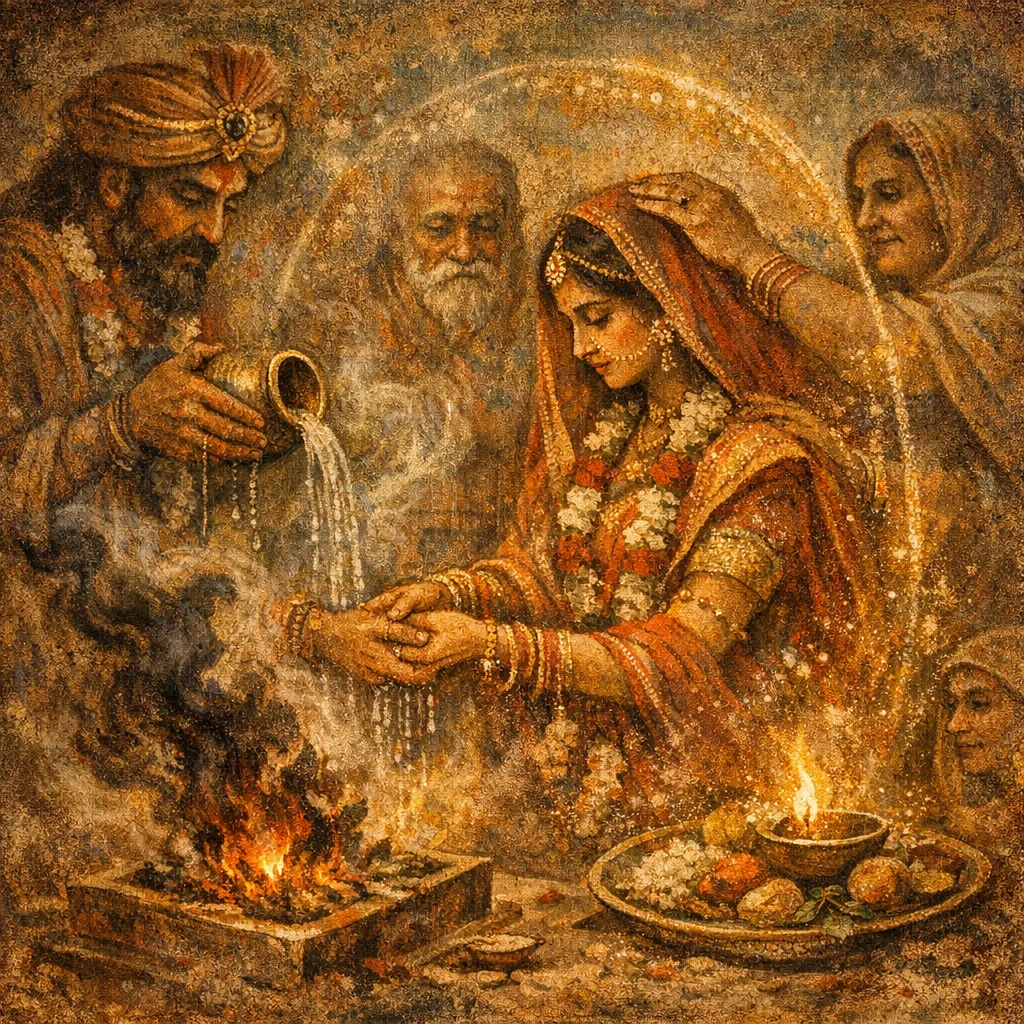
Sukta 1
Rishi: Traditionally assigned within the AV marriage corpus (requires anukramaṇī confirmation for AVŚ 14.1.1)
Devata: Satya, Sūrya, Ṛta, Ādityas, Soma (cosmic supports and witnesses)
Chandas: Mixed meters in the vivāha section; this verse is commonly treated as Triṣṭubh-like in cadence (requires metrical verification against pada lengths).
Mantras
Mantra 1
विवाह- प्रकरणम्। ३८ पुरोबृहती त्रिपदा परोष्णिक्; (४८ पथ्यापङ्क्तिः) ६० पराऽनुष्टुप्। सत्येनोत्तभिता भूमिः सूर्येणोत्तभिता द्यौः । ऋतेनादित्यास्तिष्ठन्ति दिवि सोमो अधि श्रितः
By Truth is Earth upheld; by the Sun is Heaven upheld. By Ṛta the Ādityas stand fast in the sky; and Soma rests aloft, established.
Mantra 2
सोमेनादित्या बलिनः सोमेन पृथिवी मही। अथो नक्षत्राणामेषामुपस्थे सोम आहितः
By Soma are the Ādityas made strong; by Soma the broad Earth is made great. Moreover, in the bosom of these constellations Soma is laid up and established.
Mantra 3
सोमं मन्यते पपिवान् यत् संपिंषन्त्योषधिम्। सोमं यं ब्रह्माणो विदुर्न तस्याश्नाति पार्थिवः
He deems it Soma, having drunk, when they crush the herb together. But the Soma which the Brahmans know—of that the earthly man partakes not.
Mantra 4
यत् त्वा सोम प्रपिबन्ति तत आ प्यायसे पुनः । वायुः सोमस्य रक्षिता समानां मास आकृतिः
When they drink thee, O Soma, therefrom thou swellest full again. Vāyu is Soma’s guardian; the month is the form of the equal-running days.
Mantra 5
आच्छद्विधानैर्गुपितो बार्हतैः सोम रक्षितः । ग्राव्णामिच्छृण्वन् तिष्ठसि न ते अश्नाति पार्थिवः
Covered by ordinances, guarded by lofty means, O Soma, thou art protected. Listening indeed to the pressing-stones, thou standest: the earthly man partakes not of thee.
Mantra 6
चित्तिरा उपबर्हणं चक्षुरा अभ्यञ्जनम्। द्यौर्भूमिः कोश आसीद् यदयात् सूर्या पतिम्
Splendid was the cushion, fair to the eye the unguent. Heaven and Earth were as a coffer, when Sūryā went unto her husband.
Mantra 7
रैभ्यासीदनुदेयी नाराशंसी न्योचनी । सूर्याया भद्रमिद् वासो गाथयैति परिष्कृता
Rai-bhī was her following gift; Nārāśaṃsī her laud; her covering-cloth the putting-on. Sūryā, adorned all round, goes forth with a gāthā: auspicious indeed is her garment.
Mantra 8
स्तोमा आसन् प्रतिधयः कुरीरं छन्द ओपशः । सूर्याया अश्विना वराग्निरासीत् पुरोगवः
Praises were her counter-supports; her head-crest was the metre, her coverings the woven weft. The Aśvins were Sūryā’s wooers; Agni was the fore-leader with the cattle.
Mantra 9
सोमो वधूयुरभवदश्विनास्तामुभा वरा। सूर्यां यत् पत्ये शंसन्तीं मनसा सविताददात्
Soma became the bride-seeker; the Aśvins, both, were her wooers. When Sūryā, praising for her husband, Savitar bestowed her—by the mind’s assent.
Mantra 10
मनो अस्या अन आसीद् द्यौरासीदुत च्छदिः । शुक्रावनड्वाहावास्तां यदयात् सूर्या पतिम्
Her mind was the wagon; heaven was the canopy-cover. Two shining draft-bulls were her team, when Sūryā went unto her husband.
Mantra 11
ऋक्सामाभ्यामभिहितौ गावौ ते सामनावैताम्। श्रोत्रे ते चक्रे आस्तां दिवि पन्थाश्चराचरः
With Ṛc and Sāman laid upon them, two cows came to thee as two Sāmans. Thy ears were the two wheels; in heaven were the paths—of all that moves and moves not.
Mantra 12
शुची ते चक्रे यात्या व्यानो अक्ष आहतः । अनो मनस्मयं सूर्यारोहत् प्रयती पतिम्
Pure are thy wheels for travel, broad-spread; the axle is well driven home. The mind-delighting car—Sūryā mounted it, faring forth unto her husband.
Mantra 13
सूर्याया वहतुः प्रागात् सविता यमवासृजत्। मघासु हन्यन्ते गावः फल्गुनीषु व्युऽह्यते
Sūryā’s bridal train hath gone forth: Savitṛ hath sent her to the appointed one. In Maghās the kine are driven on; in Phalgunīs the procession is drawn in ordered array.
Mantra 14
यदश्विना पृच्छमानावयातं त्रिचक्रेण वहतुं सूर्यायाः । क्वैकं चक्रं वामासीत् क्वऽदेष्ट्राय तस्थथुः
When, O Aśvins, being questioned, ye came unto Sūryā’s bridal car with three wheels—where was the one wheel of you twain? where stood ye upon the draw-pole?
Mantra 15
यदयातं शुभस्पती वरेयं सूर्यामुप । विश्वे देवा अनु तद् वामजानन् पुत्रः पितरमवृणीत पूषा
When ye came, O Lords of Splendor, unto Sūryā at her choosing, all the Gods thereafter recognized that deed of you twain: Pūṣan, the son, chose for himself the father.
Mantra 16
द्वे ते चक्रे सूर्ये ब्रह्माण ऋतुथा विदुः । अथैकं चक्रं यद् गुहा तदद्धातय इद् विदुः
Two wheels of thine, O Sūryā, the Brahmans know in ordered season; but that one wheel which is hidden—verily that the wayfarers alone do know.
Mantra 17
अर्यमणं यजामहे सुबन्धुं पतिवेदनम्। उर्वारुकमिव बन्धनात् प्रेतो मुञ्चामि नामुतः
We worship Aryaman, the kindly kinsman, the Finder of the Husband. Like a cucumber from its bond I loose thee, gone forth—loose thee from hence, not from yonder.
Mantra 18
प्रेतो मुञ्चामि नामुतः सुबद्धाममुतस्करम्। यथेयमिन्द्र मीढ्वः सुपुत्रा सुभगासति
Gone forth, I loose thee not from yonder: firmly bound, making thee belong to yonder. So, O Indra, bounteous one, may this woman be rich in good sons, and fortunate.
Mantra 19
प्र त्वा मुञ्चामि वरुणस्य पाशाद् येन त्वाबध्नात् सविता सुशेवाः । ऋतस्य योनौ सुकृतस्य लोके स्योनं ते अस्तु सहसंभलायै
Forth do I loose thee from the noose of Varuṇa, wherewith Savitar, most gracious, bound thee. In ṛta’s womb, in the world of well-doing, may there be for thee a kindly seat, for joint abundance.
Mantra 20
भगस्त्वेतो नयतु हस्तगृह्याश्विना त्वा प्र वहतां रथेन । गृहान् गच्छ गृहपत्नी यथासो वशिनी त्वं विदथमा वदासि
May Bhaga lead thee hence, thy hand being taken; may the Aśvins bear thee onward in their chariot. Go to the home as house-mistress, that, having mastery, thou mayest speak in the assembly.
Mantra 21
इह प्रियं प्रजायै ते समृध्यतामस्मिन् गृहे गार्हपत्याय जागृहि । एना पत्या तन्वं१ सं स्पृशस्वाथ जिर्विर्विदथमा वदासि
Here may what is dear to thee for offspring prosper; in this house wake thou for the gārhapatya fire. With this thy husband touch thou thy body in union; then, being vigorous, shalt thou speak in the assembly.
Mantra 22
इहैव स्तं मा वि यौष्टं विश्वमायुर्व्यऽश्नुतम्। क्रीडन्तौ पुत्रैर्नप्तृभिर्मोदमानौ स्वस्तकौ
Here, even here, stand fast; go not asunder. Attain ye the whole of life’s allotted span; sporting with sons and sons of sons, rejoicing, a pair of blessed fortune.
Mantra 23
पूर्वापरं चरतो माययैतौ शिशू क्रीडन्तौ परि यातोऽर्णवम्। विश्वान्यो भुवना विचष्ट ऋतूंरन्यो विदधज्जायसे नवः
By wondrous power these twain move to and fro, like children sporting, they go about the ocean-flood. The one surveys all beings and all worlds; the other, ordering the seasons, is born anew.
Mantra 24
नवोनवो भवसि जायमानोऽह्नां केतुरुषसामेष्यग्रम्। भागं देवेभ्यो वि दधास्यायन् प्र चन्द्रमस्तिरसे दीर्घमायुः
Ever new thou art, as thou art born; the sign of days, of dawns thou goest in the van. Apportioning duly the share unto the Gods as thou proceedest, O Moon, thou traversest forth long life.
Mantra 25
परा देहि शामुल्यं ब्रह्मभ्यो वि भजा वसु । कृत्यैषा पद्वती भूत्वा जाया विशते पतिम्
Send thou away the śāmulya; to the Brahmans apportion wealth. This Kṛtyā, made footed, departs; the wife enters unto her husband.
Mantra 26
नीललोहितं भवति कृत्यासक्तिर्व्यऽज्यते । एधन्ते अस्या ज्ञातयः पतिर्बन्धेषु बध्यते
Blue-red it comes to be: the clinging of Kṛtyā is wiped away. Her kinsmen prosper; the husband is bound fast in bonds no more (i.e., the binding is averted).
Mantra 27
अश्लीला तनूर्भवति रुशती पापयामुया। पतिर्यद् वध्वो३वाससः स्वमङ्गमभ्यूर्णुते
Unseemly becomes the body, though shining, through that evil influence, when the husband, with the bride’s garment, wraps over his own person.
Mantra 28
आशसनं विशसनमथो अधिविकर्तनम्। सूर्यायाः पश्य रूपाणि तानि ब्रह्मोत शुम्भति
Cutting off, cutting asunder, yea, over-cutting—behold the forms of Sūryā: those the sacred spell, moreover, makes fair and splendid.
Mantra 29
तृष्टमेतत् कटुकमपाष्ठवद् विषवन्नैतदत्तवे । सूर्यां यो ब्रह्मा वेद स इद् वाधूयमर्हति
Sharp is this, bitter, like chaff, like poison—this is not for eating. He who, as brahman-priest, knows Sūryā, he indeed is worthy of bridehood.
Mantra 30
स इत् तत् स्योनं हरति ब्रह्मा वासः सुमङ्गलम्। प्रायश्चित्तिं यो अध्येति येन जाया न रिष्यति
He indeed brings that kindly boon—the brahman-priest—(even) the garment most auspicious: he who studies the expiation whereby the wife is not harmed.
Mantra 31
युवं भगं सं भरतं समृद्धमृतं वदन्तावृतोद्येषु । ब्रह्मणस्पते पतिमस्यै रोचय चारु संभलो वदतु वाचमेताम्
Ye twain, bring hither Bhaga, fully prospered, speaking ṛta in the uprisings of ṛta. O Lord of Prayer, make for her the husband acceptable and fair: let the well-provided bridegroom speak this utterance.
Mantra 32
इहेदसाथ न परो गमाथेमं गावः प्रजया वर्धयाथ । शुभं यतीरुस्रियाः सोमवर्चसो विश्वे देवाः क्रन्निह वो मनांसि
Here, even here, abide; go not away beyond. This man, O Cows, with progeny increase ye. Auspicious, onward-moving, ruddy, Soma-splendoured—may all the Gods here make your minds accordant.
Mantra 33
इमं गावः प्रजया सं विशाथायं देवानां न मिनाति भागम्। अस्मै वः पूषा मरुतश्च सर्वे अस्मै वो धाता सविता सुवाति
This man, O Cows, with progeny enter ye wholly: he minishes not the Gods’ appointed portion. For him let Pūṣan, and all the Maruts, and for him let Dhātṛ, Savitar, impel your boon.
Mantra 34
अनृक्षरा ऋजवः सन्तु पन्थनो येभिः सखायो यन्ति नो वरेयम्। सं भगेन समर्यम्णा सं धाता सृजतु वर्चसा
Unharmful, straight, be ye the paths whereby our comrades go unto the wooing. With Bhaga, with Aryaman, with Dhātṛ—let him send us forth endowed with splendour.
Mantra 35
यच्च वर्चो अक्षेषु सुरायां च यदाहितम्। यद् गोष्वश्विना वर्चस्तेनेमां वर्चसावतम्
What splendour is in the dice, and what is laid up in the surā; what splendour is in the cows, in the horses—therewith endow this woman with splendour.
Mantra 36
ये न महानघ्न्या जघनमश्विना येन वा सुरा । येनाक्षा अभ्यषिच्यन्त तेनेमां वर्चसावतम्
That greatness which is in the inviolable cows’ hind-part, and in the horses; or that whereby the surā, whereby the dice are sprinkled—therewith endow this woman with splendour.
Mantra 37
यो अनिध्मो दीदयदप्स्व१न्तर्यं विप्रास ईडते अध्वरेषु । अपां नपान्मधुमतीरपो दा याभिरिन्द्रो वावृधे वीर्याऽवान्
He who, self-kindled, shone within the waters—whom the inspired priests invoke in the solemn rites—O Child of the Waters, grant the honeyed Waters, whereby Indra waxed strong, possessed of heroic might.
Mantra 38
इदमहं रुशन्तं ग्राभं तनूदूषिमपोहामि । यो भद्रो रोचनस्तमुदचामि
This ruddy seizure, this body-defiling grasp, I thrust away: but that benign brightness—this I draw forth and raise.
Mantra 39
आस्यै ब्राह्मणाः स्नपनीर्हरन्त्ववीरघ्नीरुदजन्त्वापः । अर्यम्णो अग्निं पर्येतु पूषन् प्रतीक्षन्ते श्वशुरो देवरश्च
For her let the Brahmans bring the bathing-waters; let the Waters come forth, not slaying sons. Let Pūṣan lead her about Aryaman’s Fire: the father-in-law and the husband’s brother await.
Mantra 40
शं ते हिरण्यं शमु सन्त्वापः शं मेथिर्भवतु शं युगस्य तर्द्म । शं त आपः शतपवित्रा भवन्तु शमु पत्या तन्वं१ सं स्पृशस्व
Weal be thy gold; weal, verily, be the Waters; weal be the pin, weal the yoke’s fastening. Weal be to thee the Waters, hundredfold purifying: in weal, with thy husband, touch thy body unto union.
Mantra 41
खे रथस्य खेऽनसः खे युगस्य शतक्रतो । अपालामिन्द्र त्रिष्पूत्वाकृणोः सूर्यत्वचम्
In the socket of the chariot, in the socket of the wain, in the socket of the yoke, O Śatakratu—Apālā, O Indra, having thrice purified, thou madest sun-skinned.
Mantra 42
आशासाना सौमनसं प्रजां सौभाग्यं रयिम्। पत्युरनुव्रता भूत्वा सं नह्यस्वामृताय कम्
Hoping for kindly concord, for offspring, good fortune, and wealth—become obedient to thy husband’s ordinance; bind thyself fast, wholly, for deathlessness and for bliss.
Mantra 43
यथा सिन्धुर्नदीनां साम्राज्यं सुषुवे वृषा । एवा त्वं सम्राज्ञ्येधि पत्युरस्तं परेत्य
As Sindhu, bull-like, hath brought forth sovereignty over the rivers, so, entering thy husband’s home, be thou a sovereign lady.
Mantra 44
सम्राज्ञ्येधि श्वशुरेषु सम्राज्ञ्युत देवृषु । ननान्दुः सम्राज्ञ्येधि सम्राज्ञ्युत श्वश्र्वाः
Be thou a sovereign lady among thy fathers-in-law, a sovereign lady also among the husband’s brothers; among the sisters-in-law be thou a sovereign lady, a sovereign lady also among the mothers-in-law.
Mantra 45
या अकृन्तन्नवयन् याश्च तत्निरे या देवीरन्तां अभितोऽददन्त । तास्त्वा जरसे सं व्ययन्त्वायुष्मतीदं परि धत्स्व वासः
They who have cut it, they who have woven it, and they who have stretched it out—those goddesses who set the border round about: may they enfold thee wholly unto old age. Long-lived, do thou put on this garment round about thee.
Mantra 46
जीवं रुदन्ति वि नयन्त्यध्वरं दीर्घामनु प्रसितिं दीध्युर्नरः । वामं पितृभ्यो य इदं समीरिरे मयः पतिभ्यो जनये परिष्वजे
Alive they weep; they lead her forth unto the solemn rite: the men have urged her onward along the long course of going. A gracious good from her fathers have they thus set in motion—delight for the husbands, for the wife, for the embrace.
Mantra 47
स्योनं ध्रुवं प्रजायै धारयामि तेऽश्मानं देव्याः पृथिव्या उपस्थे । तमा तिष्ठानुमाद्या सुवर्चा दीर्घं त आयुः सविता कृणोतु
A kindly, steadfast stone for offspring do I set for thee, upon the lap of Earth the Goddess. Stand thou thereon, rejoicing, fair of lustre: may Savitar ordain for thee long life.
Mantra 48
ये नाग्निरस्या भूम्या हस्तं जग्राह दक्षिणम्। तेन गृह्णामि ते हस्तं मा व्यथिष्ठा मया सह प्रजया च धनेन च
With that wherewith Agni took the right hand of this maid upon the earth, with that same do I take thy hand. Be not distressed with me, together with offspring and with wealth.
Mantra 49
देवस्ते सविता हस्तं गृह्णातु सोमो राजा सुप्रजसं कृणोतु । अग्निः सुभगां जतवेदाः पत्ये पत्नीं जरदष्टिं कृणोतु
May the god Savitar take thy hand; may Soma the King make thee rich in good offspring. May Agni, Jātavedas, make thee a fortunate wife unto thy husband, enduring unto old age.
Mantra 50
गृह्णामि ते सौभगत्वाय हस्तं मया पत्या जरदष्टिर्यथासः । भगो अर्यमा सविता पुरंधिर्मह्यं त्वादुर्गार्हपत्याय देवाः
I take thy hand for good fortune, that with me as husband thou mayest attain old age. Bhaga, Aryaman, Savitar, and Purandhi—the Gods—give thee unto me for secure, unassailable house-lordship.
Mantra 51
भगस्ते हस्तमग्रहीत् सविता हस्तमग्रहीत्। पत्नी त्वमसि धर्मणाहं गृहपतिस्तव
Bhaga hath taken thy hand; Savitar hath taken thy hand. By ordinance of right thou art the wife; I am thy lord of the house.
Mantra 52
ममेयमस्तु पोष्या मह्यं त्वादाद् बृहस्पतिः । मया पत्या प्रजावति सं जीव शरदः शतम्
Mine be this woman; let her be for my prosperity. Bṛhaspati hath given thee unto me. With me, thy husband, O rich in offspring, live ye together a hundred autumns.
Mantra 53
त्वष्टा वासो व्यदधाच्छुभे कं बृहस्पतेः प्रशिषा कवीनाम्। तेनेमां नारीं सविता भगश्च सूर्यामिव परि धत्तां प्रजया
Tvaṣṭṛ hath duly set the raiment on, for beauty and for bliss, by ordinance of Bṛhaspati, by the seers’ direction. Therewith may Savitar and Bhaga encompass this woman, as Sūryā, and invest her with offspring.
Mantra 54
इन्द्राग्नी द्यावापृथिवी मातरिश्वा मित्रावरुणा भगो अश्विनोभा। बृहस्पतिर्मरुतो ब्रह्म सोम इमां नारीं प्रजया वर्धयन्तु
Indra and Agni, Heaven and Earth, Mātariśvan, Mitra and Varuṇa, Bhaga, both Aśvins; Bṛhaspati, the Maruts, holy Prayer, and Soma—let these increase this woman with offspring.
Mantra 55
बृहस्पतिः प्रथमः सूर्यायाः शीर्षे केशां अकल्पयत्। तेनेमामश्विना नारीं पत्ये सं शोभयामसि
Bṛhaspati first arranged the tresses on Sūryā’s head. Therewith, O Aśvins, this woman we wholly adorn for her husband.
Mantra 56
इदं तद् रूपं यदवस्त योषा जायां जिज्ञासे मनसा चरन्तीम्। तामन्वर्तिष्ये सखिभिर्नवग्वैः क इमान् विद्वान् वि चचर्त पाशान्
This is that form which thou hast seen—the maiden, the wife, whom thou in mind seekest to know as she moves abroad. Her will I follow with companions, with the Navagvas: who, being wise, hath sundered these nooses?
Mantra 57
अहं वि ष्यामि मयि रूपमस्या वेददित् पश्यन् मनसः कुलायम्। न स्तेयमद्मि मनसोदमुच्ये स्वयं श्रथ्नानो वरुणस्य पाशान्
I will enter forth; in me be her fair form established—knowing, yea, beholding the mind’s own nest. No theft I practise: from the mind I am unloosed, myself unfastening Varuṇa’s nooses.
Mantra 58
प्र त्वा मुञ्चामि वरुणस्य पाशाद् येन त्वाबध्नात् सविता सुशेवाः । उरुं लोकं सुगमत्र पन्थां कृणोमि तुभ्यं सहपत्न्यै वधु
Forth from Varuṇa’s noose I loose thee—wherewith the gracious Savitṛ had bound thee. A wide world, here an easy path, I fashion for thee, O bride, for rightful wifehood.
Mantra 59
उद्यच्छध्वमप रक्षो हनाथेमं नारीं सुकृते दधात । धाता विपश्चित् पतिमस्यै विवेद भगो राजा पुर एतु प्रजानन्
Rise up; drive off—smite ye the Rākṣas: then set this woman in good fortune. The wise Disposer hath found a husband for her; let King Bhaga go before, in knowledge leading.
Mantra 60
भगस्ततक्ष चतुरः पादान् भगस्ततक्ष चत्वार्युष्पलानि । त्वष्टा पिपेश मध्यतोऽनु वर्ध्रान्त्सा नो अस्तु सुमङ्गली
Bhaga hath shaped the four supports; Bhaga hath shaped the four soft pads. Tvaṣṭṛ hath pressed the central fastenings in due order: may she be unto us most auspicious.
Mantra 61
सुकिंशुकं वहतुं विश्वरूपं हिरण्यवर्णं सुवृतं सुचक्रम्। आ रोह सूर्ये अमृतस्य लोकं स्योनं पतिभ्यो वहतुं कृणु त्वम्
The bridal car, well-decked, of many hues, gold-coloured, well-covered, well-wheeled—mount thou it, O Sūryā, unto the realm of immortality, the kindly place; make thou the conveyance blissful for the husbands.
Mantra 62
अभ्रातृघ्नीं वरुणापशुघ्नीं बृहस्पते । इन्द्रापतिघ्नीं पुत्रिणीमास्मभ्यं सवितर्वह
Bring hither for us, O Savitar, a bride who slayeth not the brother, who under Varuṇa slayeth not the cattle;—O Bṛhaspati,—who under Indra slayeth not the husband, a woman rich in sons.
Mantra 63
मा हिंसिष्टं कुमार्यं१ स्थूणे देवकृते पथि। शालाया देव्या द्वारं स्योनं कृण्मो वधूपथम्
Harm not the maiden, O posts, upon the path that gods have fashioned. The door of the sacred hall we make benign—a kindly way for the bride.
Mantra 64
ब्रह्मापरं युज्यतां ब्रह्म पूर्वं ब्रह्मान्ततो मध्यतो ब्रह्म सर्वतः । अनाव्याधां देवपुरां प्रपद्य शिवा स्योना पतिलोके वि राज
Let brahman be harnessed behind; brahman in front; brahman from the ends, from the midst—brahman on every side. Entering the gods’ fortress, unassailable, be thou auspicious, kindly; in the husband’s realm shine forth in splendour.
Frequently Asked Questions
It makes the wedding a cosmically grounded act: if satya and ṛta hold the world steady, they can also ‘hold steady’ the new household, giving the union legitimacy and stability.
It is a ritual image for constraining bonds—fear, social restriction, or prior ties. The mantra declares a lawful release (with Savitṛ as regulator) so the bride can enter rightful wifehood without obstruction.
Often Soma is invoked as an auspicious, consecratory power rather than as a physical substance in later domestic practice. The hymn uses Soma to signify uplifted, sanctifying support for the marriage.