Sarga 67
जटायुवृत्तान्तः — Jatāyu’s Testimony and Rāma’s Grief
अरण्यकाण्ड
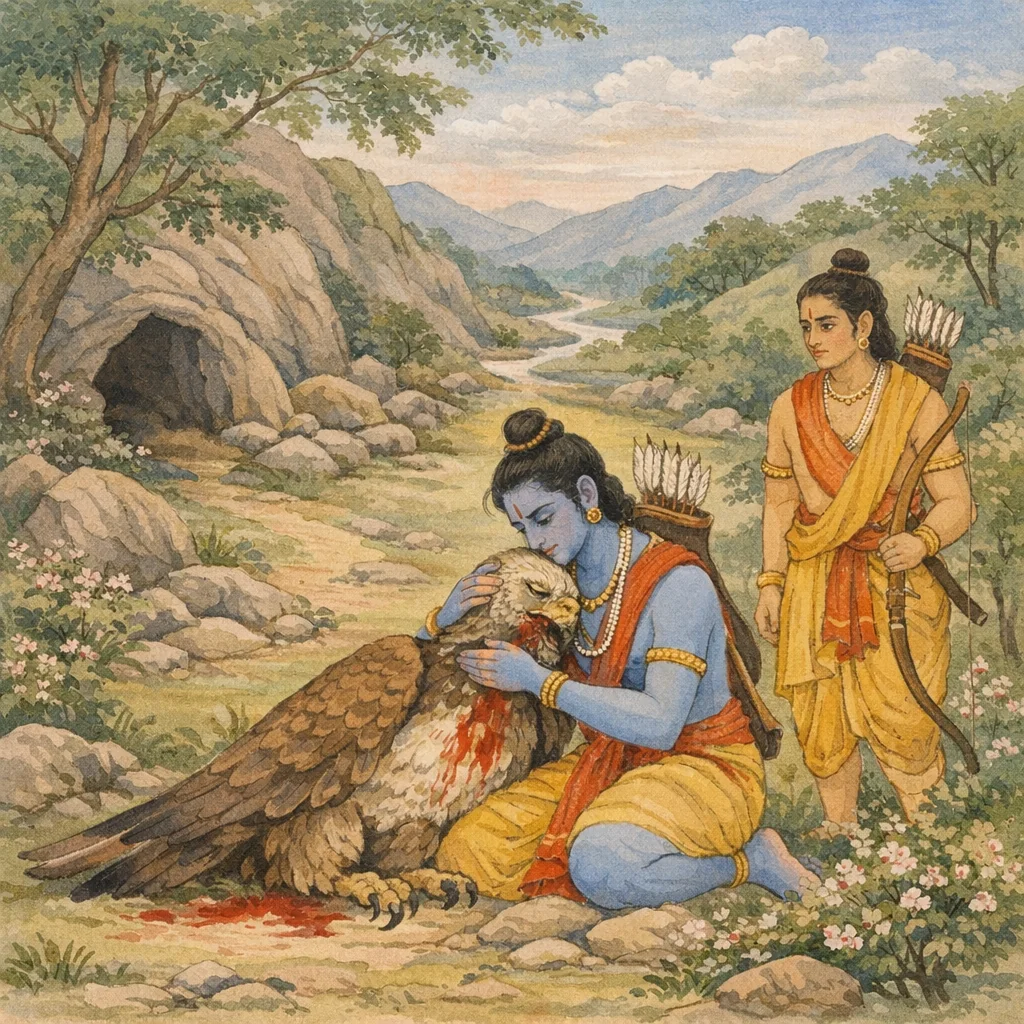
In Sarga 67, Lakṣmaṇa urges Rāma to search Janasthāna with method and steadiness—scanning mountain strongholds, caves, valleys, and fearsome groves—for constancy in adversity is the mark of the wise. Rāma accepts the counsel’s essence, yet his grief-kindled anger stays near as he moves with bow readied. They come upon Jatāyu fallen and bloodied, mountain-like in form. Rāma at first mistakes him for a rākṣasa in vulture-shape and resolves to slay him, but Jatāyu, speaking with difficulty, corrects him: Rāvaṇa carried off Sītā, and Jatāyu fought to protect her—shattering the chariot, bow, and quiver, and killing the charioteer—before his wings were cut. The testimony doubles Rāma’s sorrow. He embraces the dying bird, his father’s friend, laments his misfortunes, and collapses in grief, while still showing filial compassion and reverence toward the faithful Jatāyu.
Shlokas
Verse 1
पूर्वजोऽप्युक्तमात्रस्तु लक्ष्मणेन सुभाषितम्।सारग्राही महासारं प्रतिजग्राह राघवः।।।।
Though elder, Rāghava—able to seize the essence—accepted at once the weighty substance of Lakṣmaṇa’s well-spoken counsel as soon as it was expressed.
Verse 2
सन्निगृह्य महाबाहुः प्रवृत्तं कोपमात्मनः।अवष्टभ्य धनुश्चित्रं रामो लक्ष्मणमब्रवीत्।।।।
Mastering the anger that had surged up within him, the mighty-armed Rāma steadied himself upon his wondrous bow and spoke to Lakṣmaṇa.
Verse 3
किं करिष्यावहे वत्स क्व वा गच्छाव लक्ष्मण।केनोपायेन गच्छेयं सीतामिति विचिन्तय।।।।
My child, Lakṣmaṇa—what are we to do, and where shall we go? Think of some means by which I may reach Sītā.
Verse 4
तं तथा परितापार्तं लक्ष्मणो राममब्रवीत्।इदमेव जनस्थानं त्वमन्वेषितुमर्हसि।।।।राक्षसैर्बहुभिः कीर्णं नानाद्रुमलतायुतम्।
Seeing Rāma afflicted with burning grief, Lakṣmaṇa said: “You should first search this very Janasthāna—dense with many rākṣasas and filled with varied trees and creepers.”
Verse 5
सन्तीह गिरिदुर्गाणि निर्दराः कन्दराणि च।।।।गुहाश्च विविधा घोरा नानामृगगणाकुलाः।आवासाः किन्नराणां च गन्धर्वभवनानि च।।।।
Here there are hard mountain-fastnesses, ravines and caves; and many dreadful caverns crowded with herds of varied beasts—along with the dwellings of Kinnaras and the mansions of Gandharvas.
Verse 6
सन्तीह गिरिदुर्गाणि निर्दराः कन्दराणि च।।3.67.5।।गुहाश्च विविधा घोरा नानामृगगणाकुलाः।आवासाः किन्नराणां च गन्धर्वभवनानि च।।3.67.6।।
There are arduous mountain tracts, ravines, and caves—dreadful caverns thronged with many beasts—and also the dwellings of the Kinnaras and the mansions of the Gandharvas.
Verse 7
तानि युक्तो मया सार्धं त्वमन्वेषितुमर्हसि।त्वद्विधा बुद्धिसम्पन्ना महात्मानो नरर्षभ।।।।आपत्सु न प्रकम्पन्ते वायुवेगैरिवाचलाः।
With me beside you, you should search those places. Great-souled men like you—wise, O best of men—do not tremble in calamity, like mountains unmoved by the rush of the winds.
Verse 8
इत्युक्तस्तद्वनं सर्वं विचचार सलक्ष्मणः।।।।क्रुद्धो रामश्शरं घोरं सन्धाय धनुषि क्षुरम्।
Thus addressed, Rāma, with Lakṣmaṇa, ranged through the whole forest; and in anger he set upon his bow a terrible arrow, razor-sharp.
Verse 9
ततः पर्वतकूटाभं महाभागं द्विजोत्तमम्।।।।ददर्श पतितं भूमौ क्षतजार्द्रं जटायुषम्।
Then he saw Jaṭāyu—the noble bird, illustrious and great—lying fallen on the ground, wet with blood, like a mountain peak brought down.
Verse 10
तं दृष्ट्वा गिरिशृङ्गाभं रामो लक्ष्मणमब्रवीत्।।।।अनेन सीता वैदेही भक्षिता नात्र संशयः।
Seeing him, huge like a mountain peak, Rāma said to Lakṣmaṇa: “By this one Vaidehī Sītā has been devoured—of that there is no doubt.”
Verse 11
गृध्ररूपमिदं रक्षो व्यक्तं भवति कानने।।।।भक्षयित्वा विशालाक्षीमास्ते सीतां यथासुखम्।एनं वधिष्ये दीप्तास्यैर्घोरैर्बाणैरजिह्मगैः।।।।
“This is plainly a rākṣasa in the forest, wearing the form of a vulture. Having devoured the wide-eyed Sītā, he sits at ease. I shall kill him with dreadful, straight-flying arrows with blazing points.”
Verse 12
गृध्ररूपमिदं रक्षो व्यक्तं भवति कानने।।3.67.11।।भक्षयित्वा विशालाक्षीमास्ते सीतां यथासुखम्।एनं वधिष्ये दीप्तास्यैर्घोरैर्बाणैरजिह्मगैः।।3.67.12।।
This rākṣasa, plainly taking the form of a vulture in the forest, has devoured the large‑eyed lady and now sits by Sītā at his ease. I shall slay him with dreadful, blazing arrows that fly straight and do not swerve.
Verse 13
इत्युक्त्वाभ्यपतद्गृध्रं सन्धाय धनुषि क्षुरम्।क्रुद्धो रामस्समुद्रान्तां कम्पयन्निव मेदिनीम्।।।।
Having spoken thus, the enraged Rāma sprang at the vulture, setting a keen arrow upon his bow; so fierce was his wrath that it seemed he made the sea‑girt earth tremble.
Verse 14
तं दीनं दीनया वाचा सफेनं रुधिरं वमन्।अभ्यभाषत पक्षी तु रामं दशरथात्मजम्।।।।
But the bird, wretched and spewing foamy blood, addressed Rāma, the son of Daśaratha, in a plaintive voice.
Verse 15
यामोषधिमिवायुष्मन्नन्वेषसि महावने।सा देवी मम च प्राणा रावणेनोभयं हृतम्।।।।
“O long‑lived one, she whom you seek in this great forest as one seeks a healing herb—she, that noble lady, and my very life as well: both have been taken away by Rāvaṇa.”
Verse 16
त्वया विरहिता देवी लक्ष्मणेन च राघव।ह्रियमाणा मया दृष्टा रावणेन बलीयसा।।।।
“O Rāghava, separated from you and from Lakṣmaṇa, I saw that lady being carried off by the mighty Rāvaṇa.”
Verse 17
सीतामभ्यवपन्नोऽहं रावणश्च रणे मया।विध्वंसितरथश्चात्र पातितो धरणीतले।।।।
I swooped down to defend Sītā; and in battle with me, Rāvaṇa—his chariot shattered—fell here upon the earth.
Verse 18
एतदस्य धनुर्भग्नमेतदस्य शरावरम्।अयमस्य रथो राम भग्नसाङ्ग्रामिको मया।।।।
O Rāma, this is his bow, broken; this is his quiver; and this is his chariot—his battle-gear shattered by me.
Verse 19
अयं तु सारथिस्तस्य मत्पक्षनिहतो युधि।परिश्रान्तस्य मे पक्षौ छित्त्वा खड्गेन रावणः।।।।सीतामादाय वैदेहीमुत्पपात विहायसम्।रक्षसा निहतं पूर्वं न मां हन्तुं त्वमर्हसि।।।।
This man is his charioteer, slain in battle by the blows of my wings. But when I grew exhausted, Rāvaṇa cut off my two wings with his sword.
Verse 20
अयं तु सारथिस्तस्य मत्पक्षनिहतो युधि।परिश्रान्तस्य मे पक्षौ छित्त्वा खड्गेन रावणः।।3.67.19।।सीतामादाय वैदेहीमुत्पपात विहायसम्।रक्षसा निहतं पूर्वं न मां हन्तुं त्वमर्हसि।।3.67.20।।
Taking Sītā, the princess of Videha, he leapt up into the sky. Do not kill me—you need not—for I have already been struck down before by that rākṣasa.
Verse 21
रामस्तस्य तु विज्ञाय बाष्पपूर्णमुखस्तदा।द्विगुणीकृततापार्तस्सीतासक्तां प्रियां कथाम्।।।।
When Rāma learned from him the beloved account bound up with Sītā, his face filled with tears; his sorrow doubled, and he became helpless in grief.
Verse 22
गृध्रराजं परिष्वज्य परित्यज्य महद्धनुः।निपपातावशो भूमौ रुरोद सहलक्ष्मणः।।।।
Embracing the king of vultures and casting aside his great bow, Rāma collapsed helplessly upon the ground and wept, with Lakṣmaṇa beside him.
Verse 23
एकमेकायने दुर्गे निश्श्वसन्तं कथञ्चन।समीक्ष्य दुःखिततरो रामस्सौमित्रिमब्रवीत्।।।।
Seeing him—alone in that solitary, hard-to-reach place—breathing with difficulty, Rāma, stricken with even greater sorrow, spoke to Saumitrī (Lakṣmaṇa).
Verse 24
राज्यं भ्रष्टं वने वासस्सीता नष्टा हतो द्विजः।ईदृशीयं ममालक्ष्मीर्निर्दहेदपि पावकम्।।।।
“I have fallen from my kingdom; I dwell in the forest; Sītā is lost; and this twice-born one has been slain. Such is my misfortune that it would burn even fire itself.”
Verse 25
सम्पूर्णमपि चेदद्य प्रविशेयं महोदधिम्।सोऽपि नूनं ममालक्ष्म्या विशुष्येत्सरितांपतिः।।।।
“Even if today I were to enter the great ocean, full as it is, surely—even that lord of rivers—would dry up because of my ill-fortune.”
Verse 26
नास्त्यभाग्यतरो लोके मत्तोऽस्मिन्सचराचरे।येनेयं महती प्राप्ता मया व्यसनवागुरा।।।।
In this world of moving and unmoving beings, none is more unfortunate than I—for upon me has fallen this vast snare of calamities.
Verse 27
अयं पितृवयस्यो मे गृध्रराजो जरान्वितः।शेते विनिहतो भूमौ मम भाग्यविपर्ययात्।।।।
This king of vultures—aged and a friend of my father—lies slain upon the ground, for my fortune has turned against me.
Verse 28
इत्येवमुक्त्वा बहुशो राघवस्सहलक्ष्मणः।जटायुषं च पस्पर्श पितृस्नेहं विदर्शयन्।।।।
Having spoken thus again and again, Rāghava, with Lakṣmaṇa beside him, gently touched Jaṭāyu, openly showing him the affection one bears a father.
Verse 29
निकृत्तपक्षं रुधिरावसिक्तं स गृध्रराजं परिरभ्य रामः।क्व मैथिली प्राणसमा ममेति विमुच्य वाचं निपपात भूमौ।।।।
Rāma embraced the king of vultures, his wings shorn and his body drenched in blood. Crying, “Where is Maithilī—she who is as dear to me as life itself?” his words burst forth, and he fell upon the earth.
Frequently Asked Questions
Rāma’s immediate impulse is to punish what he believes is a predatory rākṣasa; the dilemma is acting on grief-fueled inference versus verifying truth. The chapter resolves this by Jatāyu’s testimony, redirecting Rāma from misdirected violence to informed pursuit of the actual offender.
The sarga emphasizes sāra-grahaṇa (grasping the essence) and viveka (discernment): wise counsel guides action, but grief can distort perception. Ethical strength is shown in the capacity to correct oneself, honor loyal service, and temper anger with compassion.
Janasthāna and its surrounding wilderness are mapped through rugged features—mountain strongholds, caves, valleys, and dense groves—signaling a liminal cultural space where rākṣasa presence, ascetic habitats, and mythic dwellings (kinnara and gandharva abodes) coexist in the epic imagination.