Sarga 60
सीतान्वेषणविलापः (Rama’s Lament and Search for Sita)
आरण्यकाण्ड
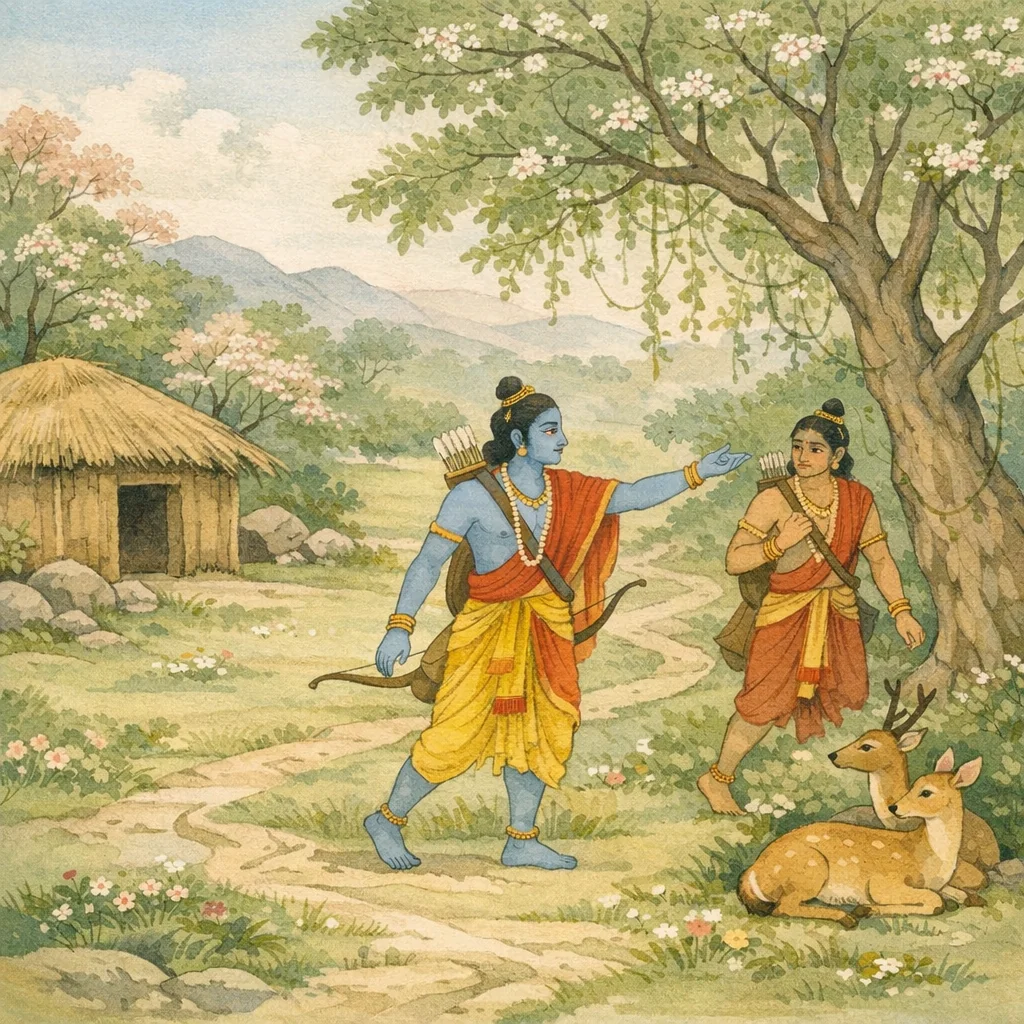
Sarga 60 dwells on the immediate inner shock of Sītā’s absence. As Rāma returns toward the āśrama, he repeatedly notices inauspicious omens—especially the throbbing of the left eye, stumbling, and bodily trembling—and reads them as warnings of danger to Sītā. Reaching the leaf-hut and finding it empty, he searches the spot in agitation; the abandoned dwelling is likened to a lotus-pond ravaged by winter, and the surrounding forest seems “to weep,” with withered flowers and dispirited birds and beasts. Rāma’s mind turns through competing possibilities—abduction, death, concealment, or ordinary foraging—until he breaks into frantic searching, running from tree to tree and from landmark to landmark. In a vivid series of addresses he questions Kadamba, Bilva, Arjuna, Kakubha, Tilaka, Aśoka, Tāla, Jambu, and Karnikāra, and even deer, elephant, and tiger, shaping his pleas with poetic similes drawn from Sītā’s appearance and ways—yellow silk, tilaka marks, and her love of flowers. The chapter culminates in grief that borders on delusion, as Rāma speaks to Sītā as though she were before him and continues to wander in search. Karuṇa-rasa thus becomes an ethical force: sorrow does not dissolve duty, but sharpens resolve and commitment to dharma.
Shlokas
Verse 1
भृशमाव्रजमानस्य तस्याधो वामलोचनम्।प्रास्फुरच्चास्खलद्रामो वेपथुश्चाप्य जायत।।3.60.1।।
As Rāma moved on, his left eye throbbed intensely; he stumbled, and a tremor arose in him—ill omens foretelling distress.
Verse 2
उपालक्ष्य निमित्तानि सोऽशुभानि मुहुर्मुहुः।अपि क्षेमं नु सीताया इति वै व्याजहार च।।3.60.2।।
Again and again, noticing inauspicious omens, he spoke to himself in anxious doubt: “Is Sītā truly safe—unharmed?”
Verse 3
त्वरमाणो जगामाथ सीतादर्शनलालसः।शून्यमावसथं दृष्ट्वा बभूवोद्विग्नमानसः।।3.60.3।।
Longing to see Sītā, he hurried to the hermitage; but on seeing the dwelling empty, his mind became deeply anxious.
Verse 4
उद्भ्रमन्निव वेगेन विक्षिपन्रघुनन्दनः।तत्र तत्रोटजस्थानमभिवीक्षय समन्ततः।।3.60.4।।ददर्श पर्णशालां च रहितां सीतया तदा।श्रिया विरहितां ध्वस्तां हेमन्ते पद्मिनीमिव।।3.60.5।।
Rāma, the joy of the Raghu line, rushed about in frantic haste, as if bewildered, flinging his hands to and fro, and again and again scanned in every direction the ground of the hermitage.
Verse 5
उद्भ्रमन्निव वेगेन विक्षिपन्रघुनन्दनः।तत्र तत्रोटजस्थानमभिवीक्षय समन्ततः।।3.60.4।।ददर्श पर्णशालां च रहितां सीतया तदा।श्रिया विरहितां ध्वस्तां हेमन्ते पद्मिनीमिव।।3.60.5।।
Then he saw the leaf-cottage, empty of Sītā—its splendor gone and its order shattered—like a lotus-pond in winter, bereft of the beauty of its lotuses.
Verse 6
रुदन्तमिव वृक्षैश्च म्लानपुष्पमृगद्विजम्।श्रिया विहीनं विध्वस्तं सन्त्यक्तवनदेवतम्।।3.60.6।।विप्रकीर्णाजिनकुशं विप्रविद्धब्रुसीकटम्।दृष्ट्वा शून्यं निजस्थानं विललाप पुनः पुनः।।3.60.7।।
The grove itself seemed to weep: trees drooped, flowers withered, beasts and birds looked dulled; its beauty was lost, it appeared ravaged, as though even the forest-deities had abandoned it.
Verse 7
रुदन्तमिव वृक्षैश्च म्लानपुष्पमृगद्विजम्।श्रिया विहीनं विध्वस्तं सन्त्यक्तवनदेवतम्।।3.60.6।।विप्रकीर्णाजिनकुशं विप्रविद्धब्रुसीकटम्।दृष्ट्वा शून्यं निजस्थानं विललाप पुनः पुनः।।3.60.7।।
Seeing his own place lying empty—deerskins and kuśa-grass scattered, and the grass-cushions and straw-mats tossed about—he lamented again and again.
Verse 8
हृता मृता वा नष्टा वा भक्षिता वा भविष्यति।निलीनाप्यथवा भीरुरथवा वनमाश्रिता।।3.60.8।।
“Perhaps the timid one has been abducted, or killed, or destroyed, or even devoured; or else she may be hiding somewhere in fear, or taking shelter in the forest.”
Verse 9
गता विचेतुं पुष्पाणि फलान्यपि च वा पुनः।अथवा पद्मिनीं याता जलार्थं वा नदीं गता।।3.60.9।।
“Or perhaps she has gone to gather flowers, or fruits; or she has gone to a lotus-pond, or to the river for water.”
Verse 10
यत्नान्मृगयमाणस्तु नाससाद वने प्रियाम्।शोकरक्तेक्षणश्शोकादुन्मत्त इव लक्ष्यते।।3.60.10।।
Though searching with every effort, he did not find his beloved in the forest; his eyes reddened by grief, he appeared, from sorrow, like one driven mad.
Verse 11
वृक्षाद्वृक्षं प्रधावन्सगिरेश्चाद्रिं नदान्नदीम्।बभूव विलपन्रामश्शोकार्णवपरिप्लुतः।।3.60.11।।
Running from tree to tree, from mountain to mountain, and from river to river, Rāma wandered weeping—overwhelmed, as though submerged in an ocean of grief.
Verse 12
अपि काचित्त्वया दृष्टा सा कदम्बप्रिया प्रिया।कदम्ब यदि जानीषे शंस सीतां शुभाननाम्।।3.60.12।।
O Kadamba tree, have you seen my beloved, she who delights in kadamba blossoms? If you know, tell me of Sītā, the fair and auspicious-faced one.
Verse 13
स्निग्धपल्लवसङ्काशा पीतकौशेयवासिनी।शंसस्व यदि वा दृष्टा बिल्व बिल्वोपमस्तनी।।3.60.13।।
O Bilva tree—if you have seen her, tell me: the lady tender as a glossy young leaf, clad in yellow silk, her breasts rounded like bilva fruit.
Verse 14
अथवाऽर्जुन शंस त्वं प्रियां तामर्जुनप्रियाम्।जनकस्य सुता भीरुर्यदि जीवति वा न वा।।3.60.14।।
Or else, O Arjuna tree—tell me of that beloved one, herself fond of the arjuna: Janaka’s timid daughter. Does she live, or does she not?
Verse 15
ककुभः ककुभोरूं तां व्यक्तं जानाति मैथिलीम्।यथा पल्लवपुष्पाढ्यो भाति ह्येष वनस्पतिः।।3.60.15।।
This Kakubha tree—radiant with tender shoots and blossoms—surely knows Maithilī, she whose thighs are like the kakubha’s own.
Verse 16
भ्रमरैरुपगीतश्च यथा द्रुमवरो ह्ययम्।एष व्यक्तं विजानाति तिलकस्तिलकप्रियाम्।।3.60.16।।
As this excellent tree is sung around by bees, this Tilaka tree surely knows the lady who delights in a tilaka mark upon her forehead.
Verse 17
अशोक शोकापनुद शोकोपहतचेतसम्।त्वन्नामानं कुरु क्षिप्रं प्रियासन्दर्शनेन माम्।।3.60.17।।
O Aśoka, remover of sorrow—quickly, by granting me the sight of my beloved, make me worthy of your very name, for my heart is struck down by grief.
Verse 18
यदि ताल त्वया दृष्टा पक्वतालफलस्तनी।कथयस्व वरारोहां कारुण्यं यदि ते मयि।।3.60.18।।
O Tāla tree—if you have seen the noble lady whose breasts are like ripe palmyra fruit, then, out of compassion for me, tell me of that fair-limbed one.
Verse 19
यदि दृष्टा त्वया सीता जम्बु जम्बूफलोपमा।प्रियां यदि विजानीषे निःशङ्कं कथयस्व मे।।3.60.19।।
O Jambu tree—if you have seen Sītā, lovely as the jambu fruit, and if you know of my beloved, tell me without hesitation.
Verse 20
अहो त्वं कर्णिकाराद्य सुपुष्पैश्शोभसे भृशम्।कर्णिकारप्रिया साध्वी शंस दृष्टा प्रिया यदि।।3.60.20।।
O karnikāra tree—today you shine splendidly with blossoms in full bloom. If you have seen my beloved, that virtuous lady who loves karnikāra flowers, tell me.
Verse 21
चूतनीपमहासालान्पनसान्कुरवान्धवान्।दाडिमाननसान्गत्वा दृष्ट्वा रामो महायशाः।।3.60.21।।मल्लिका माधवीश्चैव चम्पकान्केतकीस्तथा।पृच्छन्रामो वने भान्तः उन्मत्त इव लक्ष्यते।।3.60.22।।
The illustrious Rāma approached and looked upon mango, kadamba, great śāla trees, jackfruit, kurava, dhava, pomegranate, and anasā trees, as he searched on.
Verse 22
चूतनीपमहासालान्पनसान्कुरवान्धवान्।दाडिमाननसान्गत्वा दृष्ट्वा रामो महायशाः।।3.60.21।।मल्लिका माधवीश्चैव चम्पकान्केतकीस्तथा।पृच्छन्रामो वने भान्तः उन्मत्त इव लक्ष्यते।।3.60.22।।
He questioned jasmine (mallikā), mādhavī creepers, champaka and ketakī as well; Rāma, wandering in the forest, appeared like one maddened, so shaken was he by separation.
Verse 23
अथवा मृगशाबाक्षीं मृग जानासि मैथिलीम्।मृगविप्रेक्षणी कान्ता मृगीभिस्सहिता भवेत्।।3.60.23।।
O deer, do you know Maithilī, she of fawn-like eyes? My beloved, whose gaze is like that of a young deer, may perhaps be among the does.
Verse 24
गज सा गजनासोरूर्यदि दृष्टा त्वया भवेत्।तां मन्ये विदितां तुभ्यमाख्याहि वरवारण।3.60.24।।
O elephant, if you have seen her, she whose thighs resemble an elephant’s trunk, then I think you would recognize her. Tell me, O best of elephants.
Verse 25
शार्दूल यदि सा दृष्टा प्रिया चन्द्रनिभानना।मैथिली मम विस्रब्धं कथयस्व न ते भयम्।।3.60.25।।
O tiger, if you have seen that Maithilī of mine, my beloved with a moon-like face, then tell me freely; you need not fear.
Verse 26
किं धावसि प्रिये दूरे दृष्टासि कमलेक्षणे।वृक्षैराच्छाद्य चात्मानं किं मां न प्रतिभाषसे।।3.60.26।।
Why do you run far away, my dear lotus-eyed one? I have seen you. Why do you hide yourself behind the trees and not answer me?
Verse 27
तिष्ठ तिष्ठ वरारोहे न तेऽस्ति करुणा मयि।नात्यर्थं हास्यशीलासि किमर्थं मामुपेक्षसे।।3.60.27।।
Stay—stay, O fair-limbed one! Have you no compassion for me? You are not excessively playful; why then do you disregard me?
Verse 28
पीतकौशेयकेनासि सूचिता वरवर्णिनि।धावन्त्यपि मया दृष्टा तिष्ठ यद्यस्ति सौहृदम्।।3.60.28।।
O lady of lovely complexion, you are given away by your yellow silk; even as you run, I have seen you. If you have affection for me, then stay.
Verse 29
नैव सा नूनमथवा हिंसिता चारुहासिनी।कृच्छ्रप्राप्तं न मां नूनं यथोपेक्षितुमर्हति।।3.60.29।।
Surely that sweet-smiling lady has not been harmed—or else, surely, she would not ignore me when I have fallen into such distress.
Verse 30
व्यक्तं सा भक्षिता बाला राक्षसैः पिशिताशनैः।विभज्याङ्कानि सर्वाणि मया विरहिता प्रिया।।3.60.30।।
It seems certain to him that, separated from him, his young beloved has been torn limb from limb and devoured by flesh-eating rākṣasas.
Verse 31
नूनं तच्छुभदन्तोष्ठं सुनासं चारुकुण्डलम्।पूर्णचन्द्रनिभं ग्रस्तं मुखंनिष्प्रभतां गतम्।।3.60.31।।
Surely, that face—graced with lovely teeth and lips, a well-shaped nose, and beautiful earrings, radiant like the full moon—has been ‘eclipsed’ and robbed of its luster.
Verse 32
सा हि चम्पकवर्णाभा ग्रीवा ग्रैवेयशोभिता।कोमला विलपन्त्यास्तु कान्ताया भक्षिता शुभा।।3.60.32।।
That auspicious, delicate neck of his beloved—campaka-flower hued and adorned with a necklace—he imagines has been devoured as she cried out.
Verse 33
नूनं विक्षिप्यमाणौ तौ बाहू पल्लवकोमलौ।भक्षितौ वेपमानाग्रौ सहस्ताभरणाङ्गदौ।।3.60.33।।
Surely those two arms—tender as fresh shoots, their fingertips trembling, adorned with bracelets and armlets—he imagines have been devoured while they were flung about in struggle.
Verse 34
मया विरहिता बाला रक्षसां भक्षणाय वै।सार्धेनेव परित्यक्ता भक्षिता बहुबान्धवा।।3.60.34।।
Separated from him, the young woman—though she has many kinsmen—he imagines has been seized for a rākṣasa’s meal and then cast aside as if half-eaten.
Verse 35
हा लक्ष्मण महाबाहो पश्यसि त्वं प्रियां क्वचित्।हा प्रिये क्व गता भद्रे हा सीतेति पुनः पुनः।।3.60.35।।
“Alas, Lakṣmaṇa, mighty-armed—do you see my beloved anywhere? Alas, dear one! Where have you gone, gentle lady? Alas, Sītā!”—thus he cried again and again.
Verse 36
इत्येवं विलपन्रामः परिधावन्वनाद्वनम्।क्वचिदुद्भ्रमते वेगात्क्वचिद्विभ्रमते बलात्।।3.60.36।।क्वचिन्मत्त इवाभाति कान्तान्वेषणतत्परः।
Thus lamenting, Rāma ran from one tract of forest to another—at times leaping in haste, at times striding forcefully; intent on searching for his beloved, he at moments appeared like one maddened.
Verse 37
स वनानि नदीश्शैलान् गिरिप्रस्रवणानि च।।3.60.37।।काननानि च वेगेन भ्रमत्यपरिसंस्थितः।
Unsteady in mind, he hurriedly wandered through forests and rivers, over hills and mountains, along mountain springs and streams, and through dense woodlands, unable to find rest.
Verse 38
तथा स गत्वा विपुलम् महद्वनं परीत्य सर्वं त्वथ मैथिलीं प्रति।अनिष्ठिताशस्सचकार मार्गणे पुनः प्रियायाः परमं परिश्रमम्।।3.60.38।।
Thus, entering the vast and mighty forest and searching it all for Maithilī, he did not abandon hope; once more he exerted himself to the utmost in seeking his beloved.
Frequently Asked Questions
Rama confronts the dharma-crisis of uncertainty: without evidence, he must act decisively for Sita’s welfare, balancing rational possibilities (foraging, fetching water) against ominous signs and the threat of raksasa violence, leading to an urgent, wide-ranging search.
Grief is not portrayed as mere collapse but as a catalyst for duty: karuṇa intensifies vigilance and commitment, while the repeated self-questioning models ethical responsibility under incomplete information.
Key markers include the āśrama and leaf-cottage (parṇaśālā), the forest’s rivers, hills, and mountain streams, and culturally resonant flora (Aśoka, Kadamba, Champaka, Ketakī, Jambu, Tāla) used as a ‘living map’ through which Rama navigates and interrogates the landscape.