Sarga 55
रावणस्य सीताप्रलोभनम् (Ravana’s Attempt to Allure Sita)
अरण्यकाण्ड
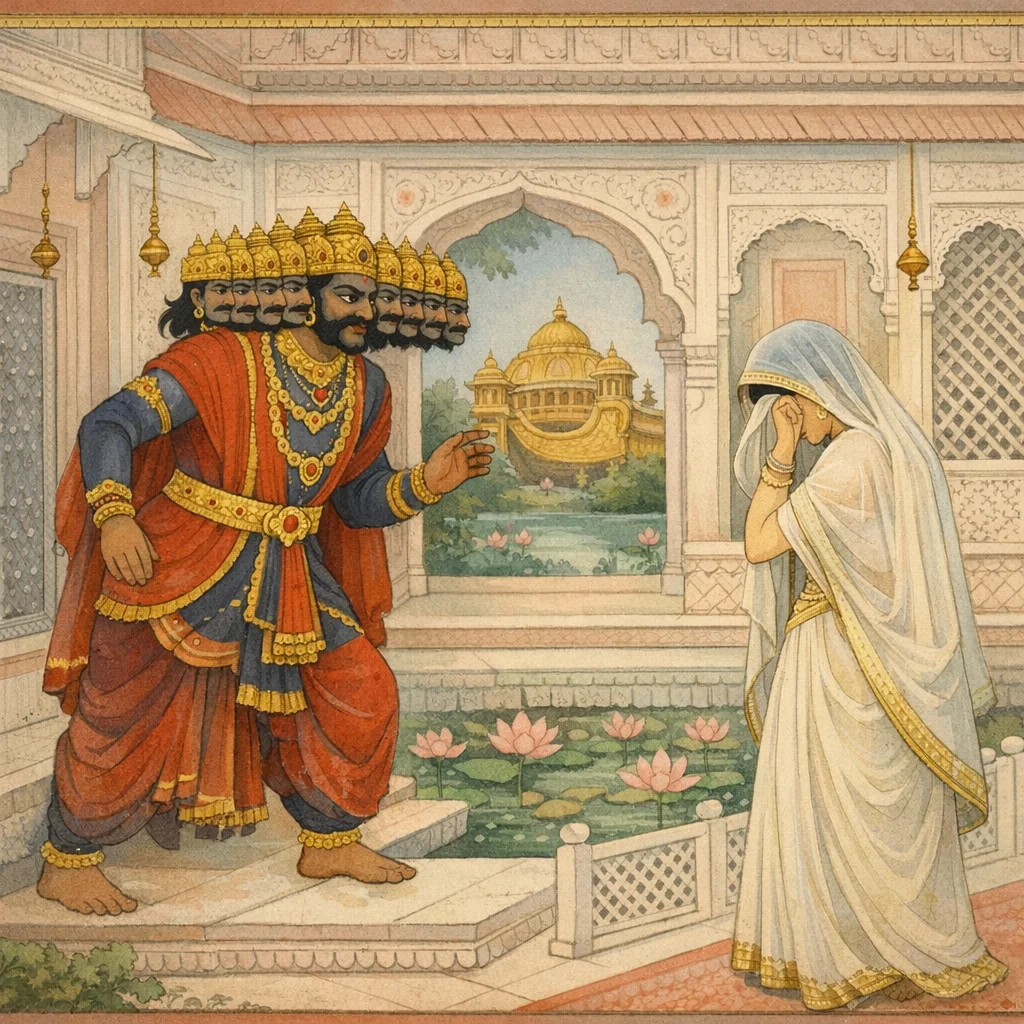
In Lanka, Ravana—after dispatching eight fierce and powerful rākṣasas—deems himself “accomplished” through distorted judgment. He enters the residence to see Sita, portrayed through layered similes of grief and helplessness: like a boat sinking in a storm, and like a deer separated from the herd and hemmed in by hounds. He then forcibly leads her through an opulent architectural complex—palaces, jeweled pillars, golden gateways, ivory and silver windows, golden trelliswork, crystal floors, step-wells, and lotus tanks—using material splendor as coercive persuasion. His speech turns to political and military boasting: vast hosts and attendants, impregnable Lanka, claims of his own superiority, and contempt for Rama as a dispossessed human. Ravana offers Sita queenship in his household and sovereignty over Lanka, with luxuries and the Pushpaka vimāna taken from Kubera. Sita answers without words: she veils her moonlike face and weeps, her radiance dimmed by anxiety. Ravana intensifies his manipulation, recasting the deed as fate-approved and even bowing his heads at her feet, ending in the delusion that she is already “his,” foreshadowing his moral downfall.
Shlokas
Verse 1
सन्दिश्य राक्षसान्घोरान् रावणोऽष्टौ महाबलान्।आत्मानं बुद्धिवैक्लब्यात्कृतकृत्यममन्यत।।3.55.1।।
Having dispatched eight fierce and mighty rākṣasas, Rāvaṇa—his intellect perverted—considered himself as having already achieved his purpose.
Verse 2
स चिन्तयानो वैदेहीं कामबाणसमर्पितः।प्रविवेश गृहं रम्यं सीतां द्रष्टुमभित्वरन्।।3.55.2।।
Brooding on Vaidehī and overwhelmed by Kāma’s arrows, he hastened to see Sītā and entered the lovely dwelling.
Verse 3
स प्रविश्य तु तद्वेश्म रावणो राक्षसाधिपः।अपश्यद्राक्षसीमध्ये सीतां शोकपरायणाम्।।3.55.3।।
Rāvaṇa, lord of the rākṣasas, entered that residence and saw Sītā—overwhelmed by grief—sitting amid the demonesses.
Verse 4
अश्रुपूर्णमुखीं दीनां शोकभाराभिपीडिताम्।वायुवेगैरिवाक्रान्तां मज्जन्तीं नावमर्णवे।।3.55.4।।मृगयूथपरिभ्रष्टां मृगीं श्वभिरिवावृताम्।अधोमुखमुखीं सीतामभ्येत्य च निशाचरः।।3.55.5।।तां तु शोकपरां दीनामवशां राक्षसाधिपः।स बलाद्दर्शयामास गृहं देवगृहोपमम्।।3.55.6।।
Sītā—her face flooded with tears, wretched and crushed beneath the weight of grief—seemed like a boat upon the sea, driven by fierce winds and sinking down.
Verse 5
अश्रुपूर्णमुखीं दीनां शोकभाराभिपीडिताम्।वायुवेगैरिवाक्रान्तां मज्जन्तीं नावमर्णवे।।3.55.4।।मृगयूथपरिभ्रष्टां मृगीं श्वभिरिवावृताम्।अधोमुखमुखीं सीतामभ्येत्य च निशाचरः।।3.55.5।।तां तु शोकपरां दीनामवशां राक्षसाधिपः।स बलाद्दर्शयामास गृहं देवगृहोपमम्।।3.55.6।।
Approaching Sītā with her face lowered, Rāvaṇa, the night-roamer, came upon her like hounds surrounding a doe separated from her herd.
Verse 6
अश्रुपूर्णमुखीं दीनां शोकभाराभिपीडिताम्।वायुवेगैरिवाक्रान्तां मज्जन्तीं नावमर्णवे।।3.55.4।।मृगयूथपरिभ्रष्टां मृगीं श्वभिरिवावृताम्।अधोमुखमुखीं सीतामभ्येत्य च निशाचरः।।3.55.5।।तां तु शोकपरां दीनामवशां राक्षसाधिपः।स बलाद्दर्शयामास गृहं देवगृहोपमम्।।3.55.6।।
But the lord of the rākṣasas, seeing her helpless, pitiable, and consumed by grief, forcibly made her look upon his dwelling—like a palace of the gods.
Verse 7
हर्म्यप्रासादसम्बाधं स्त्रीसहस्रनिषेवितम्।नानापक्षिगणैर्जुष्टं नानारत्नसमन्वितम्।।3.55.7।।दान्तकैस्तापनीयैश्च स्फाटिकै राजतैरपि।वज्रवैडूर्यचित्रैश्च स्तम्भैर्दृष्टिमनोहरैः।।3.55.8।।दिव्यदुन्दुभिनिर्ह्रादं तप्तकाञ्चनतोरणम्।
It was thronged with mansions and palaces, attended by thousands of women, filled with many flocks of birds, and adorned with a variety of gems.
Verse 8
हर्म्यप्रासादसम्बाधं स्त्रीसहस्रनिषेवितम्।नानापक्षिगणैर्जुष्टं नानारत्नसमन्वितम्।।3.55.7।।दान्तकैस्तापनीयैश्च स्फाटिकै राजतैरपि।वज्रवैडूर्यचित्रैश्च स्तम्भैर्दृष्टिमनोहरैः।।3.55.8।।दिव्यदुन्दुभिनिर्ह्रादं तप्तकाञ्चनतोरणम्।
It had sight-delighting pillars inlaid with ivory and gold, with crystal and silver, and patterned with diamond and vaidūrya.
Verse 9
सोपानं काञ्चनं चित्रमारुरोह तया सह।।3.55.9।।दान्तका राजताश्चैव गवाक्षाः प्रियदर्शनाः।हेमजालावताश्चासन्स्तत्र प्रासादपङ्क्तयः।।3.55.10।।
Along with her, he ascended a wondrous staircase made of gold.
Verse 10
सोपानं काञ्चनं चित्रमारुरोह तया सह।।3.55.9।।दान्तका राजताश्चैव गवाक्षाः प्रियदर्शनाः।हेमजालावताश्चासन्स्तत्र प्रासादपङ्क्तयः।।3.55.10।।
There were rows of palatial buildings, lovely to behold, with windows fashioned of ivory and silver, and screened with lattices of gold.
Verse 11
सुधामणिविचित्राणि भूमिभागानि सर्वशः।दशग्रीवस्स्वभवने प्रादर्शयत मैथिलीम्।।3.55.11।।
In his own mansion, Daśagrīva showed Maithilī the many sections of flooring everywhere, inlaid with crystal and gems.
Verse 12
दीर्घिकाः पुष्करिण्यश्च नानावृक्षसमन्विताः।रावणो दर्शयामास सीतां शोकपरायणाम्।।3.55.12।।
Rāvaṇa showed Sītā—plunged in grief—step-wells and lotus-ponds, adorned with many kinds of trees.
Verse 13
दर्शयित्वा तु वैदेह्याः कृत्स्नं तद्भवनोत्तमम्।उवाच वाक्यं पापात्मा सीतां लोभितुमिच्छया।।3.55.13।।
Having shown Vaidehī the entire, most splendid mansion, that sinful one spoke to Sītā, wishing to entice her.
Verse 14
दश राक्षसकोट्यश्च द्वाविंशतिरथापराः।तेषां प्रभुरहं सीते सर्वेषां भीमकर्मणाम्।।3.55.14।।वर्जयित्वा जरावृद्धान्बालांश्च रजनीचरान्।
“O Sītā, setting aside the aged and the young among the night-rangers, I am the lord of them all—of ten crores of rākṣasas and a further twenty-two, all of dreadful deeds.”
Verse 15
सहस्रमेकमेकस्य मम कार्यपुरस्सरम्।।3.55.15।।यदिदं राजतन्त्रं मे त्वयि सर्वं प्रतिष्ठितम्।जीवितं च विशालाक्षि त्वं मे प्राणैर्गरीयसी।।3.55.16।।
“For me alone there are a thousand attendants standing ready to carry out my commands. And the whole governance of my kingdom rests upon you; O large-eyed one, you are dearer to me than my very life-breath.”
Verse 16
सहस्रमेकमेकस्य मम कार्यपुरस्सरम्।।3.55.15।।यदिदं राजतन्त्रं मे त्वयि सर्वं प्रतिष्ठितम्।जीवितं च विशालाक्षि त्वं मे प्राणैर्गरीयसी।।3.55.16।।
“Among the many thousands of women who are my consorts, O Sītā, become their mistress; beloved, be my wife.”
Verse 17
बहूनांस्त्रीसहस्राणां मम योऽसौ परिग्रहः।तासां त्वमीश्वरा सीते मम भार्या भव प्रिये।।3.55.17।।
“Among the many thousands of women who are my consorts, O Sītā, become their mistress; beloved, be my wife.”
Verse 18
साधु किं तेऽन्यया बुद्ध्या रोचयस्व वचो मम।भजस्वमाभितप्तस्य प्रसादं कर्तुमर्हसि।।3.55.18।।
“Why entertain any other thought? Accept my words. I am tormented with desire; you ought to show me favour.”
Verse 19
परिक्षिप्ता समुद्रेण लङ्केयं शतयोजना।नेयं धर्षयितुं शक्या सेन्द्रैरपि सुरासुरैः।।3.55.19।।
This Laṅkā, a hundred yojanas in extent and encircled by the sea, cannot be assaulted—even by gods and asuras, even with Indra among them.
Verse 20
न देवेषु न यक्षेषु न गन्धर्वेषु पक्षिषु।अहं पश्यामि लोकेषु यो मे वीर्यसमो भवेत्।।3.55.20।।
Among gods, Yakṣas, Gandharvas, or even birds, I see no one in the worlds who could be my equal in valor.
Verse 21
राज्यभ्रष्टेन दीनेन तापसेन गतायुषा।किं करिष्यसि रामेण मानुषेणाल्पतेजसा।।3.55.21।।
What will you gain from Rāma—a human, stripped of his kingdom, despondent, living as an ascetic, short-lived, and of little splendor?
Verse 22
भजस्व सीते मामेव भर्ताहं सदृशस्तव।यौवनं ह्यध्रुवं भीरु रमस्वेह मया सह।।3.55.22।।
Choose me alone, O Sītā; I am a husband worthy of you. Youth, O timid one, is truly impermanent—delight here with me while it yet remains.
Verse 23
दर्शने माकृथा बुद्धिं राघवस्य वरानने।कास्य शक्तिरिहागन्तुमपि सीते मनोरथैः।।3.55.23।।
Do not set even your mind, O fair-faced Sītā, on seeing Rāghava again. What power has he to reach this place—even in imagination?
Verse 24
न शक्यो वायुराकाशे पाशैर्बद्धुं महाजवः।दीप्यमानस्य वाप्यग्नेर्गृहीतुं विमलां शिखाम्।।3.55.24।।
As the swift wind in the sky cannot be bound with ropes, and as the pure flame of blazing fire cannot be seized, so too (he implies) is resistance to his power futile.
Verse 25
त्रयाणामपि लोकानां न तं पश्यामि शोभने।विक्रमेण नयेद्यस्त्वां मद्बाहुपरिपालिताम्।।3.55.25।।
O beautiful one, in all the three worlds I see no man who could, by valor, carry you away while you are guarded within my arms.
Verse 26
लङ्कायां सुमहद्राज्यमिदं त्वमनुपालय।त्वत्प्रेष्या मद्विधाश्चैव देवाश्चापि चराचराः।।3.55.26।।
Rule here in Laṅkā over this vast kingdom. Those like me—and even the gods, and all beings moving and unmoving—will stand at your command.
Verse 27
अभिषेकोदकक्लिन्ना तुष्टा च रमयस्व माम्।दुष्कृतं यत्परा कर्म वनवासेन तद्गतम्।।3.55.27।।यश्च ते सुकृतो धर्मस्तस्येह फलमाप्नुहि।
Bathed in consecration-water and content, delight me. Whatever evil karma was formerly yours has been exhausted by your forest-dwelling; now obtain here the fruit of your meritorious dharma.
Verse 28
इह माल्यानि सर्वाणि दिव्यगन्धानि मैथिलि।।3.55.28।।भूषणानि च मुख्यानि सेवस्व च मया सह।।
Here are all garlands of divine fragrance, O Maithilī; and the finest ornaments as well—wear and enjoy them here with me.
Verse 29
पुष्पकं नाम सुश्रोणि भ्रातुर्वैश्रवणस्य मे।।3.55.29।।विमानं सूर्यसङ्काशं तरसा निर्जितं मया।
O fair-hipped lady, I won by force from my brother Vaiśravaṇa (Kubera) that aerial car called Puṣpaka, radiant like the sun.
Verse 30
विशालं रमणीयं च तद्विमानमनुत्तम्।।3.55.30।।तत्र सीते मया सार्धं विहरस्व यथासुखम्।
That unsurpassed aerial car is vast and beautiful. O Sītā, there you may roam at ease together with me.
Verse 31
वदनं पद्मसङ्काशममलं चारुदर्शनम्।शोकार्तंतु वरारोहे न भ्राजति वरानने।।3.55.31।।
O noble lady of lovely form—your face, lotus-like, pure and pleasing to behold, does not shine now, stricken by grief.
Verse 32
एवं वदति तस्मित्सा वस्त्रान्तेन वराङ्गना।पिधायेन्दुनिभं सीता मुखमश्रूण्यवर्तयत्।।3.55.32।।
As he spoke thus, Sītā—the noble woman—covered her moon-like face with the edge of her garment and stood, letting tears flow.
Verse 33
ध्यायन्तीं तामिवास्वस्थां दीनां चिन्ताहतप्रभाम्।उवाच वचनं पापो रावणो राक्षसेश्वरः।।3.55.33।।
Seeing her as though sunk in thought—unwell, forlorn, her radiance dulled by anxiety—the sinful Rāvaṇa, lord of the rākṣasas, spoke to her again.
Verse 34
अलं व्रीडेन वैदेहि धर्मलोपकृतेन च।।3.55.34।।आर्षोऽयं दैवनिष्यन्दो यस्त्वामभिगमिष्यति।
“O Vaidehī, do not be held back by shame, nor by the thought that this violates dharma. This union that comes to you is a fate-sent gift—approved, as it were, by the seers.”
Verse 35
एतौ पादौ मया स्निग्धौ शिरोभिः परिपीडितौ।।3.55.35।।प्रसादं कुरु मे क्षिप्रं वश्यो दासोऽहमस्मिते।
“These shining feet of yours I press with my heads in reverence. Show me favor quickly; I am your servant, obedient and under your control, O smiling one.”
Verse 36
इमाश्शून्य मया वाचश्शुष्यमाणेन भाषिताः।।3.55.36।।न चापि रावणः काञ्चिन्मूर्ध्ना स्त्रीं प्रणमेत ह।
These empty words have I spoken with a parched throat. For Rāvaṇa has never bowed his head in reverence to any woman.
Verse 37
एवमुक्त्वा दशग्रीवो मैथिलीं जनकात्मजाम्।।3.55.37।।कृतान्तवशमापन्नो ममेयमिति मन्यते।
Having spoken thus to Maithilī, Janaka’s daughter, Daśagrīva—fallen under the power of Death—imagined in delusion, “She is mine.”
Frequently Asked Questions
The pivotal action is coercive persuasion following abduction: Ravana combines physical compulsion (moving Sita through his residence) with psychological pressure (boasts, offers of sovereignty, denigration of Rama), testing whether Sita will compromise marital fidelity and moral agency under threat and allure.
The sarga contrasts external power with inner rectitude: wealth, numbers, and claims of invulnerability are shown as unstable foundations when driven by delusion and desire. Sita’s silent refusal emphasizes that dharma can be upheld through restraint even when speech is unsafe or futile.
Lanka is framed as an island-fortified polity surrounded by the sea and portrayed through courtly architecture: palace complexes, jeweled pillars, golden stairways, crystal floors, step-wells and lotus tanks, and the iconic Pushpaka vimāna—objects and spaces used as cultural markers of royal luxury and as instruments of intimidation.