Sarga 38
अष्टत्रिंशः सर्गः — मारीचोपदेशः (Maricha’s Warning and the Memory of Rama’s Power)
अरण्यकाण्ड
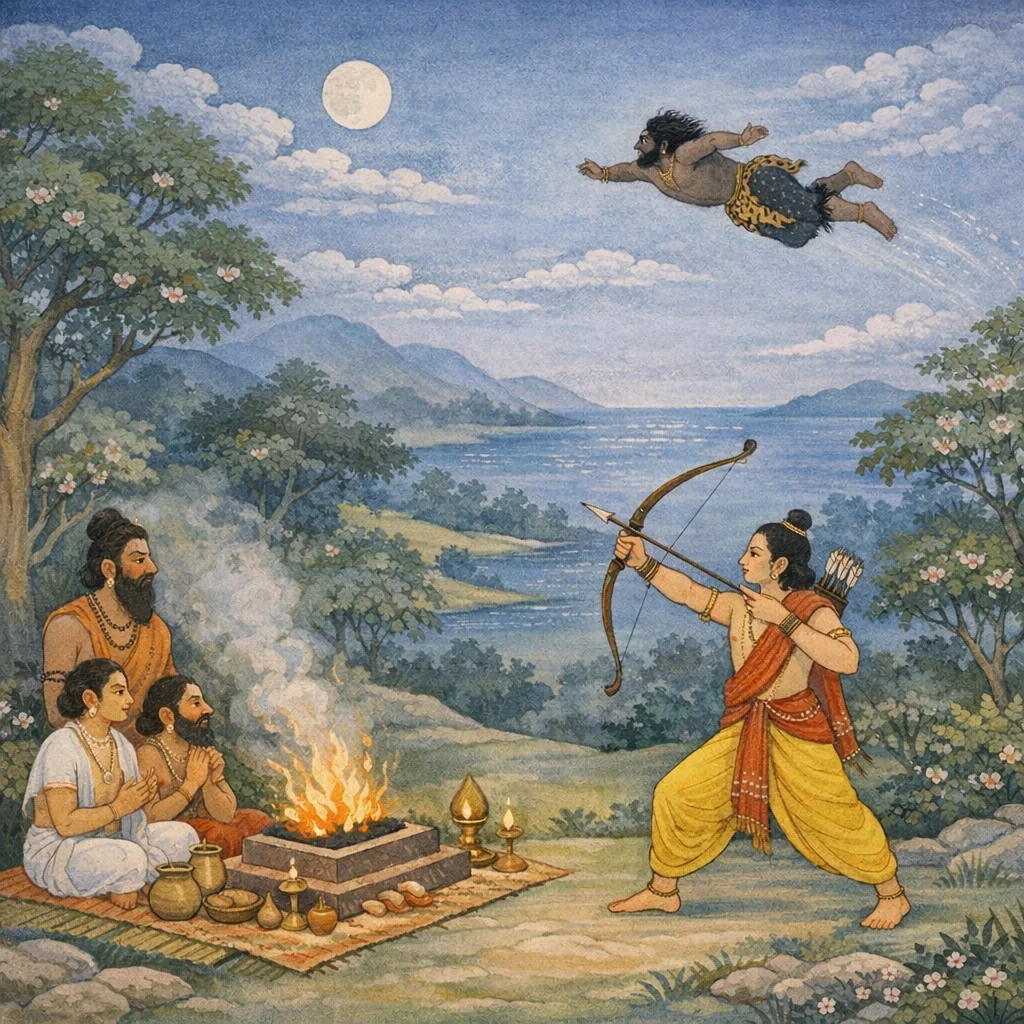
This sarga offers a retrospective testimony and a stern warning. Mārīca recounts his former predation in Daṇḍakāraṇya—endowed with strength likened to “a thousand elephants,” cloud-dark splendor, and weapon-bearing terror—by which he preyed upon ascetics. The narrative then recalls Rāma’s earlier protective service under Viśvāmitra’s sacrificial discipline. Radiant like the moon, youthful in form and austere in simplicity, Rāma stands guard at the rite. When Mārīca assaults the altar, Rāma remains unshaken, strings his bow, and releases a keen arrow that flings Mārīca a hundred yojanas into the sea; notably, Rāma does not kill him, while Mārīca’s companions are destroyed. From this lived proof, Mārīca warns Rāvaṇa against violating another’s wife (paradāra), foretells Laṅkā’s devastation for Sītā’s sake, and teaches that association with sin spreads through society, like fish perishing in a serpent-pool. Thus the chapter fuses memory, dharma, and political foresight into a direct deterrent counsel.
Shlokas
Verse 1
कदाचिदप्यहं वीर्यात्पर्यटन्पृथिवीमिमाम्।बलं नागसहस्रस्य धारयन्पर्वतोपमः।।3.38.1।।नीलजीमूतसङ्काशस्तप्तकाञ्चनकुण्डलः।भयं लोकस्य जनयन्किरीटी परिघायुधः।।3.38.2।।व्यचरं दण्डकारण्ये ऋषिमांसानि भक्षयन्।
Once, driven by my own brute prowess, I roamed this earth—mountain-like, bearing the strength of a thousand elephants. Dark as a rain-cloud, wearing gleaming gold earrings and a crown, weapon in hand, I spread fear among the people.
Verse 2
कदाचिदप्यहं वीर्यात्पर्यटन्पृथिवीमिमाम्।बलं नागसहस्रस्य धारयन्पर्वतोपमः।।3.38.1।।नीलजीमूतसङ्काशस्तप्तकाञ्चनकुण्डलः।भयं लोकस्य जनयन्किरीटी परिघायुधः।।3.38.2।।व्यचरं दण्डकारण्ये ऋषिमांसानि भक्षयन्।
Once, driven by my own brute prowess, I roamed this earth—mountain-like, bearing the strength of a thousand elephants. Dark as a rain-cloud, wearing gleaming gold earrings and a crown, weapon in hand, I spread fear among the people.
Verse 3
विश्वामित्रोऽथ धर्मात्मा मद्वित्रस्तो महामुनिः।।3.38.3।।स्वयं गत्वा दशरथं नरेन्द्रमिदमब्रवीत्।
I ranged through the Daṇḍaka forest, feeding on the flesh of ascetics.
Verse 4
अद्य रक्षतु मां रामः पर्वकाले समाहितः।।3.38.4।।मारीचान्मे भयं घोरं समुत्पन्नं नरेश्वर।
O king, from Mārīca a dreadful fear has arisen for me; therefore let Rāma—composed and vigilant—protect me today at the time of the sacred observance.
Verse 5
इत्येवमुक्तो धर्मात्मा राजा दशरथस्तदा।।3.38.5।।प्रत्युवाच महाभागं विश्वामित्रं महामुनिम्।
Thus addressed, the righteous King Daśaratha then replied to the illustrious great sage Viśvāmitra.
Verse 6
बालो द्वादशवर्षोऽयमकृतास्त्रश्च राघवः।।3.38.6।।कामं तु मम यत्सैन्यं मया सह गमिष्यति।
“This Rāghava is but a boy of twelve and not yet trained in weapons; therefore my army will certainly go along with me.”
Verse 7
बलेन चतुरङ्गेण स्वयमेत्य निशाचरान्।।3.38.7।।वधिष्यामि मुनिश्रेष्ठ शत्रूंस्ते मनसेप्सितान्।
O best of sages, I myself will come with my fourfold army and slay those night-roaming foes—your enemies whom you wish to be destroyed.
Verse 8
इत्येवमुक्तस्समुनी राजानमिदमब्रवीत्।।3.38.8।।रामान्नान्यद्बलं लोके पर्याप्तं तस्य रक्षसः।
When the king spoke thus, the sage replied: in this world no power is sufficient against that rākṣasa—except Rāma.
Verse 9
देवतानामपि भवान् समरेष्वभिपालकः।।3.38.9।।आसीत्तव कृतं कर्म त्रिलोके विदितं नृप।
O king, you have served as a protector even of the gods in battle; your deeds are renowned throughout the three worlds.
Verse 10
काममस्तु महत्सैन्यं तिष्ठत्विह परन्तप।।3.38.10।।बालोऽप्येष महातेजास्समर्थस्तस्य निग्रहे।गमिष्ये राममादाय स्वस्ति तेऽस्तु परन्तप।।3.38.11।।
“If you so desire, O scorcher of foes, let your great army remain here. Though he is only a boy, this radiant Rāma is fully capable of subduing him. I shall go, taking Rāma with me—may auspiciousness be yours, O subduer of enemies.”
Verse 11
काममस्तु महत्सैन्यं तिष्ठत्विह परन्तप।।3.38.10।।बालोऽप्येष महातेजास्समर्थस्तस्य निग्रहे।गमिष्ये राममादाय स्वस्ति तेऽस्तु परन्तप।।3.38.11।।
“If you so desire, O scorcher of foes, let your great army remain here. Though he is only a boy, this radiant Rāma is fully capable of subduing him. I shall go, taking Rāma with me—may auspiciousness be yours, O subduer of enemies.”
Verse 12
एवमुक्त्वा तु स मुनिस्तमादाय नृपात्मजम्।जगाम परमप्रीतो विश्वामित्रस्स्वमाश्रमम्।।3.38.12।।
Having spoken thus, the sage Viśvāmitra, greatly delighted, took the king’s son with him and went to his own hermitage.
Verse 13
तं तदा दण्डकारण्ये यज्ञमुद्दिश्य दीक्षितम्।बभूवोपस्थितो रामश्चित्रं विष्फारयन्धनुः।।3.38.13।।
Then, in the Daṇḍaka forest, with the sacrifice in view and the rite undertaken, Rāma stood ready on guard, drawing back his wondrous bow.
Verse 14
अजातव्यञ्जनश्रीमान्पद्मपत्रनिभेक्षणः।एकवस्त्रधरो धन्वी शिखी कनकमालया।।3.38.14।।शोभयन् दण्डकारण्यं दीप्तेन स्वेन तेजसा।अदृश्यत ततो रामो बालचन्द्र इवोदितः।।3.38.15।।
With no beard yet grown, handsome, lotus-petaled in gaze—clad in a single garment, bow in hand, hair bound up, wearing a golden garland—Rāma shone there. With his own radiant splendor he seemed to beautify the Daṇḍaka forest, like the young moon newly risen.
Verse 15
अजातव्यञ्जनश्रीमान्पद्मपत्रनिभेक्षणः।एकवस्त्रधरो धन्वी शिखी कनकमालया।।3.38.14।।शोभयन् दण्डकारण्यं दीप्तेन स्वेन तेजसा।अदृश्यत ततो रामो बालचन्द्र इवोदितः।।3.38.15।।
With no beard yet grown, handsome, lotus-petaled in gaze—clad in a single garment, bow in hand, hair bound up, wearing a golden garland—Rāma shone there. With his own radiant splendor he seemed to beautify the Daṇḍaka forest, like the young moon newly risen.
Verse 16
ततोऽहं मेघसङ्काशस्तप्तकाञ्चनकुण्डलः।बली दत्तवरोदर्पादाजगाम तदाश्रमम्।।3.38.16।।
Then I—cloud-dark, wearing gleaming gold earrings—strong, and swollen with the pride of boons granted to me, came to that hermitage.
Verse 17
तेन दृष्टः प्रविष्टोऽहं सहसैवोद्यतायुधः।मां तु दृष्ट्वा धनुस्सज्यमसम्भ्रान्तश्चकार सः।।3.38.17।।
Spotted by him, I rushed in at once with weapons raised; but when he saw me, he calmly strung his bow, unshaken.
Verse 18
अवजानन्नहं मोहाद्बालोऽयमिति राघवम्।विश्वामित्रस्य तां वेदिमभ्यधावं कृतत्वरः।।3.38.18।।
Deluded, I belittled Rāghava as “only a boy,” and in my haste I rushed toward Viśvāmitra’s sacrificial altar.
Verse 19
तेन मुक्तस्ततो बाणः शितश्शत्रुनिबर्हणः।तेनाहं त्वाहतः क्षिप्तस्समुद्रे शतयोजने।।3.38.19।।
Then he loosed a sharp arrow, a crusher of enemies; struck by it, I was hurled a hundred yojanas away into the sea.
Verse 20
नेच्छता तात मां हन्तुं तदा वीरेण रक्षितः।रामस्य शरवेगेन निरस्तोऽहमचेतनः।।3.38.20।।
O dear one, though he did not wish to slay me, that hero preserved me; hurled away by the swift force of Rāma’s arrow, I fell unconscious.
Verse 21
पातितोऽहं तदा तेन गम्भीरे सागराम्भसि।प्राप्य संज्ञां चिरात्तात लङ्कां प्रतिगतः पुरीम्।।3.38.21।।
Then he cast me into the deep waters of the ocean; after a long while, regaining consciousness, I returned to the city of Laṅkā.
Verse 22
एवमस्मि तदा मुक्तस्सहायास्तु निपातिताः।अकृतास्त्रेण बालेन रामेणाक्लिष्टकर्मणा।।3.38.22।।
Thus I was spared then, though my companions were struck down—by the young Rāma, who, even without full mastery of weapons, accomplishes deeds without strain.
Verse 23
तन्मया वार्यमाणस्त्वं यदि रामेण विग्रहम्।करिष्यस्यापदं घोरां क्षिप्रं प्राप्स्यसि रावण।।3.38.23।।
Therefore, even as I restrain you with this counsel, if you choose conflict with Rāma, O Rāvaṇa, you will swiftly meet a dreadful calamity.
Verse 24
क्रीडारतिविधिज्ञानां समाजोत्सवशालिनाम्।रक्षसां चैव सन्तापमनर्थं चाहरिष्यसि।।3.38.24।।
You will bring anguish and ruin upon the rākṣasas as well—upon those skilled in pleasures and pastimes, and those who flourish in social gatherings and festivities.
Verse 25
हर्म्यप्रासादसम्बाधां नानारत्नविभूषिताम्।द्रक्ष्यसि त्वं पुरीं लङ्कां विनष्टां मैथिलीकृते।।3.38.25।।
You will behold Laṅkā—crowded with mansions and palaces, adorned with many gems—lying in ruins, all because of Maithilī.
Verse 26
अकुर्वन्तोऽपि पापानि शुचयः पापसंश्रयात्।परपापैर्विनश्यन्ति मत्स्या नागह्रदे यथा।।3.38.26।।
Even the pure, though committing no sin themselves, are ruined by the sins of others when they take shelter among the wicked—like fish that perish in a pool infested with serpents.
Verse 27
दिव्यचन्दनदिग्धाङ्गान्दिव्याभरणभूषितान्।द्रक्ष्यस्यभिहतान्भूमौ तव दोषात्तु राक्षसान्।।3.38.27।।
Even the pure, though committing no sin themselves, are ruined by the sins of others when they take shelter among the wicked—like fish that perish in a pool infested with serpents.
Verse 28
हृतदारान् सदारांश्च दश विद्रवतो दिशः।हतशेषानशरणान्द्रक्ष्यसि त्वं निशाचरान्।।3.38.28।।
You will see the surviving night-rangers—some with their wives carried off, others fleeing with their wives—scattering in all ten directions, helpless and without refuge.
Verse 29
शरजालपरिक्षिप्तामग्निज्वालासमावृताम्।प्रदग्धभवनां लङ्कां द्रक्ष्यसि त्वं न संशयः।।3.38.29।।
Without doubt you will behold Laṅkā: strewn about with a net of arrows, encircled by tongues of fire, its dwellings burnt and blazing.
Verse 30
परदाराभिमर्शात्तु नान्यत्पापतरं महत्।प्रमदानां सहस्रं च तव राजन्परिग्रहः।।3.38.30।।
O king, there is no great sin more grievous than violating another man’s wife—especially when you yourself already possess a thousand women in your household.
Verse 31
भव स्वदारनिरतस्वकुलं रक्ष राक्षस।मानमृद्धिं च राज्यं च जीवितं चेष्टमात्मनः।।3.38.31।।
O rākṣasa, be devoted to your own wives; protect your lineage, your honor, your prosperity, your kingdom—and your own dear life.
Verse 32
कलत्राणि च सौम्यानि मित्रवर्गं तथैव च।यदीच्छसि चिरं भोक्तं मा कृथा रामविप्रियम्।।3.38.32।।
If you wish to enjoy for a long time your gentle wives and the company of your friends, do not commit any offense that makes you hostile to Rāma.
Verse 33
निवार्यमाणस्सुहृदा मया भृशं प्रसह्य सीतां यदि धर्षयिष्यसि।गमिष्यसि क्षीणबलस्सबान्धवो यमक्षयं रामशरात्तजीवितः।।3.38.33।।
Though I, your well-wisher, strongly restrain you—if you still violate Sītā by force, your life will be taken by Rāma’s arrows, and with your kinsmen, your strength exhausted, you will go to Yama’s abode.
Frequently Asked Questions
The pivotal action is Mārīca’s attempt to disrupt a yajña by attacking the sacrificial altar, contrasted with Rāma’s disciplined, proportionate response—defeating the aggressor while choosing not to kill him—followed by Mārīca’s explicit ethical injunction to Rāvaṇa against paradāra (violating another’s wife).
The sarga teaches that adharma generates predictable systemic consequences: personal transgression (especially sexual violation) escalates into collective ruin; moreover, even the “innocent” can perish through proximity to sin (pāpa-saṅśraya), so wise governance requires restraint, right association, and heed to experienced counsel.
Daṇḍakāraṇya functions as the wilderness arena where ascetic culture (yajña, dīkṣā, the vedī) meets rākṣasa violence; the ocean/sea marks Mārīca’s forced displacement by Rāma’s arrow; Laṅkā is invoked as the future political capital whose destruction is prophesied as a consequence of harming Sītā.