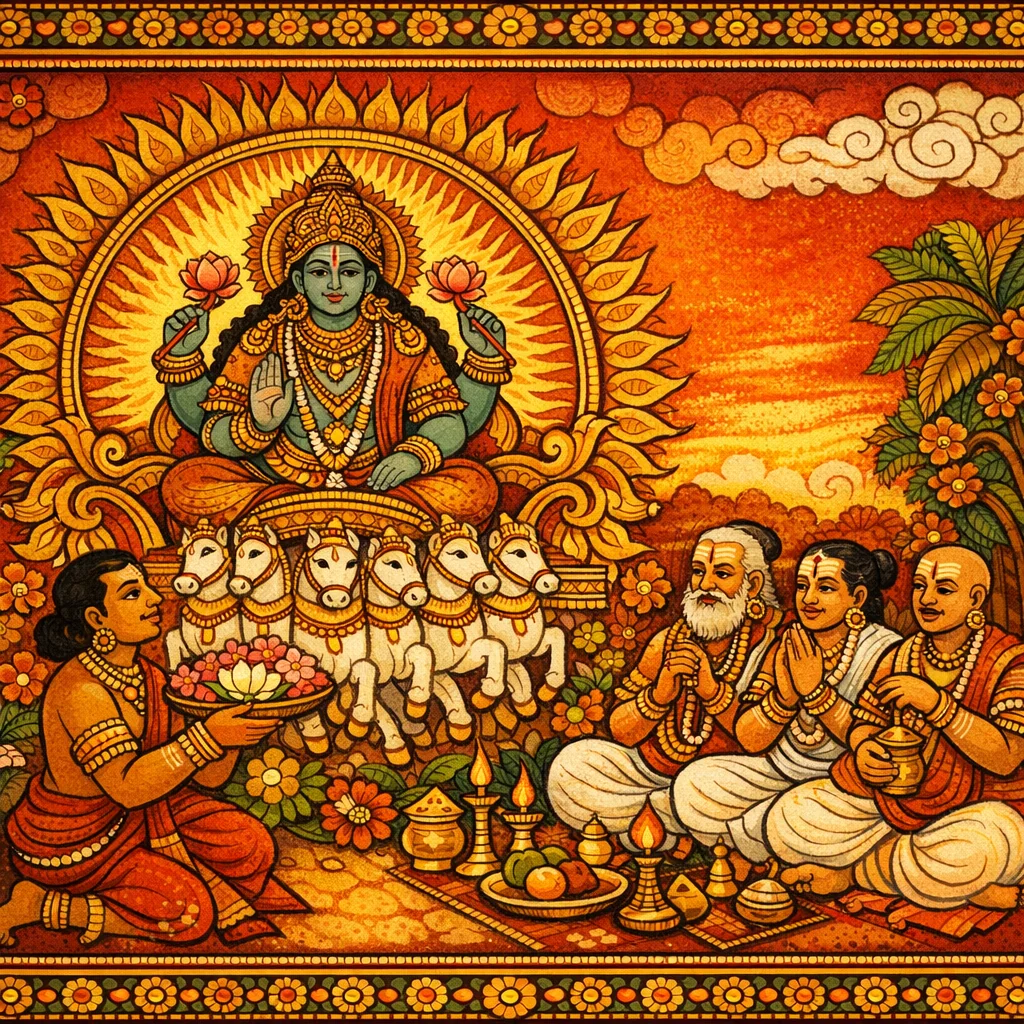
Adhyaya 75: The Viśokā-Saptamī Vow (Saptamī Observance for Freedom from Grief)
विशोकासप्तमी-व्रतवर्णनम्
Speaker: Īśvara (the Lord), Muni-puṅgava (best of sages)
Within the ongoing Purāṇic dialogue, the Lord answers the sage’s devotional query by teaching the Viśokā-Saptamī vow, an observance that dispels grief. He prescribes a Māgha day-by-day discipline: bathe with kṛṣṇa-tila (black sesame), take kṛsarā on the sixth day, keep night fasting and brahmacarya, then rise for japa and worship Arka/Āditya (the Sun) with a golden lotus, red flowers, and red garments, praying for lifelong viśokatā (freedom from sorrow). The rite is completed by honoring Brāhmaṇas, regulated conduct, salt-and-oil-free food and silence on Saptamī, and Purāṇa-śravaṇa for prosperity. The vow continues through both fortnights until Māgha śukla saptamī, ending with major gifts—a kalaśa with a golden lotus, a bed, and a milch cow. The Lord concludes with the phalaśruti: sincere performers attain the highest goal; even hearing or reciting it grants Indra-loka and release from sorrow-laden births.
Key Concepts
Shlokas in Adhyaya 75
Verse 1
*ईश्वर उवाच विशोकसप्तमीं तद्वद् वक्ष्यामि मुनिपुंगव यामुपोष्य नरः शोकं न कदाचिदिहाश्नुते //
The Lord said: “O best of sages, I shall likewise describe the Viśoka-Saptamī. By fasting (upavāsa) on that sacred seventh lunar day, a person never experiences grief in this world.”
Verse 2
माघे कृष्णतिलैः स्नात्वा षष्ठ्यां वै शुक्लपक्षतः कृताहारः कृसरया दन्तधावनपूर्वकम् उपवासव्रतं कृत्वा ब्रह्मचारी भवेन्निशि //
In the month of Māgha, having bathed with water mixed with black sesame (kṛṣṇa-tila), on the sixth lunar day of the bright fortnight one should first cleanse the teeth and then eat only kṛsarā (a simple rice-and-pulse dish). Thereafter, having undertaken the vow of fasting (upavāsa-vrata), one should observe brahmacarya (celibate restraint) at night.
Verse 3
ततः प्रभात उत्थाय कृतस्नानजपः शुचिः कृत्वा तु काञ्चनं पद्मम् अर्कायेति च पूजयेत् करवीरेण रक्तेन रक्तवस्त्रयुगेन च //
Then, rising at dawn—having bathed, completed japa, and become purified—one should prepare a golden lotus and worship (the deity) with the invocation “for Arka,” offering red karavīra (oleander) flowers and a pair of red garments.
Verse 4
यथा विशोकं भुवनं त्वयैवादित्य सर्वदा तथा विशोकता मे ऽस्तु त्वद्भक्तिः प्रतिजन्म च //
O Āditya, just as this world is ever free from sorrow through you alone, so may I too be free from sorrow; and may devotion (bhakti) to you be mine in every birth.
Verse 5
एवं सम्पूज्य षष्ठ्यां तु भक्त्या सम्पूजयेद्द्विजान् सुप्त्वा संप्राश्य गोमूत्रम् उत्थाय कृतनैत्यकः //
Thus, having duly completed the worship, on the sixth day he should, with devotion, honor and worship the dvija, the twice-born (Brāhmaṇas). Having slept, he should sip (saṃprāśya) cow’s urine; then, rising, he should perform the daily obligatory rites (nitya-karman).
Verse 6
सम्पूज्य विप्रानन्नेन गुडपात्रसमन्वितम् तद्वस्त्रयुग्मं पद्मं च ब्राह्मणाय निवेदयेत् //
After duly honoring the Brahmins with food, and together with a vessel of jaggery, one should present to a Brahmin a pair of garments and a lotus as well.
Verse 7
अतैललवणं भुक्त्वा सप्तम्यां मौनसंयुतः ततः पुराणश्रवणं कर्तव्यं भूतिमिच्छता //
On Saptamī, having eaten food prepared without oil and salt, and observing silence, one who desires prosperity should then undertake the listening of the Purāṇa.
Verse 8
अनेन विधिना सर्वम् उभयोरपि पक्षयोः कृत्वा यावत्पुनर्माघशुक्लपक्षस्य सप्तमी //
Having performed everything in this manner in both fortnights—the dark and the bright halves—one should continue again until the Saptamī of the bright fortnight of Māgha.
Verse 9
व्रतान्ते कलशं दद्यात् सुवर्णकमलान्वितम् शय्यां सोपस्करां दद्यात् कपिलां च पयस्विनीम् //
At the completion of the vow, one should gift a ritual water-pot (kalaśa) adorned with a golden lotus. One should also donate a bed complete with its furnishings, and a tawny milch-cow (kapilā) rich in milk.
Verse 10
अनेन विधिना यस्तु वित्तशाठ्यविवर्जितः विशोकसप्तमीं कुर्यात् स याति परमां गतिम् //
Whoever performs the Viśokā-Saptamī observance in this prescribed manner—free from deceit regarding wealth—attains the supreme destination.
Verse 11
यावज्जन्मसहस्राणां साग्रं कोटिशतं भवेत् तावन्न शोकमभ्येति रोगदौर्गत्यवर्जितः //
For as long as a hundred koṭis and more of thousands of births, one does not fall into sorrow, remaining free from disease and misfortune.
Verse 12
यं यं प्रार्थयते कामं तं तमाप्नोति पुष्कलम् निष्कामः कुरुते यस्तु स परं ब्रह्म गच्छति //
Whatever desire a person prays for, that very desire he attains in abundance; but the one who acts without desire attains the Supreme Brahman.
Verse 13
यः पठेच्छृणुयाद्वापि विशोकाख्यां च सप्तमीम् सो ऽपीन्द्रलोकमाप्नोति न दुःखी जायते क्वचित् //
Whoever recites or even listens to the account of the seventh lunar day called Viśokā attains Indra’s world; and he is never born anywhere as one afflicted by sorrow.
Frequently Asked Questions
Adhyāya 75 teaches the complete method (vidhi) of the Viśokā-Saptamī vrata in Māgha—purification, fasting and restraint, Āditya/Arka worship with specific red and golden offerings, honoring Brāhmaṇas, silence and Purāṇa listening, and concluding charity—stating that sincere practice removes grief, supports prosperity, and, when performed without desire, leads to the Supreme Brahman.
This chapter is primarily Dharma in the form of vrata-vidhi (ritual observance), dāna (charity), and phalaśruti (promised results). It does not address Vāstu-śāstra measurements, temple architecture, rājadhrama, or Purāṇic genealogy in these verses.
After dawn bathing and japa, the votary prepares a kāñcana-padma (golden lotus) and worships with the invocation “arkāya,” offering red karavīra (oleander) flowers and a pair of red garments, followed by a prayer seeking freedom from sorrow and devotion in every birth.
At vrata completion, the text prescribes gifting a kalasha (water-pot) adorned with a golden lotus, donating a furnished bed, and giving a kapilā (tawny) milch-cow rich in milk, along with earlier gifts to a Brāhmaṇa such as jaggery vessel, garments, and a lotus.