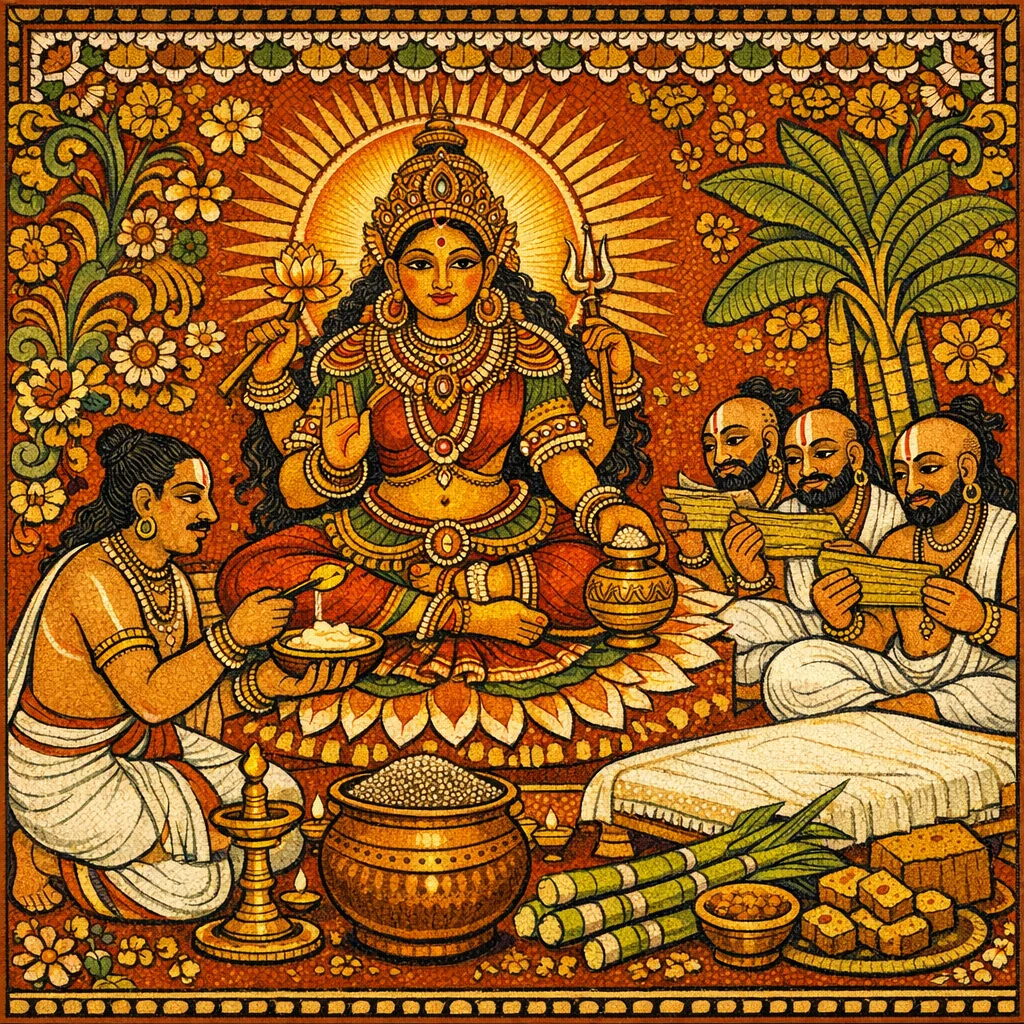
Adhyaya 80: The Procedure and Merit of the Śubha-Saptamī Vrata (Aśvayuja Observance)
शुभसप्तमी-व्रतविधिः
Speaker: Śrī Bhagavān
Bhagavān continues his instruction by introducing “another observance,” the Śubha-Saptamī, and at once declares its chief benefit: freedom from disease, grief, and suffering. He fixes its performance in the month of Āśvayuja and prescribes preliminaries—bathing, japa, maintaining purity, and arranging Vedic recitation by brāhmaṇas—before beginning the vrata. The rite proceeds with devotion to the Kapilā goddess (associated with the Sun), followed by ordered dāna: sesame measured as one prastha in a copper vessel, a golden bull with fragrant items and jaggery, and food offerings twice daily with the formula “Aryamā prīyatām.” After taking pañcagavya and sleeping on the ground without envy, the practitioner honors brāhmaṇas at dawn. Monthly gifts continue through the year, culminating in a year-end gift of a bed; then all is offered to a Veda-knower with “Viśvātmā prīyatām.” Bhagavān concludes with ascending results—from prosperity and fame to divine realms, leadership among vidyādharas, rulership of the saptadvīpas, and finally Viṣṇu’s supreme abode through seven years of observance.
Key Concepts
Shlokas in Adhyaya 80
Verse 1
*श्रीभगवानुवाच अथान्यामपि वक्ष्यामि शोभनां शुभसप्तमीम् यामुपोष्य नरो रोगशोकदुःखैः प्रमुच्यते //
The Blessed Lord said: “Now I shall also describe another observance—the splendid, auspicious Śubha-Saptamī. By fasting on it (upavāsa), a person is released from disease, grief, and suffering.”
Verse 2
पुण्येन चाश्वयुजे मासि कृतस्नानजपः शुचिः वाचयित्वा ततो विप्रान् आरभेच्छुभसप्तमीम् //
In the holy month of Āśvayuja, having bathed and performed japa, remaining pure, one should then have brāhmaṇas recite the sacred texts and thereafter begin the auspicious Saptamī observance.
Verse 3
कपिलां पूजयेद्भक्त्या गन्धमाल्यानुलेपनैः नमामि सूर्यसम्भूताम् अशेषभुवनालयाम् त्वामहं शुभकल्याणशरीरां सर्वसिद्धये //
With devotion one should worship the tawny Kapilā goddess with perfumes, garlands, and unguents: “I bow to you—born of the Sun, the abiding support of all worlds; I revere you, whose form is auspicious and beneficent, for the attainment of every success.”
Verse 4
अथ कृत्वा तिलप्रस्थं ताम्रपात्रेण संयुतम् काञ्चनं वृषभं तद्वद् गन्धमाल्यगुडान्वितैः //
Then, having prepared a prastha-measure of sesame and placing it in a copper vessel, one should likewise offer a golden bull, accompanied by fragrance, garlands, and jaggery.
Verse 5
फलैर् नानाविधैर् भक्ष्यैर् घृतपायससंयुतैः दद्याद्द्विकालवेलायाम् अर्यमा प्रीयतामिति //
At the two appointed times of the day, one should offer assorted fruits and various foods together with ghee and sweet rice-pudding (pāyasa), uttering: “May Aryaman be pleased.”
Verse 6
पञ्चगव्यं च संप्राश्य स्वपेद्भूमौ विमत्सरः ततः प्रभाते संजाते भक्त्या सम्पूजयेद्द्विजान् //
After duly partaking of pañcagavya (the five cow-products used for purification), one should sleep on the ground, free from envy; then, when morning has arisen, one should devotedly honor and worship the twice-born (brāhmaṇas).
Verse 7
अनेन विधिना दद्यान् मासि मासि सदा नरः वाससा वृषभं हैमं तद्वद्गां काञ्चनोद्भवाम् //
By this prescribed procedure, a man should give—month after month, continually—garments, a golden bull, and likewise a cow fashioned of gold.
Verse 8
संवत्सरान्ते शयनम् इक्षुदण्डगुडान्वितम् सोपधानकविश्रामं भाजनासनसंयुतम् //
At the end of the year, one should gift a bed furnished with sugarcane-stalks and jaggery, complete with a pillow and a resting-support, and accompanied by vessels and a seat.
Verse 9
ताम्रपात्रे तिलप्रस्थं सौवर्णं वृषभं तथा दद्याद्वेदविदे सर्वं विश्वात्मा प्रीयतामिति //
Placing a prastha-measure of sesame in a copper vessel, and also a golden bull, one should give all of this to a knower of the Veda, (praying,) “May the Universal Self be pleased.”
Verse 10
अनेन विधिना विद्वान् कुर्याद्यः शुभसप्तमीम् तस्य श्रीर्विपुला कीर्तिर् भवेज्जन्मनि जन्मनि //
A learned person who performs the Śubha-Saptamī observance according to this prescribed method attains prosperity and wide-ranging fame, life after life.
Verse 11
अप्सरोगणगन्धर्वैः पूज्यमानः सुरालये वसेद्गणाधिपो भूत्वा यावदाभूतसंप्लवम् कल्पादाववतीर्णस्तु सप्तद्वीपाधिपो भवेत् //
Honoured by hosts of Apsarases and Gandharvas, he dwells in the abode of the gods; becoming a chief of the Gaṇas, he remains there until the cosmic dissolution. Then, descending again at the beginning of a new kalpa, he becomes a sovereign ruler over the seven continents (saptadvīpas).
Verse 12
ब्रह्महत्यासहस्रस्य भ्रूणहत्याशतस्य च नाशायालमियं पुण्या पठ्यते शुभसप्तमी //
This holy Śubha-Saptamī, when recited, is fully sufficient to destroy the sin of a thousand brahmin-slaughters and a hundred killings of embryos.
Verse 13
इमां पठेद्यः शृणुयान्मुहूर्तं पश्येत्प्रसङ्गादपि दीयमानम् सो ऽप्यत्र सर्वाघविमुक्तदेहः प्राप्नोति विद्याधरनायकत्वम् //
Whoever recites this, or listens to it for even a single muhūrta, or even happens to see it being given (recited or bestowed) by mere association—he too, in this very state, becomes freed from all sin; and he attains the rank of a leader among the Vidyādharas.
Verse 14
यावत्समाः सप्त नरः करोति यः सप्तमीं सप्तविधानयुक्ताम् स सप्तलोकाधिपतिः क्रमेण भूत्वा पदं याति परं मुरारेः //
A man who, for seven years, observes the Saptamī rite endowed with its seven prescribed constituents, becomes in due course the lord of the seven worlds, and thereafter attains the supreme abode of Murāri (Vishnu).
Frequently Asked Questions
Adhyāya 80 teaches the complete method (vidhi) and fruits (phala) of the Śubha-Saptamī vrata: observe the fast in Āśvayuja with purity (snāna, japa), arrange brāhmaṇa recitation, worship the kapilā goddess described as sun-born, and perform specified dānas—sesame (prastha) in a copper vessel, a golden bull, and regulated food offerings with the mantra “Aryamā prīyatām.” The chapter stresses ethical restraint (sleeping on the ground, freedom from envy) and culminates in honoring brāhmaṇas and gifting to a Veda-knower with “Viśvātmā prīyatām.”
This chapter is primarily Dharma in the form of Vrata-Dharma and Dāna-Dharma (ritual observance and gifting). It does not address Vāstu-śāstra measurements, temple architecture, or Purāṇic genealogy; instead it focuses on calendrical observance (Āśvayuja), devotional worship, mantra-formulas (Aryaman/Viśvātmā satisfaction), purification practices (pañcagavya), and the karmic and cosmological rewards described in Purāṇic soteriology.