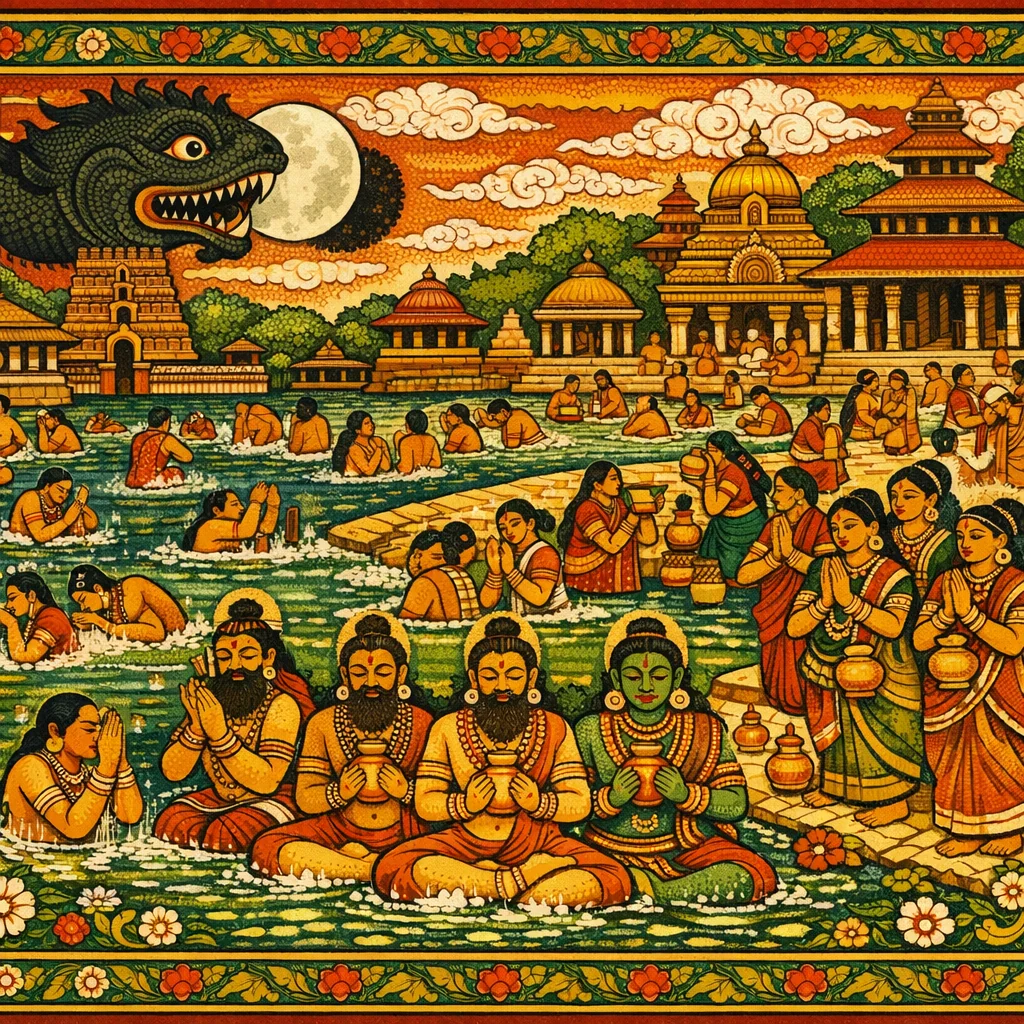
Adhyaya 107: The Greatness of Prayaga: Manasa Tirtha, Magha Snana, Austerities, and the Debt-Removing Tirtha
प्रयागमाहात्म्ये मानसा-तीर्थ-ऋणप्रमोचन-तीर्थवर्णनम्
Speaker: Mārkaṇḍeya, Rājā (King)
Mārkaṇḍeya resumes praising Prayāga’s greatness to the king, naming key tīrthas and observances: Mānasā on the Gaṅgā’s north bank (a three-night fast), the power of merely remembering the tīrtha, and the liberating promise of entering the Gaṅgā. He describes post-mortem fruits—celestial vehicles, long enjoyment in svarga, and, when merit is spent, rebirth in wealthy or royal families. In Māgha, when sacred time converges, innumerable tīrthas and rivers “arrive” at the Gaṅgā–Yamunā saṅgama; bathing for three days equals vast gifts of cows. He lists austerities (karṣāgni, enduring fire, offering oneself to birds) and their heavenly or royal results, and says eclipse-bathing at the famed confluence destroys sin and grants Somaloka. Finally, he locates the Ṛṇa-pramocana (debt-removing) tīrtha near Prayāga on the Yamunā’s north bank, prescribing a one-night stay and bath to be freed from debts.
Key Concepts
Shlokas in Adhyaya 107
Verse 1
*मार्कण्डेय उवाच शृणु राजन्प्रयागस्य माहात्म्यं पुनरेव तु यच्छ्रुत्वा सर्वपापेभ्यो मुच्यते नात्र संशयः //
Mārkaṇḍeya said: Listen, O King, once again to the greatness of Prayāga; by hearing it, one is freed from all sins—of this there is no doubt.
Verse 2
मानसं नाम तत्तीर्थं गङ्गाया उत्तरे तटे त्रिरात्रोपोषितो भूत्वा सर्वकामानवाप्नुयात् //
There is a sacred ford named Mānasā on the northern bank of the Gaṅgā. Having observed a fast there for three nights, one attains the fulfillment of all desired aims.
Verse 3
गोभूहिरण्यदानेन यत्फलं प्राप्नुयान्नरः स तत्फलमवाप्नोति तत्तीर्थं स्मरते पुनः //
Whatever merit a person would obtain by gifting cows, land, and gold—he attains that very merit again simply by remembering that sacred tīrtha.
Verse 4
अकामो वा सकामो वा गङ्गायां यो ऽभिपद्यते मृतस्तु लभते स्वर्गं नरकं च न पश्यति //
Whether one is free of desires or full of desires, whoever enters the Gaṅgā—upon death—attains heaven and does not behold hell.
Verse 5
अप्सरोगणसंगीतैः सुप्तो ऽसौ प्रतिबुध्यते हंससारसयुक्तेन विमानेन स गच्छति बहुवर्षसहस्राणि स्वर्गं राजेन्द्र भुञ्जति //
Awakened from sleep by the music of the hosts of Apsarās, he rises; and, mounting a celestial vimāna yoked with swans and cranes, he departs. For many thousands of years, O king of kings, he enjoys heaven.
Verse 6
ततः स्वर्गात्परिभ्रष्टः क्षीणकर्मा दिवश्च्युतः सुवर्णमणिमुक्ताढ्ये जायते विपुले कुले //
Then, fallen back from heaven—his store of merit exhausted and thus cast down from the celestial world—he is born into a great and prosperous family abounding in gold, jewels, and pearls.
Verse 7
षष्टितीर्थसहस्राणि षष्टिकोट्यस्तथापगाः माघमासे गमिष्यन्ति गङ्गायमुनसंगमम् //
In the month of Māgha, sixty thousand sacred fords (tīrthas) and likewise sixty crores of rivers will proceed to the confluence of the Gaṅgā and Yamunā.
Verse 8
गवां शतसहस्रस्य सम्यग्दत्तस्य यत्फलम् प्रयागे माघमासे तु त्र्यहस्नानात्तु तत्फलम् //
Whatever merit arises from properly gifting one hundred thousand cows—that very merit is obtained by bathing for three days at Prayāga during the month of Māgha.
Verse 9
गङ्गायमुनयोर्मध्ये कर्षाग्निं यस्तु साधयेत् अहीनाङ्गो ह्यरोगश्च पञ्चेन्द्रियसमन्वितः //
Whoever performs the austerity called “karṣāgni” in the land between the Gaṅgā and the Yamunā becomes free from bodily defect and disease, and remains endowed with all five senses.
Verse 10
यावन्ति रोमकूपाणि तस्य गात्रेषु देहिनः तावद्वर्षसहस्राणि स्वर्गलोके महीयते //
As many hair-pores as are on the limbs of that embodied person, for that many thousands of years he is honored in the heavenly world.
Verse 11
ततः स्वर्गात्परिभ्रष्टो जम्बूद्वीपपतिर्भवेत् स भुक्त्वा विपुलान्भोगांस् तत्तीर्थं स्मरते पुनः //
Then, when he falls away from heaven, he is born as a sovereign lord of Jambūdvīpa. Having enjoyed abundant pleasures, he remembers that sacred ford (tīrtha) again.
Verse 12
जलप्रवेशं यः कुर्यात् संगमे लोकविश्रुते राहुग्रस्ते तथा सोमे विमुक्तः सर्वकिल्बिषैः //
Whoever enters the water (for a ritual bath) at a world-renowned confluence, and likewise when the Moon is seized by Rāhu (during a lunar eclipse), is freed from all sins.
Verse 13
सोमलोकमवाप्नोति सोमेन सह मोदते षष्टिवर्षसहस्राणि स्वर्गलोके महीयते //
He attains the world of Soma, rejoices together with Soma, and for sixty thousand years is honored in the heavenly realm.
Verse 14
स्वर्गे च शक्रलोके ऽस्मिन् नृषिगन्धर्वसेविते परिभ्रष्टस्तु राजेन्द्र समृद्धे जायते कुले //
And in this heaven—the realm of Śakra (Indra), frequented by seers and Gandharvas—when one falls from there, O king of kings, one is born into a prosperous family.
Verse 15
अधःशिरास्तु यो ज्वालाम् ऊर्ध्वपादः पिबेन्नरः शतवर्षसहस्राणि स्वर्गलोके महीयते //
A man who, hanging with his head downward and his feet upward, “drinks” (endures) the blazing fire is honored in the heavenly world for a hundred thousand years.
Verse 16
परिभ्रष्टस्तु राजेन्द्र सो ऽग्निहोत्री भवेन्नरः भुक्त्वा तु विपुलान्भोगांस् तत्तीर्थं भजते पुनः //
O best of kings, even a man who has fallen from his proper religious observances becomes again an Agnihotrin—one who maintains the sacred fire. Having enjoyed abundant worldly pleasures, he once more resorts to that sacred ford (tīrtha).
Verse 17
यः स्वदेहं तु कर्तित्वा शकुनिभ्यः प्रयच्छति विहगैरुपभुक्तस्य शृणु तस्यापि यत्फलम् //
He who, offering up his own body, gives it to the birds—hear also what fruit accrues to one whose body is consumed by winged creatures.
Verse 18
शतं वर्षसहस्राणां सोमलोके महीयते तस्मादपि परिभ्रष्टो राजा भवति धार्मिकः //
For a hundred thousand years he is honored in the Moon-world (Somaloka); and even when he falls from there, he is reborn as a righteous king.
Verse 19
गुणवान् रूपसम्पन्नो विद्वांश्च प्रियवाचकः भुक्त्वा तु विपुलान्भोगांस् तत्तीर्थं भजते पुनः //
Endowed with virtues and beauty—learned, and sweet of speech—having enjoyed abundant pleasures, one returns again to resort to that sacred tīrtha.
Verse 20
यामुने चोत्तरे कूले प्रयागस्य तु दक्षिणे ऋणप्रमोचनं नाम तत्तीर्थं परमं स्मृतम् //
On the northern bank of the Yamunā, and to the south of Prayāga, there is a sacred ford called Ṛṇa-pramocana (“Release from Debts”); it is remembered as a tīrtha of supreme excellence.
Verse 21
एकरात्रोषितः स्नात्वा ऋणैः सर्वैः प्रमुच्यते स्वर्गलोकमवाप्नोति अनृणश्च सदा भवेत् //
After staying for a single night and then bathing (at that sacred place), one is released from all debts; one attains the heavenly world and becomes ever free from indebtedness.
Frequently Asked Questions
The chapter teaches that Prayāga and its associated tīrthas are powerful means of purification and merit: fasting at Mānasā, bathing at the Gaṅgā–Yamunā saṅgama (especially in Māgha), and bathing during a lunar eclipse remove sins and yield major karmic rewards. It also presents Ṛṇa-pramocana tīrtha as a dharmic remedy for freedom from debts through a simple one-night stay and bath.
This adhyāya is primarily Dharma-focused—tīrtha-mahātmyā, vratas (fasting), snāna rites, tapas, dāna-equivalences, and karmic फल (svarga, rebirth in wealthy/royal families). It does not treat Vāstu-śāstra measurements or purāṇic genealogies directly, but it does describe rebirth into prosperous or kingly lineages as a karmic outcome.
It states that during Māgha, vast numbers of tīrthas and rivers converge at the Gaṅgā–Yamunā saṅgama, and that bathing for three days at Prayāga in Māgha grants merit equal to properly gifting one hundred thousand cows.
Ṛṇa-pramocana (“release from debts”) is located near Prayāga on the northern bank of the Yamunā, south of Prayāga. The text says that staying one night and bathing there frees a person from all debts, grants heaven, and makes one perpetually ‘unindebted’ (anṛṇa).