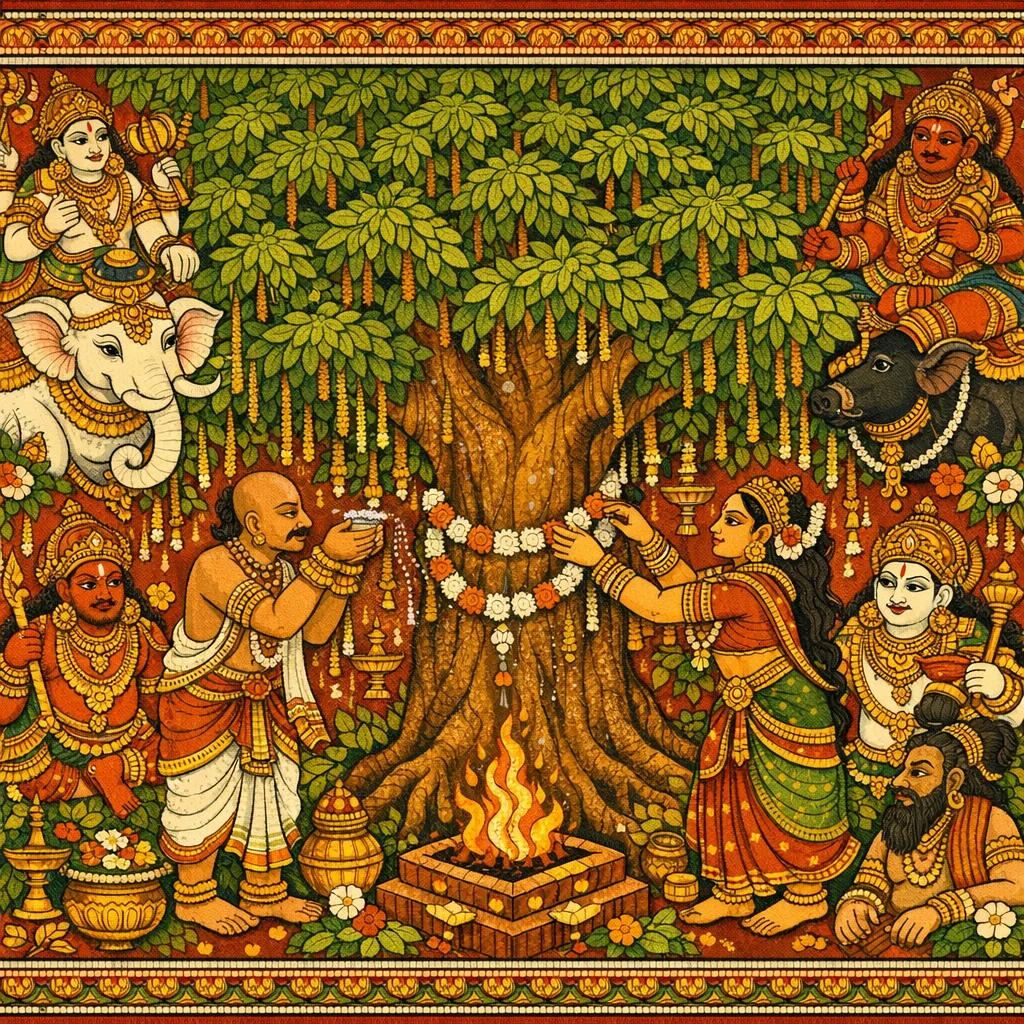
Adhyaya 59: Rites for Consecrating and Celebrating Trees (Pādapa-Udyāpana / Vṛkṣotsava)
पादपोद्यापनविधिः (वृक्षोत्सवविधानम्)
Speaker: Rishis, Suta
The sages ask Sūta for a well-ordered, detailed code concerning trees and the rite for consecrating and establishing a tree, along with clarification of the worlds spoken of in tradition and the post-mortem fruits of such deeds. Sūta replies by fitting tree-rites to the already-set pattern of the “pond-ritual”: prepare the maṇḍapa and officiants, honor brāhmaṇas, ritually purify and adorn the trees, perform adhivāsa with fruits, offer incense and bali, install kumbhas, and conduct homa to the Lokapālas (especially Indra) and to Vanaspati. He then prescribes releasing an auspicious, ornamented milch cow and performing snapana/abhiṣeka with Ṛg–Yajus–Sāma and Varuṇa formulas. The yajamāna rewards the priests, maintains four days of milk-based feeding and gifts, and concludes with further dakṣiṇā and a respectful dismissal of the ācārya. The phalaśruti closes the chapter: desires are fulfilled, merit becomes inexhaustible, even one tree grants prolonged heavenly residence; salvific benefit increases with the number of trees; and listeners/reciters gain honor in Brahmaloka.
Key Concepts
Shlokas in Adhyaya 59
Verse 1
*ऋषय ऊचुः पादपानां विधिं सूत यथावद्विस्तराद्वद विधिना केन कर्तव्यं पादपोद्यापनं बुधैः //
The sages said: “O Sūta, tell us, in proper sequence and in full detail, the prescribed rules concerning trees. By what ritual procedure should the wise perform the consecration and establishment of a tree (pādapa-udyāpana)?”
Verse 2
ये च लोकाः स्मृतास्तेषां तानिदानीं वदस्व नः यत्फलं लभते प्रेत्य तत्सर्वं वक्तुमर्हसि //
“And concerning the worlds spoken of in tradition—tell us of them now. Also explain in full what reward a person obtains after death; you ought to declare all of that.”
Verse 3
*सूत उवाच पादपानां विधिं वक्ष्ये तथैवोद्यानभूमिषु तडागविधिवत्सर्वम् आसाद्य जगदीश्वर //
Sūta said: “I shall describe the proper procedure regarding trees, and likewise regarding garden-lands. Having approached the Lord of the world, I shall relate everything in accordance with the rules prescribed for ponds.”
Verse 4
ऋत्विङ्मण्डपसम्भारश् चाचार्यश्चैव तद्विधः पूजयेद्ब्राह्मणांस्तद्वद् धेमवस्त्रानुलेपनैः //
The officiating priest (ṛtvij), together with the preparations for the ritual pavilion, and likewise the qualified ācārya in accordance with that rule, should honour the brāhmaṇas in the same manner—by gifts of gold, garments, and unguents for anointing.
Verse 5
सर्वौषध्युदकैः सिक्तान् पिष्टातकविभूषितान् वृक्षान्माल्यैरलंकृत्य वासोभिरभिवेष्टयेत् //
He should sprinkle the trees with water infused with all healing herbs; adorn them with piṣṭātaka (a decorative paste), decorate them with garlands, and then wrap them with cloth.
Verse 6
सूच्या सौवर्णया कार्यं सर्वेषां कर्णवेधनम् अञ्जनं चापि दातव्यं तद्वद्धेमशलाकया //
The ear-piercing for all should be performed with a golden needle; and anjana (collyrium) should likewise be applied with a golden probe (rod).
Verse 7
फलानि सप्त चाष्टौ वा कालधौतानि कारयेत् प्रत्येकं सर्ववृक्षाणां वेद्यां तान्यधिवासयेत् //
One should arrange seven or eight fruits, cleansed and mellowed by time; and, for each sacred tree, place those fruits upon the vedī (altar) for the rite of adhivāsa.
Verse 8
धूपो ऽत्र गुग्गुलः श्रेष्ठस् ताम्रपात्रैरधिष्ठितान् सप्तधान्यस्थितान्कृत्वा वस्त्रगन्धानुलेपनैः //
Here, the finest incense is guggulu. It should be placed in copper vessels, set upon a base of the seven grains, and accompanied by cloth, fragrances, and perfumed anointing.
Verse 9
कुम्भान्सर्वेषु वृक्षेषु स्थापयित्वा नरेश्वर सहिरण्यानशेषांस्तान् कृत्वा बलिनिवेदनम् //
O king, having set up ritual jars (kumbhas) at all the trees and having furnished each of them with gold, one should then make the complete offering of bali (propitiatory oblations).
Verse 10
यथास्वं लोकपालानाम् इन्द्रादीनां विशेषतः वनस्पतेश्च विद्वद्भिर् होमः कार्यो द्विजातिभिः //
In due order, the learned twice-born should perform homa—offerings into the sacred fire—for the Lokapālas (Guardians of the Worlds), especially Indra and the other gods, and also for Vanaspati, lord of vegetation and trees.
Verse 11
ततः शुक्लाम्बरधरां सौवर्णकृतभूषणाम् सकांस्यदोहां सौवर्णशृङ्गाभ्याम् अतिशालिनीम् पयस्विनीं वृक्षमध्याद् उत्सृजेद्गामुदङ्मुखीम् //
Then one should release, from the space between the trees, a milk-yielding cow—abundant and well-nourished—draped in white cloth, adorned with ornaments of gold, with a bronze milking-vessel, and with horns covered in gold, facing north.
Verse 12
ततो ऽभिषेकमन्त्रेण वाद्यमङ्गलगीतकैः ऋग्यजुःसाममन्त्रैश्च वारुणैरभितस्तथा तैरेव कुम्भैः स्नपनं कुर्याद्ब्राह्मणपुंगवः //
Then, with the consecration (abhiṣeka) mantra—amid instrumental music and auspicious songs—and with Ṛg, Yajus, and Sāma Vedic mantras, as well as Varuṇa-related water formulas recited all around, the foremost of Brahmins should perform the ceremonial bathing (snapana) using those very water-pots (kumbhas).
Verse 13
स्नातः शुक्लाम्बरस्तद्वद् यजमानो ऽभिपूजयेत् गोभिर् विभवतः सर्वान् ऋत्विजस्तान्समाहितः //
Having bathed and wearing white garments, the sacrificer (yajamāna) should likewise honor them with reverent worship; and, according to his means, he should respectfully reward all those officiating priests (ṛtvij-s) with gifts of cows, remaining composed and attentive.
Verse 14
हेमसूत्रैः सकटकैर् अङ्गुलीयपवित्रकैः वासोभिः शयनीयैश्च तथोपस्करपादुकैः क्षीरेण भोजनं दद्याद् यावद्दिनचतुष्टयम् //
With golden threads, small carts, rings and sacred finger-rings, garments and bedding, as well as household utensils and footwear—one should offer food prepared with milk for a full four days.
Verse 15
होमश्च सर्षपैः कार्यो यवैः कृष्णतिलैस्तथा पलाशसमिधः शस्ताश् चतुर्थे ऽह्नि तथोत्सवः दक्षिणा च पुनस्तद्वद् देया तत्रापि शक्तितः //
A fire-offering (homa) should be performed with mustard seeds, with barley, and likewise with black sesame; and sticks of palāśa wood are praised as the proper fuel. On the fourth day there should also be a festival observance (utsava); and again, in the same manner, a priestly fee (dakṣiṇā) should be given there too, according to one’s capacity.
Verse 16
यद्यदिष्टतमं किंचित् तत्तद् दद्यादमत्सरी आचार्ये द्विगुणं दद्यात् प्रणिपत्य विसर्जयेत् //
Whatever one cherishes most, even if it is only a little, the person free from envy should give that very thing. To one’s teacher (ācārya) one should give twice as much, and after bowing in reverence, take leave respectfully.
Verse 17
अनेन विधिना यस्तु कुर्याद्वृक्षोत्सवं बुधः सर्वान्कामानवाप्नोति फलं चानन्त्यमश्नुते //
The wise person who performs the tree-festival according to this prescribed method attains all desired aims, and also enjoys an imperishable, endless fruit of merit.
Verse 18
यश्चैकमपि राजेन्द्र वृक्षं संस्थापयेन्नरः सो ऽपि स्वर्गे वसेद्राजन् यावदिन्द्रायुतत्रयम् //
O best of kings, whoever establishes even a single tree—such a man too, O king, dwells in heaven for as long as three ayutas of Indra, an exceedingly vast span measured in Indra-years.
Verse 19
भूतान्भव्यांश्च मनुजांस् तारयेद्द्रुमसंमितान् परमां सिद्धिमाप्नोति पुनरावृत्तिदुर्लभाम् //
Whoever helps ferry across to safety and higher good human beings—those of the past and those yet to come—numbering as many as trees, attains the supreme spiritual perfection, one that is hard to regain once the cycle of return begins again.
Verse 20
य इदं शृणुयान्नित्यं श्रावयेद्वापि मानवः सो ऽपि सम्पूजितो देवैर् ब्रह्मलोके महीयते //
Whoever regularly listens to this teaching/recitation, or even causes it to be recited for others—such a person, honored by the gods, is exalted in the world of Brahmā (Brahmaloka).
Frequently Asked Questions
Adhyāya 59 teaches the full ritual protocol for pādapa-udyāpana (consecrating/establishing a tree) and observing a vṛkṣotsava. It prescribes preparations (maṇḍapa, ṛtvij, ācārya), honoring brāhmaṇas, purifying and adorning trees, adhivāsa with fruits, incense and bali, kumbha installation, homa to Lokapālas (notably Indra) and Vanaspati, snapana/abhiṣeka with Vedic and Vāruṇa formulas, cow release, multi-day feeding, and dakṣiṇā—followed by stated spiritual rewards.
This chapter is primarily Dharma and ritual practice (vrata–dāna orientation), applied to sacred ecology: tree establishment, garden/landscape sanctification, and merit-making. It is not a genealogy or creation narrative chapter; its Vastu relevance is indirect—treating trees/groves as sanctified elements of ordered space (udyāna/ārāma) and aligning their rites with pond-consecration procedures.
Key items include herb-infused water for sprinkling, decorative paste (piṣṭātaka), garlands and cloth wrappings, gold instruments (needle for symbolic ear-piercing; gold rod for anjana), 7 or 8 ripe/aged fruits for adhivāsa on the vedī, guggulu incense placed in copper vessels set upon seven grains, kumbhas placed at each tree with gold, bali offerings, and homa materials such as mustard, barley, black sesame, with palāśa sticks as praised fuel.
The homa is directed to the Lokapālas (Guardians of the Worlds), with special emphasis on Indra and the other gods, and additionally to Vanaspati, the lord/presiding deity of vegetation and trees.
The text promises fulfillment of desired aims and ‘endless’ merit for performing the vṛkṣotsava correctly. It further states that even establishing a single tree grants residence in heaven for an exceedingly long duration (three ayutas of Indra). It also frames tree establishment as saving/benefiting multitudes ‘as many as trees,’ leading to supreme siddhi, and says that regular hearing or sponsoring recitation brings honor in Brahmaloka.