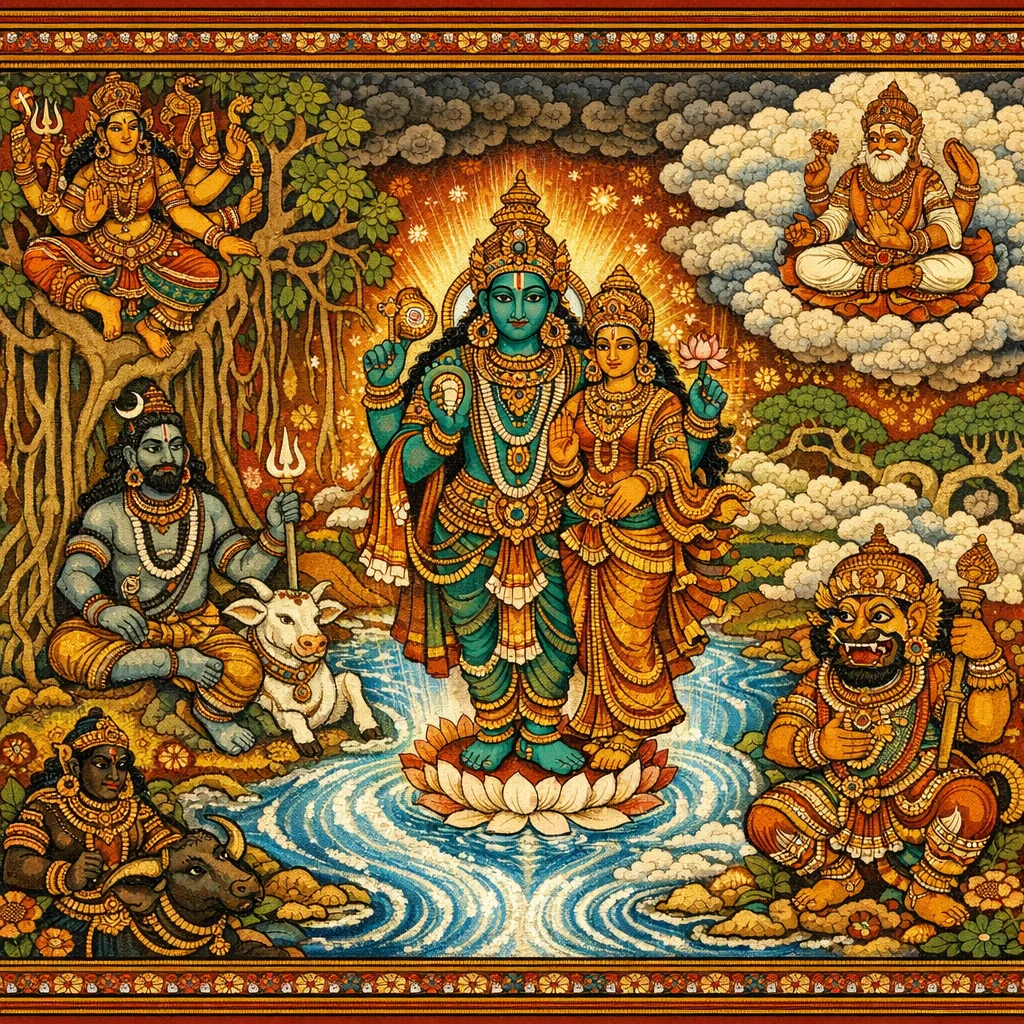
Adhyaya 111: Prayaga Mahatmya: Trimurti Presence, Cosmic Functions, and Liberative Vision
प्रयागमाहात्म्ये त्रिमूर्तितत्त्वप्रतिपादनम्
Speaker: Yudhiṣṭhira, Mārkaṇḍeya
Yudhiṣṭhira asks for a complete account of Prayāga’s teaching as a means to liberation. Mārkaṇḍeya declares Prayāga the place where the whole world and the Trimūrti are manifest, explains the cosmic functions—Brahmā creates, Viṣṇu nourishes and sustains, Rudra dissolves—and affirms that Prayāga remains imperishable even at the end of a kalpa. Yudhiṣṭhira then asks how this śruti is firmly established and why the best people remain steadfast in it. The sage replies with sacred topography: a five-yojana Prayāga-maṇḍala guarded to bar sin; Brahmā dwelling incognito north of Pratiṣṭhāna; Viṣṇu present as Veṇī-Mādhava; and Śiva present as the Maheśvara-vaṭa. He teaches that offerings there burn away sins and avert hell, names Prayāga as Prajāpati’s holy field, and concludes by urging Yudhiṣṭhira to found stable, righteous kingship with his brothers.
Key Concepts
Shlokas in Adhyaya 111
Verse 1
*युधिष्ठिर उवाच कथं सर्वमिदं प्रोक्तं प्रयागस्य महामुने एतन्नः सर्वमाख्याहि यथा हि मम तारयेत् //
Yudhiṣṭhira said: “O great sage, how has all this concerning Prayāga been declared? Please explain it all to us fully, so that it may indeed become a means of deliverance for me.”
Verse 2
*मार्कण्डेय उवाच शृणु राजन्प्रयागे तु प्रोक्तं सर्वमिदं जगत् ब्रह्मा विष्णुस्तथेशानो देवताः प्रभुरव्ययः //
Mārkaṇḍeya said: “Listen, O King—at Prayāga this entire world is spoken of (and made manifest): Brahmā, Viṣṇu, and likewise Īśāna (Śiva)—the deities—the imperishable Lord.”
Verse 3
ब्रह्मा सृजति भूतानि स्थावरं जङ्गमं च यत् तान्येतानि परं लोके विष्णुः संवर्धते प्रजाः //
Brahmā creates the beings—both the immovable and the movable; and in the higher world it is Viṣṇu who nurtures and causes these creatures (the progeny) to flourish.
Verse 4
कल्पान्ते तत्समग्रं हि रुद्रः संहरते जगत् तदा प्रयागतीर्थं च न कदाचिद्विनश्यति //
At the end of a kalpa, Rudra indeed withdraws (dissolves) this entire world; yet even then, the sacred ford of Prayāga never perishes at any time.
Verse 5
ईश्वरः सर्वभूतानां यः पश्यति स पश्यति यत्नेनानेन तिष्ठन्ति ते यान्ति परमां गतिम् //
He alone truly sees who beholds the Lord dwelling in all beings. Established in this disciplined effort, they attain the supreme destination—mokṣa (liberation).
Verse 6
*युधिष्ठिर उवाच आख्याहि मे यथातथ्यं यथैषा तिष्ठति श्रुतिः केन वा कारणेनैव तिष्ठन्ते लोकसत्तमाः //
Yudhiṣṭhira said: Tell me truthfully and precisely how this sacred teaching (śruti) stands established. And for what reason, indeed, do the foremost among people remain steadfast in it?
Verse 7
*मार्कण्डेय उवाच प्रयागे निवसन्त्येते ब्रह्मविष्णुमहेश्वराः कारणं तत्प्रवक्ष्यामि शृणु तत्त्वं युधिष्ठिर //
Mārkaṇḍeya said: In Prayāga dwell these very deities—Brahmā, Viṣṇu, and Maheśvara. I shall explain the reason for that; listen to the true principle, O Yudhiṣṭhira.
Verse 8
पञ्चयोजनविस्तीर्णं प्रयागस्य तु मण्डलम् तिष्ठन्ति रक्षणायात्र पापकर्मनिवारणात् //
The sacred maṇḍala of Prayāga extends for five yojanas; there, protective powers stand guard for the removal and restraint of sinful deeds.
Verse 9
उत्तरेण प्रतिष्ठानाच् छद्मना ब्रह्म तिष्ठति वेणीमाधवरूपी तु भगवांस्तत्र तिष्ठति //
To the north of Pratiṣṭhāna, Brahmā abides in a concealed (incognito) manner; and there too the Blessed Lord dwells, taking the form known as Veṇī-Mādhava.
Verse 10
माहेश्वरो वटो भूत्वा तिष्ठते परमेश्वरः ततो देवाः सगन्धर्वाः सिद्धाश्च परमर्षयः रक्षन्ति मण्डलं नित्यं पापकर्मनिवारणात् //
Having become the Maheśvara-vaṭa (Śiva’s sacred banyan), the Supreme Lord abides there. Therefore the gods, together with the Gandharvas, the Siddhas, and the great seers, continually protect that holy maṇḍala, for it averts sinful deeds.
Verse 11
यस्मिञ्जुह्वन्स्वकं पापं नरकं च न पश्यति एवं ब्रह्मा च विष्णुश्च प्रयागे स महेश्वरः //
In that sacred place, one who performs the homa (fire-offering) casts his own sins into the fire and does not behold hell. Thus, at Prayāga, Brahmā and Viṣṇu are present—there indeed is Maheśvara (Śiva).
Verse 12
सप्तद्वीपाः समुद्राश्च पर्वताश्च महीतले रक्षमाणाश्च तिष्ठन्ति यावदाभूतसंप्लवम् //
Upon the earth’s surface, the seven continents, the oceans, and the mountains stand firm as guardians, enduring so long as the great dissolution of beings—the cosmic deluge—has not arrived.
Verse 13
ये चान्ये बहवः सर्वे तिष्ठन्ति च युधिष्ठिर यत् पृथिवी तत्समाश्रित्य निर्मिता दैवतैस् त्रिभिः //
And many others as well, O Yudhiṣṭhira, remain established; for the Earth—resting upon that very foundation—was fashioned by the three deities.
Verse 14
प्रजापतेरिदं क्षेत्रं प्रयागमिति विश्रुतम् एतत्पुण्यं पवित्रं वै प्रयागं च युधिष्ठिर स्वराज्यं कुरु राजेन्द्र भ्रातृभिः सहितो ऽनघ //
This sacred tract is Prajāpati’s own kṣetra (holy field), renowned by the name Prayāga. O Yudhiṣṭhira, this Prayāga is truly meritorious and purifying. Therefore, O best of kings, O sinless one, establish your sovereign rule together with your brothers.
Frequently Asked Questions
Adhyaya 111 teaches that Prayāga is an imperishable tīrtha where the Trimūrti are present and where the entire cosmic order is symbolically manifest. By understanding Brahmā as creator, Viṣṇu as nourisher, and Rudra as dissolver—and by practicing the inner discipline of seeing the Lord in all beings—one attains the supreme goal (mokṣa). It also instructs that ritual offering at Prayāga destroys sin and prevents falling into hell.
This chapter is primarily Dharma and Tīrtha-Māhātmya with a strong mokṣa-philosophy layer. It includes sacred geography (the five-yojana Prayāga-maṇḍala, Pratiṣṭhāna, Veṇī-Mādhava, Maheśvara-vaṭa), cosmic theology (Trimūrti roles across the kalpa), and a Rajadharma implication by urging Yudhiṣṭhira to establish sovereign rule after purification. It does not present Vāstu-śāstra measurements or genealogical lists in these verses.