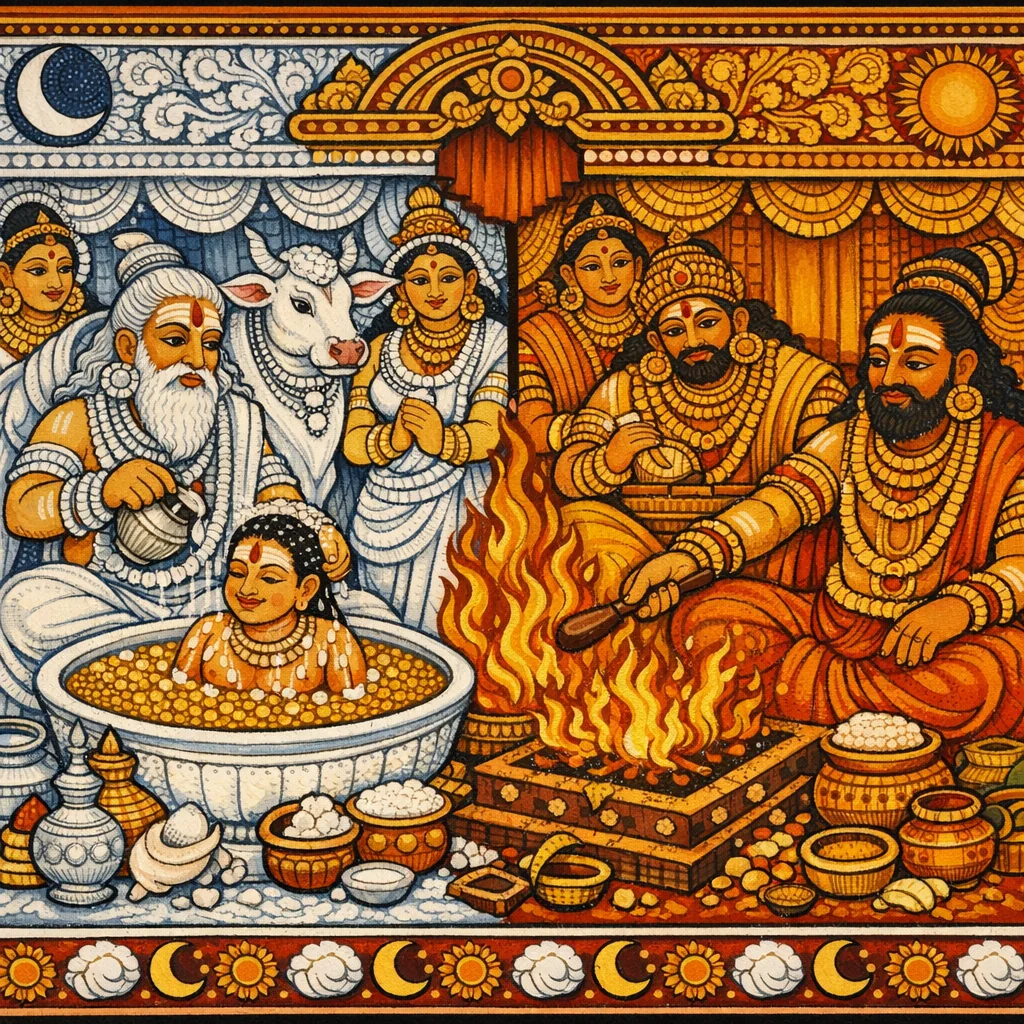
Adhyaya 73: Pratiśukra Rite and the Worship of Śukra (Venus) & Bṛhaspati (Jupiter) for Pacification and Success
प्रतिशुक्र-वाचस्पति-पूजा-विधानम्
Speaker: Pippalāda, King Yudhiṣṭhira
Pippalāda instructs Yudhiṣṭhira in a pacificatory observance called Pratiśukra, to be performed at the start and end of journeys and at the rising of Śukra (Venus). He specifies the proper vessel materials and white offerings, prescribes a formal arghya with a Śukra-stuti mantra, and declares the fruits—wish-fulfillment and honor in Viṣṇu’s world. He then adds a restraint: one should not eat until Śukra’s worship is completed with the prescribed foods and garlands, maintained as a threefold observance for kāma and artha. Next he teaches Vācaspati/Bṛhaspati worship: a gold icon in a golden vessel, yellow garments and flowers, ritual bathing with ingredients including pañcagavya, ghṛta-homa, and gifting a cow to a brāhmaṇa, with a mantra praising Bṛhaspati as nectar to those afflicted by harsh planets. The chapter ends by recommending key times—Saṅkrānti, Amāvāsyā, journeys, and auspicious occasions—for complete success.
Key Concepts
Shlokas in Adhyaya 73
Verse 1
*पिप्पलाद उवाच अथातः शृणु भूपाल प्रतिशुक्रं प्रशान्तये यात्रारम्भे ऽवसाने च तथा शुक्रोदये त्विह //
Pippalāda said: Now then, O King, listen to the rite called Pratiśukra, performed for pacification—(to be observed) at the beginning of a journey and at its completion, and likewise here at the rising of Venus (Śukra).
Verse 2
राजते वाथ सौवर्णे कांस्यपात्रे ऽथवा पुनः शुक्लपुष्पाम्बरयुते सिततण्डुलपूरिते //
It should be placed in a vessel of silver, or of gold, or again in a bronze vessel—adorned with white flowers and a white cloth, and filled with white rice.
Verse 3
विधाय राजतं शुक्रं शुचिमुक्ताफलान्वितम् मन्त्रेणानेन तत्सर्वं सामगाय निवेदयेत् //
Having prepared pure, bright silver adorned with clean pearls, one should, with this very mantra, present all of it as an offering to the Sāmaga (the Sāmavedic chanter).
Verse 4
नमस्ते सर्वलोकेश नमस्ते भृगुनन्दन कवे सर्वार्थसिद्ध्यर्थं गृहाणार्घ्यं नमो ऽस्तु ते //
Salutations to you, Lord of all worlds! Salutations to you, O descendant of Bhṛgu! O inspired sage-poet—please accept this arghya offering, for the attainment and fulfillment of all aims. Salutations to you indeed.
Verse 5
एवमस्योदये कुर्वन् यात्रादिषु च भारत सर्वान्कामानवाप्नोति विष्णुलोके महीयते //
O Bhārata, one who performs (this rite) in this manner at its proper rising time—and likewise during pilgrimages and related observances—obtains all desired aims and is honoured in Viṣṇu’s world.
Verse 6
यावच्छुक्रस्य न हृता पूजा सा माल्यकैः शुभैः वटकैः पूरिकाभिश्च गोधूमैश्चणकैरपि तावदन्नं न चाश्नीयात् त्रिभिः कामार्थसिद्धये //
So long as the worship of Śukra (Venus) has not been duly performed—with auspicious garlands, with vātaka-cakes and pūrikā pastries, and also with wheat and chickpeas—one should not eat food. (This observance is to be maintained) for three (days/occasions), for the attainment of desire and wealth.
Verse 7
तद्वद्वाचस्पतेः पूजां प्रवक्ष्यामि युधिष्ठिर सुवर्णपात्रे सौवर्णम् अमरेशपुरोहितम् //
In the same manner, O Yudhiṣṭhira, I shall now describe the worship of Vācaspati (Bṛhaspati). One should worship the priest of the Lord of the gods, fashioned of gold and placed in a golden vessel.
Verse 8
पीतपुष्पाम्बरयुतं कृत्वा स्नात्वाथ सर्षपैः पलाशाश्वत्थयोगेन पञ्चगव्यजलेन च //
Having adorned oneself with yellow flowers and yellow garments, one should then bathe using mustard seeds, together with the sanctifying presence of palāśa and aśvattha, and also with water mixed with pañcagavya.
Verse 9
पीताङ्गरागवसनो घृतहोमं तु कारयेत् प्रणम्य च गवा सार्धं ब्राह्मणाय निवेदयेत् //
Wearing yellow garments and yellow unguents, one should have a ghee-offering (ghṛta-homa) performed; and, having bowed down, one should present a cow as a gift to a brāhmaṇa.
Verse 10
नमस्ते ऽङ्गिरसां नाथ वाक्पते च बृहस्पते क्रूरग्रहैः पीडितानाम् अमृताय नमो नमः //
Salutations to you—lord of the Aṅgirasas, master of sacred speech, O Bṛhaspati. To you who are like nectar for those afflicted by cruel planets, salutations again and again.
Verse 11
संक्रान्तावस्य कौन्तेय यात्रास्वभ्युदयेषु च कुर्वन्बृहस्पतेः पूजां सर्वान्कामान्समश्नुते //
O son of Kuntī, one who performs the worship of Bṛhaspati at the time of Saṅkrānti, on the new-moon day, and during journeys and occasions of prosperity, attains the fulfillment of all desired aims.
Frequently Asked Questions
The chapter teaches graha-śānti and success-oriented worship: (1) the Pratiśukra rite and Śukra (Venus) arghya to be done at journey start/end and at Śukra-udaya, using white offerings in precious-metal vessels; and (2) the worship of Vācaspati/Bṛhaspati (Jupiter) with yellow-coded purity, ghṛta-homa, and go-dāna, especially on Saṅkrānti and Amāvāsyā, to overcome harsh planetary afflictions and attain desired aims.
This adhyāya is primarily Dharma/Upāsanā (ritual law and worship practice), specifically graha-śānti, yātrā-vidhi, vrata-like restraint, homa, and dāna. It does not address Vāstu Śāstra measurements or purāṇic genealogy in the provided verses; its focus is planetary worship timing, offerings, mantras, and promised results.