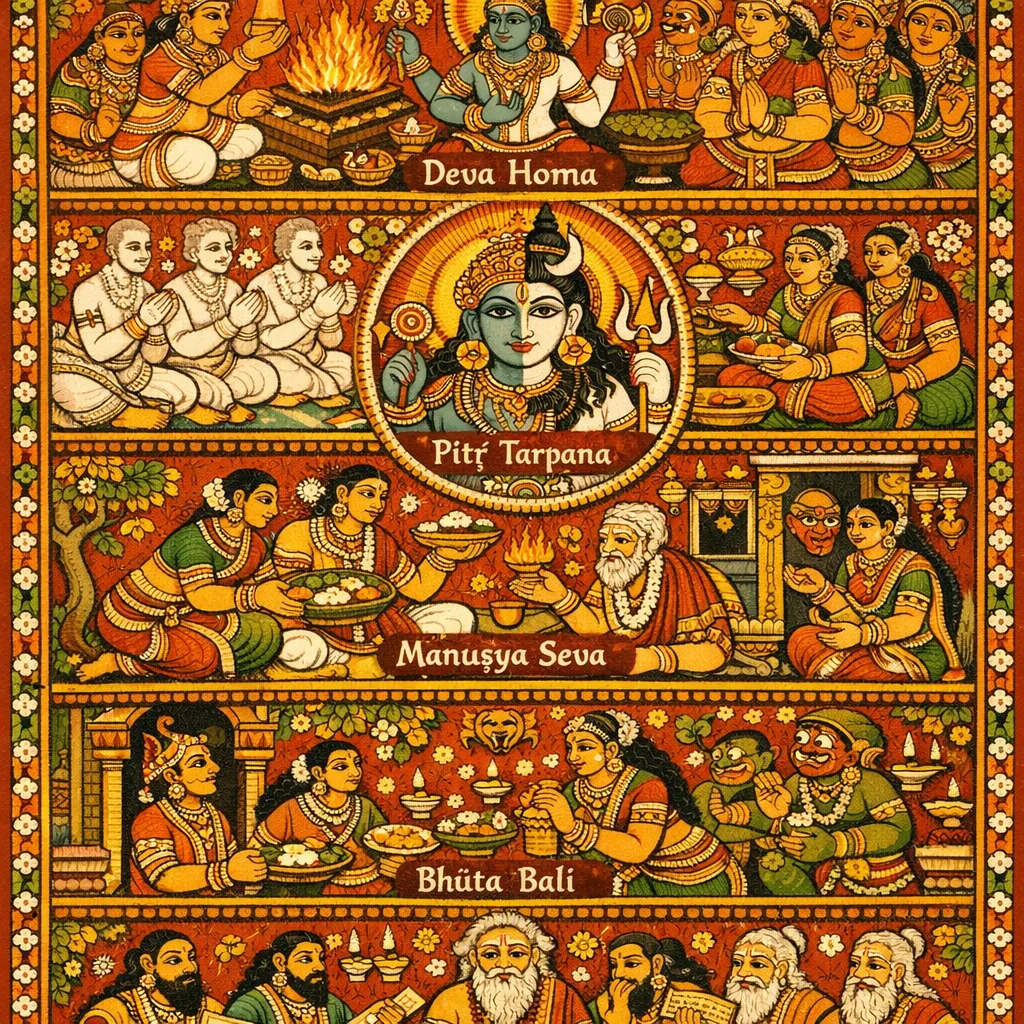
Adhyaya 52: Marks of Karma-yoga and the Five Great Daily Sacrifices (Pancha Mahāyajñas)
कर्मयोग-लक्षणं तथा पञ्चमहायज्ञ-विधिः
Speaker: Rishis, Suta
The Ṛṣis ask Sūta to recount Viṣṇu’s earlier teaching on the full range of dharma and adharma. Sūta explains that it originated from Janārdana in Matsya form, who instructed Manu on creation and re-creation, and on Karma-yoga and Sāṃkhya. Pressed again, Sūta defines Karma-yoga, teaching that true knowledge arises from rightly performed action joined with discernment. He grounds dharma in the Veda and in ācāra (established right conduct), lists eight inner virtues required for spiritual fitness, and states that Kriyā-yoga disciplines the practitioner into Jñāna-yoga. He then sets out the daily sacrificial duties—tarpaṇa, homa, śrāddha, and anna-dāna/bali—as the five great sacrifices (pañca mahāyajñas) meant to neutralize the inevitable harm of household life. The discourse ends by prescribing worship through gifts, vows, fasting, japa and homa, and by teaching abheda-bhāva: worship of any major deity, understood as non-different, is worship of the entire cosmos.
Key Concepts
Shlokas in Adhyaya 52
Verse 1
*ऋषय ऊचुः इदानीं प्राह यद्विष्णुः पृष्टः परममुत्तमम् तदिदानीं समाचक्ष्व धर्माधर्मस्य विस्तरम् //
The sages said: “Now tell us in full the broad extent of dharma and adharma—what Viṣṇu previously declared when he was asked that supremely excellent matter.”
Verse 2
*सूत उवाच एवमेकार्णवे तस्मिन् मत्स्यरूपी जनार्दनः विस्तारमादिसर्गस्य प्रतिसर्गस्य चाखिलम् //
Sūta said: Thus, in that single, all-engulfing ocean, Janārdana in the form of a Fish expounded in full detail the primordial creation and also the complete process of re-creation.
Verse 3
कथयामास विश्वात्मा मनवे सूर्यसूनवे कर्मयोगं च सांख्यं च यथावद्विस्तरान्वितम् //
Then the All-Self, the Universal Spirit, explained to Manu, the son of the Sun, both Karma-yoga and Sāṃkhya—properly and in full detail.
Verse 4
*ऋषय ऊचुः श्रोतुमिच्छामहे सूत कर्मयोगस्य लक्षणम् यस्मादविदितं लोके न किंचित्तव सुव्रत //
The sages said: “O Sūta, we wish to hear the defining characteristics of karma-yoga; for in this world nothing is unknown to you, O man of excellent vows.”
Verse 5
*सूत उवाच कर्मयोगं च वक्ष्यामि यथा विष्णुविभाषितम् ज्ञानयोगसहस्राद्धि कर्मयोगः प्रशस्यते //
Sūta said: “I shall also expound Karma-yoga, just as Viṣṇu explained it; for Karma-yoga is praised as superior even to a thousand discourses on Jñāna-yoga.”
Verse 6
कर्मयोगोद्भवं ज्ञानं तस्मात्तत्परमं पदम् कर्मज्ञानोद्भवं ब्रह्म न च ज्ञानमकर्मणः //
Knowledge arises from Karma-yoga; therefore that (Karma-yoga) is the highest state. Brahman is realized through the conjoint arising of action and knowledge; and knowledge does not arise from mere inaction.
Verse 7
तस्मात्कर्मणि युक्तात्मा तत्त्वमाप्नोति शाश्वतम् वेदो ऽखिलो धर्ममूलम् आचारश्चैव तद्विदाम् //
Therefore, one whose inner self is disciplined and engaged in rightful action attains the eternal Truth. The entire Veda is the very root of Dharma, and so too is the established conduct of those who truly know it.
Verse 8
अष्टावात्मगुणास् तस्मिन् प्रधानत्वेन संस्थिताः दया सर्वेषु भूतेषु क्षान्ती रक्षातुरस्य तु //
In him (the protector), eight virtues of character are established as foremost—compassion toward all beings; and for one devoted to protection, patience and forbearance are essential qualities.
Verse 9
अनसूया तथा लोके शौचमन्तर्बहिर्द्विजाः अनायासेषु कार्येषु माङ्गल्याचारसेवनम् //
Freedom from envy in the world, and purity—both inward and outward—for the twice-born; and, in undertakings that can be done without strain, the practice of auspicious conduct—these are to be cultivated.
Verse 10
न च द्रव्येषु कार्पण्यम् आर्तेषूपार्जितेषु च तथास्पृहा परद्रव्ये परस्त्रीषु च सर्वदा //
One should not be miserly with one’s wealth—especially with wealth acquired for the relief of the distressed; and one should always remain free from craving for another’s property and for another’s wife.
Verse 11
अष्टावात्मगुणाः प्रोक्ताः पुराणस्य तु कोविदैः अयमेव क्रियायोगो ज्ञानयोगस्य साधकः //
The wise have declared eight inner qualities as the very essence of the Purāṇa; and this very discipline of Kriyā-yoga (the yoga of sacred practice) is what enables the attainment of Jñāna-yoga (the yoga of true knowledge).
Verse 12
कर्मयोगं विना ज्ञानं कस्यचिन् नेह दृश्यते श्रुतिस्मृत्युदितं धर्मम् उपतिष्ठेत्प्रयत्नतः //
Without the discipline of karma-yoga, true knowledge is not seen to arise in anyone here. Therefore one should diligently adhere to the dharma taught in the Śruti and the Smṛti.
Verse 13
देवतानां पितॄणां च मनुष्याणां च सर्वदा कुर्यादहरहर्यज्ञैर् भूतर्षिगणतर्पणम् //
One should always, day after day, perform—through daily sacrificial offerings—the acts of satiation (tarpaṇa) for the gods, the forefathers, human beings, and also for the hosts of beings and sages.
Verse 14
स्वाध्यायैरर्चयेच्चर्षीन् होमैर्विद्वान्यथाविधि पितॄञ्छ्राद्धैर् अन्नदानैर् भूतानि बलिकर्मभिः //
By Vedic self-study (svādhyāya) one should honor the seers (ṛṣis); the learned person should perform fire-offerings (homa) according to rule; one should satisfy the ancestors through śrāddha rites; and one should appease living beings through gifts of food and by the prescribed bali-offerings.
Verse 15
पञ्चैते विहिता यज्ञाः पञ्चसूनापनुत्तये कण्डनी पेषणी चुल्ली जलकुम्भी प्रमार्जनी //
These five sacrifices (yajñas) are prescribed to ward off the five “household harms”: the pounding-stone, the grinding-stone, the hearth, the water-pot, and the broom—namely, the acts of pounding, grinding, cooking, drawing water, and sweeping, which unavoidably injure minute beings.
Verse 16
पञ्च सूना गृहस्थस्य तेन स्वर्गं न गच्छति तत्पापनाशनायामी पञ्च यज्ञाः प्रकीर्तिताः //
For the householder there are five “slaughter-houses,” sources of unavoidable harm; because of them he does not attain heaven. Therefore, to destroy that sin, the five sacrifices (yajñas) have been proclaimed.
Verse 17
द्वाविंशतिस्तथाष्टौ च ये संस्काराः प्रकीर्तिताः तद्युक्तो ऽपि न मोक्षाय यस्त्वात्मगुणवर्जितः //
Even if one is endowed with the proclaimed twenty-two and also the eight saṃskāras, one is still not fit for liberation (mokṣa) if one is devoid of the soul’s inner virtues.
Verse 18
तस्मादात्मगुणोपेतः श्रुतिकर्म समाचरेत् गोब्राह्मणानां वित्तेन सर्वदा भद्रमाचरेत् //
Therefore, endowed with self-restraint and noble virtues, one should duly perform the duties of śruti and karma enjoined by the Veda; and with one’s wealth one should always act for the welfare of cows and Brahmins, ever doing what is auspicious and beneficial.
Verse 19
गोभूहिरण्यवासोभिर् गन्धमाल्योदकेन च पूजयेद्ब्रह्मविष्ण्वर्करुद्रवस्वात्मकं शिवम् //
With gifts of cows, land, gold, and garments—and also with fragrance, garlands, and water—one should worship Śiva, who embodies Brahmā, Viṣṇu, the Sun, Rudra, and the Vasus.
Verse 20
व्रतोपवासैर् विधिवच्छ्रद्धया च विमत्सरः यो ऽसाव् अतीन्द्रियः शान्तः सूक्ष्मो ऽव्यक्तः सनातनः वासुदेवो जगन्मूर्तिस् तस्य सम्भूतयो ह्य् अमी //
By vows and fasting duly performed, and with faith—free from envy—one should worship Vasudeva, who is beyond the senses, peaceful, subtle, unmanifest, and eternal. He is the embodied form of the universe; indeed, all these beings are His manifestations.
Verse 21
ब्रह्मा विष्णुश्च भगवान् मार्तण्डो वृषवाहनः अष्टौ च वसवस्तद्वद् एकादश गणाधिपाः लोकपालाधिपाश्चैव पितरो मातरस्तथा //
Brahmā, and Viṣṇu the Blessed Lord; Mārtaṇḍa (the Sun), and the Bull-borne one (Śiva); likewise the eight Vasus, the eleven chiefs of the Gaṇas, the presiding lords of the guardians of the quarters, and also the Pitṛs (ancestral fathers) and the Mothers (Mātṛkās)—all are to be understood as the divine hosts.
Verse 22
इमा विभूतयः प्रोक्ताश् चराचरसमन्विताः ब्रह्माद्याश् चतुरो मूलम् अव्यक्ताधिपतिः स्मृतः //
These manifestations (vibhūtis) have been declared as comprising all that is moving and unmoving. Beginning with Brahmā, the four are said to be the root-principles; and the Lord of the Unmanifest (Avyakta) is remembered as their presiding ruler.
Verse 23
ॐ ॐ ब्रह्मणा चाथ सूर्येण विष्णुनाथ शिवेन वा अभेदात्पूजितेन स्यात् पूजितं सचराचरम् //
Om, Om. Whether one worships Brahmā, or the Sun, or Lord Viṣṇu, or Śiva—when worship is performed with the understanding of non-difference, the entire world of moving and unmoving beings becomes worshipped.
Verse 24
ब्रह्मादीनां परं धाम त्रयाणामपि संस्थितिः वेदमूर्ताव् अतः पूषा पूजनीयः प्रयत्नतः //
Pūṣan is the supreme abode of Brahmā and the other gods, and the very support in which the three are established as well. Since he is embodied as the Veda itself, Pūṣan should therefore be worshipped with earnest effort.
Verse 25
तस्मादग्निद्विजमुखान् कृत्वा सम्पूजयेदिमान् दानैर्व्रतोपवासैश्च जपहोमादिना नरः //
Therefore, regarding Fire (Agni) and the Brāhmaṇas as the foremost “mouth” through which offerings are received, a man should duly honor them—by gifts, by vows and fasting, and by practices such as mantra-recitation (japa) and fire-offerings (homa).
Verse 26
इति क्रियायोगपरायणस्य वेदान्तशास्त्रस्मृतिवत्सलस्य विकर्मभीतस्य सदा न किंचित् प्राप्तव्यमस्तीह परे च लोके //
Thus, for one devoted to kriyā-yoga—who cherishes Vedānta, the śāstras, and the Smṛtis, and who is ever afraid of wrongful action (vikarma)—there remains nothing further that must be attained, either in this world or in the next.
Frequently Asked Questions
Adhyāya 52 teaches that Karma-yoga—disciplined, righteous action grounded in Śruti–Smṛti—produces and matures true knowledge. It insists that mere inaction does not generate jñāna; rather, Brahman is realized through the combined rise of action and knowledge. The chapter then makes this practical by prescribing inner virtues (ātma-guṇas) and daily duties (Pancha Mahāyajñas) so that spiritual insight is supported by ethical character and household responsibility.
This chapter is primarily Dharma-focused: Karma-yoga, Kriyā-yoga leading to Jñāna-yoga, Śruti–Smṛti authority, ācāra, virtues, and household ritual obligations (Pancha Mahāyajñas). It briefly recalls the larger Matsya teaching-context involving creation and re-creation (sṛṣṭi/pratisṛṣṭi) as background, but it does not present Vāstu-śāstra measurements or genealogical lists in this adhyāya.
The chapter frames daily duties as five sacrificial obligations: (1) honoring ṛṣis through svādhyāya, (2) honoring devas through homa and offerings, (3) satisfying pitṛs through śrāddha, (4) serving humans through hospitality/food-giving, and (5) appeasing beings through anna-dāna and bali-karman. These are performed as ongoing tarpaṇa/satiation for gods, ancestors, humans, beings, and sages.
The text identifies unavoidable harm in household life arising from the pounding-stone, grinding-stone, hearth, water-pot, and broom—daily acts that inadvertently injure small beings. Because these ‘five slaughter-houses’ obstruct heavenly merit, the Pancha Mahāyajñas are prescribed as a regular discipline to neutralize that sin and restore dharmic balance.
Adhyāya 52 emphasizes eight core inner qualities, including compassion to all beings, forbearance/patience (especially for one charged with protection), non-envy, inner and outer purity, practicing auspicious conduct in feasible undertakings, non-miserliness in wealth (especially for relieving the distressed), and constant non-covetousness toward others’ property and others’ spouses. These virtues are presented as the essence of Purāṇic teaching and essential for liberation.
It explicitly teaches abheda (non-difference) in worship: whether one worships Brahmā, Sūrya, Viṣṇu, or Śiva, if done with the understanding of unity, worship reaches the entire moving and unmoving cosmos. It also lists divine hosts (Vasus, Gaṇas, Lokapālas, Pitṛs, Mātṛkās) as manifestations within that unified framework.