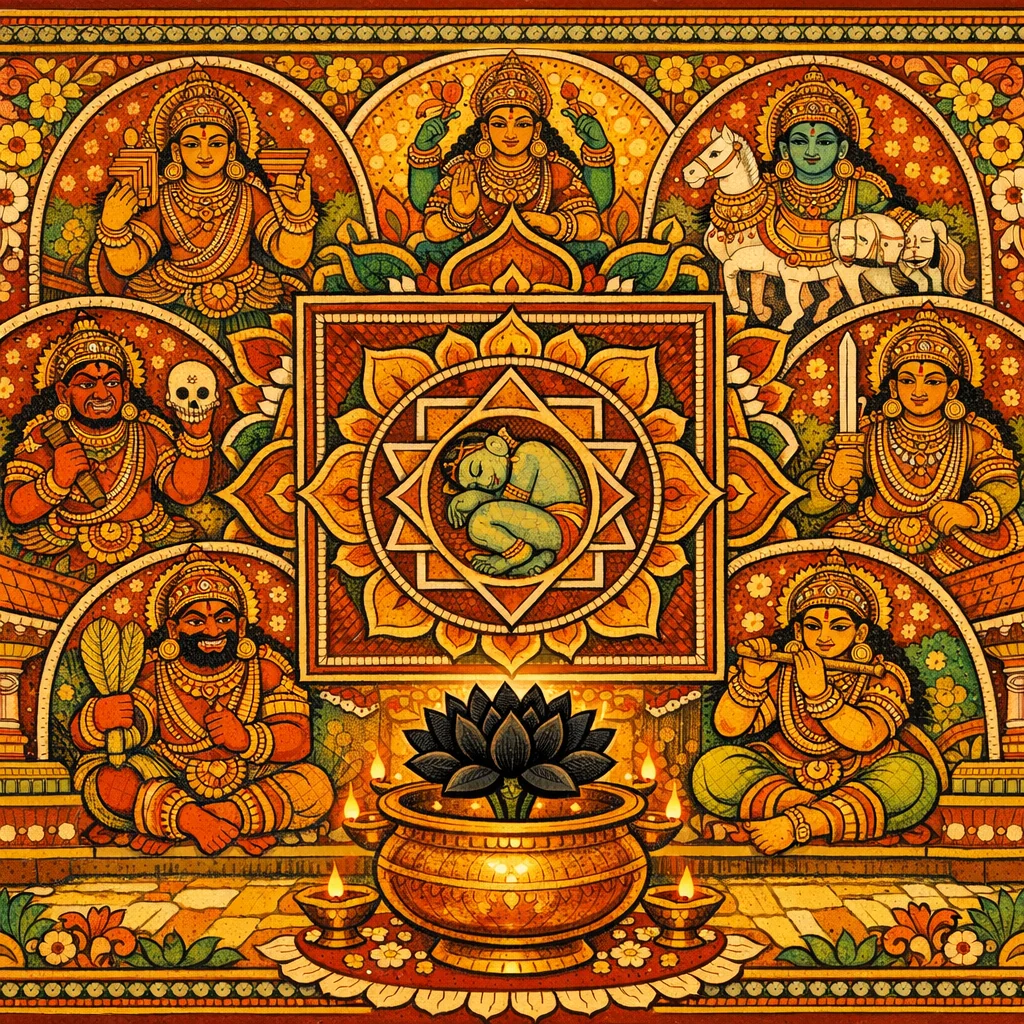
Adhyaya 79: Mandāra-Saptamī Vrata (Sun-oriented Saptamī observance) — Procedure, Mantras, and Fruits
मन्दारसप्तमीव्रतवर्णनम्
Speaker: Īśvara (the Lord as teacher)
The Lord declares He will teach the Mandāra-Saptamī observance that destroys sin. He gives the preliminaries: a light meal on the 5th day, fasting on the 6th with the tooth-stick rite, honoring brāhmaṇas, night use of mandāra, and a dawn bath. The main worship is performed by forming an eight-petalled lotus of black sesame in a copper vessel, offering golden mandāra flowers, and invoking Sun-deities in the directions. In the center the Vāstu-Puruṣa is installed with the mantra “sarvātmanaḥ,” offerings are made, and the rite is transferred as dāna to a Veda-knower. The householder eats with restraint (no oil or salt), repeats it monthly for a year without greed, and concludes by donating the ritual setup on the kalaśa along with cows. The chapter ends with a prayer to Ravi and a phalaśruti promising freedom from sin and attainment of desired aims even by hearing or reciting it.
Key Concepts
Shlokas in Adhyaya 79
Verse 1
*ईश्वर उवाच अथातः सम्प्रवक्ष्यामि सर्वपापप्रणाशिनीम् सर्वकामप्रदां रम्यां नाम्ना मन्दारसप्तमीम् //
The Lord said: “Now I shall fully describe the delightful observance called Mandāra-Saptamī—one that destroys all sins and grants every desired aim.”
Verse 2
माघस्यामलपक्षे तु पञ्चम्यां लघुभुङ्नरः दन्तकाष्ठं ततः कृत्वा षष्ठीमुपवसेद्बुधः //
In the pure bright fortnight of Māgha, on the fifth lunar day a man should eat lightly; then, having performed the rite of cleansing the teeth with a tooth-stick, the wise should observe a fast on the sixth day.
Verse 3
विप्रान् सम्पूजयित्वा तु मन्दारं प्राशयेन्निशि ततः प्रभात उत्थाय कृत्वा स्नानं पुनर्द्विजान् //
Having duly honored the Brahmins, one should at night partake of (or administer) mandāra; then, rising at dawn and performing the ritual bath, one should again attend to and honor the dvija, the twice-born.
Verse 4
भोजयेच्छक्तितः कृत्वा मन्दारकुसुमाष्टकम् सौवर्णं पुरुषं तद्वत् पद्महस्तं सुशोभनम् //
Having prepared, according to one’s capacity, an octad of mandāra blossoms, one should feed the recipients. Likewise, one should fashion a beautiful golden male figure, splendid, holding a lotus in the hand.
Verse 5
पद्मं कृष्णतिलैः कृत्वा ताम्रपात्रे ऽष्टपत्त्रकम् हैममन्दारकुसुमैर् भास्करायेति पूर्वतः //
Fashioning an eight-petalled lotus out of black sesame in a copper vessel, one should then, facing east, offer golden mandāra blossoms with the mantra, “(Obeisance) to Bhāskara (the Sun).”
Verse 6
नमस्कारेण तद्वच्च सूर्यायेत्यानले दले दक्षिणे तद्वदर्काय तथार्यम्णे च नैरृते //
With a reverential salutation, in the south-east direction one should offer worship with the mantra “(obeisance) to Sūrya”; likewise, in the southern quarter one should worship Arka, and in the south-west (Nairṛta) one should worship Āryaman as well.
Verse 7
पश्चिमे वेदधाम्ने च वायव्ये चण्डभानवे पूष्णेत्युत्तरतः पूज्यम् आनन्दायेत्यतः परम् //
In the western quarter one should worship the deity called Vedadhāman; in the north-west, Caṇḍabhānu; to the north, Pūṣan is to be worshipped; and beyond that, Ānandāya is to be revered.
Verse 8
कर्णिकायां च पुरुषं सर्वात्मन इति न्यसेत् शुक्लवस्त्रैः समावेष्ट्य भक्ष्यैर्माल्यफलादिभिः //
In the central lotus (the core of the maṇḍala), one should install by nyāsa the Vāstu-Puruṣa with the mantra “sarvātmanaḥ” (“the One who is the Self of all”). Having wrapped (the seat) with white cloth, one should offer edibles, garlands, fruits, and the like.
Verse 9
एवमभ्यर्च्य तत्सर्वं दद्याद्वेदविदे पुनः भुञ्जीतातैललवणं वाग्यतः प्राङ्मुखो गृही //
Having thus duly worshipped, the householder should again give all of that to a knower of the Veda. Then, facing east and restraining his speech, he should eat—avoiding oil and salt.
Verse 10
अनेन विधिना सर्वं सप्तम्यां मासि मासि च कुर्यात्संवत्सरं यावद् वित्तशाठ्यविवर्जितः //
Following this prescribed method, one should perform the entire observance on the seventh lunar day (saptamī), month after month, for as long as a full year—free from deceit or miserliness regarding one’s wealth.
Verse 11
एतदेव व्रतान्ते तु निधाय कलशोपरि गोभिर्विभवतः सार्धं दातव्यं भूतिमिच्छता //
At the conclusion of the vow (vrata), placing precisely this upon the top of the ritual kalaśa, one who desires prosperity should donate it together with cows, according to one’s means.
Verse 12
नमो मन्दारनाथाय मन्दारभवनाय च त्वं रवे तारयस्वास्मान् संसारभयसागरात् //
Salutations to the Lord of Mandāra, and to Him whose abode is Mandāra. O Ravi (the Sun), carry us across the ocean of fear that is saṃsāra, worldly existence.
Verse 13
अनेन विधिना यस्तु कुर्यान्मन्दारसप्तमीम् विपाप्मा स सुखी मर्त्यः कल्पं च दिवि मोदते //
Whoever performs the Mandāra-Saptamī observance in this prescribed manner becomes free from sin; that mortal lives happily and rejoices in heaven for an entire kalpa.
Verse 14
इमामघौघपटलभीषणध्वान्तदीपिकाम् गच्छन्प्रगृह्य संसारे सर्वार्थांश्च लभेन्नरः //
In this worldly existence, the man who goes forth holding fast to this “lamp” that dispels the dreadful darkness formed by masses of sin, attains all desired aims.
Verse 15
मन्दारसप्तमीम् एताम् ईप्सितार्थफलप्रदाम् यः पठेच्छृणुयाद्वापि सर्वपापैः प्रमुच्यते //
Whoever recites, or even listens to, this account of the Mandāra-Saptamī—bestowing the fruits of desired aims—is freed from all sins.
Frequently Asked Questions
It teaches the complete procedure of the Mandāra-Saptamī vrata: preparatory fasting and purity, constructing an eight-petalled sesame lotus in a copper vessel, offering golden mandāra blossoms while invoking solar names in the directions, installing the Vāstu-Puruṣa in the center with “sarvātmanaḥ,” and completing the vow through ethical conduct and concluding donations—promising sin-destruction and attainment of desired aims.
Primarily Dharma (vrata, fasting rules, brāhmaṇa-honor, dāna, and phalaśruti) with a clear Vastu-linked element through Vāstu-Puruṣa nyāsa in the lotus mandala. Genealogy and creation narratives are not the focus in this chapter.
The rite integrates spatial sacralization with solar worship: placing Vāstu-Puruṣa in the mandala’s center (karnikā) using the mantra “sarvātmanaḥ” frames the ritual space as a living cosmic body. This aligns household order (vāstu), directional deities, and the Sun’s sustaining power into one coherent cosmogram.
The chapter prescribes offerings across the lotus petals/directions invoking: Bhāskara (east-facing offering), Sūrya (south-east), Arka (south), Āryaman (south-west), Vedadhāman (west), Caṇḍabhānu (north-west), Pūṣan (north), and Ānandāya (beyond/north-eastward progression), with the Vāstu-Puruṣa installed in the center.
It is performed on Saptamī month after month for one full year, without deceit or stinginess. At the vow’s end, the ritual arrangement is placed atop the kalaśa and donated along with cows according to one’s means, aimed at prosperity (bhūti) and merit.