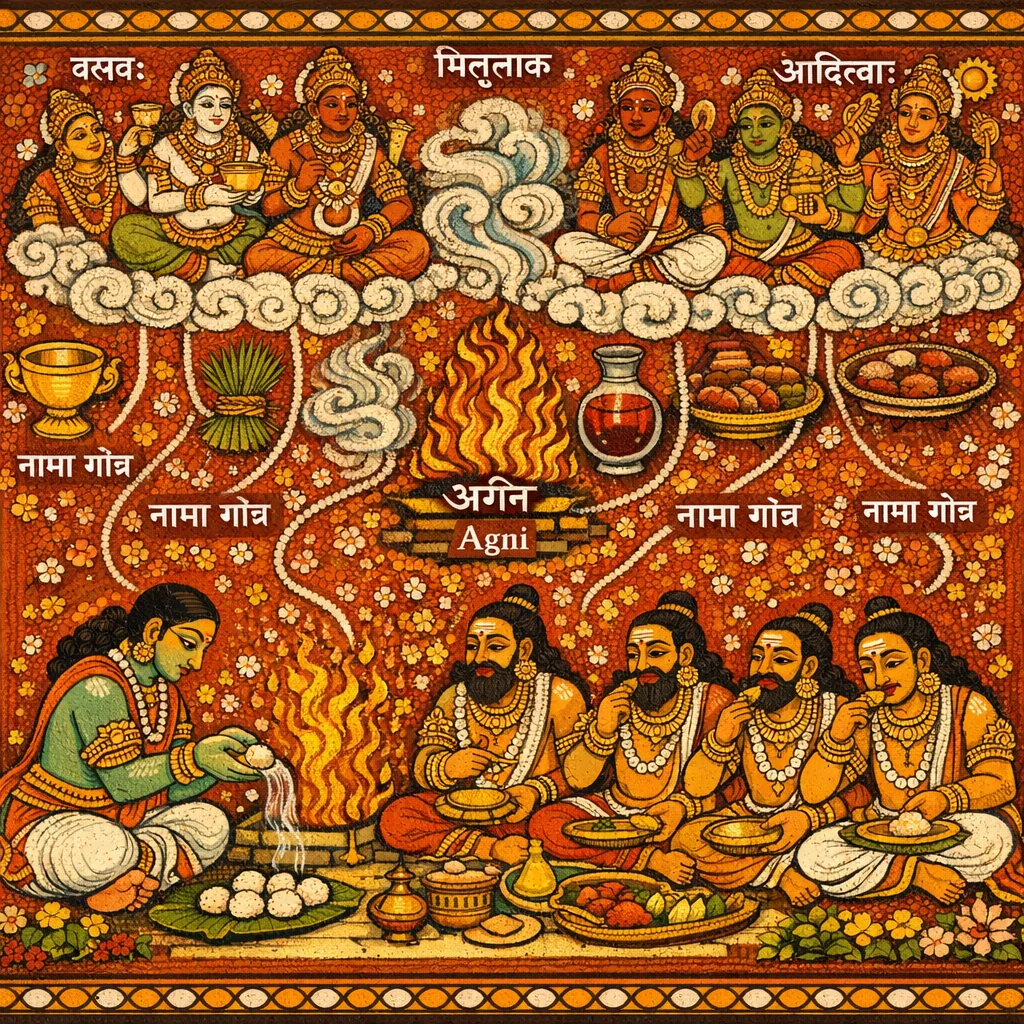
Adhyaya 19: How Śrāddha Offerings Reach the Ancestors (Pitṛs): The Principle of Name, Gotra, and Transformative Enjoyment
श्राद्धपितृतर्पणप्रापकविचारः
Speaker: Rishis, Suta
The Ṛṣis ask how ritual gifts are transmitted: if Śrāddha offerings are eaten by Brāhmaṇas or placed in fire, how are they “enjoyed” by the ancestors (Pitṛs) in Pitṛloka, even by those in auspicious or inauspicious post-death states? Sūta replies with a Vedic classification of Pitṛ groups (Vasus/Rudras/Ādityas) and teaches that the effective carrier is the invoked identity—nāma and gotra—made potent by correct śrāddha mantras and heartfelt śraddhā. He adds that Pitṛ-gaṇas such as the Agniṣvāttas maintain records of identity, time, and place even across rebirth. The dialogue culminates in a graded doctrine of experiential transformation: the same offering becomes different subtle “foods” according to the recipient—deity, demonic being, animal, serpent, yakṣa, rākṣasa, dānava, preta, or human. The chapter ends by exalting śraddhā as the rite’s essence, promising royal prosperity and liberation through ancestral satisfaction and continuity of lineage.
Key Concepts
Shlokas in Adhyaya 19
Verse 1
*ऋषय ऊचुः कथं कव्यानि देयानि हव्यानि च जनैरिह गच्छन्ति पितृलोकस्थान् प्रापकः को ऽत्र गद्यते //
The sages said: “How do the offerings meant for the ancestors (kavya) and the offerings meant for the gods (havis), given here by people, reach those who abide in the world of the Pitṛs (Pitṛloka)? Who, in this matter, is declared to be the one that conveys them?”
Verse 2
यदि मर्त्यो द्विजो भुङ्क्ते हूयते यदि वानले शुभाशुभात्मकैः प्रेतैर् दत्तं तद्भुज्यते कथम् //
If a mortal Brāhmaṇa eats the offering, or if it is poured into the fire as an oblation, then how is that gift—made for the departed pretas, whether in auspicious or inauspicious condition—actually enjoyed by them?
Verse 3
*सूत उवाच वसून्वदन्ति च पितॄन् रुद्रांश्चैव पितामहान् प्रपितामहांस्तथादित्यान् इत्येवं वैदिकी श्रुतिः //
Sūta said: “The Vedic revelation (śruti) speaks in this way: it calls the Vasus the Pitṛs (ancestral fathers), the Rudras the grandfathers, the Ādityas the great‑grandfathers, and so on.”
Verse 4
नाम गोत्रं पितॄणां तु प्रापकं हव्यकव्ययोः श्राद्धस्य मन्त्राः श्रद्धा च उपयोज्यातिभक्तितः //
Indeed, the ancestors’ name and lineage (gotra) are what convey the offerings—both the oblations to the gods (havis) and the food-offerings to the ancestors (kavya). Therefore, in the śrāddha rite, one should employ the prescribed mantras and faith (śraddhā) with deep devotion.
Verse 5
अग्निष्वात्तादयस्तेषाम् आधिपत्ये व्यवस्थिताः नामगोत्रकालदेशा भवान्तरगतानपि //
The Pitṛ-groups, such as the Agniṣvātta and others, are established in lordship over them; and they duly govern and keep record of their names, lineages, times, and places—even when those beings have passed into another state of existence.
Verse 6
प्राणिनः प्रीणयन्त्येते तदाहारत्वमागतान् देवो यदि पिता जातः शुभकर्मानुयोगतः //
These offerings gladden living beings who have come to partake of that food. And if, through the performance of auspicious deeds, one’s father has attained the state of a deity, then such offerings please him as well.
Verse 7
तस्यान्नममृतं भूत्वा दिव्यत्वे ऽप्यनुगच्छति दैत्यत्वे भोगरूपेण पशुत्वे च तृणं भवेत् //
For him, that very food becomes nectar and follows him even into a divine state; in a daitya (demonic) state it turns into objects of enjoyment, and in an animal state it becomes grass.
Verse 8
श्राद्धान्नं वायुरूपेण सर्पत्वे ऽप्युपतिष्ठति पानं भवति यक्षत्वे राक्षसत्वे तथामिषम् //
Food offered in the śrāddha reaches the departed in the form of subtle ‘air’ even if they have taken birth as serpents; drink becomes available to them if they are in a Yakṣa state, and meat likewise if they are in a Rākṣasa state.
Verse 9
दनुजत्वे तथा माया प्रेतत्वे रुधिरोदकम् मनुष्यत्वे ऽन्नपानानि नानाभोगरसं भवेत् //
In the condition of being born among the Dānavas, one’s experience is dominated by māyā, delusive power; in the state of a preta (restless departed spirit), it becomes blood and water; but in human birth, it becomes food and drink, taking on the varied flavors of enjoyment.
Verse 10
रतिशक्तिः स्त्रियः कान्ता भोज्यं भोजनशक्तिता दानशक्तिः सविभवा रूपमारोग्यमेव च //
A beloved wife endowed with the capacity for conjugal delight; food, together with the ability to partake of it and digest it well; the power to give in charity along with sufficient means; and beauty and health as well—these are counted among the desirable endowments.
Verse 11
श्रद्धा पुष्पमिदं प्रोक्तं फलं ब्रह्मसमागमः आयुः पुत्रान् धनं विद्यां स्वर्गं मोक्षं सुखानि च //
Faith (śraddhā) is declared to be the flower of this observance; its fruit is communion with Brahman. From it arise long life, sons, wealth, knowledge, heaven, liberation (mokṣa), and also happiness.
Verse 12
राज्यं चैव प्रयच्छन्ति प्रीताः पितृगणा नृणाम् श्रूयते च पुरा मोक्षं प्राप्ताः कौशिकसूनवः पञ्चभिर्जन्मसम्बन्धैर् गता विष्णोः परं पदम् //
When pleased, the hosts of the Pitṛs (ancestors) bestow even kingship upon men. And it is heard from ancient times that the sons of Kauśika attained liberation; through bonds of relationship spanning five births, they went to Viṣṇu’s supreme abode.
Frequently Asked Questions
That śrāddha and havis offerings reach the intended ancestor not by the gross act of eating or burning alone, but through correct invocation of the ancestor’s name and gotra, supported by prescribed mantras and genuine śraddhā (faith). The chapter teaches that śraddhā is the essential power of the rite and that the offering is experienced in forms appropriate to the ancestor’s current state of existence.
The text states that the ‘conveyer’ (prāpaka) is the ancestor’s nāma (name) and gotra (lineage) when properly employed in śrāddha with the right mantras and śraddhā. It also notes that Pitṛ-gaṇas such as the Agniṣvāttas preside over and keep account of identities, times, and places, ensuring the offering’s correct reach even across rebirth.
It presents a transformation doctrine: for a deified ancestor the food becomes nectar; in a demonic state it becomes enjoyments; in an animal state it becomes grass; for serpents it reaches as subtle ‘air’; for Yakṣas it becomes drink; for Rākṣasas it becomes meat; in preta-state it becomes blood and water; and in human birth it becomes food and drink with varied tastes.
Primarily Dharma—especially ritual dharma of śrāddha, Pitṛ-yajña, mantra-usage, and śraddhā. It also touches a genealogical/lineage principle through the emphasis on gotra and ancestral identification, but it does not teach Vāstu or architectural measurements in this chapter.