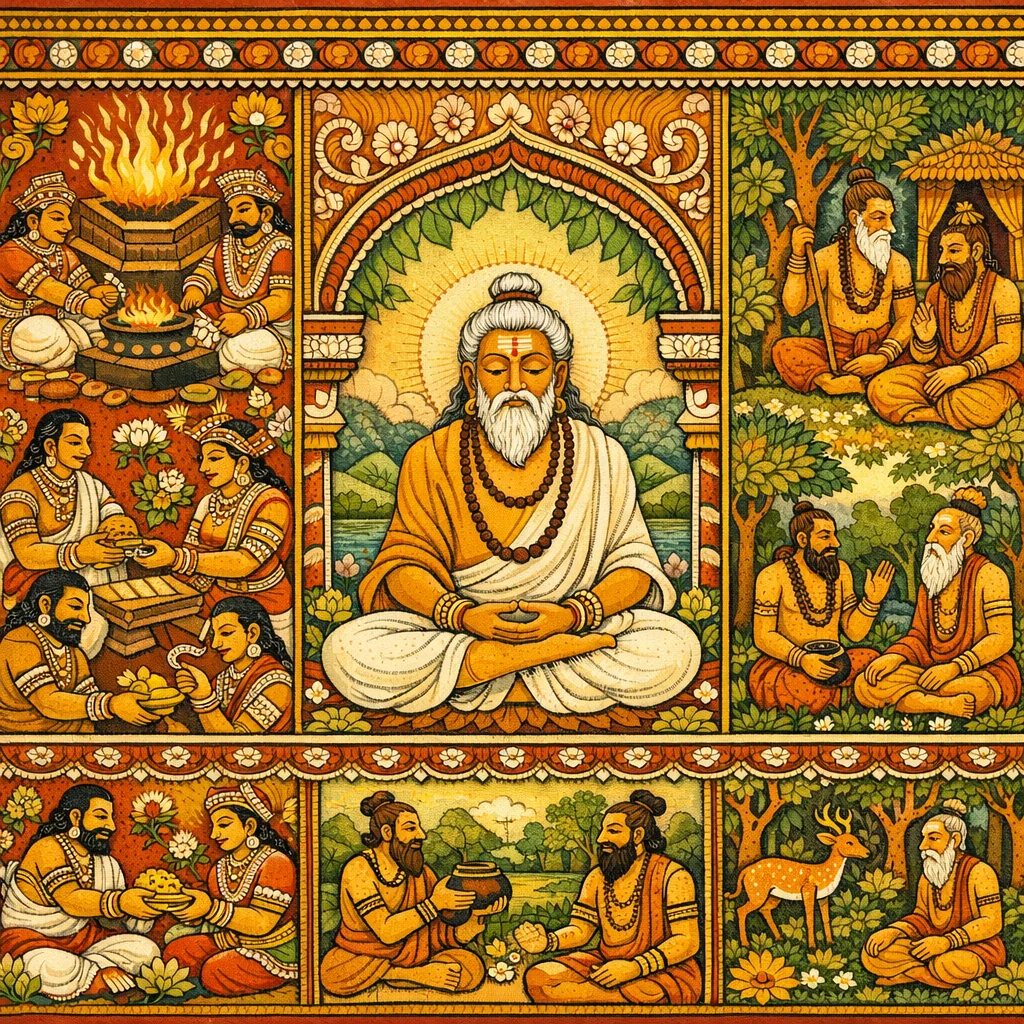
Adhyaya 40: Duties of the Four Āśramas and the Power of Mauna (Silence)
आश्रमधर्म-मौन-सिद्धि-प्रकरणम्
Speaker: Aṣṭaka, King Yayāti
Aṣṭaka begins with a comparative question: by what path do the four āśramas reach the gods despite differing teachings? Yayāti answers in graded counsel—first the brahmacārin’s discipline and study, then the gṛhastha’s dharmic pursuit of wealth with ritual, charity, and hospitality, then the forest-dweller’s ahimsa and regulated life, and finally the bhikṣu’s radical detachment and homelessness. When Aṣṭaka asks about “deva-munis” and forms of mauna, Yayāti defines true sagehood as inner renunciation: living in the forest while leaving the village behind, or living in a village while keeping the forest within. He explains how “village” follows the forest-dweller through lingering habits, and how “forest” follows the villager through simplicity and restraint. The chapter culminates in mauna: abandoning desire and action, conquering the senses and dualities through tapas, the muni attains siddhi and the higher worlds.
Key Concepts
Shlokas in Adhyaya 40
Verse 1
*अष्टक उवाच चरन्गृहस्थः कथमेति देवान् कथं भिक्षुः कथम् आचार्यकर्मा वानप्रस्थः सत्पथे संनिविष्टो बहून्यस्मिन् सम्प्रति वेदयन्ति //
Aṣṭaka said: “How does a householder, while living an active worldly life, attain the gods? How does a mendicant (bhikṣu) attain them? How does one devoted to a teacher’s discipline and duties (ācārya-karman) attain them? And how does a forest-dweller (vānaprastha), firmly established on the good path, attain that goal? In this matter, many differing views are taught even now.”
Verse 2
*ययातिरुवाच आहूताध्यायी गुरुकर्मसु चोद्यतः पूर्वोत्थायी चरमं चोपशायी मृदुर्दान्तो धृतिमानप्रमत्तः स्वाध्यायशीलः सिध्यति ब्रह्मचारी //
Yayāti said: The brahmacārin who studies when summoned, who is prompt in the duties of the teacher, who rises before others and lies down last, who is gentle and self-controlled, steadfast and vigilant, and devoted to self-study (svādhyāya)—such a student attains success in sacred learning and discipline.
Verse 3
धर्मागतं प्राप्य धनं यजेत दद्यात्सदैवातिथीन्भोजयेच्च अनाददानश्च परैरदत्तं सैषा गृहस्थोपनिषत्पुराणी //
Having obtained wealth through righteous means, one should perform worship and sacrifice (yajña); one should always give in charity and feed guests. And one should not accept what has not been given by others—this is the ancient Purāṇic instruction for the householder.
Verse 4
स्ववीर्यजीवी वृजिनान्निवृत्तो दाता परेभ्यो न परोपतापी तादृङ्मुनिः सिद्धिमुपैति मुख्यां वसन्न् अरण्ये नियताहारचेष्टः //
Living by his own strength, turning away from sinful gain, giving to others and never causing others harm—such a sage, dwelling in the forest with disciplined food and conduct, attains the highest accomplishment.
Verse 5
अशिल्पजीवी विगृहश्च नित्यं जितेन्द्रियः सर्वतो विप्रमुक्तः अनोकशायी लघु लिप्समानश् चरन् देशानेकचरः स भिक्षुः //
A bhikṣu is one who does not live by crafts or trade, who is ever without quarrel, who has conquered the senses, who is wholly detached, who does not sleep in any fixed home, who seeks only little, and who wanders through many lands.
Verse 6
रात्र्या यया चाभिरताश्च लोका भवन्ति कामाभिजिताः सुखेन च तामेव रात्रिं प्रयतेत विद्वान् अरण्यसंस्थो भवितुं यतात्मा //
On that very night by which people become absorbed in pleasures and are easily conquered by desire, on that same night the wise man should exert himself, self-restrained, resolved to live in the forest.
Verse 7
दशैव पूर्वान्दश चापरांस्तु ज्ञातींस्तथात्मानमथैकविंशम् अरण्यवासी सुकृतं दधाति मुक्त्वा त्व् अरण्ये स्वशरीरधातून् //
One who dwells in the forest bestows his store of merit upon twenty-one—ten ancestors, ten descendants, and his own self as the twenty-first—after laying aside in the wilderness the bodily constituents of his frame.
Verse 8
*अष्टक उवाच कतिस्विद् देवमुनयो मौनानि कति चाप्युत भवन्तीति तदाचक्ष्व श्रोतुम् इच्छामहे वयम् //
Aṣṭaka said: “How many are the sacred sages among the gods, and how many are the observances of mauna (silence) as well? Please explain that to us—we wish to hear.”
Verse 9
*ययातिरुवाच अरण्ये वसतो यस्य ग्रामो भवति पृष्ठतः ग्रामे वा वसतो ऽरण्यं स मुनिः स्याज्जनाधिप //
Yayāti said: “O lord of men, he is truly a sage—whether he lives in the forest with the village left behind him, or lives in the village yet keeps the forest within as his inner state.”
Verse 10
*अष्टक उवाच कथंस्विद्वसतो ऽरण्ये ग्रामो भवति पृष्ठतः ग्रामे वा वसतो ऽरण्यं कथं भवति पृष्ठतः //
Aṣṭaka said: “How is it that, for one dwelling in the forest, a village comes to be ‘behind’ him? And for one dwelling in a village, how does a forest come to be ‘behind’ him?”
Verse 11
*ययातिरुवाच न ग्राम्यमुपयुञ्जीत य आरण्यो मुनिर्भवेत् तथास्य वसतो ऽरण्ये ग्रामो भवति पृष्ठतः //
Yayāti said: “A sage who has become a forest-dweller should not indulge in what is ‘village-born’—worldly comforts and habits. For when he lives in the forest, the village, with its ways and attachments, follows close behind him.”
Verse 12
अनग्निरनिकेतश् चाप्य् अगोत्रचरणो मुनिः कौपीनाच्छादनं यावत् तावदिच्छेच्च चीवरम् //
A sage should live without maintaining a sacrificial fire and without a fixed home; moving about without attachment to lineage or clan, he should desire only so much clothing as is needed for a loincloth (kaupīna) and mere covering—no more.
Verse 13
यावत्प्राणाभिसंधानं तावदिच्छेच्च भोजनम् तदास्य वसतो ग्रामे ऽरण्यं भवति पृष्ठतः //
One should desire food only so long as it sustains life. For the person who lives thus in a village, the wilderness is, as it were, left behind him.
Verse 14
यस्तु कामान्परित्यज्य त्यक्तकर्मा जितेन्द्रियः आतिष्ठेत मुनिर् मौनं स लोके सिद्धिमाप्नुयात् //
But he who, abandoning desires, having relinquished worldly action, and having mastered the senses, abides as a sage in the vow of silence (mauna)—he attains siddhi, spiritual accomplishment, in this very world.
Verse 15
धौतदन्तं कृत्तनखं सदा स्नातमलंकृतम् असितं सितकर्मस्थं कस्तं नार्चितुमर्हति //
Who would not be worthy to worship one who keeps the teeth clean, the nails trimmed, is always bathed and well-adorned—though dark in complexion, yet established in pure conduct and virtuous deeds?
Verse 16
तपसा कर्शितः क्षामः क्षीणमांसास्थिशोणितः यदा भवति निर्द्वंद्वो मुनिर्मौनं समास्थितः //
When, worn down by austerities—emaciated, with flesh, bones, and blood diminished—a sage becomes free from the pairs of opposites, then he is said to be firmly established in silence (mauna).
Verse 17
अथ लोकमिमं जित्वा लोकं चापि जयेत्परम् आस्येन तु यदाहारं गोवन्मृगयते मुनिः अथास्य लोकैः सर्वो यः सो ऽमृतत्वाय कल्पते //
Then, having conquered this world, he also conquers the higher world. The sage who seeks his food only by his mouth—wandering and foraging like a cow—becomes fit for immortality; indeed, all the worlds become his.
Frequently Asked Questions
The chapter teaches that the divine goal can be pursued through any āśrama when its dharma is performed with discipline and detachment: the brahmacārin through guru-sevā and svādhyāya, the gṛhastha through dharmic earning and yajña–dāna–hospitality, the forest-dweller through restraint and non-harm, and the bhikṣu through radical non-attachment and minimal needs—culminating in mauna (silence) and freedom from dualities as a direct means to siddhi.
This adhyāya is primarily Dharma-focused—especially āśrama-dharma, renunciation ethics, tapas, and mauna. It does not treat Vāstu-śāstra measurements, temple architecture, royal statecraft (rājadharma), or purāṇic genealogy in these verses.
A bhikṣu is described as one who does not live by crafts or trade, avoids quarrel, conquers the senses, is fully detached, does not sleep in a fixed home, seeks very little, and wanders across many lands—signaling homelessness, minimalism, and non-possessiveness.
Yayāti presents ‘forest’ as an inner condition of renunciation: living without fixed home and fire, without clinging to lineage, limiting clothing and food to bare necessity, and abandoning desire. When these restraints are maintained even amid society, the person is said to have the ‘forest behind’ (i.e., embodied inwardly) while living in the village.
Mauna is portrayed as a mature vow of a muni who has abandoned desires and worldly action and mastered the senses. Through tapas he becomes nirdvandva (beyond opposites); such established silence yields siddhi in this world and conquest of higher worlds, making the sage fit for immortality.