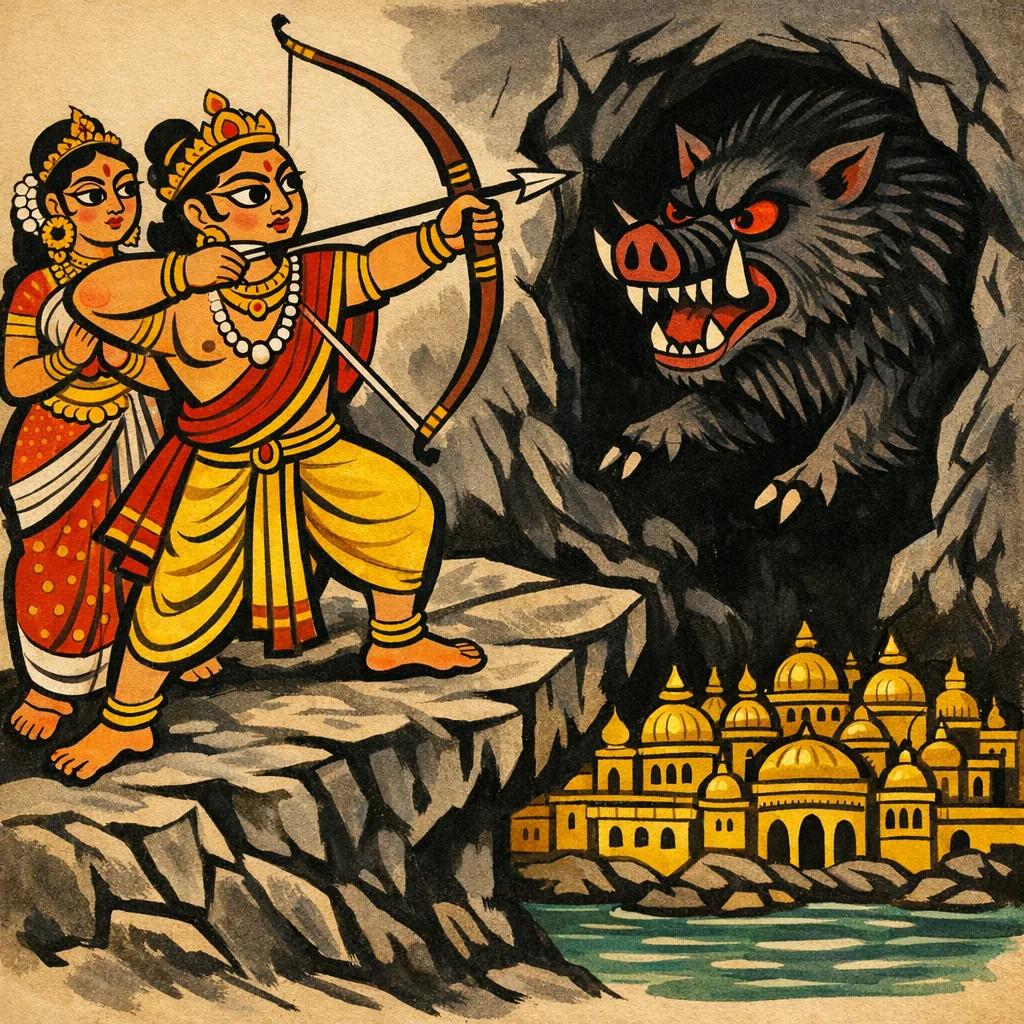
Adhyaya 21: Kuvalayashva’s Descent to Patala and the Rescue of Madalasa
कुवलयाश्व-पातालगमनम् तथा मदालसाहरण-निवारणम् (Kuvalayāśva-pātālagamanam tathā Madālasā-haraṇa-nivāraṇam)
Householder's Dharma
In this adhyaya, King Kuvalayāśva descends to Pātāla to prevent the abduction of Madālasā. Braving the perils of the netherworld and confronting asuric power, he upholds courage and dharma, foils the plot, rescues Madālasā, and brings her safely back, preserving the honor of his lineage and the sacred order.
Divine Beings
Celestial Realms
Key Content Points
Focus Keywords
Shlokas in Adhyaya 21
Verse 1
इति श्रीमार्कण्डेयपुराणे पितापुत्रसंवादेऽथ कुवलयाश्वीयो नाम विंशोऽध्यायः । एकविंशोऽध्यायः । पितोवाच गालवेन समं गत्वा नृपपुत्रेण तेन यत् । कृतं तत् कथ्यतां पुत्रौ विचित्रा युवयोः कथा ॥
Thus ends the twentieth chapter, called “Kuvalayāśvīya,” in the Markāṇḍeya Purāṇa, within the dialogue of the father and the sons. Now begins the twenty-first chapter. The father said: “Tell me, my sons, what that prince did after going together with Gālava; wondrous indeed is the tale of you two.”
Verse 2
पुत्रावूचतुः स गालवाश्रमे रम्ये तिष्ठन् भूपालनन्दनः । सर्वविघ्रोपशमनं चकार ब्रह्मवादिनाम् ॥
The sons said: “While staying in Gālava’s delightful hermitage, that prince performed the rite of pacification, removing all obstacles for the sages who proclaim Brahman.”
Verse 3
वीरं कुवलयाश्वं तं वसन्तं गालवाश्रमे । मदावलोपोपहतो नाजानाद्दानवाधमः ॥
That base demon, struck by intoxication and arrogance, did not recognize the hero Kuvalayāśva dwelling in Gālava’s hermitage.
Verse 4
ततस्तं गालवं विप्रं सन्ध्योपासनतत्परम् । शौकरं रूपमास्थाय प्रधर्षयितुमागतम् ॥
Then, assuming the form of a boar, he came to molest the brahmin Gālava, who was intent upon the worship of the sandhyā.
Verse 5
मुनिशिष्यैरथोत्क्रुष्टे शीघ्रमारुह्य तं हयम् । अन्वधावद्वराहं तं नृपपुत्रः शरासनी ॥
When the sage’s disciples raised an alarm, the prince—armed with bow—quickly mounted that horse and pursued that boar.
Verse 6
आजघान च बाणेन चन्द्रार्धाकारवर्चसा । आकृष्य बलवच्चापं चारुचित्रोपशोभितम् ॥
Drawing a mighty bow adorned with beautiful designs, he struck it with an arrow shining like the curve of a half-moon.
Verse 7
नाराचाभिहतः शीघ्रमात्मत्राणपरो मृगः । गिरिपादपसम्बाधां सोऽन्वक्रामन्महाटवीम् ॥
Struck by the arrow, the deer—intent only on saving its own life—swiftly entered a great forest, crowded with mountain trees.
Verse 8
तमन्वधावद्वेगेन तुरगोऽसौ मनोजवः । चोदितो राजपुत्रेण पितुरादेशकारिणा ॥
That swift horse, fast as thought, chased after it at speed, urged on by the prince who was carrying out his father’s command.
Verse 9
अतिक्रम्याथ वेगेन योजनानि सहस्रशः । धरण्यां विवृते गर्ते निपपात लघुक्रमः ॥
Then, having swiftly crossed thousands of yojanas, the light-stepping one fell into a gaping pit opened in the earth.
Verse 10
तस्यानन्तरमेवाशु सोऽप्यश्वी नृपतेः सुतः । निपपात महागर्ते तिमिरौघसमावृते ॥
Immediately after that, the prince too—mounted on his horse—fell into the great pit, shrouded in masses of darkness.
Verse 11
ततो नादृश्यत मृगः स तस्मिन् राजसूनुना । प्रकाशञ्च स पातालमपश्यत तत्र नापि नम् ॥
Then the prince did not see the deer there; instead, he beheld that underworld region shining with light, and he did not perceive it as a mere void.
Verse 12
ततोऽपश्यत स सौवर्ण-प्रासादशतसङ्कुलम् । पुरन्दरपुरप्रख्यं पुरं प्राकारशोभितम् ॥
Then he saw a city thronged with hundreds of golden palaces—like the city of Purandara (Indra)—adorned with ramparts and walls.
Verse 13
तत् प्रविश्य स नापश्यत तत्र कञ्चिन्नरं पुरे । भ्रमता च ततो दृष्टा तत्र योषित् त्वरान्विता ॥
Entering it, he saw no man at all in that city. As he wandered, he then saw a woman there, hurrying along.
Verse 14
सा पृष्टा तेन तन्वङ्गी प्रस्थिताऽ केन कस्य वा । नोवाच किञ्चित् प्रासादमारुरोह च भामिनी ॥
Asked by him—“Who are you, and for whom or by whom have you set out?”—the slender-limbed woman said nothing at all; the fair lady climbed up into a palace.
Verse 15
सोऽप्यश्वमेकतो बद्ध्वा तामेवानुससार वै । विस्मयोत्फुल्लनयनो निःशङ्को नृपतेः सुतः ॥
He too, having tied his horse to one side, followed only her—his eyes wide with wonder; the king’s son was without fear.
Verse 16
ततोऽपश्यत् सुविस्तीर्णे पर्यङ्के सर्वकाञ्चने । निषण्णां कन्याकामेकां कामयुक्तां रतीमिव ॥
Then he saw, seated upon a broad couch made wholly of gold, a single maiden—endowed with desire—like Rati herself.
Verse 17
विस्पष्टेन्दुमुखीं सुभ्रूं पीनश्रोणिपयोधराम् । बिम्बाधरोष्ठीं नन्वङ्गीं नीलोत्पलविलोचनाम् ॥
She had a clearly moon-like face and beautiful brows; full hips and breasts; lips like the bimba fruit; a slender body; and eyes like blue lotuses.
Verse 18
रक्ततुङ्गनखीṃ श्यामां मृद्वीṃ ताम्रकराङ्घ्रिकाम् । करभोरुṃ सुदशनां नीलसूक्ष्मस्थिरालकाम् ॥
Her nails were red and prominent; she was dark-complexioned and soft; her hands and feet were coppery-reddish; her thighs were like an elephant’s trunk; her teeth were beautiful; and her dark, fine curls lay steady in place.
Verse 19
तां दृष्ट्वा चारुसर्वाङ्गीमनङ्गाङ्गलतामिव । सोऽमन्यत् पार्थिवसुतस्तां रसातलदेवताम् ॥
Seeing her—lovely in every limb, like a creeper made of the body of Anaṅga (Kāma)—the king’s son thought her to be a deity of Rasātala (the netherworld).
Verse 20
सा च दृष्ट्वैव तं बाला नीलकुञ्चितमूर्धजम् । पीनोरुस्कन्धबाहुं तममंस्त मदनं शुभा ॥
And that young girl, as soon as she saw him—with dark, curly hair, and full thighs, shoulders, and arms—auspicious-looking, thought him to be Madana (Kāma).
Verse 21
उत्तस्थौ च महाभागा चित्तक्षोभमवाप्य सा । लज्जाविस्मयदैन्यानां सद्यस्तन्वी वशं गता ॥
That fortunate, slender maiden rose, her mind shaken; and at once, through modesty, astonishment, and distress, she came under their sway.
Verse 22
कोऽयं देवो नु यक्षो वा गन्धर्वो वोरगोऽपि वा । विद्याधरो वा सम्प्राप्तः कृतपुण्यरतिर्नरः ॥
“Who is this—perhaps a god, or a Yakṣa, or a Gandharva, or even a Nāga? Or a Vidyādhara who has arrived? Or is he a man whose delight is the fruit of merit?”
Verse 23
एवं विचिन्त्य बहुधा निश्वस्य च महीतले । उपविश्य ततो भेजे सा मूर्च्छां मदिरक्षणा ॥
Thinking thus in many ways, and sighing, she sat down upon the ground; then she fell into a swoon, as though intoxicated by wine.
Verse 24
सोऽपि कामशराघातमवाप्य नृपतेः सुतः । तां समाश्वासयामास न भेतव्यमिति ब्रुवन् ॥
And the king’s son too, having been struck by the blow of Kāma’s arrows, comforted her, saying, “You need not fear.”
Verse 25
सा च स्त्री या तदा दृष्टा पूर्वं तेन महात्मना । तालवृन्तमुपादाय पर्यवीजयदाकुला ॥
And the woman whom that noble one had seen earlier, taking up a palm-leaf fan, fanned him, though she was agitated.
Verse 26
समाश्वास्य तदा पृष्टा तेन संमोहकारणम् । किञ्चिल्लज्जान्विता बाला तस्याः सख्युर् न्यवेदयत् ॥
After comforting her, he then asked her the cause of her bewilderment. The young girl, somewhat overcome with shame, conveyed it through her friend.
Verse 27
सा चास्मै कथयामास नृपपुत्राय विस्तरात् । मोहस्य कारणं सर्वं तद्दर्शनसमुद्भवम् । यथा तया समाख्यातं तद्वृत्तान्तञ्च भामिनी ॥
And she told him—the prince—in detail the entire cause of her delusion, which had arisen from seeing him/that event. Thus the fair lady recounted that whole occurrence as it had happened.
Verse 28
स्त्र्युवाच— विश्वावसुरिति ख्यातो दिवि गन्धर्वराट् प्रभो । तस्येयमात्मजा सुभ्रूर् नाम्नरा ख्याता मदालसा ॥
The woman said: ‘O lord, in heaven there is a king of the Gandharvas famed as Viśvāvasu. This is his daughter, the fair-browed one, renowned by name as Madālasā.’
Verse 29
वज्रकेतुः सुतश्चोग्रो दानवोऽरिविदारणः । पातालकेतुर् विख्यातः पातालान्तरसंश्रयः ॥
He is the fierce son of Vajraketu—a Dānava, a crusher of foes—renowned as Pātālaketu, dwelling in the inner regions of Pātāla.
Verse 30
तेनेयम् उद्यानगता कृत्वा मायां तमोमयीम् । अपहृत्य मयां हीना बाला नीता दुरात्मना ॥
He, having employed a māyā made of darkness, abducted this girl when she had gone to the garden; deprived of her attendants, the young girl was carried off by that wicked one.
Verse 31
आगामिन्यां त्रयोदश्याम् उद्वक्ष्यति किलासुरः । स तु नार्हति चार्वङ्गीं शूद्रो वेदश्रुतीमिव ॥
When the thirteenth lunar day arrives, that asura is said to intend to marry her. Yet he is not worthy of the lovely-limbed maiden—just as a Śūdra is not worthy of the recitation of the Veda.
Verse 32
अतीते च दिने बालाम् आत्मव्यापदनोद्यताम् । सुरभिः प्राह नायं त्वां प्राप्स्यते दानवाधमः ॥
And when a day had passed, as the girl was ready to give up her life, Surabhī said: “This vile dānava will not obtain you.”
Verse 33
मर्त्यलोकमनुप्राप्तं य एनं छेत्स्यते शरैः । स ते भर्ता महाभागे अचिरेण भविष्यति ॥
“He who, having come into the mortal world, will cut him down with arrows—he, O greatly fortunate one, will soon become your husband.”
Verse 34
अहं चास्याः सखी नाम्नरा कुण्डलेति मनस्विनी । सुता विन्ध्यवतः पत्नी वीरपुष्करमालिनः ॥
“And I am her friend, the high-minded one named Kuṇḍalā—daughter of Vindhyavat and wife of the hero Puṣkaramālin.”
Verse 35
हते भर्तरि शुम्भेन तीर्थात् तीर्थम् अनुव्रता । चरामि दिव्यया गत्या परलोकार्थम् उद्यता ॥
“After my husband was slain by Śumbha, faithful to my vow, I wander from pilgrimage-place to pilgrimage-place, moving by a divine course, intent upon the welfare of the next world.”
Verse 36
पातालकेतुर्दुष्टात्मा वाराहं वपुरास्थितः । केनापि विद्धो बाणेन मुनीनां त्राणकारणात् ॥
Pātālaketu, wicked at heart, having assumed the body of a boar, was pierced by someone’s arrow—by this means the sages were saved.
Verse 37
तञ्चाहं तत्त्वतोऽन्विष्य त्वरिता समुपागता । सत्यमेव स केनापि ताडितो दानवाधमः ॥
Having investigated that matter in truth, I came here swiftly. Indeed, that vilest of dānavas was struck by someone.
Verse 38
इयञ्च मूर्च्छामगमत् कारणं यत् शृणुष्व तत् । त्वयि प्रीतिमती बाला दर्शनादेव मानद ॥
And she fell into a swoon—hear the reason for it: the young girl became enamored of you merely upon seeing you, O honored one.
Verse 39
देवपुत्रोपमे चारु-वाक्यादिगुणशालिनि । भर्ता चान्यस्य विहिता येन विद्धः स दानवः ॥
Though she is like a god’s daughter and endowed with virtues such as charming speech, she has been destined as another man’s wife—by him that dānava was pierced.
Verse 40
एतस्मात् कारणान्मोहं महान्तमियमागतā । यावज्जीवं च तन्वङ्गी दुःखमेवोपभोक्ष्यते ॥
For this reason she has fallen into great delusion; and that slender-limbed girl will experience nothing but sorrow for as long as she lives.
Verse 41
त्वय्यस्या हृदयं रागि भर्ता चान्यो भविष्यति । यावज्जीवमतो दुःखं सुरभ्या नान्यथा वचः ॥
O passionate one, her heart is bound to you, yet her husband will be another. Therefore sorrow will remain with her as long as she lives—Surabhī’s word cannot be otherwise.
Verse 42
अहं त्वस्याḥ प्रभि प्रीत्या दुःखितात्र समागता । यतो विशेषो नैवास्ति स्वसखी-निजदेहयोः ॥
But I, out of affection for her, have come here in sorrow; for, as it were, there is no distinction between one’s dear friend and one’s own body.
Verse 43
यद्येषाभिमतं वीरं पतिमाप्नोति शोभना । ततस्तपस्त्वहं कुर्यां निर्व्यलीकेन चेतसा ॥
If this lovely girl obtains as her husband the hero she desires, then I would undertake austerity (tapas) with a sincere, guileless heart.
Verse 44
त्वन्तु को वा किमर्थं वा सम्प्राप्तोऽत्र महामते । देवो दैत्यो नु गन्धर्वः पन्नगः किन्नरोऽपि वा ॥
But who are you, and for what purpose have you come here, O great-minded one? Are you a deva, or a daitya, or a gandharva, or a serpent-being (nāga), or even a kinnara?
Verse 45
न ह्यत्र मानुषगतिर्न चेदृङ्मानुषं वपुः । तत्त्वमाख्याहि कथितं यथैवावितथं मया ॥
For there is no human passage here, and yet you have a human form. Tell the truth of it, as I have spoken to you without falsehood.
Verse 46
कुवलयाश्व उवाच यन्मां पृच्छसि धर्मज्ञे कस्त्वं किं वा समागतः । तच्छृणुष्वामलप्रज्ञे कथयाम्यादितस्तव ॥
Kuvalayāśva said: “O knower of dharma, since you ask who I am and why I have come—listen, O one of stainless understanding. I shall tell you from the beginning.”
Verse 47
राज्ञः शत्रुजितः पुत्रः पित्रा सम्प्रेषितः शुभे । मुनिरक्षणमुद्दिश्य गालवाश्रममागतः ॥
“I am the son of King Śatrujit, sent by my father, O auspicious one, and I came to Gālava’s hermitage with the aim of protecting the sages.”
Verse 48
कुर्वतो मम रक्षाञ्च मुनीनां धर्मचारिणाम् । विघ्नार्थमागतः कोऽपि शौकरं रूपमास्थितः ॥
“While I was providing protection to those sages who practice dharma, someone came to create an obstacle, having assumed the form of a boar.”
Verse 49
मया स विद्धो बाणेन चन्द्रार्धाकारवर्चसा । अपक्रान्तोऽतिवेगेन तमस्म्यनुगतो हयी ॥
“I struck him with an arrow shining like the crescent moon; he fled at great speed, and I, mounted on my horse, pursued him into the darkness.”
Verse 50
पपात सहसा गर्ते सक्रीडोऽश्वश्च मामकः । सोऽहमश्वं समारूढस्तमस्येकः परिभ्रमन् ॥
“Suddenly my horse, along with its trappings, fell into a pit. Then I remounted the horse and wandered alone in the darkness.”
Verse 51
प्रकाशमासादितवान्दृष्टा च भवती मया । पृष्टया च न मे किञ्चिद्भवत्या दत्तमुत्तरम् ॥
“I reached a place of light, and I saw you. But though I questioned you, you gave me no reply at all.”
Verse 52
त्वाञ्चैवानुप्रविष्टोऽहमिमं प्रासादमुत्तमम् । इत्येतत्कथितं सत्यं न देवोऽहं न दानवः ॥
“And I followed you and entered this excellent palace. This is the truth I have told: I am neither a god nor a demon.”
Verse 53
न पन्नगो न गन्धर्वः किन्नरो वा शुचिस्मिते । समस्ता पूज्यपक्षो वै देवाद्या मम कुण्डले । मनुष्योऽस्मि विशङ्का ते न कर्तव्यात्र कर्हिचित् ॥
“O fair-smiling one, I am not a serpent-being, nor a Gandharva, nor a Kinnara. The venerable ones—gods and the rest—are all depicted upon my earrings. I am a human; you should never entertain suspicion here.”
Verse 54
पुत्रावूचतुः ततः प्रहृष्टा सा कन्या सखीवदनमुत्तमम् । लज्जाजडं वीक्षमाणा किञ्चिन्नोवाच भामिनी ॥
Then the two young women spoke: that maiden, delighted, looked at the excellent face of her friend; becoming stiff with shyness, the lovely girl said nothing at all.
Verse 55
सा सखी पुनरप्येनां प्रहृष्टा प्रत्युवाच ह । यथावत् कथितं तेन सुरभ्या वचनानुगे ॥
That friend, delighted, again replied to her (or on her behalf), in accordance with Surabhī’s instruction—just as he had narrated it properly.
Verse 56
कुण्डलोवाच वीर सत्यमसन्दिग्धं भवताभिहितं वचः । नान्यत्र हृदयन्त्वस्या दृष्ट्वा स्थैर्यं प्रयास्यति ॥
Kuṇḍalā said: “Hero, the words you have spoken are true and free from doubt. Once her heart has seen your steadfastness, it will not turn elsewhere.”
Verse 57
चन्द्रमेवाधिका कान्तिः समुपैति रविं प्रभा । भूतिर्धन्यं धृतिर्धोरं क्षान्तिरभ्येति चोत्तमम् ॥
“Greater beauty comes like the moon; radiance approaches like the sun. Prosperity and blessedness come; formidable fortitude comes; and patience attains the highest.”
Verse 58
त्वयैव विद्धोऽसन्दिग्धं स पापो दानवाधमः । सुरभिः सा गवां माता कथं मिथ्या वदिष्यति ॥
“That wicked wretch, the vilest of the Dānavas, has certainly been struck by you—there is no doubt. She is Surabhī, the mother of cows; how could she speak falsely?”
Verse 59
तद्धन्येयं सभाग्या च त्वत्सम्बन्धं समेत्य वै । कुरुष्व वीर यत् कार्यं विधिनैव समाहितम् ॥
“Therefore she is truly blessed and fortunate, having attained relationship with you. Hero, do what must be done—according to proper procedure, with a composed mind.”
Verse 60
पुत्रावूचतुः परवाऽनहमित्याह राजपुत्रः सतां पितुः । सा च तं चिन्तयामास तुम्बुरुं तत्कुले गुरुम् ॥
“The sons spoke. The prince said, ‘I am not indifferent (I accept).’ And she then remembered Tumburu, the preceptor of that family.”
Verse 61
स चापि तत्क्षणात् प्राप्तः प्रगृहीतसमित्कुशः । मदालसायाः समप्रीत्या कुण्डलागौरवेण च ॥
And at that very moment he arrived, bearing fuel-sticks and a ritual goad (aṅkuśa). He did so out of affection for Madālasā and out of respect for Kuṇḍalā as well.
Verse 62
प्रज्वाल्य पावकं हुत्वा मन्त्रवित् कृतमङ्गलाम् । वैवाहिकविधिं कन्यां प्रतिपाद्य यथागतम् ॥
Kindling the sacred fire and offering oblations (homa), the knower of mantras performed the auspicious rites; having established the maiden within the marriage procedure, he then departed as he had come.
Verse 63
जगाम तपसे धीमान् स्वाश्रमपदं तदा । सा चाह तां सखीṃ बालाṃ कृतार्थास्मि वरानने ॥
Then the wise one departed to his own hermitage to practice austerity. And she said to her young friend, “O fair-faced one, I am fulfilled.”
Verse 64
संयुक्ताममुनाऽऽदृष्ट्वा त्वामहं रूपशालिनीम् । तमस्तप्स्येऽहमतुलं निर्व्यलीकेन चेतसा ॥
Seeing you—endowed with beauty—united with him, I shall now practice incomparable austerity, with a mind free of deceit.
Verse 65
तीर्थाम्बुधूतपापा च भवित्री नेदृशी यथा । तञ्चाह राजपुत्रं सा प्रश्रयावनता तदा । गन्तुकामा निजसखी-स्नेहविक्लवभाषिणी ॥
And she will become such as this—her sins washed away by the waters of the sacred tīrthas, the holy fords. Then she, bowing with humility, spoke to the prince—wishing to depart, and speaking falteringly out of affection for her own friend.
Verse 66
कुण्डलोवाच पुंभिरप्यमितप्रज्ञ नोपदेशो भवद्विधे । दातव्यः किमुत स्त्रीभिरतो नोपदिशामि ते ॥
Kuṇḍalā said: “O man of boundless understanding, counsel is not to be given even to men of your sort—how much less to women. Therefore I shall not instruct you.”
Verse 67
किं त्वस्यास्तनुमध्यायाः स्नेहाकृष्टेन चेतसा । त्वया विश्रम्भिता चास्मि स्मारयाम्यरिसूदन ॥
“But because my mind is drawn by affection for this slender-waisted woman, and because I have been trusted by you, O slayer of foes, I will remind you (of what should be done).”
Verse 68
भर्तव्या रक्षितव्या च भार्या हि पतिना सदा । धर्मार्थकामसंसिद्ध्यै भार्या भर्तृसहायिनी ॥
“A wife must always be maintained and protected by her husband; for the fulfillment of dharma, wealth, and desire, the wife is the husband’s helper.”
Verse 69
यदा भार्या च भर्ता च परस्परवशानुगौ । तदा धर्मार्थकामानां त्रयाणामपि सङ्गतम् ॥
“When wife and husband are mutually attentive and guided by one another, then the three—dharma, wealth, and desire—are harmoniously attained.”
Verse 70
कथं भार्यामृते धर्ममर्थं वा पुरुषः प्रभो । प्राप्नोति काममथवा तस्यां त्रितयमाहितम् ॥
“How, without a wife, can a man attain dharma or wealth—or even desire, O lord? In her, this triad is established.”
Verse 71
तथैव भर्तारमृते भार्या धर्मादिसाधने । न समर्था त्रिवर्गोऽयं दाम्पत्यं समुपाश्रितः ॥
Likewise, a wife without a husband is not able to accomplish dharma and the other aims; this threefold purpose is founded upon married life.
Verse 72
देवातापितृभृत्यानामतिथीनाञ्च पूजनम् । न पुंभिः शक्यते कर्तुमृते भार्यां नृपात्मज ॥
O prince, without a wife men cannot carry out worship and proper honoring of the deities, the ancestors, servants, and guests.
Verse 73
प्राप्तोऽपि चार्थो मनुजैरानीतोऽपी निजं गृहम् । क्षयमेति विना भार्यां कुभार्यासंश्रयेऽपि वा ॥
Even wealth obtained by men, even when brought into one’s own house, goes to ruin without a wife—or even when one relies upon a bad wife.
Verse 74
कामस्तु तस्य नैवास्ति प्रत्यक्षेणोपलक्ष्यते । दम्पत्योः सहधर्मेण त्रयीधर्ममवाप्नुयात् ॥
As for kāma (desire), it is plainly seen that without the conjugal bond he has none. Through the shared dharma of husband and wife, one attains the “threefold dharma”.
Verse 75
पितॄन् पुत्रैस्तथैवान्नसाधनैरतिथीन् नरः । पूजाभिरमरांस्तद्वत् साध्वीं भार्यां नरोऽवति ॥
By sons, and likewise by provisions of food, a man honors the ancestors and guests; by acts of worship he honors the gods—so too should a man cherish and protect a virtuous wife.
Verse 76
स्त्रियाश्चापि विना भर्त्रा धर्मकामार्थसन्ततिः । नैव तस्मात् त्रिवर्गोऽयं दाम्पत्यमधिगच्छति ॥
Even for a woman, without a husband there is no attainment of dharma, kāma, artha, and lawful progeny. Therefore this threefold set of aims is not attained except through marriage, the conjugal state.
Verse 77
एतन्मयोक्तं युवयोर्गच्छामि च यथेप्सितम् । वर्ध त्वमनया सार्धं धनपुत्रसुखायुषा ॥
“This is what I have told you two; now I depart as I wish. May you prosper together with her—through wealth, sons, happiness, and long life.”
Verse 78
पुत्रावूचतुरित्युक्त्वा सा परिष्वज्य स्वसखीम् तं नमस्य च । जगाम दिव्यया गत्या यथाभिप्रेतमात्मनः ॥
The two said, “So be it.” Then she embraced her own friend, bowed to him, and departed with a divine movement, according to her own intention.
Verse 79
सोऽपि शत्रुजितः पुत्रस्तामारोप्य तुरङ्गमम् । निर्गन्तुकामः पातालाद्विज्ञातो दनुसम्भवैः ॥
That son, Śatrujita, having seated her upon a horse and wishing to depart from Pātāla, was noticed and recognized by the Danu-born Dānava beings.
Verse 80
ततस्तैः सहसोत्कृष्टं ह्रियते ह्रियतेऽति वै । कन्यारत्नं यदानितं दिवः पातालकेतुना ॥
Then they suddenly cried out loudly, “She is being carried off! She is being carried off indeed!”—as the jewel-like maiden, brought down from heaven by Pātālaketu, was being taken away.
Verse 81
ततः परिघनिस्त्रिंशगदाशूलशरायुधम् । दानवानां बलं प्राप्तं सह पातालकेतुना ॥
Then the host of the Dānava-s arrived, armed with clubs, swords, maces, spears, and arrows, together with Pātālaketu.
Verse 82
तिष्ठ तिष्ठेति जल्पन्तस्ते तदा दानवोत्तमाः । शरवर्षैस्तथा शूलैर्ववर्षुर्नृपनन्दनम् ॥
Then those foremost Dānava-s, shouting “Stand! Stand!”, showered the king’s son with rains of arrows and with spears.
Verse 83
स च शत्रुजितः पुत्रस्तदस्त्राण्यतिवीर्यवान् । चिच्छेद शरजालेन प्रहसन्निव लीलया ॥
And that son, Śatrujita, exceedingly mighty, cut down those weapons with a net of arrows, as though laughing—playfully, as it were.
Verse 84
क्षणेन पातालतलमसिखक्त्यृष्टिशायकैः । छिन्नैः सञ्छन्नमभवदृतध्वजशरोत्करैः ॥
In an instant the floor of Pātāla became covered with severed swords, spears, and arrows, and with heaps of arrows and fallen standards.
Verse 85
ततोऽस्त्रं त्वाष्ट्रमादाय चिक्षेप प्रति दानवान् । तेन ते दानवाः सर्वे सह पातालकेतुना ॥
Then, taking up the Tvāṣṭra missile, he hurled it against the Dānava-s. By it, all those Dānava-s—together with Pātālaketu—were struck and overpowered.
Verse 86
ज्वालामालातितीव्रेण स्फुटदस्थिचयाः कृताः । निर्दग्धाः कापिलं तेजः समासाद्येव सागराः ॥
By an exceedingly fierce garland of flames, they were reduced to heaps of shattered bones; burned up, they were like oceans that have encountered Kapila’s fiery radiance.
Verse 87
ततः स राजपुत्रोऽश्वी निहत्यासुरसत्तमान् । स्त्रीरत्नेन समं तेन समागच्छत् पितुः पुरम् ॥
Then that horse-riding prince, having slain the foremost of the Asuras, returned to his father’s city together with that jewel among women.
Verse 88
प्रणिपत्य च तत् सर्वं स तु पित्रे न्यवेदयत् । पातालगमनञ्चैव कुण्डलायाश्च दर्शनम् ॥
Having bowed down, he reported all of it to his father—his descent to Pātāla and also the sighting/meeting of Kuṇḍalā.
Verse 89
तद्वन्मदालसाप्राप्तिं दानवैश्चापि सङ्गरम् । वधञ्च तेषामस्त्रेण पुनरागमनं तथा ॥
Likewise he reported his reaching (meeting) Madālasā, the battle with the Dānavas, their slaying by a weapon, and also his return.
Verse 90
इति श्रुत्वा पिता तस्य चरितं चारुचेतसः । प्रीतिमानभवच्चेदं परिष्वज्याह चात्मजम् ॥
Hearing thus the conduct of his noble-minded son, his father became filled with joy; embracing his child, he spoke these words.
Verse 91
सत्पात्रेण त्वया पुत्र तारितोऽहं महात्मना । भयेभ्यो मुनयस्त्राता येन सद्धर्मचारिणः ॥
By you—my son, a worthy recipient and great-souled—have I been delivered; by you the sages who practice true dharma have been protected from fears.
Verse 92
मत्पूर्वैः ख्यातिमानीतं मया विस्तारितं पुनः । पराक्रमवता वीर त्वया तद्वहुलीकृतम् ॥
The fame brought by my forefathers, and again expanded by me—this, O hero endowed with valor, has been made still greater by you.
Verse 93
यदुपात्तं यशः पित्रा धनं वीर्यमथापि वा । तन्न हापयते यस्तु स नरो मध्यमः स्मृतः ॥
He who does not diminish what has been acquired by his father—be it fame, wealth, or even valor—is regarded as a middling man.
Verse 94
तद्वीर्यादधिकं यस्तु पुनरन्यत् स्वशक्तितः । निष्पादयति तं प्राज्ञाः प्रवादन्ति नरोत्तमम् ॥
But he who, by his own strength, accomplishes something further and greater than that inherited valor—him the wise proclaim the best of men.
Verse 95
यः पिता समुपात्तानि धनवीर्ययशांसि वै । न्यूनतां नयति प्राज्ञास्तमाहुः पुरुषाधमम् ॥
He who brings to decline the wealth, valor, and fame acquired by his father—him the wise call the lowest of men.
Verse 96
तन्मया ब्राह्मणत्राणं कृतमासीद्यथा त्वया । पातालगमनं यच्च यच्चासुरविनाशनम् ॥
In my case too, the protection of the brāhmaṇas was accomplished—just as by you; and likewise the descent to Pātāla and the destruction of the asuras.
Verse 97
एतदप्यधिकं वत्स तेन त्वं पुरुषोत्तमः । तद्धन्योऽस्म्य बाल त्वमहमेव गुणाधिकम् ॥
This, my child, is even more exceptional; therefore you are the best of men. Thus I am blessed—O boy—for you are indeed superior in virtues (and thereby my repute too is made greater).
Verse 98
त्वां पुत्रमीदृशं प्राप्य श्लाघ्यः पुण्यवतामपि । न स पुत्रकृतां प्रीतिं मन्ये प्राप्नोति मानवः ॥
Having obtained a son like you, one becomes worthy of praise even among the meritorious. I do not think a man attains joy caused by a son of this kind in any other way.
Verse 99
पुत्रेण नातिशयितो यः प्रज्ञादानविक्रमैः । धिग्जन्म तस्य यः पित्रा लोके विज्ञायते नरः ॥
A man whom his son does not surpass in wisdom, generosity, and valor—fie upon the birth of that man, who is known in the world only through his father.
Verse 100
यः पुत्रात् ख्यातिमभ्येति तस्य जन्म सुजन्मनः । आत्मना ज्ञायते धन्यो मध्यः पितृपितामहैः ॥
He who attains fame through his son—his birth is a good birth. He is known in himself as blessed, standing honored in the line between father and grandfathers.
Verse 101
मातृपक्षेण मात्रा च ख्यातिमेति नराधमः । तत् पुत्र धनवीर्यैस्त्वं विवर्धस्व सुखेन च ॥
By the mother’s side—and by the mother herself—even the lowest man attains renown. Therefore, my son, may you prosper in wealth and heroism, and also in happiness.
Verse 102
गन्धर्वतनया चेयं मा त्वया वै वियुज्यताम् । इति पित्रा बहुविधं प्रियं उक्तः पुनः पुनः ॥
“This woman is the daughter of a Gandharva; do not, indeed, be separated from her.” Thus the father spoke to him many affectionate words, again and again.
Verse 103
परिष्वज्य स्वमावासं सभार्यः स विसर्जितः । स तया भार्यया सार्धं रेमे तत्र पितुः पुरे ॥
Embracing him, they dismissed him to his own residence along with his wife. There, in his father’s city, he lived happily together with that wife.
Verse 104
अन्येषु च तथोद्यान-वन-पर्वतसानुषु । श्वश्रू-श्वसुरयोः पादौ प्रणिपत्य च सा शुभा । प्रातः प्रातस्ततस्तेन सह रेमे सुमध्यमā ॥
And likewise in other places—gardens, forests, and mountain slopes—she, the auspicious one, having bowed each morning at the feet of her mother-in-law and father-in-law, thereafter the slender-waisted lady enjoyed herself together with him.
Frequently Asked Questions
The chapter frames royal heroism as dharmic guardianship: protecting ascetic ritual order, restraining violence within a moral mandate, and demonstrating how a son’s duty includes preserving and augmenting ancestral yaśas through righteous action.
This Adhyāya is not structured as a Manvantara catalogue; instead it functions as a dynastic-ethical episode within a royal lineage context, emphasizing kṣatriya protection of sages and the transmission (and increase) of fame and virtue across generations.
The pitā–putra framework foregrounds King Śatrujit and his son Kuvalayāśva, using their dialogue to articulate standards of filial excellence and to integrate the gandharva lineage of Viśvāvasu through Madālasā’s marriage and legitimizing rite performed by Tumburu.