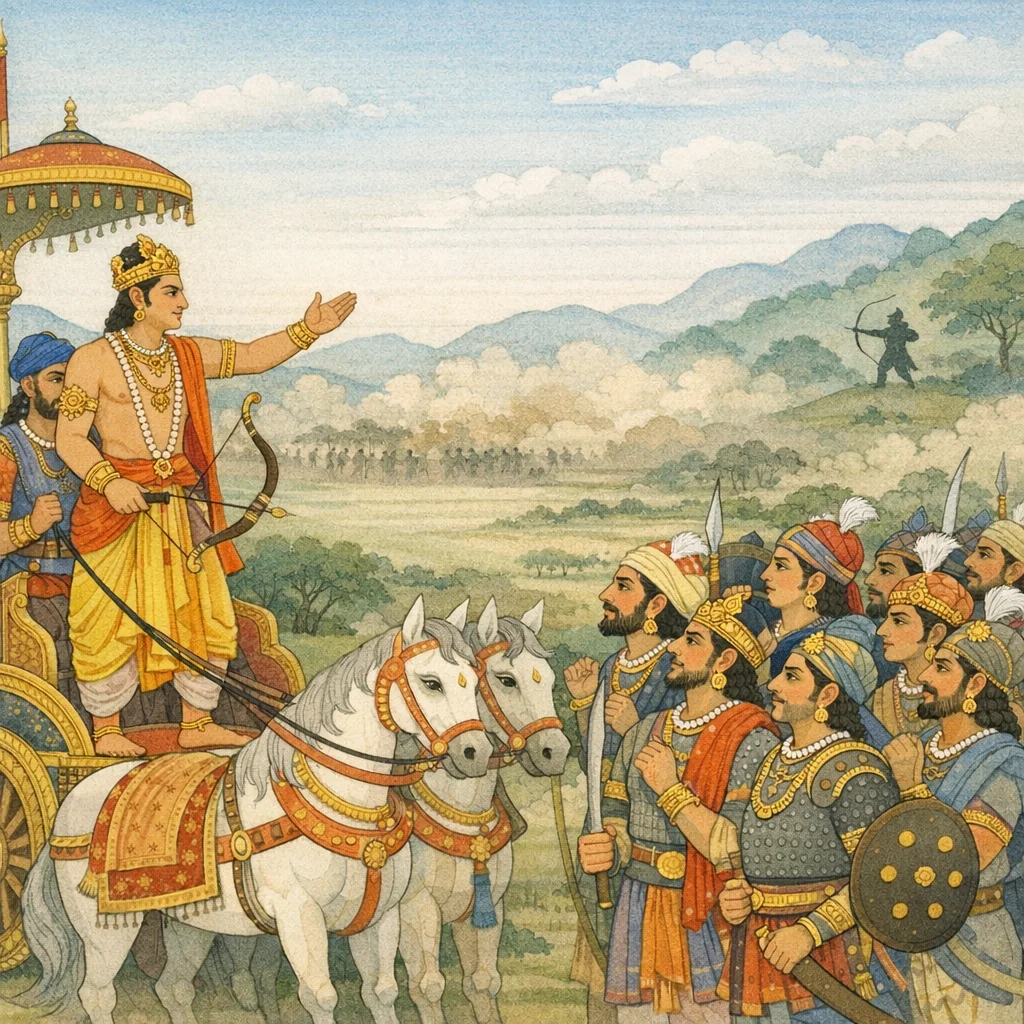
Adhyaya 48
Arjuna’s Approach, Drona’s Recognition, and the Turning of the Cattle (अर्जुनागमनम्, द्रोणवाक्यम्, गोगमनिवृत्तिः)
Upa-parva: Gograhaṇa (Cattle-Raid) Upa-Parva
Vaiśaṃpāyana describes the Kaurava battle-array established by great chariot-warriors when Arjuna rapidly approaches, announcing himself through chariot-roar and the thunderous resonance of the Gāṇḍīva. The Kuru forces perceive his banner and the distinctive soundscape of his arrival. Drona, reading the signs—Pārtha’s distant standard, the ‘cloud-like’ tumult, and the vānara emblem’s roar—identifies Arjuna and assesses the strategic risk of facing him in an aroused state. Arjuna instructs his charioteer (Virāṭa’s prince acting as sārathi) to hold within arrow-range while he surveys the army, seeking Duryodhana as the decisive target; he notes the placement of Drona, Aśvatthāman, Bhīṣma, Kṛpa, and Karṇa, and infers that the king (Virāṭa) has withdrawn with the cattle along the southern route. Arjuna then redirects the chariot toward Duryodhana, intending engagement there, while Drona advises pursuit and cautions that no single warrior should confront Arjuna alone. Arjuna proclaims his name and showers the army with rapid volleys, producing battlefield disorientation; he blows his conch, draws the bow, and the combined martial din induces the cattle to turn back southward, reversing the raid’s outcome.
Chapter Arc: कौरव-सेना में भय और असमंजस की लहर है—सामने से अज्ञात पराक्रमी रथी (वास्तव में छन्नवेष अर्जुन) का प्रचण्ड प्रतिरोध; इसी क्षण कर्ण अपने शब्दों से रणभूमि का ताप बढ़ाता है। → कर्ण सबको ‘भीत, संत्रस्त, अयुद्धमनस्क’ कहकर ललकारता है और घोषणा करता है कि चाहे मत्स्यराज स्वयं हो या बीभत्सु (अर्जुन) आ गया हो, वह समुद्र-तट की वेला की तरह उसे रोक देगा; अपने धनुष से छूटे बाणों को सर्पों-सा अवरोध-अजेय बताकर सेना का मनोबल खींचता है। → कर्ण अपनी पुरानी प्रतिज्ञा स्मरण कर ‘आज अर्जुन को मारकर’ धृतराष्ट्र-पुत्र के ऋण को चुकाने की बात कहता है; इन्द्र-तुल्य तेजस्वी पार्थ को भी उल्काओं से कुंजर-सा पीड़ित करने का दर्पपूर्ण संकल्प सुनाता है और परशुराम से प्राप्त अस्त्र-विद्या के बल पर ‘वासव से भी’ युद्ध करने की क्षमता का दावा करता है। → वह कौरवों को विकल्प देता है—चाहें तो केवल गोधन लेकर लौट जाएँ, या रथों पर टिककर उसका युद्ध-पराक्रम देखें; अध्याय का अंत कर्ण के विकत्थन (आत्म-प्रशंसा) को एक उकसावे और मनोबल-भाषण के रूप में स्थिर कर देता है। → कर्ण के दर्प-घोष के बाद प्रश्न हवा में लटकता है—क्या यह वाणी रण में सत्य सिद्ध होगी, या छन्नवेष पार्थ उसके गर्व को तोड़ेगा?
Shlokas
Verse 1
#2:8 #23:.7 () मल अा८ अष्टचत्वारिशो< ध्याय: कर्णकी आत्मप्रशंसापूर्ण अहंकारोक्ति कर्ण उवाच सर्वानायुष्मतो भीतान् संत्रस्तानिव लक्षये । अयुद्धमनसश्नैव सर्वाश्वैवानवस्थितान्,कर्ण बोला--मैं आप सब आयुष्मानोंको भयभीत एवं त्रस्त-सा देखता हूँ। आपकमेंसे किसीका मन युद्धमें नहीं लग रहा है एवं सभी चञचल दिखायी देते हैं
Karna said: “I observe all of you—men of long life—looking fearful and as though shaken with panic. None of you seems to have a mind for battle, and all appear unsteady and unsettled.”
Verse 2
यद्येष राजा मत्स्यानां यदि बीभत्सुरागत: । अहमावारयिष्यामि वेलेव मकरालयम्,यदि यह मत्स्यदेशका राजा हो अथवा यदि स्वयं अर्जुन आया हो, तो भी जैसे वेला समुद्रको रोक देती है, उसी प्रकार मैं भी इसे आगे बढ़नेसे रोक दूँगा
Karna said: “Whether this be the king of the Matsyas, or Arjuna himself—Bībhatsu—who has come, I will stop him from advancing, just as the shoreline holds back the ocean, the abode of crocodiles.”
Verse 3
मम चापप्रयुक्तानां शराणां नतपर्वणाम् | नावृत्तिर्गच्छतां तेषां सर्पाणामिव सर्पताम्,मेरे धनुषसे छूटकर सर्पोकी भाँति आगे बढ़नेवाले और झुकी हुई गाँठवाले बाण कभी अपने लक्ष्यसे च्युत नहीं होते
Karna said: “The arrows I release from my bow—hard-jointed and bent at the knots—do not turn back or stray once they have been sent forth. Like serpents gliding straight toward their prey, they press onward to their mark.”
Verse 4
रुक्मपुड्खा सुतीक्षणाग्रा मुक्ता हस्तवता मया | छादयन्तु शरा: पार्थ शलभा इव पादपम्,सुनहरी पाँख और तीखी नोकवाले बाण मेरे हाथोंसे छूटकर अर्जुनको ठीक उसी तरह, ढक लेंगे; जैसे टिड्डियाँ पेड़को आच्छादित कर देती हैं
Karna said: “Golden-fletched and razor-pointed arrows, released by my own hand, will cover you, O Partha, just as swarming locusts blanket a tree.”
Verse 5
शराणां पुड्खसक्तानां मौर्व्याभिहतया दृढम् । श्रूयतां तलयो: शब्दो भेयोराहतयोरिव,पाँखवाले बाणोंको धनुषकी प्रत्यज्चापर चढ़ाकर भलीभाँति खींचनेके पश्चात् मेरी दोनों हथेलियोंका ऐसा शब्द होता है, जैसे दो नगाड़े पीटे गये हों। आज वह शब्द आपलोग सुनें
Karna said: “When I set arrows whose feathered ends are fixed to the string and draw the bowstring hard, a resounding crack issues from my two palms—like the beating of a pair of kettledrums. Let all of you hear that sound today.”
Verse 6
समाहितो हि बीभत्सुर्वर्षाण्यष्टी च पठच च | जातस्नेहश्न युद्धेडस्मिन् मयि सम्प्रहरिष्यति,अर्जुन तेरह वर्षोतक वनमें समाधि लगाता रहा है, किंतु उसका इस युद्धमें स्नेह है; अतः मुझपर वह बाणोंका प्रहार करेगा
Karna said: “Indeed, Bībhatsu (Arjuna) has lived in disciplined concentration for thirteen years; yet in this battle his affection and attachment are fully awakened. Therefore he will strike at me with his arrows.”
Verse 7
पात्रीभूतश्व॒ कौन्तेयो ब्राह्मणो गुणवानिव । शरीौघान् प्रतिगृह्नातु मया मुक्तानू सहस्रश:,कुन्तीनन्दन धनंजय गुणवान् ब्राह्मणकी भाँति मेरे लिये एक सुपात्र व्यक्ति है। अतः आज वह मेरे छोड़े हुए सहस्रों बाणसमुदायोंका दान स्वीकार करे
Karna said: “This son of Kunti is, for me, a worthy recipient—like a virtuous Brahmin. Let him accept, as a gift, the thousands of volleys of arrows that I have released.”
Verse 8
एष चैव महेष्वासस्त्रिषु लोकेषु विश्ुत: । अहं चापि नरश्रेष्ठादर्जुनान्नावर: क्वचित्,यह तीनों लोकोंमें महान् धनुर्थरके रूपमें विख्यात है और मैं भी नरश्रेष्ठ अर्जुनसे किसी बातमें कम नहीं हूँ
Karna said: “This warrior is indeed a great archer, renowned throughout the three worlds. And I too am in no way inferior to Arjuna, the best of men.”
Verse 9
इतश्वेतश्न निर्मुक्ता: काउचनैर्गार्ध्रवाजितै: । दृश्यतामद्य वै व्योम खद्योतैरिव संवृतम्,इधर-उधर दोनों ओरसे छूटे हुए गीधकी पाँखोंसे युक्त सुवर्णमय बाणोंद्वारा आच्छादित हो आज आकाश जुगुनुओंसे भरा हुआ-सा दिखायी देगा
Karna said: “From here, let those bright, golden arrows—fletched with vulture-feathers—be released. Today the sky will be seen as though covered over with fireflies.”
Verse 10
अद्याहमृणमक्षय्यं पुरा वाचा प्रतिश्रुतम् । धार्तराष्ट्राय दास्यामि निहत्य समरे<र्जुनम्,मैं आज युद्धमें अर्जुनको मारकर पहले की हुई अपनी प्रतिज्ञाके अनुसार दुर्योधनका अक्षय ऋण चुका दूँगा
Karna said: “Today, by slaying Arjuna in battle, I shall repay to Dhritarashtra’s son the imperishable debt I once pledged by my word.”
Verse 11
अन्तराच्छिद्यमानानां पुड्खानां व्यतिशीर्यताम् | शलभानामिवाकाशे प्रचार: सम्प्रदृश्यताम्,आज बीचसे कटकर इधर-उधर बिखर जानेवाले पंखयुक्त बाणोंका आकाशमें फतिंगोंकी भाँति उड़ना और गिरना देखो
Karna said: “Look—see how the feathered shafts, struck and severed in mid-course, scatter apart; and how, like swarming locusts in the sky, their fragments whirl, fly, and fall.”
Verse 12
इन्द्राशनिसमस्पर्श्महेन्द्रसमतेजसम् । अर्दयिष्याम्यहं पार्थमुल्काभिरिव कुज्जरम्,यद्यपि अर्जुन महेन्द्रके समान तेजस्वी है, तो भी आज उसे उल्काओं (मशालों) द्वारा गजराजकी भाँति इन्द्रके वज़्की तरह कठोर स्पर्शवाले अपने बाणोंसे पीड़ित कर दूँगा
Karna said: “Though Partha (Arjuna) shines with a brilliance equal to that of great Indra, today I shall crush and torment him with my arrows—hard to the touch like Indra’s thunderbolt—just as a mighty elephant is battered by blazing meteors.”
Verse 13
रथादतिरयथं शूरं सर्वशस्त्रभृतां वरम् । विवशं पार्थमादास्ये गरुत्मानिव पन्नगम्,जो रथियोंसे भी बढ़कर अतिरथी, सम्पूर्ण शस्त्र-धारियोंमें श्रेष्ठ और शूरवीर है, उस कुन्तीपुत्रको आज मैं युद्धमें विवश करके उसी प्रकार दबोच लूँगा, जैसे गरुड़ साँपको पकड़ लेता है
“Today I shall force the son of Kunti—an atiratha surpassing other chariot-warriors, the bravest and best among all who bear arms—into helplessness in battle, and seize him like Garuḍa seizes a serpent.”
Verse 14
तमग्निमिव दुर्धर्षमसिशक्तिशरेन्धनम् | पाण्डवाग्निमहं दीप्तं प्रदहन्तमिवाहितम्,जो अग्निकी भाँति दुर्धर्ष है, खड़ग, शक्ति और बाणरूपी ईंधनसे प्रज्वलित है और अपने शत्रुको भस्म कर रही है, उस अर्जुनरूपी जलती हुई आगको आज मैं महामेघ बनकर बुझा दूँगा। मेरे अश्वोंका वेग ही पुरवैया हवाका काम करेगा। रथसमूहकी घर्घराहट ही बादलोंकी गम्भीर गर्जनगा होगी और बाणोंकी धारा ही जलधाराका काम करेगी
Karna said: “Like a fire that is hard to withstand—fed with fuel in the form of swords, spears, and arrows—this blazing Pāṇḍava-fire (Arjuna) seems set to burn down his foes. Today I shall become a great rain-cloud and extinguish that raging flame.”
Verse 15
अश्ववेगपुरोवातो रथौघस्तनयित्नुमान् । शरधारो महामेघ: शमयिष्यामि पाण्डवम्,जो अग्निकी भाँति दुर्धर्ष है, खड़ग, शक्ति और बाणरूपी ईंधनसे प्रज्वलित है और अपने शत्रुको भस्म कर रही है, उस अर्जुनरूपी जलती हुई आगको आज मैं महामेघ बनकर बुझा दूँगा। मेरे अश्वोंका वेग ही पुरवैया हवाका काम करेगा। रथसमूहकी घर्घराहट ही बादलोंकी गम्भीर गर्जनगा होगी और बाणोंकी धारा ही जलधाराका काम करेगी
Karna said: “With the speed of my horses as the driving wind, with the thunderous roar of my massed chariots as the rumbling of clouds, and with a torrent of arrows as the pouring rain, I shall become a great storm-cloud and extinguish that blazing Pāṇḍava (Arjuna).”
Verse 16
मत्कार्मुकविनिर्मुक्ता: पार्थमाशीविषोपमा: । शरा: समभिसर्पन्तु वल्मीकमिव पन्नगा:,आज मेरे धनुषसे छूटे हुए सर्पोके समान विषैले बाण अर्जुनके शरीरमें उसी प्रकार प्रवेश करेंगे, जैसे साँप बाँबीमें घुसते हैं
Karna declared: “Let the arrows released from my bow—venomous like deadly serpents—crawl into Arjuna’s body, just as snakes slip into an anthill.”
Verse 17
सुतेजनै रुक्मपुड्खै: सुधौतैर्नतपर्वभि: । आचितं पश्य कौन्तेयं कर्णिकारैरिवाचलम्,कनेरके फूलोंसे व्याप्त पर्वतकी जैसी शोभा होती है, उसी प्रकार मेरे तेज, सुनहरे पंखवाले, उज्ज्वल और झुकी हुई गाँठवाले बाणोंद्वारा कुन्तीपुत्र अर्जुनको आच्छादित हुआ देखो
Karna said: “Behold the son of Kunti—Arjuna—covered over by my blazing arrows, their golden fletching gleaming as if freshly polished and their joints bent down; he appears like a mountain clothed in karṇikāra blossoms.”
Verse 18
जामदग्न्यान्मया हास्त्रं यत् प्राप्तमृषिसत्तमात् | तदुपाश्रित्य वीर्य च युध्येयमपि वासवम्,मुनिश्रेष्ठ परशुरामजीसे मैंने जो अस्त्र प्राप्त किये हैं, उन अस्त्रों और अपने पराक्रमका आश्रय लेकर मैं इन्द्रसे भी युद्ध कर सकता हूँ
Karna said: “The weapon-science I obtained from Jāmadagnya (Paraśurāma), the best of sages—relying on that and on my own valor, I could fight even Vāsava (Indra).”
Verse 19
ध्वजाग्रे वानरस्तिष्ठन् भल्लेन निहतो मया । अद्यैव पततां भूमौ विनदन् भैरवान् रवान्,अर्जुनकी ध्वजाके अग्रभागपर स्थित होनेवाला वानर जो भयंकर गर्जना किया करता है, वह आज ही मेरे बाणोंसे मारा जाकर पृथ्वीपर गिर जाय
Karna said: “That monkey who stands at the very tip of Arjuna’s banner—who roars with dreadful cries—let him be struck down by my sharp arrow and fall to the earth this very day.”
Verse 20
शत्रोर्मया विपन्नानां भूतानां ध्वजवासिनाम् | दिश: प्रतिष्ठमानानामस्तु शब्दो दिवंगम:
Karna said: “May the cry of those beings who dwell upon the enemy’s banner—now struck down by me and departing to their destined quarters—rise upward and pass into the heavens.”
Verse 21
शत्रुकी ध्वजामें निवास करनेवाले भूतगण भी मुझसे मारे जाकर जब चारों दिशाओंमें भागने लगेंगे, उस समय उनके हाहाकारका शब्द स्वर्गलोकतक पहुँच जायगा ।। अद्य दुर्योधनस्याहं शल्यं हृदि चिरस्थितम् | समूलमुद्धरिष्यामि बीभत्सुं पातयन् रथात्
Karna said: “When the beings who dwell upon the enemy’s banner are slain by me and scatter to the four directions, their wailing cry will reach the heavens. And today I shall at last tear out, root and all, the thorn long lodged in Duryodhana’s heart—by striking down Bībhatsu (Arjuna) and casting him from his chariot.”
Verse 22
अर्जुनको रथसे गिराकर आज मैं दुर्योधनके हृदयमें चिरकालसे चुभे हुए काँटेको जड़सहित निकाल फेंकूँगा ।। हताश्चं विरथं पार्थ पौरुषे पर्यवस्थितम् | निःश्वसन्तं यथा नागमद्य पश्यन्तु कौरवा:,पुरुषार्थसाधनमें लगे हुए अर्जुनके घोड़े मार दिये जायँगे और वह रथहीन होकर केवल साँपकी भाँति फुफकार मारता फिरेगा। कौरवलोग आज उसकी यह अवस्था भी देखें
Karna said: “Today I will cast Arjuna down from his chariot and tear out, root and all, the thorn that has long been lodged in Duryodhana’s heart. Let the Kauravas see it today—Arjuna, steadfast in his manly effort, will be left helpless and chariotless; his horses will be slain, and he will roam about hissing like a serpent.”
Verse 23
काम॑ गच्छन्तु कुरवो धनमादाय केवलम् | रथेषु वापि तिष्ठन्तो युद्ध पश्यन्तु मामकम्,कौरवोंकी इच्छा हो, तो वे केवल गोधन लेकर यहाँसे चले जायँ अथवा अपने रथोंपर बैठे रहकर अर्जुनके साथ मेरा युद्ध देखें
Karna declares that if the Kauravas so desire, they may simply take the cattle-wealth and depart from here; or, remaining seated upon their chariots, they may stay and witness his battle with Arjuna.
Verse 47
इस प्रकार श्रीमहाभारत विराटपर्वके अन्तर्गत गोहरणपर्वमें उत्तरगोग्रहमें दुर्योधनवाक्यसम्बन्धी सैतालीसवाँ अध्याय पूरा हुआ
Thus concludes the forty-seventh chapter of the Mahābhārata’s Virāṭa Parva, within the Go-haraṇa (Cattle-Raid) section, in the episode of the Northern cattle-seizure, specifically connected with Duryodhana’s statements.
Verse 48
इति श्रीमहाभारते विराटपर्वणि गोहरणपर्वणि उत्तरगोग्रहे कर्णविकत्थने अष्टचत्वारिंशो5ध्याय:
Thus ends the forty-eighth chapter of the Virāṭa Parva in the Śrī Mahābhārata—within the episode of the cattle-raid—at the section concerning the seizure of Uttara’s cattle and Karṇa’s boastful speech.
Frequently Asked Questions
Arjuna must act decisively to protect Virāṭa’s assets and safety while still operating under concealment constraints, choosing a method that is effective yet controlled—prioritizing strategic capture/defeat of leadership rather than indiscriminate harm.
Competence and restraint can coexist: disciplined skill (rapid archery, clear targeting, controlled escalation) becomes an instrument of dharma when aligned with protective duty and situational awareness.
No explicit phalaśruti appears here; the chapter’s meta-function is evidentiary—establishing recognition markers (banner, sounds, commanders’ assessments) that authenticate Arjuna’s identity and the inevitability of broader conflict.